Median nerve slider (neck-to-arm nerve glide)
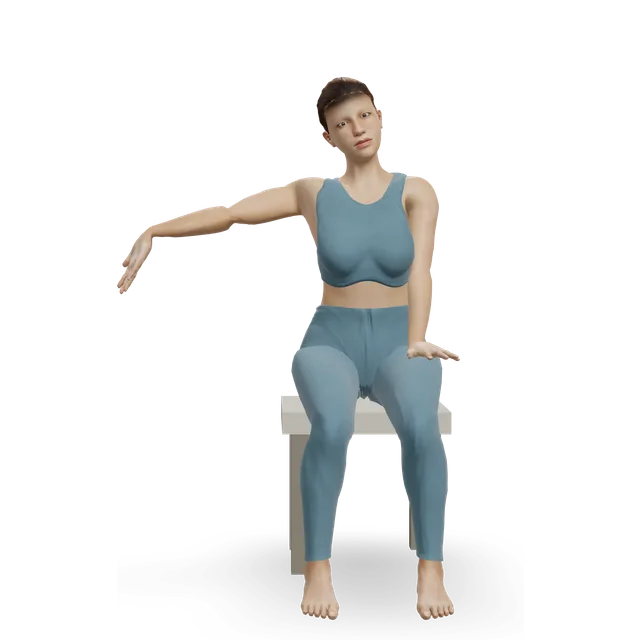
Sitting tall with one arm out to the side, you straighten the elbow and bend the wrist back while tilting your head toward that arm, then bend the elbow as the head tilts away, so the nerve slides along its path without being pulled tight at both ends.
Movement guide
Median nerve slider (neck-to-arm nerve glide)
Loading the 3D figure…
Source-researched guide. Clinical review is pending.
How to move
- Sit tall on a firm chair, shoulders relaxed down.
- Lift the affected arm out to the side to about shoulder height or a little lower, elbow bent, palm facing up.
- Slowly straighten the elbow and bend the wrist back, fingers pointing down, while you tilt your head toward that arm.
- Stop at the first sense of a pull or tingle in the arm. It should never be painful.
- Slowly bend the elbow and let the wrist relax while you tilt your head away from the arm.
- Keep the two movements in time, at an even, relaxed speed. Repeat for the set.
Form cues
- This is a gliding movement, not a stretch: keep it moving.
- A mild pull in the arm is OK; pain is not.
- Avoid: straightening the arm while tilting the head away (that pulls the nerve tight at both ends), moving fast or jerkily, shrugging the shoulder up, or pushing into pain.
Practice and cautions
10 slow repetitions, 2 to 3 times a day. An editorial starting point that mirrors the seated sciatic nerve slider: the hand-therapy leaflet this glide follows leaves the repetitions for the therapist to set, and no trial has tested this exact routine.
Not during the first, most painful days of a pinched nerve. Any increase in tingling should settle within an hour; if it does not, do fewer or stop. Stop if the arm feels weaker or numbness spreads: worsening weakness is a reason to see a doctor. This is movement education, not an assessment or treatment prescription. Stop for sharp or increasing pain, dizziness, numbness or tingling; seek individual guidance for symptoms, injury or restrictions.
Sources and review status
Sources support the educational description; they do not establish that this exercise is suitable for you.
- Blanpied 2017 · Neck pain: revision 2017, recommending nerve mobilisation for neck pain with arm pain (JOSPT clinical practice guideline) ↗
- Basson 2017 · Neural mobilisation for neuromusculoskeletal conditions (meta-analysis, JOSPT) ↗
- St George's University Hospitals NHS · Median nerve gliding (hand therapy leaflet, 2024) ↗
- Wrightington, Wigan and Leigh NHS · Cervical radiculopathy: patient information (2021) ↗
No variation is labeled clinically validated.
What it works
Muscles
Main: Forearms. Also: Neck, Shoulders.
Anatomy: Brachioradialis, Wrist and finger flexors, Wrist and finger extensors.
Equipment
A bench or box
Level
Beginner.
Pain guides that use it
Part of a staged plan, with when to get help first.
Similar moves
Browse more
Questions people ask
What muscles does the Median nerve slider (neck-to-arm nerve glide) work?
Mainly the forearms, with help from the neck and shoulders.
What equipment do I need for the Median nerve slider (neck-to-arm nerve glide)?
A bench or box.
Is the Median nerve slider (neck-to-arm nerve glide) good for beginners?
It is graded beginner, so it suits most people starting out.