Slow breathing (6 breaths a minute)
Breathing in gently for about 4 seconds and out for about 6, with no holds: about 6 breaths a minute. It is the slow, gentle breathing the NHS suggests for stress, and it raises heart rate variability, a sign of the calming side of the nervous system, while you do it. It is a calming tool, not a treatment for an anxiety disorder.
Movement guide
Slow breathing (6 breaths a minute)

Loading the 3D figure…
Make it easier or harder
Start where you can move well, then step up.
Easier option
 3D demoBreath reachBeginner · No equipment
Suggested next step, beginner grade.
Harder option
 3D demoCrocodile Breathing (prone diaphragmatic breathing)Beginner · No equipment
Suggested next step, beginner grade.
Source-researched guide. Clinical review is pending.
How to move
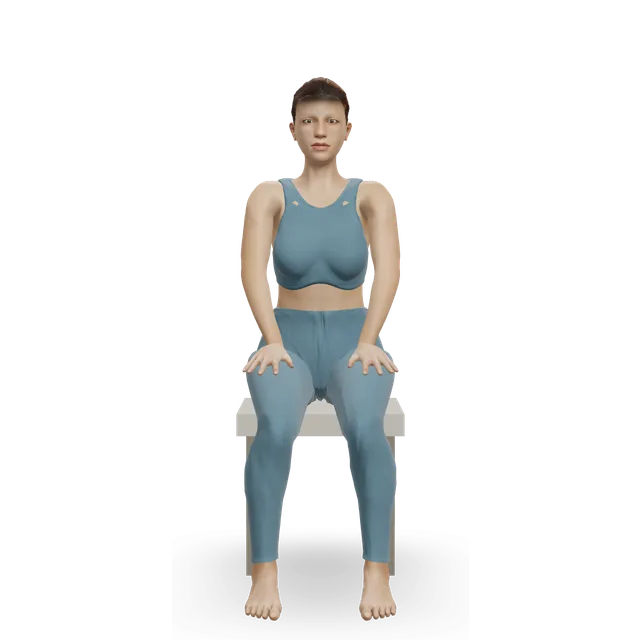
- Sit with your back supported and both feet flat, or lie down. Loosen anything tight around your waist, and rest one hand on your belly and the other on your lower ribs.
- Breathe in gently through your nose for a count of about 4, letting your belly and lower ribs widen.
- Breathe out slowly through your mouth or nose for a count of about 6. Let the air go rather than pushing it out.
- Go straight into the next breath in. There are no holds.
- Keep each breath small and quiet, and carry on for 5 minutes. If 4 and 6 feel long, count 3 in and 4 out, or 5 in and 5 out as the NHS does.
Form cues
- Slow, not big: the breath should be quiet.
- Let the out-breath be as long as the in-breath, or a little longer.
- Avoid: gulping air or lifting the shoulders. If you feel light-headed or tingly, make the breaths smaller.
Practice and cautions
At least 5 minutes, done regularly as part of your daily routine: the NHS breathing exercise for stress, which counts 1 to 5 in and 1 to 5 out. Once or twice a day, plus whenever you feel anxious, is an editorial starting point. The 4-in, 6-out count is one of the two 6-breaths-a-minute patterns in Marchant 2025, which raised heart rate variability more than box or 4-7-8 breathing; none of the three changed mood in a single session. Across 20 trials, breathing exercises reduced anxiety by a small amount, and in panic disorder, adding breathing training to CBT added nothing in one trial.
If you feel dizzy, light-headed or tingly, you are probably breathing too deeply: make the breaths smaller or go back to normal breathing. If you have a lung condition, follow the breathing advice your own team gives you. Slow breathing can help you through a panic attack, but chest pain, fainting, or palpitations that don't settle need urgent help: call 999. This is movement education, not an assessment or treatment prescription. Stop for sharp or increasing pain, dizziness, numbness or tingling; seek individual guidance for symptoms, injury or restrictions.
Sources and review status
Sources support the educational description; they do not establish that this exercise is suitable for you.
- NHS · Breathing exercises for stress (reviewed June 2026) ↗
- Marchant 2025 · Square, 4-7-8 and 6 breaths-a-minute breathing compared: heart rate variability, CO2 and mood in 84 students (Applied Psychophysiology and Biofeedback) ↗
- Laborde 2022 · Voluntary slow breathing, heart rate and heart rate variability: 223 studies (systematic review and meta-analysis, Neuroscience and Biobehavioral Reviews) ↗
- Fincham 2023 · Breathwork for stress and mental health: 20 randomised trials (meta-analysis, Scientific Reports) ↗
- Schmidt 2000 · Dismantling CBT for panic disorder: questioning the usefulness of breathing retraining (RCT, Journal of Consulting and Clinical Psychology) ↗
No variation is labeled clinically validated.
What it works
Muscles
Works the whole body. Individual muscles are not yet classified.
Equipment
None: body weight and floor space.
Level
Beginner. See the easier and harder options above.
Workouts that use it
Similar moves


Browse more
Questions people ask
What muscles does the Slow breathing (6 breaths a minute) work?
It works the whole body.
What equipment do I need for the Slow breathing (6 breaths a minute)?
No equipment: your body weight and a little floor space.
Is the Slow breathing (6 breaths a minute) good for beginners?
It is graded beginner, so it suits most people starting out. When it feels easy, try the Crocodile Breathing (prone diaphragmatic breathing).
What is an easier alternative to the Slow breathing (6 breaths a minute)?
Try the Breath reach. It is the suggested step down from this move.
How do I make the Slow breathing (6 breaths a minute) harder?
Progress to the Crocodile Breathing (prone diaphragmatic breathing), or add load, range or slower lowering once your form is solid.