Strength at home
Shoulder mobility and stability routine (with a band)
Built on the four parts of a warm-up programme that cut shoulder problems by over a quarter in a trial of 660 handball players: range for turning the arm in, strength for turning it out, shoulder-blade strength and upper-back mobility. The exercise choices are ours. Use a light band, do it 3 times a week or as a warm-up, and keep any discomfort mild.
Move
- Shoulder CARs (controlled articular rotations)4 slow circles each armBeginner · 3D demo2 each way. Work around any pinch rather than through itEasier: Arm circles
- Thoracic rotation6 each sideBeginner · 3D demoTurn from the ribs, hips stillHarder: Reverse lunge with rotation
- Wall angel8 slow slidesBeginner · Back, Shoulders · 3D demoA small range is fineHarder: Prone Y-T-W raises
- Cross-body shoulder stretch2 holds of 30 s each sideBeginner · Shoulders, Back · 3D demoArm at chest height; lower it if the front of the shoulder pinchesHarder: Sleeper stretch




Rotator cuff
2 rounds · Rest 45 s between rounds
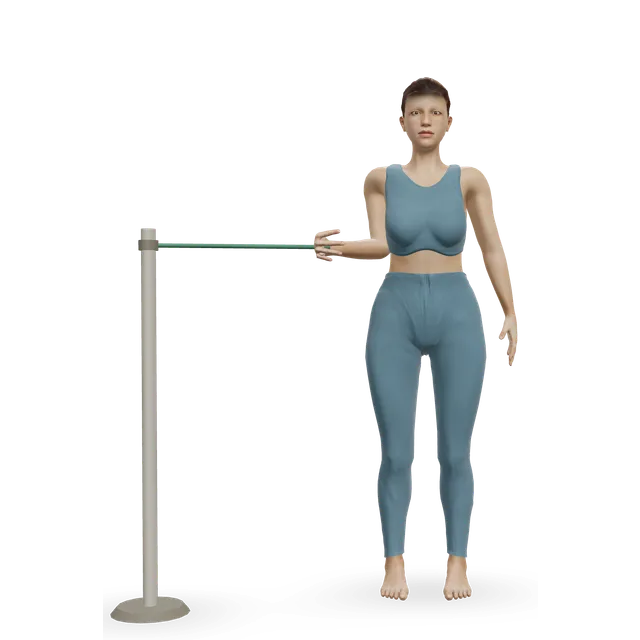
- Standing band external rotation12 to 15 reps each armBeginner · Shoulders, Back · 3D demoElbow at your side, with a rolled towel under it if you likeHarder: Side-lying external rotation
- Band internal rotation12 to 15 reps each armBeginner · Shoulders · 3D demoElbow at your sideHarder: Side-lying external rotation
- Scaption raise10 to 12 repsBeginner · Shoulders, Chest · 3D demoThumbs up, to shoulder height, lowering over 3 s; a light weightEasier: Band lateral raiseHarder: Smith machine upright row


Shoulder blades
2 rounds · Rest 45 s between rounds
- Beginner · Shoulders, Chest, Abs · 3D demoOn a wall or a bench, pausing for 1 s at the topEasier: Dumbbell shoulder-blade punchHarder: Pike push-up
- Band pull-apart15 repsIntermediate · Shoulders, Back · 3D demoA light band, slowlyEasier: Prone Y-T-W raisesHarder: Barbell rear-delt row
- Prone Y-T-W raises5 of each shapeBeginner · Back, Shoulders, Neck · 3D demoForehead on a folded towelEasier: Wall angelHarder: Bent-over reverse fly
- Band row12 repsBeginner · Back, Biceps, Shoulders · 3D demoHarder: Supported single-arm dumbbell row




Finish
- Doorway chest opener30 s each sideBeginner · Chest, Shoulders · 3D demoElbow at or below shoulder heightEasier: Elbows backHarder: Fish Pose (Matsyasana)

Tips
- Use a light band: the rotator cuff muscles are small, and the aim is smooth control, not effort.
- If a shoulder is sore, pain up to about 5 out of 10 during the exercises is acceptable if it's back to normal by your next session; if it isn't, go lighter, not to nothing. This is the rule our shoulder pain guide uses.
- If your shoulders are very flexible or have slipped out before, keep your elbow by your side for the rotations, keep the doorway stretch low, and stop short of any feeling of slipping.
- Skip the cross-body stretch while the top of your shoulder (the AC joint) is sore, because the stretch presses on it.
- Keep your neck long and your face down in the Y-T-W raises, and stop if your lower back cramps.
- Check the band for nicks and anchor it securely: a band that slips at full stretch snaps back towards your face.
- The handball programme ran 3 times a week for a whole season, so give it several weeks.
- Shoulder or arm pain with chest pain or tightness, or severe difficulty breathing, is a 999 call (911 in the US), not a reason to stretch.
The doses are suggested starting points, not a prescription. Choose a range you can control and stop for sharp or increasing pain, numbness or tingling. Get individual advice after an injury or surgery, or if you are pregnant or managing a health condition.
Guides that recommend it
Find more moves like these
More strength at home




Beginner bodyweight workout
A 20-minute full-body workout with no equipment: squats, knee push-ups, bridges, lunges and planks.
20 minBeginner10 movesNo equipment


Full-body bodyweight workout
An intermediate no-equipment workout: push-ups, split squats, single-leg bridges, pike push-ups and core work.
30 minIntermediate11 movesNo equipment

Full-body dumbbell workout
A 35-minute full-body strength workout with dumbbells: goblet squats, presses, rows, Romanian deadlifts and carries.
35 minIntermediate9 movesA band, A dumbbellQuestions people ask
How long does the shoulder mobility and stability routine (with a band) take?
About 25 minutes, including any warm-up and cool-down listed. Shorten it by doing fewer rounds; lengthen it by adding one.
What equipment do I need?
You need: A wall, A band, An anchor point, A dumbbell. Each move links to its guide, where you can find an alternative if you are missing something.
Is it suitable for beginners?
It is written for beginners. 6 of its 12 moves have an easier option listed beside them if you need one.
How do I make it easier or harder?
Use the easier or harder option listed under each move, change the number of rounds, or adjust the rest. Progress one change at a time.