Pain guide · Knee pain

Exercises after a knee replacement: a stage-by-stage recovery plan

A knee replacement swaps the worn ends of the thigh bone and shin bone for metal and plastic parts. Rehab starts on the day of surgery or the next day, and the exercises you do over the following weeks and months make a real difference to how well the knee bends, straightens and carries you. Most people do well, but about 1 in 5 still have troublesome pain years later.

This guide sets out the usual stages, from the hospital bed to getting back to golf, with the exercises and doses NHS physiotherapy leaflets use and a 3D demo of each move. Your surgical team's plan comes first: every hospital's protocol and timings differ, and a partial replacement usually recovers faster. Use this page to understand what you've been asked to do and why, and to know which warning signs need NHS 111 or 999.

When to get help first

Exercise is for pain that has been checked or is clearly mild and settling.

Get urgent medical help if

  • Leg pain or swelling with breathlessness or chest pain: call 999 or go to A&E, and do not drive yourself. It can be a blood clot that has reached the lungs.
  • Throbbing or cramping pain in your leg (a clot usually hurts in the calf or thigh): ask for an urgent GP appointment or get help from NHS 111. It could be a blood clot.
  • A high temperature, or feeling hot, cold or shivery, or redness, tenderness, swelling or pain in the knee that is not getting better or is getting worse: ask for an urgent GP appointment or get help from NHS 111. These can be signs of an infection.
  • Oozing or pus from the wound: ask for an urgent GP appointment or get help from NHS 111. If you feel unwell or feverish and the wound looks infected, go to A&E.
  • Your knee suddenly becomes very painful, you cannot move it or put weight on it, or it is badly swollen or has changed shape, for example after a fall: get advice from NHS 111 now.

See a doctor or physiotherapist if

  • The knee is not bending to about 90°, or not getting straight, by around 6 weeks, or it was moving well and is getting stiffer: tell your physiotherapist or surgical team now rather than waiting for a routine appointment. Stiffness is easier to treat early. (The 6-week check is our threshold, built from NHS trust leaflets.)
  • Exercise pain that takes hours to settle, keeps waking you, or builds week on week: ease off and tell your physiotherapist.
  • New or worsening pain, a limp or loss of function months or years after the operation: see your GP, who should refer you back to the orthopaedic team.

Understand it

What the operation involves

In a total knee replacement, the lower end of the thigh bone and the upper end of the shin bone are replaced with metal and plastic parts, and some people have the back of the kneecap replaced too. A partial replacement replaces only the worn half of the knee, through a smaller cut, and usually recovers faster. Most people have the operation for osteoarthritis, when knee pain is having a big effect on their life and other treatments haven't worked.

NICE (the National Institute for Health and Care Excellence) says people with arthritis in only the inner half of the knee should be offered a choice of a partial or a total replacement. The exercise and weight advice that comes before surgery is in the knee arthritis guide.

Sources 1, 2

What recovery usually looks like

One NHS trust gives these timings, and says some people meet them easily and some never do. Your own team's timings come first.

Swelling of the knee and calf can last 3 months or more, and the knee can stay slightly warm for 3 to 6 months. The NHS says full recovery can take several months or longer, depending on your age and general health.

  • Day of surgery or the next day: up and walking with a frame, then crutches or sticks. Home once you're safe on crutches and stairs, usually 1 to 4 days after the operation, and sometimes the same day.
  • By 2 weeks: confident around the house, often on one stick or none indoors.
  • From 4 weeks: the knee moves more freely and feels less stiff, and an exercise bike can start.
  • 1 to 3 months: most pain has usually gone, though some stiffness and pain along the joint line may remain.
  • 3 to 6 months: daily activities without restriction, including stairs, and activities such as golf, gentle tennis, bowls and dancing.
  • 6 months to a year: back to normal life. An ache along the joint line can last up to 2 years.

Sources 3, 4, 5

How much bend you needEmerging evidence

In a study of 20 older adults, walking and slopes used less than 90° of knee bend, stairs and chairs 90° to 120°, and getting in and out of a bath about 135°; the authors suggested 110° as a goal for rehab. One NHS trust aims for a straight knee and about 90° of bend by the time you go home.

Straightening matters as much as bending. An international consensus grades stiffness after knee surgery both by how far the knee bends (mild at 90° to 100°, severe below 70°) and by how far it stays short of straight (mild at 5° to 10°, severe beyond 20°).

Sources 6, 5, 7

Most people do well, but not everyoneEmerging evidence

In the best-quality studies, about 20% of people had an unfavourable pain outcome years after a knee replacement (10% to 34% across studies). The NHS lists the possible ongoing problems: difficulty bending the knee, ongoing pain and stiffness, and a knee that feels unstable when you stand or walk. Most knee replacements last about 25 years.

Sources 8, 9

What helps, and how strong the evidence is

Start moving on the day of surgery or the next dayStrong evidence

NICE says a physiotherapist or occupational therapist should offer rehab, including getting up and walking and a home exercise programme, on the day of surgery if possible and no more than 24 hours after. In 5 trials (622 people), getting up early shortened the hospital stay by about 1.8 days, with no increase in complications.

Sources 2, 10

Exercising before surgery helps a littleEmerging evidence

In a 2023 meta-analysis, exercise before a knee replacement improved function and thigh strength before surgery, and function 6 weeks after it (moderate certainty), with a smaller, less certain gain at 3 months. Most programmes ran for at least 4 weeks, twice a week or more. An earlier review judged the gains too small and short-lived to matter much.

NICE says everyone having a joint replacement should be given advice on exercises to do before and after surgery, and the NHS suggests starting while you wait because waiting lists can be long. The 2026 US physical therapy guideline also recommends an exercise programme before surgery. The knee arthritis plan is a good place to start.

Sources 11, 12, 2, 13, 14

Exercise after you go home helps; where you do it matters lessMixed evidence

Compared with minimal physiotherapy, exercise improved function and pain 3 to 4 months after a knee replacement (18 trials, 1,739 people), though the trials were small.

Where you exercise mattered less. In 5 trials (752 people), clinic and home programmes gave no clinically important difference in walking, pain or function. In an Australian trial of 165 people, 10 days of inpatient rehab added nothing to a monitored home programme at 26 weeks. In the UK CORKA trial of 621 people at risk of a poor outcome, a home programme run by rehabilitation assistants did as well as outpatient physiotherapy at 12 months, and cost less.

NICE recommends a self-directed programme with clear goals and a point of contact, and supervised rehab for people who struggle with daily activities or find the home programme isn't working. The 2026 US physical therapy guideline still recommends supervised sessions, while noting the benefits are small. The guidelines differ; doing the exercises is what counts.

Sources 15, 16, 17, 18, 2, 14

Strength and balance training from the early weeksStrong evidence

The 2026 US physical therapy guideline strongly recommends progressive strength training from the early weeks after surgery, and balance and movement training, based on many high- and moderate-quality studies. In a trial of 162 people, a high-intensity programme was safe but no better than a low-intensity one at 3 or 12 months, so there is no need to push hard.

Sources 14, 19

Home exercises work the thigh hardEmerging evidence

In 24 people 4 to 8 weeks after a knee replacement, a knee extension against an elastic band worked the thigh harder than the knee extension machine (93% against 75% of maximum), and single-leg squats and sit-to-stands worked it harder than the leg press. You don't need a gym.

Source 20

A bending machine isn't neededStrong evidence

In 24 trials (1,445 people), continuous passive motion (CPM), a machine that bends and straightens the knee for you, added about 2° of bend and made no difference to function. The 2026 US physical therapy guideline strongly recommends against it after an uncomplicated knee replacement. Some NHS hospitals use it only as an extra for people struggling to bend in hospital, never instead of the exercises.

Sources 21, 14, 5

If the knee stays stiff, act earlyEmerging evidence

One NHS trust warns that scar tissue tightens over the first 6 weeks and that after 3 months flexibility becomes very hard to improve; another aims for about 90° of bend by the time you go home. From these leaflets, we suggest telling your team if the knee isn't bending to about 90° by around 6 weeks. That is our editorial threshold, not a tested rule.

If the knee stays stiff, you may be offered a manipulation under anaesthetic: the knee is moved firmly through bending and straightening while you're asleep to loosen scar tissue, and moving it often afterwards keeps the gain. The evidence for it is observational. In 22 studies (1,488 people) it improved movement in most people, with the best results within about 12 weeks of surgery, and in 14 studies early manipulation gained more bend than late manipulation (32° against 19°).

Sources 3, 5, 22, 23, 24

Sport after a knee replacementEmerging evidence

Between 36% and 89% of people returned to sport after a total knee replacement, at about 13 weeks on average, with a shift towards lower-impact sports. In a survey of 139 US hip and knee surgeons, over 95% placed no limits on walking, stairs, cycling on the flat, swimming or golf. Higher-impact sport was more often discouraged, with wide variation, and none of the surgeons said there was strong evidence for their advice.

One NHS trust encourages walking and swimming, starts golf at 8 to 12 weeks with chipping and putting, and advises against jogging, jumping and contact sport.

Sources 25, 26, 3

How much pain is OK while you exercise?

An ache that settles is fine; pain that lasts for hours is notEmerging evidence

One NHS trust puts it like this: a moderate ache that settles quickly is acceptable; severe pain that takes hours to settle is not. If you feel a sharp pain, stop the activity, and contact your GP if it persists.

Another says it is normal to feel pain, discomfort or stretching during and after the exercises. If the pain lasts more than about 30 minutes, or keeps getting stronger, do the exercise less forcefully or less often, and talk to your physiotherapist if that doesn't help.

Let swelling guide you too: the 2026 US physical therapy guideline progresses exercise in a way that avoids excessive swelling, pain or soreness that lingers. This is practical advice from clinical teams rather than a tested rule, and your own team's advice comes first. The knee pain hub's 0 to 10 rule is for long-standing knee pain, not the weeks after surgery.

Sources 3, 5, 14

The exercise plan: 4 stages

Start at the first stage. Each move opens a full guide with a 3D demo.

Stage 1

In hospital and the first days at home: straighten, bend, walk

As your team allows. Get up on the day of surgery or the next day and walk with the aid you're given. Start with about 5 of each exercise once or twice a day and, if pain and swelling don't increase, build to 10 of each, 3 to 4 times a day. These are one NHS trust's doses; another asks for 10 of each every hour for the first 2 weeks, so follow your own leaflet.

Ankle circles demonstrated on the 3D figure3D demoAnkle circlesBeginner · No equipment

Pump the feet up and down 10 times and circle each ankle 5 times each way, every hour · In bed or sitting; keeps the blood moving in your calves

Quad set (static quads) demonstrated on the 3D figure3D demoQuad set (static quads)Beginner · No equipment

Hold 5 to 10 s; 5 times, building to 10 · With the heel on a rolled towel and nothing under the knee, let the knee sag straight between squeezes

Harder: Straight-leg raise

Straight-leg raise demonstrated on the 3D figure3D demoStraight-leg raiseBeginner · No equipment

Lift about 5 cm and hold 5 to 10 s; 5 times, building to 10 · Even an attempt works the muscle

Easier: Quad set (static quads) · Harder: Leg extension

Supine heel slide demonstrated on the 3D figure3D demoSupine heel slideBeginner · No equipment

Hold the bend 5 to 10 s; 5 times, building to 10 · A plastic bag or a tray under the heel helps it slide

Harder: Hip Windshield Wipers

Seated knee extension (chair) demonstrated on the 3D figure3D demoSeated knee extension (chair)Beginner · A bench or box + Something with weight

Hold for a slow count of 10; 10 times, no weight yet · Once you're sitting out in a chair

Easier: Quad set (static quads) · Harder: Leg extension

Move on when: You walk safely with your aid, the knee straightens fully or nearly, it bends to about 90° (a common target by the time you go home), and you can lift the straight leg without the knee sagging. Timings vary between hospitals.

Follow along: a timer, a cue and the next move, one step at a time.
Stage 2

Home to about 6 weeks: standing exercises and more bend

As your team allows. Keep the stage 1 exercises going and add standing ones, holding a worktop or rail, once you're steady on your feet. Many people are on one stick or none indoors by about 2 weeks, and the NHS suggests trying without an aid after about 6 weeks. These are one NHS trust's doses.

Standing hamstring curl demonstrated on the 3D figure3D demoStanding hamstring curlBeginner · A wall

Hold 2 to 3 s; 5 to 10 times · Holding a worktop, bend the knee to lift the heel behind you as far as you can

Harder: Slider hamstring curl

Sit squat (partial squat) demonstrated on the 3D figure3D demoSit squat (partial squat)Beginner · No equipment

5 to 10 times · Half squats holding a support, only as far as is comfortable

Harder: Bodyweight squat

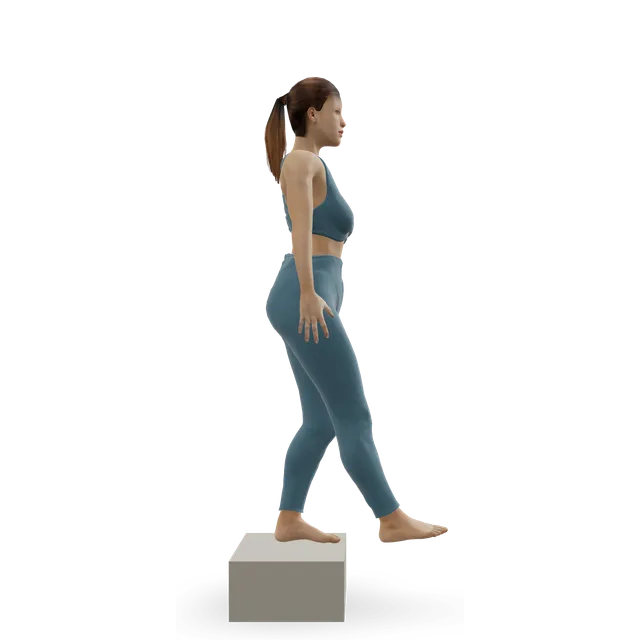
Step-up demonstrated on the 3D figure3D demoStep-upBeginner · A step

5 to 10 times, from about 2 to 3 weeks · Operated leg up first onto the bottom stair, holding the banister

Easier: Low step-up · Harder: Dumbbell step-up

Single-leg stand demonstrated on the 3D figure3D demoSingle-leg standBeginner · A wall

Hold 20 to 30 s; 5 to 10 times · On the operated leg, holding on as much as you need

Easier: Tandem stance and heel-to-toe walk · Harder: Single Leg Reach Matrix

Stationary cycling demonstrated on the 3D figure3D demoStationary cyclingBeginner · Cardio machine

5 to 10 min, 3 times a day, from about week 4 · Rock the pedals back and forth until you can pedal round

Harder: Air bike intervals

Move on when: You walk around the house with one stick or none, manage stairs with a rail, the knee bends past 90° and is still improving, and swelling settles between sessions (it can last 3 months).

Follow along: a timer, a cue and the next move, one step at a time.
Stage 3

About 6 to 12 weeks: build strength

As your team allows; your 6-week check is usually around now. Add light resistance, such as a 0.5 to 1 kg ankle weight or a band, as NHS and American Academy of Orthopaedic Surgeons (AAOS) leaflets suggest. Do 2 to 3 strength sessions a week with walking on most days; that frequency is our suggestion.

Seated knee extension (chair) demonstrated on the 3D figure3D demoSeated knee extension (chair)Beginner · A bench or box + Something with weight

3 sets of 10 with a 0.5 to 1 kg ankle weight or a light band · Sets are editorial

Easier: Quad set (static quads) · Harder: Leg extension

Sit to stand from a chair demonstrated on the 3D figure3D demoSit to stand from a chairBeginner · A bench or box

3 sets of 8 to 10 · Use your hands less as it gets easier (editorial dose)

Harder: Bodyweight squat

Patrick step-down demonstrated on the 3D figure3D demoPatrick step-downIntermediate · A step

10 times, building to 2 to 3 sets · From the bottom stair, holding the rail

Easier: Bodyweight squat · Harder: Skater squat

Single-leg calf raise from a step demonstrated on the 3D figure3D demoSingle-leg calf raise from a stepIntermediate · A step + A wall

Hold 8 to 10 s at the top; 5 to 10 times · Start with the operated leg on the flat floor, then use a step

Easier: Slow calf raise · Harder: Single-leg pogo hops

Treadmill walking demonstrated on the 3D figure3D demoTreadmill walkingBeginner · Cardio machine

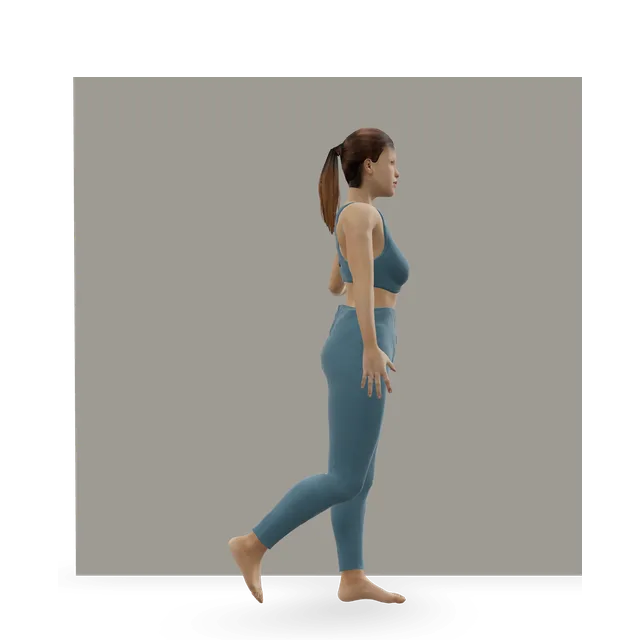
Most days, building towards 20 to 30 min at a time · Walking outdoors works as well

Harder: Treadmill jogging

Move on when: You walk without a limp or an aid, stairs are getting easier, and pain and swelling don't rise after sessions. Then stage 4, from about 3 months, as your team allows.

Follow along: a timer, a cue and the next move, one step at a time.
Stage 4

After 3 months: strength for the long term

Daily activities and stairs without restriction, balance without holding on, and back to activities such as golf, gentle tennis, bowls and dancing between 3 and 6 months (one NHS trust's timeline). Two strength days a week; these doses are editorial. Ask your surgeon before running, jumping or contact sport.

Dumbbell goblet squat demonstrated on the 3D figure3D demoDumbbell goblet squatIntermediate · A dumbbell

3 sets of 8 to 10, sitting back to a chair

Easier: Bodyweight squat · Harder: Back squat with bands

Split squat demonstrated on the 3D figure3D demoSplit squatIntermediate · No equipment

2 to 3 sets of 6 to 8 each leg · Holding a support

Easier: Bodyweight squat · Harder: Reverse lunge

Step-up demonstrated on the 3D figure3D demoStep-upBeginner · A step

3 sets of 8 to 10 each leg on a higher step · Later holding light dumbbells

Easier: Low step-up · Harder: Dumbbell step-up

Single-leg stand demonstrated on the 3D figure3D demoSingle-leg standBeginner · A wall

3 holds of 30 s each leg without holding on · Stay within reach of a counter

Easier: Tandem stance and heel-to-toe walk · Harder: Single Leg Reach Matrix

Elliptical trainer demonstrated on the 3D figure3D demoElliptical trainerBeginner · Cardio machine

20 to 30 min · Or the exercise bike for 20 to 30 min, 3 to 4 times a week (AAOS)

Harder: Stair-stepper machine

Move on when: Add a little load or a harder option every week or two while the knee stays settled. Some aching along the joint line can last up to 2 years.

Follow along: a timer, a cue and the next move, one step at a time.

What to change for now

Rest the knee straight, not propped on a pillow

NHS advice is not to rest or sleep with a pillow under the knee, because it stops the knee getting fully straight. Support the calf and heel instead, and keep the leg raised when you rest to limit swelling; one NHS trust suggests an hour lying flat on the bed each morning and afternoon.

To work on straightening, NHS and AAOS leaflets rest the heel on a small rolled towel, with nothing under the knee, and tighten the thigh to press the back of the knee down. The AAOS version holds each squeeze for 5 to 10 seconds and keeps going for about 3 minutes. That is the quad set in stage 1 with the heel propped.

Ice wrapped in a damp towel for 10 to 20 minutes, with 20 to 30 minutes between, eases pain and swelling (one NHS trust's advice).

Sources 4, 27, 5, 3, 28

Typical timings, which your team may change

These come from the NHS and one NHS trust. Your own team's advice comes first.

  • Home 1 to 4 days after the operation; stitches or clips out after about 10 days; compression stockings for at least 6 weeks; a follow-up about 6 weeks after.
  • Walking aids at first, trying without one after about 6 weeks if you feel ready.
  • Driving: at least 6 weeks after a total replacement, or 3 after a partial one, once you can do an emergency stop and your doctor agrees you're fit to drive. Tell the DVLA (the Driver and Vehicle Licensing Agency) and your insurer if you're still not driving at 3 months.
  • Work: usually after about 6 to 12 weeks, depending on the job.
  • No heavy household jobs, such as vacuuming or carrying shopping, for the first 3 months, and don't sit with your legs crossed for the first 6 weeks.
  • Flying: one NHS trust advises against flying within 6 weeks, because of the risk of a blood clot, and against long-haul flights for 3 months.

Sources 4, 3

Positions to swap, and why

Habit or positionWhy it mattersInstead
Resting or sleeping with a pillow under the kneeIt can stop the knee getting fully straight.Support the calf and heel instead, and do quad sets with the heel on a rolled towel.
Standing still for long spellsYour ankles and leg swell.Short walks, then rest with the leg raised and pump your ankles.
Kneeling before your team says it's OKThe NHS says wait until your doctor says you can. One NHS trust says kneeling does the replacement no harm, though some people never find it comfortable.When you're cleared and the scar is comfortable, start on something soft, such as the bed.
Twisting on the knee, bending down and reaching up, early onThe NHS advises avoiding these as much as possible at first.Turn by stepping your feet round, and use a grabber.
Heavy household jobs in the first 3 monthsNHS advice: no lifting or moving heavy things, such as vacuuming or carrying shopping.Lighter loads, and help at home.
Crossing your legs in the first 6 weeksNHS advice.Sit with your feet flat, hip-width apart.
Breaststroke kick in the first 6 weeksOne NHS trust says it is likely to be too uncomfortable.Front crawl or backstroke kick once the wound has fully healed.
Running, jumping and contact sportImplants aren't made for high-impact activity, and surgeons more often discourage it, though without strong evidence.Walking, swimming and cycling; golf from about 8 to 12 weeks, starting with chipping and putting.
Pushing through pain that takes hours to settleIt flares the knee and slows progress.Do a little less next time, not nothing.

Routines to follow

More moves for this area

Questions people ask

How long does it take to recover from a knee replacement?

Several months or longer, depending on your age and general health, and a partial replacement usually recovers faster. One NHS trust says most pain has usually gone by 1 to 3 months, daily activities are back to normal by 3 to 6 months, and life by 6 to 12 months, though an ache along the joint line can last up to 2 years. About 1 in 5 people still have troublesome pain years later.

What exercises should I do before a knee replacement?

NICE says everyone should be given advice on exercises to do before and after surgery. In trials, programmes of at least 4 weeks, mostly twice a week or more, improved strength and function before surgery and a little afterwards. Follow the knee arthritis plan, and practise quad sets, straight-leg raises and heel slides so they are familiar on day one.

How far should my knee bend after a knee replacement?

Many hospitals aim for a straight knee and about 90° of bend by the time you go home. Stairs and chairs need roughly 90° to 120°, and getting out of a bath about 135°. If your knee isn't bending to about 90° by around 6 weeks, tell your team: that is our editorial threshold, built from NHS trust leaflets.

What exercises should I avoid after a knee replacement?

Early on, avoid twisting, deep bending and heavy lifting, don't cross your legs for 6 weeks, and don't kneel until your team says you can. In the long term, running, jumping and contact sport are usually discouraged.

When can I walk without crutches or a stick?

Use two crutches or sticks until you can walk without a limp, then one, then none. Many people are on one stick or none indoors by about 2 weeks, and the NHS suggests trying without an aid after about 6 weeks if you feel ready.

When can I drive after a knee replacement?

The NHS says wait at least 6 weeks after a total replacement, or 3 weeks after a partial one, and check with your doctor that you're fit to drive. You need to be able to do an emergency stop. Tell the DVLA and your insurer if you're still not driving at 3 months.

Do I need a CPM (bending) machine?

Not usually. In 24 trials it added about 2° of bend, too little to matter, and the 2026 US physical therapy guideline recommends against it after an uncomplicated knee replacement. Some hospitals use one as an extra if you're struggling to bend in hospital.

My knee is still stiff. What can be done?

Tell your team early, and keep up the bending and straightening exercises. If the knee stays stiff, you may be offered a manipulation under anaesthetic. In observational studies it gained more movement when it was done within about 3 months of surgery.

Can I kneel after a knee replacement?

One NHS trust says kneeling won't harm the replacement, though some people never find it comfortable. The NHS says don't kneel on the new knee until your doctor says you can; then start on something soft, such as the bed.

Is it normal for my knee to stay swollen and warm?

Yes, for a while: swelling can last 3 months or more and warmth 3 to 6 months. Raise the leg when you rest and use ice wrapped in a damp towel. Swelling, redness or pain that is getting worse, or a high temperature, needs an urgent GP appointment or NHS 111.

Can I play sport after a knee replacement?

Walking, swimming, cycling and golf are usually fine, and gentle tennis from about 3 to 6 months; check with your surgeon before returning to sport. Jogging, jumping and contact sport are usually discouraged, though in a survey of US surgeons none claimed strong evidence for their advice.

Do I need physio sessions, or can I exercise at home?

For most people, a home programme with good advice works as well as supervised sessions, and NICE recommends that approach, with supervised rehab if you're struggling. A US guideline still favours supervised sessions, noting the benefits are small. Either way, doing the exercises is what counts.

Related exercise guides

Other pain guides

Sources

  1. NHS · How a knee replacement is done
  2. NICE NG157 · Joint replacement (primary): hip, knee and shoulder (2020)
  3. Royal Berkshire NHS Foundation Trust · Advice and exercises after total knee replacement (physiotherapy leaflet, 2024)
  4. NHS · Recovering from a knee replacement
  5. West Hertfordshire Teaching Hospitals NHS Trust · Physiotherapy after your knee replacement (patient leaflet, 2025)
  6. Rowe 2000 · How much knee bend everyday activities need (gait study, Gait Posture)
  7. Kalson 2016 · International consensus on defining stiffness (fibrosis) of the knee (Bone Joint J)
  8. Beswick 2012 · Long-term pain after hip or knee replacement (systematic review, BMJ Open)
  9. NHS · Complications of a knee replacement
  10. Guerra 2015 · Early mobilisation after hip or knee replacement and hospital stay (systematic review, Clin Rehabil)
  11. Punnoose 2023 · Exercise before orthopaedic surgery (meta-analysis of 48 trials, JAMA Netw Open)
  12. Wang 2016 · Rehabilitation before hip or knee replacement (meta-analysis of 22 trials, BMJ Open)
  13. NHS · Preparing for a knee replacement
  14. Bove 2026 · Physical therapist management of total knee arthroplasty: clinical practice guideline (Phys Ther)
  15. Artz 2015 · Physiotherapy exercise after knee replacement (meta-analysis, BMC Musculoskelet Disord)
  16. Buhagiar 2019 · Clinic-based vs home-based rehab after knee replacement (meta-analysis, JAMA Netw Open)
  17. Buhagiar 2017 · Inpatient rehab vs a monitored home programme after knee replacement: HIHO (RCT, JAMA)
  18. Barker 2021 · Home-based rehab vs outpatient physiotherapy after knee replacement: CORKA (RCT, BMJ Open)
  19. Bade 2017 · High- vs low-intensity rehab after knee replacement (RCT, Arthritis Care Res)
  20. Jakobsen 2019 · Thigh muscle activity in home and machine exercises after knee replacement (J Exp Orthop)
  21. Harvey 2014 · Continuous passive motion after knee replacement (Cochrane review)
  22. Royal Orthopaedic Hospital NHS Foundation Trust · Manipulation under anaesthetic (patient information)
  23. Gu 2018 · Manipulation under anaesthesia for stiffness after knee replacement (systematic review, J Arthroplasty)
  24. Akhtar 2024 · Early vs delayed manipulation under anaesthesia after knee replacement (meta-analysis, J Arthroplasty)
  25. Witjes 2016 · Return to sport after knee replacement (meta-analysis, Sports Med)
  26. Swanson 2009 · Activity advice after hip and knee replacement: a survey of US surgeons (J Arthroplasty)
  27. Sandwell and West Birmingham NHS Trust · Exercises following a total knee replacement (physiotherapy leaflet, 2024)
  28. AAOS OrthoInfo · Total knee replacement exercise guide

Exercise education, not a diagnosis or treatment plan. It is written from the guidelines and studies listed above; review by a clinician is pending. If your pain follows an injury, is severe, is getting worse, or comes with any warning sign listed on this page, get it assessed. Health disclaimer.