3D demo
Elliptical trainer
Conditioning · Quads, Glutes, Hamstrings
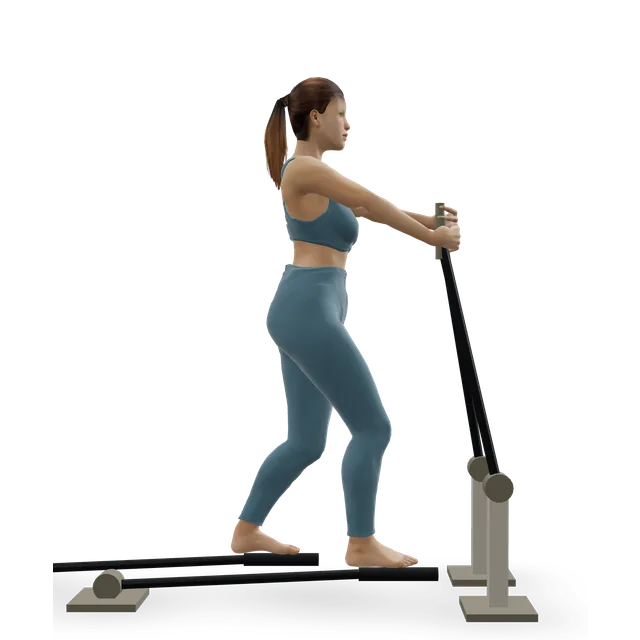
Loading the 3D figure…
The figure repeats the movement from its starting position. Drag to turn it; the arrows open the demos either side.
Standing on two pedals that travel in long ovals, you stride smoothly while each arm pushes and pulls a moving handle, with no impact because the feet never leave the pedals. The hips and knees move much as in walking but bend further, and the gluteus maximus and the front of the thigh worked harder than in walking (Burnfield 2010).
Movement guide
Elliptical trainer
Make it easier or harder
Choose a version that fits your control and comfort.
Easier option
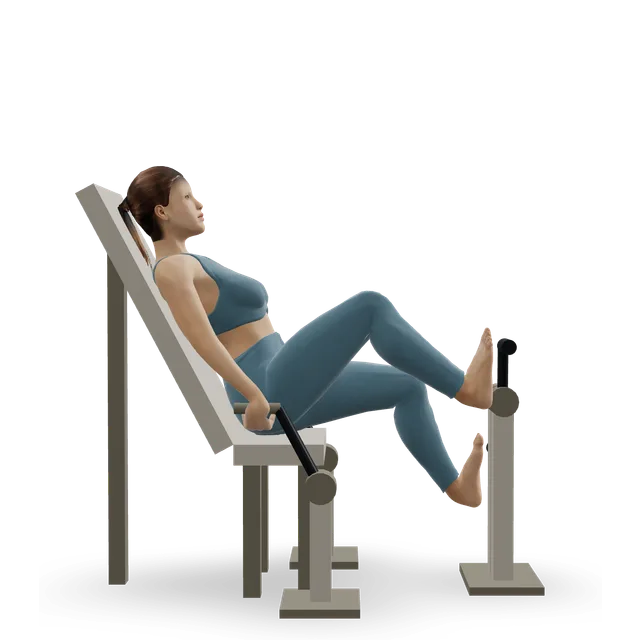 3D demoRecumbent exercise bikeBeginner · Cardio machine
Suggested next step, beginner grade.
Harder option
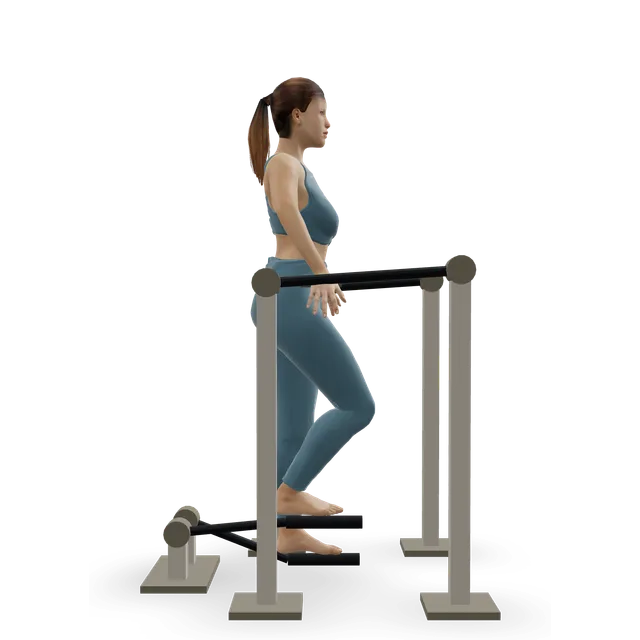 3D demoStair-stepper machineIntermediate · Cardio machine
Similar move, intermediate grade.
Source-researched guide.
Form cues
- Keep the whole foot on the pedal and the heels down.
- Drive the pedals with the legs rather than leaning on the handles.
- Avoid: locking the knees as each pedal goes back.
Practice and cautions
10 to 20 minutes at a moderate effort to start, building towards 30 (our editorial starting point). Moderate means you can talk but not sing, and those minutes count towards the 150 a week the NHS recommends.
Hold the handles to step on and off, and start slowly. Knee or hip pain that builds as you go is a sign to lower the resistance or switch to a bike. Knee loads were higher on an elliptical than on a stationary bike in one study, and rose with a faster pedalling rate. This is movement education, not an assessment or treatment prescription. Stop for sharp or increasing pain, dizziness, numbness or tingling; seek individual guidance for symptoms, injury or restrictions.
Sources and review status
Sources support the educational description; they do not establish that this exercise is suitable for you.
- Burnfield 2010 · Elliptical training and walking compared: similar hip and knee paths with more bend, more gluteus maximus and vastus lateralis, less calf activity (EMG and motion analysis, Physical Therapy) ↗
- He 2024 · Knee loads on stationary bikes and elliptical machines: higher on the elliptical, and rising with a faster cadence (motion analysis, Medicina) ↗
- NHS · Physical activity guidelines for adults aged 19 to 64 (moderate: you can talk but not sing; vigorous: only a few words without pausing for breath) ↗
- Free Exercise DB · community text ↗
Unlicense · Free Exercise DB contributors; derived from wrkout/exercises.json. Text import; no photographs or media. · Revision f00c92c7dcf1216a928a52c3706c7ce8e2f71ed5
No variation is labeled clinically validated.
What it works
Muscles
Main: Quads, Glutes. Also: Hamstrings, Calves.
Anatomy: Sartorius, Quadriceps, Rectus femoris, Vastus medialis, Vastus lateralis, Gluteus maximus.
Equipment
Cardio machine
Level
Beginner. See the easier and harder options above.
Workouts that use it
Pain guides that use it
Part of a staged plan, with when to get help first.
- Exercises for knee arthritis (osteoarthritis)
- Shin splints exercises: settle, strengthen, return to running
- Exercises after a knee replacement: a stage-by-stage recovery plan
- Exercises after a hip replacement, and what hip precautions mean
- Ankle arthritis and stiff ankles: what exercise can and cannot do
- Exercises after a broken leg (tibia and fibula): the recovery stages and warning signs
- Exercises after meniscus surgery: recovery after a trim or a repair
- Exercises after hip arthroscopy: recovery after impingement or labral surgery
Show all 33 pain guidesShow fewer pain guides
- Knee bursitis (housemaid's knee): what helps, and when it's infected
- Plica syndrome: a painful fold in the knee, and what helps
- Meralgia paresthetica: a burning, numb outer thigh, what helps and when it's your back
- Osteitis pubis (pubic bone pain): rehab, recovery time and how it differs from a sports hernia
- Heel fat pad syndrome: a bruise-like pain in the centre of the heel
- Turf toe: a sprained big toe joint, from first aid to return to play
- Plantar plate tear: second toe pain, a toe that drifts or lifts, and what taping, shoes and surgery can do
- Slipped upper femoral epiphysis (SUFE or SCFE): an urgent teenage hip problem, surgery and sport
- Broken kneecap (patella fracture): brace or surgery, and the exercises that follow
- Tibial plateau fracture: weight-bearing limits, rehab and the long-term outlook
- Broken heel (calcaneus fracture): weight limits, surgery or not, and walking again
- Plantar fibroma (Ledderhose disease): a lump in the arch, when to get it checked, and what helps
- Freiberg's disease: pain under the second toe joint, offloading, and getting back to sport and dance
- Osteochondral lesion of the talus (talar dome lesion, ankle OCD): deep ankle pain after a sprain
- Exercises after knee cartilage surgery: microfracture, cell transplants (ACI) and grafts
- Shin pain: shin splints, a stress fracture, compartment syndrome and the muscles at the front
- Knee pain on the elliptical: the kneecap, stride and resistance, foot position and what helps
- Back pain from jump rope: landings, posture and rope length, young athletes and what helps
- Hip pain on the elliptical: the hip flexors, the outer hip, the groin, foot position and what helps
- Shin pain on the treadmill: shin splints, a stress fracture, incline, stride and what helps
- Lower back pain on the elliptical: leaning on the handles, stride, the ramp, stenosis and what helps
- Foot pain on the elliptical: numb toes, the ball of the foot, the heel, laces, shoes and what helps
- Shin pain when hiking: shin splints, stress fractures, descents, boots and laces, and what helps
- Ankle pain on the elliptical: the Achilles, the front and outer ankle, the ramp and what helps
- Shin pain from jump rope: shin splints, stress fractures, floors, landings and what helps
Guides that use it
- Lipoedema guide
- Exercise for weight loss
- Exercise for type 2 diabetes
- Exercise for arthritis
- Exercise with type 1 diabetes
- Exercise during and after cancer treatment
- Exercises for ankylosing spondylitis
- Exercise for migraine
Show all 75 guidesShow fewer guides
- Exercise for high cholesterol
- Exercise for fatty liver disease (MASLD)
- Exercises for lymphoedema (lymphedema)
- Exercise for erectile dysfunction
- Exercise for PoTS
- Exercise for lipoedema (lipedema)
- Exercise for an underactive thyroid (hypothyroidism)
- Exercise with gout
- Exercise for endometriosis
- Exercise for IBS
- Exercise with Crohn's and colitis (IBD)
- Exercise for lupus
- Exercise for autistic children and adults
- Exercise and epilepsy
- Exercise with a hernia and after hernia surgery
- Exercise after a hysterectomy
- Exercise for bipolar disorder
- Exercise with HIV
- Exercise with atrial fibrillation (AF)
- Exercise for psoriatic arthritis
- Exercise with prostate cancer
- Exercise with an abdominal aortic aneurysm
- Exercise when trying to conceive
- Exercise with fibroids
- Exercise with an overactive thyroid (hyperthyroidism)
- Exercise after weight-loss surgery
- Exercise after a caesarean (C-section)
- Exercise for psychosis and schizophrenia
- Exercise for OCD
- Exercise with bowel cancer
- Exercise with hypertrophic cardiomyopathy (HCM)
- Exercise after myocarditis or pericarditis
- Exercise with glaucoma
- Exercise after cataract surgery
- Exercise with diabetic retinopathy
- Exercise after an organ transplant
- Exercise after a brain injury
- Exercise with haemophilia (hemophilia)
- Exercise for prediabetes
- Exercise and sleep apnoea
- Exercise with a prolapse
- Exercise with acid reflux and heartburn
- Exercise after gallbladder removal
- Exercise after appendix removal (appendectomy)
- Exercise with piles (haemorrhoids)
- Exercise while breastfeeding
- Exercise with an enlarged prostate (BPH)
- Zone 2 cardio guide
- HIIT guide
- Cardio and weights guide
- How to lose arm fat guide
- How to lose thigh fat guide
- How to increase stamina guide
- Gym for beginners guide
- Elliptical guide
- How to lose back fat guide
- How to lose chest fat guide
- How to lose love handles guide
- Calf fat guide
- Body recomposition guide
- How to get a smaller waist guide
- Getting back into working out guide
- Hip fat guide
- Toned legs guide
- Running longer guide
- Resting heart rate guide
- Running in the heat guide
Similar moves
Browse more
Questions people ask
What muscles does the Elliptical trainer work?
Mainly the quads and glutes, with help from the hamstrings and calves.
What equipment do I need for the Elliptical trainer?
Cardio machine.
Is the Elliptical trainer good for beginners?
It is graded beginner, so it suits most people starting out. When it feels easy, try the Stair-stepper machine.
What is an easier alternative to the Elliptical trainer?
Try the Recumbent exercise bike or the Stationary cycling. It is the suggested step down from this move.
How do I make the Elliptical trainer harder?
Progress to the Stair-stepper machine or the Step mill (revolving stair machine). Follow that guide’s technique and any stated timing.