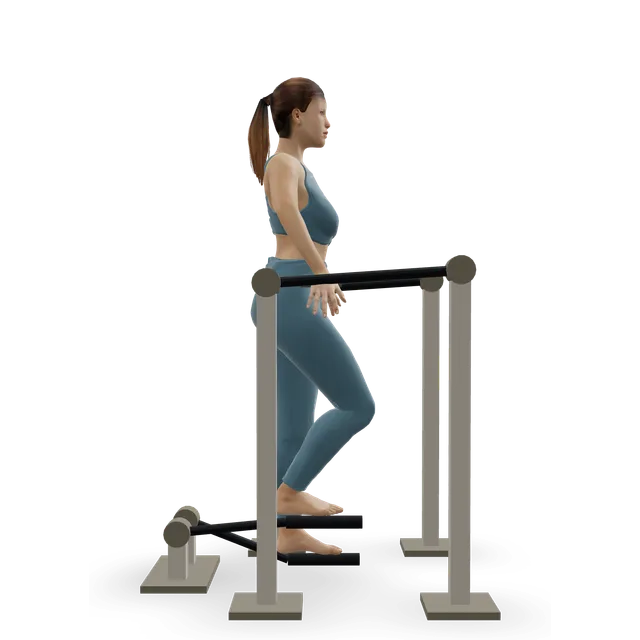
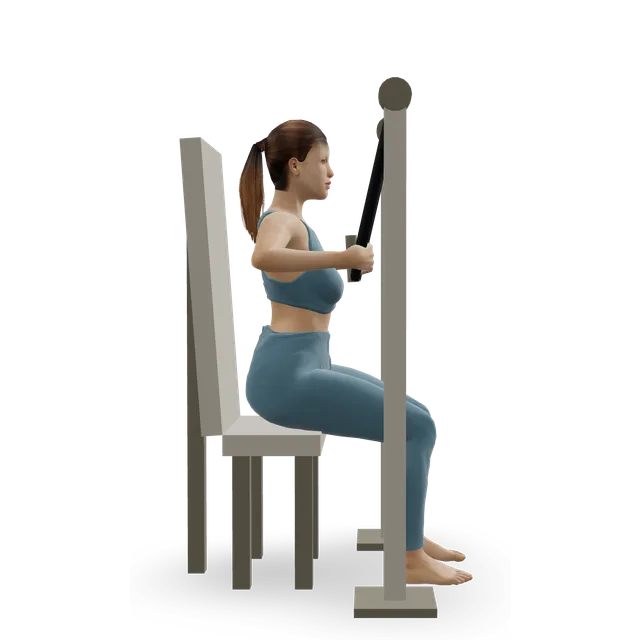
Training guide

How to use an elliptical (cross trainer): stride, resistance and incline, the arm handles, calories, your knees and back, and a first workout

An elliptical, or cross trainer, is a gym machine whose pedals travel in long ovals so your feet never leave them, usually with handles that move with your legs. To use one, hold the fixed handles and step onto the lowest pedal, start pedalling forwards slowly at a low resistance, stand tall with your heels down, and push and pull the handles in time with your legs. Build to 10 to 20 minutes at a pace where you can talk but not sing, then towards 30.

It's real cardio, rated about as hard as brisk walking at a moderate effort and about as hard as running at a vigorous one, with much less impact under your feet. But it isn't the gentlest machine for the knee joint itself, your heart rate can run higher than the effort feels, and the calorie display tends to read high.

This guide covers the machine step by step on the 3D figure, the settings and handles, pedalling backwards, calories, your knees and back, and a beginner workout to follow.

The short version

One machine, two names

"Elliptical" and "cross trainer" are the same machine: two pedals that travel in long ovals, usually with handles that move with them. Get on with the near pedal at its lowest point, holding the fixed handles, and let the pedals stop before you step off, as the makers advise.

Sources 1, 2

It's real cardio

The Compendium of Physical Activities rates it 5.0 METs (multiples of the energy you use at rest) at moderate effort and 9.0 at vigorous. Peak oxygen uptake on an elliptical was close to a treadmill's, and 12 weeks of elliptical training raised fitness as much as treadmill running in a small trial.

Sources 3, 4, 5

Your heart rate may run higher than it feels

At the same effort rating, heart rate was 164 on an elliptical against 145 on a treadmill in 18 untrained adults, with similar energy use. Go by your breathing.

Source 6

Low impact, not the gentlest on the knee

Foot loads averaged 73% of body weight against 112% walking and 175% treadmill jogging. But in 3 people with instrumented knee replacements, the elliptical loaded the knee about as much as treadmill walking and twice as much as cycling, and a small study in young men also found higher knee loads than a bike. If your knees complain, a bike is gentler.

Sources 7, 8, 9

Backwards and the ramp are variety, not glute tricks

We found no published study showing that pedalling backwards or raising the ramp works the glutes or hamstrings more. Backwards pedalling bent the knee a little less.

Source 10

The calorie display reads high

The maker's estimate was too high in a lab study, and one model's display over-read in another, by an uncertain amount. For a 70 kg person, 30 minutes is about 175 calories at moderate effort and 315 at vigorous (our arithmetic from the Compendium).

Sources 11, 12, 3

How to use an elliptical, step by step

From our elliptical move page's steps and cues and one maker's manual ("When mounting the machine it is recommended that the pedal closest to you is in its lowest position"). The 3 to 5 minutes at each end is editorial, matching our plans' warm-up. Machines differ in their buttons and stride length; read the label on yours.

  1. Check the resistance is low and the pedals are still.
  2. Holding the fixed handles, step onto the pedal that sits lowest, then put your other foot on its pedal.
  3. Start pedalling forwards slowly; the console wakes up as you move.
  4. Stand tall with your weight over the middle of your feet and your heels down.
  5. Move your hands to the moving handles and push and pull them, each arm moving opposite its own leg, as in walking.
  6. Stride in long, smooth ovals without bouncing, and keep your knees soft rather than locking them as each pedal goes back.
  7. After 3 to 5 easy minutes, raise the resistance or your pace until you can talk but not sing; ease off for the last 3 to 5 minutes.
  8. Let the pedals stop, hold the fixed handles and step off on the side where the pedal is lowest.

Loading the 3D figure…

Gets into position, then repeats the movement. Technical checks passed; qualified exercise review is pending.

The movement on the figure: Elliptical trainer

What an elliptical is, and what it works

The parts

Two foot pedals on long arms or rails, moving handles linked to them, fixed handles in the middle (often with heart-rate grips, which one maker calls "approximate"), and a console that sets the resistance, a magnetic brake on a flywheel. Some machines have a ramp (incline) and some an adjustable stride length. Arc trainers, outdoor elliptical bikes and seated under-desk ellipticals are different machines.

Sources 2, 13

What it works

Compared with walking, your hips and knees move along much the same path but bend more, the gluteus maximus and the front of the thigh work harder, and the calves and inner hamstrings work less (20 adults, four machines). The front of the thigh worked hardest of all the exercise types in a second study. Glute activity is low in absolute terms: about 4% of maximum for the gluteus maximus on a regular elliptical, against about 19% for clamshells or single-leg squats. Leg muscle effort was up to 60% lower than treadmill running, except for the thighs.

Sources 1, 14, 15, 16

How hard it is

From moderate to vigorous, set by the resistance and your pace. Peak oxygen uptake was 48.0 on the elliptical against 49.3 ml per kg a minute on a treadmill in 18 trained runners, and "similar" to treadmill running in 48 adults; in 18 other adults the treadmill's peak was higher. A standard elliptical cost less oxygen than running in 16 runners, while a long-stride model matched it.

Sources 3, 4, 17, 18, 19

How people differ

Heart rate runs high for many people, especially beginners: in 20 exercisers, a "6 out of 10" effort reached 91% of maximum heart rate. At the same heart rate, the legs felt the work more on an elliptical than on a treadmill. The motion can feel unnatural at first: 132 people found the treadmill more enjoyable and natural than the elliptical, and 4 of 30 adults in one study couldn't use an elliptical without holding the side handles. A fixed long stride suits tall people and can feel awkward if you're short. One maker's cross trainer takes users up to 181 kg; check the label.

Sources 6, 20, 21, 22, 23, 2

Stride, resistance and the ramp

Pace and resistance both add workEmerging evidence

On one machine, each extra stride a minute added about 0.1 ml of oxygen per kg a minute and each resistance level about 0.7 (26 adults). So going from 110 to 134 strides a minute adds about as much as 3 or 4 resistance levels (our arithmetic). The authors warn that people vary too much to predict anyone's own cost.

Sources 11, 24

Resistance and the load under your feetEmerging evidence

In 30 adults, higher resistance raised the load under the foot, and the authors warn that "high shear forces may exist on the lower limb joints on high resistance". Raising the ramp didn't change foot loading.

Source 23

The rampEmerging evidence

Changing the ramp changed how far the knee and hip bent on a modified elliptical in 24 adults. We found no published study showing that a higher ramp works the glutes or hamstrings harder, so use it for variety, not as a glute setting.

Source 10

Stride length and your handsEmerging evidence

In 40 men, stride length (46 or 66 cm), speed and where the hands went all changed how much the lower back bent and twisted.

Source 13

What to do

To make it harder, raise the resistance a level or two or pedal a little faster, keeping a smooth, even stride. If you bounce, add resistance; if you grind or have to haul on the handles, take some off (our suggestions).

The arm handles

Pushing and pulling adds a little workEmerging evidence

Using the moving handles raised oxygen use, breathing and effort ratings, but not heart rate, compared with legs only at the same stride rate and resistance (22 adults); the study didn't give the size. Another study's authors suggest the arms help explain why an elliptical cost more than a bike at the same share of maximum power, an idea they didn't test.

Sources 11, 25

What we don't know

We found no study of how much you use when you hold the fixed central handles instead, and nothing near the popular claim that the arms double the calories.

What to do

Push and pull the moving handles in time with your legs, arms relaxed, or let go and swing your arms if your balance is good. Where your hands go changes how your lower back moves, so if your back complains, try a different hand position and stand tall.

Source 13

Pedalling backwards

It bends the knee a little lessEmerging evidence

In 24 young adults on a modified elliptical, pedalling backwards bent the knee less at every ramp angle and let it fall inwards slightly more at the two lowest angles (by about 1 to 2.5 degrees). The authors suggest people with knee arthritis or pain around the kneecap could pedal backwards at a low ramp.

Source 10

No evidence it works the glutes or hamstrings more

The only muscle data come from an unpublished student project of 10 adults, which found the hamstring less active backwards and the front of the thigh more active, with the gluteus maximus least active of all.

Source 26

How to try it

Only once forwards feels smooth: a low resistance, holding the handles, for a minute or two at a time (our suggestion).

Calories and the display

Calories in 30 minutes (our arithmetic)Strong evidence

The Compendium rates the elliptical 5.0 METs at moderate effort and 9.0 at vigorous. Multiply by your weight in kg and the time in hours:

  • 60 kg: about 150 calories moderate, 270 vigorous.
  • 70 kg: about 175 calories moderate, 315 vigorous.
  • 80 kg: about 200 calories moderate, 360 vigorous.

Sources 3, 27

The display tends to read highEmerging evidence

In 26 adults, "The manufacturer's calculated energy expenditure was overestimated during both tests". In 34 adults on one model's quick-start setting, the display read higher than the measured energy use by a mean of about 128 calories over 30 minutes, using a default user of 150 lb, aged 35 and male. The direction matches, but the size is uncertain: the measured values in that study look low for a moderate effort. Another study notes that the makers' MET equations have unknown validity.

Sources 11, 12, 28

Against other machinesEmerging evidence

In 30 experienced men working hard, the elliptical used 12.82 calories a minute, against 15.18 on a treadmill, 13.35 on a stair climber, 12.45 on a spin bike (not significantly different), 11.94 on an upright bike and 11.07 on a recumbent bike. In untrained adults at a self-chosen effort, the elliptical and treadmill used similar energy.

Sources 29, 6, 25

Fat burning and weightEmerging evidence

Maximal fat burning was lower on an elliptical (0.41 g a minute) than on a treadmill (0.61) in 9 men, and in any case fat lost depends on the total energy you use, not the fuel mix, as our zone 2 guide explains. Exercise alone took off about 2.8 kg at 150 minutes a week across 116 trials.

Sources 30, 31, 32, 33

Your knees, hips and back

Low impact under the footStrong evidence

In 75 adults aged 19 to 72, the load under the foot averaged 112% of body weight walking, 201% jogging outside, 175% jogging on a treadmill and 73% on an elliptical. Heel pressure was 94 kPa on an elliptical against 215 walking and 188 running (20 adults). Loading rates were lower than walking, but the hip and knee muscles worked harder to make that happen (15 men).

Sources 7, 34, 35

Not zero impact over timeEmerging evidence

In 10 older adults, the total pressure over a session wasn't lower than walking, and the pedal still pushes back at about 70 to 81% of body weight.

Sources 36, 23

The knee joint itselfEmerging evidence

In 3 people with instrumented knee replacements, the elliptical put 2.24 times body weight through the knee, against 2.05 for treadmill walking and 1.03 for cycling; the authors concluded it was "no better than treadmill walking" for reducing knee forces. In 12 young men, knee forces were higher on an elliptical than a bike. These are small studies, but they agree.

Sources 8, 9

Knee arthritisEmerging evidence

In a US cohort of 415 overweight adults, the 41 who used ellipticals had the smallest increase in knee damage on MRI over 4 years, a link that can't show cause. In 15 people waiting for a hip or knee replacement, an elliptical test reached about the same peak as a treadmill, with a similar rise in pain. We found no trial of elliptical training for knee arthritis; NICE recommends exercise, including aerobic fitness, for everyone with osteoarthritis.

Sources 37, 38, 39

HipsEmerging evidence

In 18 adults, the hips felt more uncomfortable on an elliptical than on an arc trainer at similar efforts; knees and lower backs didn't differ.

Source 18

Your lower backEmerging evidence

In 40 men, the lower back bent and twisted more on an elliptical than in walking, depending on hand position, speed and stride. In 12 people with long-term low back pain, pain fell from 4.7 to 3.2 out of 10 over 4 weeks of elliptical exercise, a small study with no comparison group. No study shows harm.

Sources 13, 40

What to do

The elliptical suits people who find running's impact hard on their joints. With knee or hip pain that builds as you go, lower the resistance, shorten the session or switch to a bike, as our move page says. If your back complains, stand tall rather than leaning on the handles.

What the evidence says

Elliptical training raises fitnessEmerging evidence

In 22 moderately active women training 3 days a week for 12 weeks (30 minutes at 70 to 80% of maximum heart rate, building to 40 minutes at 80 to 90%), the elliptical group's aerobic fitness rose from 36.9 to 39.6 ml per kg a minute, as much as the treadmill and stair-climber groups. Only 8 people were in the elliptical group.

Source 5

For runnersEmerging evidence

In 20 adults who had just trained for 4 weeks, 3 weeks of elliptical training kept predicted fitness about as well as running (falls of 1.5% and 0.8%, against 4.8% with rest, none significant). After a marathon, 40-minute elliptical sessions were no better than rest for muscle recovery in 64 runners.

Sources 41, 42

After a hip replacementEmerging evidence

In a trial of 50 people, 20 minutes a day on an elliptical from the third day after surgery improved knee strength, one-leg balance and walking speed more than walking did, still ahead at 3 months. Follow your surgical team's timing.

Source 43

Older adults with obesityEmerging evidence

In 68 older adults, interval training on an elliptical raised 6-minute walk distance more than steady treadmill walking (12.4% against 5.2%), but the machine and the intensity changed together, so it can't say which mattered.

Source 44

What's missing

We found no meta-analysis of elliptical training and no study of bone. Its foot loads are below walking's, so treat it as non-impact for bone, like cycling (our reading); the UK osteoporosis consensus recommends strength and impact exercise for bone.

Sources 45, 7

The talk test works on any machineEmerging evidence

The point where talking first gets harder matched a breathing threshold on treadmills and bikes, and on an elliptical, effort ratings tracked oxygen use and heart rate closely in 60 adults.

Sources 46, 47, 48

Common mistakes and how to fix them

Leaning on the handles or console

It takes weight off your legs. Stand tall and drive the pedals with your legs, as our move page says.

Up on your toes

Keep the whole foot on the pedal and the heels down (our move page).

Locking your knees as each pedal goes back

Keep them soft (our move page).

Too little resistance, so you bounce

Add resistance until the stride feels controlled (our suggestion).

Too much resistance, so you grind

If you can't keep a smooth stride or have to haul on the handles, lower it.

Source 23

Chasing a heart-rate number or the calories

Heart rate runs high and the display reads high. Go by your breathing.

Sources 6, 11

Stepping off while the pedals turn

Wait for them to stop, then step off on the side where the pedal is lowest.

Source 2

How long and how often

Your first sessions

10 to 20 minutes at a moderate effort, building towards 30: the move page's dose, which is our editorial starting point. Moderate means you can talk but not sing, and those minutes count towards the 150 a week the NHS recommends.

Source 49

Building up

Add about 5 minutes every session or two, changing one thing at a time: time first, then resistance (our suggestion, as in our stair climber workout). Three to five sessions a week is a sensible spread.

Adding intervals

Once 20 minutes steady is comfortable: 1 minute harder, 2 minutes easy, 4 rounds building to 8, as our cardio intervals workout does. Keep hard sessions to once or twice a week, with easier days between.

The elliptical and its neighbours

The elliptical at its move page's dose, 10 to 20 minutes at a moderate effort to start, building towards 30 (editorial there). The recumbent bike is gentler on a sore knee (its page gives the same starting dose); brisk treadmill walking and the stair-stepper are the other low-skill cardio options.

Strength and stretches that go with it

On 2 days a week: goblet squats and step-ups, 3 sets of 8 to 12 (our stair climber guide's strength note), 12 glute bridges (our low-impact leg workout), calf raises, 2 or 3 sets of 10 to 15 (our incline walking guide), and side planks, 2 holds of 20 to 40 seconds each side, with bird dogs for the back. After a session, the quad, hip flexor and calf stretches for 30 seconds each side, for comfort.

Workouts to follow

Start with the elliptical workout for beginners: steady rounds first, then optional intervals. The cardio machines tour and the first gym workout try the cross trainer beside other machines, and the cardio intervals workout works on an elliptical at the same effort.

Plans with a cardio day that fits

Use the elliptical for these plans' cardio days at the same effort.

Who should change it

Heart conditions and high blood pressure

At a moderate effort most people need no check first. With a heart condition, or chest pain, dizziness or breathlessness when active, see your GP before vigorous sessions. If your blood pressure is high and not yet controlled, keep to moderate effort until it is. On a beta blocker, go by the talk test rather than your heart rate.

Sources 50, 51, 52, 53

Knee pain or knee arthritis

Keep the resistance low and the sessions short, keep pain to about 5 out of 10, settled by the next morning, and switch to a bike if it builds. Exercise is part of the treatment for knee osteoarthritis.

Sources 8, 39

After heart surgery or a hip or knee replacement

After heart surgery through the breastbone, or a heart or lung transplant, follow your surgeon's advice before pushing, pulling or lifting with your arms.

After a hip or knee replacement, follow your surgical team's timing; elliptical training from the third day helped people after hip replacement in one trial, under supervision.

Source 43

Pregnancy

If you already use a cross trainer you can usually carry on at a comfortable effort, but the NHS says it's not recommended to start a new vigorous activity in pregnancy. Hold the handles as your balance changes, and stop if you feel uncomfortable, too hot or unwell.

Source 54

Balance problems

Hold the fixed handles throughout and keep the pace steady; some people need the handles to use an elliptical at all. A recumbent bike is the steadier choice if your balance is poor (our suggestion).

Source 23

Warning signs

Stop and get medical help

If you get chest pain or pressure, feel faint or dizzy, are unusually breathless, or your heart races or beats irregularly during exercise, as our plans advise. The American Heart Association says these need immediate medical evaluation.

Source 50

Call 999 (911 in the US)

For chest pain that feels tight, heavy or squeezing, or spreads to your arms, neck, jaw or back; a sudden, extremely painful headache, especially while straining; someone who faints while exercising; or palpitations that don't go away, or come with chest pain, breathlessness or feeling faint. Don't drive yourself to A&E.

Also call 999 for pain and swelling in one leg with breathlessness or chest pain: it can be a blood clot that has reached the lungs.

Sources 55, 56, 57, 58, 59, 60, 61

Breathlessness

Severe difficulty breathing (gasping, choking or not able to get your words out) is a 999 call; being more short of breath than usual is a call to NHS 111, as the NHS advises.

Source 62

A headache with effort

Ask for an urgent GP appointment or get help from NHS 111 for a headache that's triggered or made worse by coughing, sneezing, bending down or exercising.

Source 57

Light-headed when you stop

Ease off over the last few minutes rather than stopping dead, and hold the fixed handles to step off. See a GP after any faint, and if you keep feeling light-headed after slowing down gradually, or dizziness keeps coming back.

Sources 59, 63

Your knee

Get advice from NHS 111 now: you cannot move the knee or put any weight on it, or it is very painful, badly swollen or has changed shape; or the knee locks, gives way or clicks painfully. Painless clicking is normal.

See a GP if knee pain hasn't improved within a few weeks.

Source 64

Your hip

Ask for an urgent GP appointment or get help from NHS 111 for severe hip pain that started suddenly without a fall or injury, or a hip that's swollen and hot. See a GP if hip pain hasn't improved after 2 weeks of looking after it at home, is getting worse or keeps coming back, as the NHS advises.

Source 65

Your calf or heel

Same day (NHS 111): throbbing pain and swelling in one calf or thigh, with warm, red or darker skin around it, which can be a blood clot in a leg vein; or a snap or pop at the back of the heel, then trouble walking or standing on tiptoe.

Source 61

Your lower back

Call 999 or go to A&E: loss of feeling or numbness around the genitals or bottom, new trouble peeing or controlling your bladder or bowels, changes in genital sensation during sex or problems with erections or orgasm, or pain, tingling, weakness or numbness in both legs. These are signs of cauda equina syndrome, which needs treating in hospital urgently. Don't drive yourself.

Call 999 or go to A&E: back pain with chest pain, or back pain that started after a serious accident, such as a car crash.

See a GP if pain spreading down a leg hasn't improved after a few weeks of home treatment, is getting worse or stops your normal activities. Sciatica on both sides, or weakness or numbness in both legs that's severe or getting worse, is a 999 call or a trip to A&E.

Aim for discomfort you'd call mild to moderate, no more than about 5 out of 10. It should settle within an hour or so, and your back should be no worse the next morning, as our back pain guides say. Pain, pins and needles or numbness spreading down a leg are the exception: stop, and see our sciatica guide.

Sources 66, 67

A hernia

See a GP if you think you have a hernia, a bulge or lump that may get bigger when you strain and smaller when you lie down. Get help from NHS 111 if you have a hernia and pain in or around it, a bloated tummy, you feel or are sick, you're vomiting blood or your vomit looks like coffee grounds, you're constipated, you have a high temperature or feel hot, cold or shivery, or you've suddenly become confused. Call 999 or go to A&E for a femoral hernia (a small lump at the top of your thigh, in your groin) with very bad tummy pain, sickness, being unable to fart or poo, a high temperature or sudden confusion.

Sources 68, 69

Before you start

Speak to your GP first if you haven't exercised for some time or have medical conditions or concerns, as the NHS advises. Get advice before hard or straining work if your blood pressure is uncontrolled (140/90 or higher at a clinic, or 135/85 at home), or you have heart disease or chest pain when you're active, a pacemaker or defibrillator, diabetic eye disease, glaucoma, a hernia, recent eye or tummy surgery, or you're pregnant, as our breathing guide lists.

Sources 49, 53, 50

Sore, or hurt?

Muscle soreness for a day or two after a new or harder session is common and fades. Sharp pain, or pain that builds during a set or lingers into the next day, isn't: swap to an easier version, and see a clinician if it persists, as our plans advise. The NHS says to stop exercising straight away if you feel any pain or become unwell, and to get help from 111 if symptoms worry you or don't go away.

Source 70
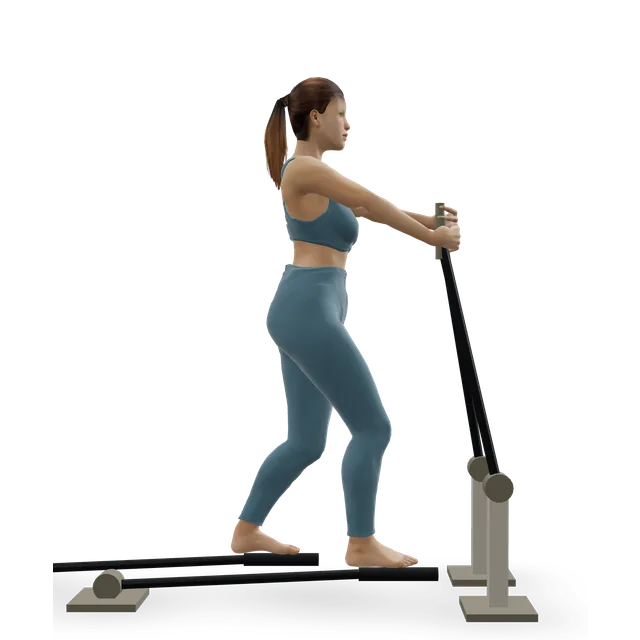
Myths

"The elliptical doesn't count as real exercise"Strong evidence

It rates 5.0 to 9.0 METs, peak oxygen uptake on it was close to a treadmill's, and 12 weeks of elliptical training raised fitness as much as treadmill running.

Sources 3, 4, 5

"The elliptical is easier on the knees than everything"Emerging evidence

It cuts the impact under your feet, but in small studies it loaded the knee joint about as much as treadmill walking and more than a bike.

Sources 7, 8, 9

"It's zero impact"Emerging evidence

It's low impact: foot loads averaged 73% of body weight, and the pedals still push back.

Sources 7, 23

"Using the arms doubles the calories"Emerging evidence

The handles raised oxygen use and effort in one study, which gave no size. Nobody has shown anything near double.

Source 11

"Pedalling backwards works the glutes and hamstrings more"Emerging evidence

We found no published study showing it. The only muscle data, from an unpublished student project, found the hamstring less active backwards; the published study measured only knee angles.

Sources 10, 26

"The ramp targets your glutes"Emerging evidence

We found no study showing it. The ramp changed knee and hip angles and didn't change the load under the foot.

Sources 23, 10

"The calorie display is accurate"Emerging evidence

The maker's estimate read high in two studies; how high is uncertain.

Sources 11, 12

"Your heart rate tells you how hard you're working"Emerging evidence

On an elliptical, heart rate ran higher than on a treadmill at the same effort and energy use. Go by your breathing.

Source 6

Questions people ask

How do you use an elliptical (cross trainer)?

Hold the fixed handles and step onto the pedal that sits lowest, then start pedalling forwards slowly at a low resistance. Stand tall with your heels down, push and pull the moving handles in time with your legs, and raise the resistance until you can talk but not sing. Ease off for the last few minutes and let the pedals stop before you step off.

Is an elliptical the same as a cross trainer?

Yes. "Cross trainer" is the usual UK name and "elliptical" the US one for a machine whose pedals travel in long ovals, usually with moving handles. Arc trainers and outdoor elliptical bikes are different machines.

Is the elliptical a good workout?

Yes. It rates about as hard as brisk walking at a moderate effort and about as hard as running at a vigorous one, peak oxygen uptake on it was close to a treadmill's, and 12 weeks of elliptical training raised fitness as much as treadmill running in a small trial.

How long should a beginner use the elliptical?

Start with 10 to 20 minutes at a talk-but-not-sing effort and build towards 30 over a few weeks. Add short harder spells once 20 minutes is easy, as our elliptical workout does. Those minutes count towards your 150 a week.

Should I use the arm handles on an elliptical?

Yes, if you're steady: pushing and pulling them raised oxygen use and effort in a lab study, without raising heart rate. Nobody has shown they double the calories, and you can let go and swing your arms if your balance is good.

What resistance should I use on an elliptical?

Enough that your stride feels smooth and controlled, but not so much that you grind or have to haul on the handles. Raising the resistance or your stride rate both add work. Levels differ between machines, so note what feels right on yours.

Is the elliptical good for your knees?

It's low impact under the foot, which helps if running jars your joints, but it isn't the gentlest machine for the knee joint itself: in small studies it loaded the knee about as much as treadmill walking and more than a bike. With knee pain, lower the resistance or try the bike.

Is the elliptical bad for your back?

No study shows harm, but it bends and twists the lower back more than walking does, depending on where your hands go, your speed and your stride. Stand tall rather than leaning on the handles, and keep sessions shorter if your back complains.

Does pedalling backwards on an elliptical work different muscles?

Not in the way people say: no published study shows it works the glutes or hamstrings more, and one unpublished study found the hamstring less active. It bends the knee a little less, so it's fine for variety.

How many calories does the elliptical burn?

For a 70 kg person, about 175 calories in 30 minutes at a moderate effort and about 315 at a vigorous one (our arithmetic from the Compendium of Physical Activities). The display tends to read high, so treat its number as a rough guide.

Is the elliptical or the treadmill better?

At the same felt effort they used similar energy in untrained adults, though heart rate ran higher on the elliptical, and both raised fitness alike in a training trial. The treadmill loads your bones and trains you for running; the elliptical spares you impact. Pick the one you'll keep using.

Is the elliptical good for weight loss?

It helps through the energy it uses, like any cardio, but exercise alone takes weight off slowly: about 2.8 kg at 150 minutes a week on average in trials. It won't take fat off your stomach in particular.

Sources

  1. Burnfield 2010 · Elliptical training and walking compared: similar hip and knee paths with more bend, more gluteus maximus and vastus lateralis, less calf activity (EMG and motion analysis, Physical Therapy)
  2. Life Fitness · Cross-trainer assembly instructions: mounting, children and moving parts (maker's manual)
  3. Compendium of Physical Activities 2024 · Conditioning exercise: the elliptical trainer at moderate (5.0 METs) and vigorous (9.0) effort (reference table)
  4. Bosch 2021 · Oxygen use and heart rate on a treadmill, elliptical trainer and stepper in 18 runners (lab study, Int J Sport Nutr Exerc Metab)
  5. Egaña 2004 · Elliptical, treadmill or stair-climbing training for 12 weeks in 22 women (randomised trial, J Sports Med Phys Fitness)
  6. Brown 2010 · Energy use on a treadmill and an elliptical at a self-chosen effort in 18 untrained adults (lab study, J Strength Cond Res)
  7. Kaplan 2014 · Foot loads in walking, jogging, treadmill jogging and on an elliptical in 75 adults (lab study, Gait Posture)
  8. D'Lima 2008 · Knee forces during exercise and recreation measured with instrumented knee replacements in 3 people (lab study, Clin Orthop Relat Res)
  9. He 2024 · Knee loads on stationary bikes and elliptical machines: higher on the elliptical, and rising with a faster cadence (motion analysis, Medicina)
  10. Hummer 2021 · Pedalling direction, ramp angle and knee movement on an elliptical in 24 adults (lab study, Knee)
  11. Mier 2006 · Stride rate, resistance and the arm handles and the energy cost of an elliptical trainer in 26 adults (lab study, Res Q Exerc Sport)
  12. Glave 2018 · An elliptical's calorie display against measured energy use in 34 adults (lab study, Exercise Medicine)
  13. Moreside 2012 · Trunk movement and muscle activity on an elliptical against walking in 40 men (lab study, Clin Biomech)
  14. Prosser 2011 · Muscle activity on an elliptical, a bike, a treadmill and overground walking in 10 adults (EMG study, Gait Posture)
  15. Lin 2016 · Glute muscle activity on a regular and an off-axis elliptical against glute exercises in 12 adults (EMG study, J Sport Rehabil)
  16. Eken 2022 · Leg muscle activity on a treadmill, stepper and elliptical in 17 runners (EMG study, J Strength Cond Res)
  17. Dalleck 2006 · Heart rate reserve and oxygen uptake reserve on an elliptical in 48 adults (lab study, J Sports Sci Med)
  18. Turner 2010 · Oxygen use, heart rate and discomfort on a treadmill, elliptical and arc trainer in 18 adults (lab study, J Strength Cond Res)
  19. Chester 2016 · Leg movement and energy cost on two ellipticals and a treadmill in 16 runners (lab study, J Appl Biomech)
  20. Batté 2003 · Oxygen use and heart rate at a set effort rating on an elliptical in 20 adults (lab study, J Sports Med Phys Fitness)
  21. Green 2004 · Heart rate and effort ratings on a treadmill and an elliptical (lab study, Percept Mot Skills)
  22. Carraro 2014 · How enjoyable people find the treadmill, elliptical and other machines, in 132 people (study, Percept Mot Skills)
  23. Kaplan 2014 · Foot loads with changing resistance, incline and speed on an elliptical in 30 adults (lab study, Orthop J Sports Med)
  24. Dalleck 2007 · An equation for the energy cost of elliptical exercise in 40 adults (lab study, Percept Mot Skills)
  25. Morio 2016 · Energy cost and efficiency on an elliptical against a bike in 14 people (lab study, J Sports Med Phys Fitness)
  26. Hansen 2002 · Muscle activity and movement on an elliptical, forwards and backwards, in 10 adults (unpublished student project, University of North Dakota)
  27. Herrmann 2024 · 2024 Adult Compendium of Physical Activities: a third update of the energy costs of activities (compendium, J Sport Health Sci)
  28. Mays 2010 · Predicting peak oxygen uptake on a treadmill, bike and elliptical in 17 women (lab study, J Strength Cond Res)
  29. Prieto-González 2024 · Energy use, oxygen and heart rate on seven indoor cardio machines in 30 men (lab study, Front Sports Act Living)
  30. Filipovic 2021 · Maximal fat burning on a treadmill, elliptical and rowing machine in 9 men (lab study, J Sports Sci Med)
  31. Achten 2002 · The exercise intensity that burns the most fat, in 18 cyclists (study, MSSE)
  32. Steele 2021 · Slow and steady, or hard and fast? Body composition with interval vs continuous training (systematic review and meta-analysis, Sports)
  33. Jayedi 2024 · Aerobic exercise and weight loss in adults: 116 trials (dose-response meta-analysis, JAMA Netw Open)
  34. Burnfield 2007 · Foot pressures on five cardio machines and in walking and running, in 20 adults (lab study, Med Sci Sports Exerc)
  35. Lu 2007 · Joint loading in the legs during elliptical exercise against walking in 15 men (lab study, Med Sci Sports Exerc)
  36. Burnfield 2020 · Foot pressures on ellipticals against walking in 10 older adults (lab study, Clin Biomech)
  37. Schirò 2021 · Types of exercise and knee changes on MRI over 4 years in 415 overweight adults (cohort study, Skeletal Radiol)
  38. Roxburgh 2021 · Exercise testing on four machines in 15 people with severe hip or knee arthritis (crossover study, Anaesthesia)
  39. NICE 2022 · Osteoarthritis in over 16s: diagnosis and management (NG226 guideline)
  40. Dillingham 2020 · Elliptical exercise for chronic low back pain in 12 people (case series, J Phys Med Rehabil)
  41. Joubert 2011 · Elliptical cross-training and fitness in recently trained runners (small trial, Int J Exerc Sci)
  42. Martínez-Navarro 2021 · Running, elliptical training or rest in the week after a marathon, in 64 runners (randomised trial, Eur J Sport Sci)
  43. Hasebe 2022 · Elliptical training after hip replacement in 50 people (randomised trial, J Phys Ther Sci)
  44. Youssef 2022 · Elliptical interval training against treadmill walking in 68 older adults with obesity (trial, Healthcare)
  45. Brooke-Wavell 2022 · Strong, steady and straight: UK consensus statement on exercise for osteoporosis (consensus statement, BJSM)
  46. Persinger 2004 · Consistency of the talk test on a treadmill and a bike in 16 adults (study, Med Sci Sports Exerc)
  47. Foster 2008 · The talk test as a marker of exercise training intensity (study, J Cardiopulm Rehabil Prev)
  48. Mays 2010 · Effort rating scales for elliptical exercise in 60 adults (validation study, Percept Mot Skills)
  49. NHS · Physical activity guidelines for adults aged 19 to 64
  50. Paluch 2024 · Resistance training with and without heart disease: 2023 update (American Heart Association scientific statement, Circulation)
  51. Bull 2020 · World Health Organization 2020 guidelines on physical activity and sedentary behaviour (guideline, BJSM)
  52. Riebe 2015 · Updating ACSM's recommendations for exercise preparticipation health screening (position statement, Med Sci Sports Exerc)
  53. NHS · High blood pressure
  54. NHS · Exercise in pregnancy
  55. NHS · Chest pain (past its review date: reviewed August 2023, review due August 2026)
  56. NHS · Heart attack
  57. NHS · Headaches
  58. NHS · Subarachnoid haemorrhage
  59. NHS · Fainting
  60. NHS · Heart palpitations
  61. NHS · Deep vein thrombosis (DVT)
  62. NHS · Shortness of breath
  63. NHS · Dizziness (past its review date: reviewed April 2023, review due April 2026)
  64. NHS · Knee pain
  65. NHS · Hip pain in adults
  66. NHS · Back pain
  67. NHS · Sciatica
  68. NHS · Hernia
  69. NHS · Femoral hernia repair
  70. NHS · How to warm up before exercising

Exercise education, not a personal prescription, and clinical review of these guides is pending. Check with a GP before starting hard training if you have a heart condition, chest pain, dizziness or breathlessness when active, and stop for sharp or increasing pain. Health disclaimer.