Pain guide · Knee pain

A swollen knee: an injury, arthritis, gout, bursitis, a Baker's cyst or infection, and what helps

A swollen knee, sometimes called water on the knee, means extra fluid in or around the joint. How fast it swelled, where it's swollen and whether the knee is hot are the main clues: swelling within hours of a twist or a fall usually means bleeding inside the joint, most often from a torn ligament, while a hot, red knee without an injury can be gout, pseudogout or an infection, and a soft swelling on the kneecap is usually bursitis.

This guide starts with the warning signs, from accident and emergency (A&E) and the National Health Service's 111 line (NHS 111) to a general practitioner (GP), including a hot knee with a fever and a swollen calf. Then it covers what to do in the first days (ice, compression, raising the leg and gentle movement), the facts about draining and injections, and a three-stage plan with a 3D demo of every move that ends with stairs, kneeling and sport.

When to get help first

Exercise is for pain that has been checked or is clearly mild and settling.

Get urgent medical help if

  • Go to A&E if you've injured your knee and it has changed shape, it becomes very swollen very quickly, you felt a pop or snap, you can see bone sticking out, or it's bleeding heavily. Don't drive yourself: ask someone to take you, or call 999 if the pain means you can't move your leg to get there.
  • Get help from NHS 111 if you've injured your knee and it's very painful, swollen or bruised, you can't stand up or move your knee, or you think your kneecap came out of place and went back.
  • Get advice from NHS 111 now: you cannot move the knee or put any weight on it, or it is very painful, badly swollen or has changed shape.
  • Your knee swelled up straight away after a twisting injury: get advice from NHS 111.
  • You hurt your knee and cannot take 4 steps, or you are 55 or over and hurt it in a fall: get it checked the same day for a broken bone.
  • Get advice from NHS 111 now: a hot, red or swollen knee with sudden severe pain, a very high temperature, or feeling hot, cold or shivery. This can be a joint infection.
  • Ask for an urgent GP appointment or get help from NHS 111 if you have severe pain in a joint, usually just 1, that started suddenly, swelling around a joint, skin around a joint that has changed colour, or difficulty moving a joint, or you have joint pain, feel generally unwell and have a high temperature or feel hot, cold or shivery. An infected joint needs treating straight away, usually in hospital.
  • Ask for an urgent GP appointment or get help from NHS 111 if a joint is suddenly painful and swollen and the pain is getting worse, or you also have a very high temperature, feel hot, cold or shivery, feel sick or can't eat: it could be an infection inside the joint.
  • Call 999 or go to A&E if redness spreads through the skin around the knee (cellulitis) and you have a very high temperature or feel hot, cold or shivery, a fast heartbeat or fast breathing, purple patches on the skin, feel dizzy or faint, are confused, or have cold, clammy or pale skin. These can be signs of a serious infection. Don't drive yourself.
  • Same day: the swelling over or below the kneecap becomes hot, red or more painful, the skin over it is broken, or you have a high temperature or feel shivery, sick or unwell. Ask for an urgent GP appointment or call NHS 111: it may be infected and need antibiotics.
  • Ask for an urgent GP appointment or get help from NHS 111 for pain or swelling in your leg that suddenly gets worse; swelling, bruising and warm skin on your leg; red or darkened skin on your leg; or swelling in your leg that gets harder or softer. These can be a burst Baker's cyst or a blood clot.
  • Same day (urgent GP appointment or NHS 111): throbbing pain in one leg (rarely both), usually the calf or thigh; swelling in one leg (rarely both); red, blue or darkened skin around the painful area, which may be harder to see on brown or black skin; or swollen veins. This can be a deep vein thrombosis (DVT). It is more likely after surgery, a hospital stay, 3 or more days in bed, a journey of over 4 hours, pregnancy or a recent birth, cancer, a previous clot, or oestrogen-containing contraception or HRT.
  • Leg pain or swelling with breathlessness or chest pain: call 999 or go to A&E, and do not drive yourself. It can be a blood clot that has reached the lungs.
  • Get advice from NHS 111 now: the knee locks, gives way or clicks painfully. Painless clicking is normal.
  • After a recent knee replacement, ask for an urgent GP appointment or call NHS 111 for redness, tenderness, swelling or pain in your knee that isn't getting better or is getting worse, a high temperature or feeling hot, cold or shivery, throbbing or cramping pain in your leg, or oozing or pus from the wound. Call 999 or go to A&E for leg pain and swelling with difficulty breathing or chest pain.
  • If you take a blood thinner (anticoagulant) and your knee swells, feels warm or bruises, with or without a knock, get advice from NHS 111 the same day (our suggestion: the NHS lists bleeding into the joint as a cause of a swollen, warm, bruised knee, more likely on these medicines).
  • Same day (urgent GP appointment or NHS 111): a child or teenager with a limp, or sudden knee or thigh pain, even if the knee itself looks normal. Hip problems can be felt in the knee.
  • Back or leg symptoms with numbness around the genitals or bottom, new trouble controlling your bladder or bowels, or severe or worsening weakness or numbness in both legs.

See a doctor or physiotherapist if

  • Your knee is hot, swollen or tender, especially if you can't remember injuring it: contact your GP practice, or NHS 111 if it's closed. A hot knee with a very high temperature is urgent (above).
  • Symptoms of gout for the first time, or gout that your usual treatment isn't helping: see a GP.
  • Bursitis that hasn't improved, or is getting worse, after 1 to 2 weeks of looking after it yourself, a knee you can't move, or very severe, sharp or shooting pains: see a GP.
  • Bursitis when you have diabetes, kidney disease, gout or rheumatoid arthritis, or take medicines that weaken the immune system, such as steroids or chemotherapy: see a GP sooner, because infection is more likely and the cause may need treating.
  • A lump behind the knee, or anywhere, that you don't know the cause of: see a GP.
  • Swelling in several joints, or morning stiffness that lasts more than 30 minutes: see a GP. It can be an inflammatory arthritis such as rheumatoid arthritis rather than wear and tear.
  • A child with a swollen knee or pain in 1 joint without an injury, or with a rash, unusual bruising, a high temperature, unusual tiredness or weight loss: see a GP.
  • Swelling that keeps coming back after activity, or hasn't gone down after a few weeks: see a GP or physiotherapist (our suggestion).
  • Knee pain that has not improved within a few weeks of looking after it at home. Many areas offer NHS physiotherapy without a GP referral.
  • Bone pain that is constant or worse at night, especially with a lump, unexplained weight loss, fever or tiredness, or a past history of cancer.

Where does it hurt?

Location narrows the likely causes; it does not diagnose.

The whole knee, puffy all round, within minutes to a few hours of a twist, a landing or a blow, often with a pop or the knee giving way

Usually bleeding inside the joint, most often from a torn anterior cruciate ligament (ACL), sometimes a dislocated kneecap or a break. See the warning signs.

Read: ACL injury →
The kneecap slipped out of place, then the knee swelled

A kneecap dislocation, the commonest cause of a bleeding knee at 16 and under in one large study.

Read: Kneecap dislocation →
After a crash or a fall from a height: a swollen knee you can't put weight on

A possible break at the top of the shin bone: go to A&E.

Read: Tibial plateau fracture →
Swelling over a day or two after a twist, with catching, locking or pain along the joint line

Often a meniscus tear.

Read: Meniscus tear →
A hot, red, very painful knee without an injury, often coming on over hours or overnight

Gout, pseudogout or an infection: get advice from NHS 111 now, as the warning signs say. Testing fluid from the knee tells them apart.

Mild swelling from mid-life that comes and goes with activity, with stiffness after rest

Often a flare of osteoarthritis, which can affect both knees over time.

Read: Knee arthritis →
Swelling in several joints on both sides, with stiffness for more than 30 minutes in the morning

Possibly rheumatoid arthritis or another inflammatory arthritis: see a GP.

A soft swelling on the front of the kneecap, after kneeling or a blow

Usually bursitis. Hot, red or broken skin, or a fever, can mean infection.

Read: Knee bursitis →
A soft lump behind the knee, more visible when you stand

Often a Baker's cyst. A sudden painful swelling down the calf can be a burst cyst or a clot.

Read: Baker's cyst →
Behind the knee, without a clear lump

Our pain behind the knee guide maps the causes.

Read: Pain behind the knee →
A tender spot on the inner shin just below the joint, worse on stairs

Possibly pes anserine pain.

Read: Pes anserine pain →
Swelling, warmth and bruising while you take a blood thinner, with or without a knock

Possibly bleeding into the joint: get advice from NHS 111 the same day (our suggestion).

The calf swollen too, throbbing, with red, blue or darker skin

A possible clot: get help the same day.

Read: Calf pain →
In the weeks and months after a knee replacement

Some swelling and warmth are expected early on; swelling that gets worse, a fever or a wound that oozes needs urgent help. Your surgical team's advice comes first.

Read: Knee replacement →
Swelling with pain at night

Our knee pain at night guide.

Read: Knee pain at night →
Pain at the front of the knee with little swelling

Our front of knee pain guide maps the kneecap, the tendons and growing knees.

Read: Front of knee pain →

Understand it

How fast it swelled is the first clueEmerging evidence

After an injury, a clinical review says swelling within minutes to a few hours usually points to bleeding inside the joint, from a torn ligament, a break inside the joint or a dislocated kneecap, while swelling that builds over hours to a few days usually points to a meniscus tear. Without an injury, swelling with redness or warmth points to gout, pseudogout, an arthritis flare or infection, and swelling limited to the kneecap points to bursitis.

In 1,145 knees in Sweden that bled into the joint after an injury, a magnetic resonance imaging (MRI) scan found a torn anterior cruciate ligament (ACL) in 52%, a meniscus tear in 41% and a dislocated kneecap in 17%. Only 12% of the ACL tears were the only injury, and at 16 and under a dislocated kneecap was the commonest. Most of the injuries (72%) happened in sport.

Sources 1, 2

A hot, swollen knee: infection, gout or pseudogoutStrong evidence

A joint infection (septic arthritis) causes sudden severe pain, usually in one joint, with swelling, a change in skin colour and difficulty moving it, often with a high temperature or feeling unwell. The NHS says it needs urgent help, and most people are treated in hospital. It's more likely with older age, diabetes, rheumatoid arthritis, recent joint surgery, a knee or hip replacement, a skin infection, a weakened immune system or human immunodeficiency virus (HIV). In 14 studies of 6,242 people, joint pain (85%), a history of swelling (78%) and fever (57%) were the only features found in more than half of those with an infected joint, so no single sign rules it out.

Gout can affect the knee, and the National Institute for Health and Care Excellence (NICE) asks clinicians to think of it when severe pain, redness or swelling comes on quickly, often overnight. Acute calcium pyrophosphate (CPP) crystal arthritis, once called pseudogout, is rare under 60, and the knee is the joint it affects most often, Arthritis UK says. European recommendations say it is confirmed by finding the crystals in fluid from the joint, which is also how an infection is found.

Sources 3, 4, 5, 6, 7, 8

Other causes: arthritis, bursitis, a Baker's cyst and blood thinnersStrong evidence

The NHS lists mild swelling with pain and stiffness, often in both knees and more common in older people, under osteoarthritis, and warm, red swelling made worse by kneeling or bending under bursitis. It lists swelling, warmth and bruising, more likely while taking a blood thinner (anticoagulant), as bleeding into the joint. Rheumatoid arthritis causes pain, swelling and stiffness, often on both sides, with morning stiffness that lasts longer than the 30 minutes or so usual in osteoarthritis (an NHS page past its review date).

Bursitis on the kneecap usually follows kneeling or a blow, the American Academy of Orthopaedic Surgeons (AAOS) says. A Baker's cyst is a soft lump behind the knee, more visible when you stand, more common between 35 and 70 and, in adults, usually caused by another knee problem, such as an injury, arthritis or gout.

Sources 9, 10, 11, 12, 13

Why the thigh switches offEmerging evidence

Fluid in the knee reduces the activity of the thigh muscle. In an experiment in 10 healthy volunteers, 20 to 30 millilitres of fluid in the knee was enough to switch off part of the inner thigh muscle, and the effect went when the joint was numbed. A review calls this arthrogenic muscle inhibition and describes it as a lasting barrier to rehabilitation after injury, surgery and in arthritis. That's why this guide starts thigh tightening and heel slides early, though no trial has tested that order in a swollen knee.

Sources 14, 15

When a test or a scan helpsStrong evidence

Fluid drawn from the knee with a needle is the test that finds an infection or crystals: the white cell count in it changes the likelihood of infection before the culture is back, and crystals confirm CPP crystal disease. NICE suggests it when gout is uncertain, with imaging if it can't be done.

After an injury, the Ottawa knee rule decides whether you need an X-ray (across 6 studies of 4,249 adults it picked up 98.5% of breaks), and an MRI scan follows when a ligament, meniscus or kneecap injury may need surgery. A suspected clot needs an ultrasound scan: NICE aims for the result within 4 hours if possible, and the NHS says you should be referred within 24 hours.

Sources 4, 8, 5, 16, 2, 17, 18

How long it lastsEmerging evidence

It depends on the cause. A gout attack usually lasts 1 to 2 weeks untreated (an NHS page past its review date). An attack of CPP crystal arthritis lasts several days to 2 weeks, with the swelling going down within a week and the joint back to normal in 2 to 3 weeks, Arthritis UK says. Bursitis that isn't infected usually settles in a few weeks; a Baker's cyst can take months to a few years to go, and a burst one a few weeks to settle. An infected joint needs about 2 weeks in hospital on average.

After an injury, it depends on what was hurt. In one trial, fluid that was drained came back within a week. No one can promise a date.

Sources 6, 7, 11, 13, 3, 19

What helps, and how strong the evidence is

The first days: ice, compression, raising the leg and gentle movementEmerging evidence

For the first 2 to 3 days after an injury, the NHS advises protecting the knee, resting from what hurts, ice for up to 20 minutes every 2 to 3 hours, a compression bandage in the day and the leg raised on a pillow, and avoiding heat, alcohol and massage for the first couple of days. NHS inform adds that compression and raising the leg help significant swelling, and that a bandage or tubular support should fit well but not be too tight.

For a new knee problem without an injury, NHS inform suggests moving the knee gently for 10 to 20 seconds every hour, raising the leg when you rest and avoiding long periods on your feet for the first day or two, then using the leg more; the NHS adds putting as little weight on the knee as you can at first. No trial opened for this guide tests these steps for the knee; they are consistent health-service advice.

Sources 20, 21, 22, 9

Draining: mainly a test, and the relief was short in one trialEmerging evidence

Draining fluid from the knee (aspiration) is mainly a test: it's how infection and crystals are found, NICE suggests it when gout is uncertain, and the NHS drains a bursa to test for infection and gout, saying it may also help your symptoms.

In one randomised trial of 167 people with a recently swollen knee, which we read as an abstract, draining gave relief that lasted only the first week, because the fluid came back, with no difference by the end of follow-up; it helped make the diagnosis when there had been no injury. That is one trial's finding, not a rule for every knee. An infected joint is drained in hospital as part of its treatment.

Sources 19, 11, 5, 4, 3

Steroid injections: weeks of relief, not a long-term planStrong evidence

For an arthritic knee, NICE says a steroid injection gives short-term relief of 2 to 10 weeks, to support exercise. A Cochrane review of 27 trials (1,767 people, low-quality evidence) found pain about 1 centimetre lower on a 10 centimetre scale: a moderate effect at 1 to 2 weeks that was gone by 26 weeks. In 140 people with knee arthritis, injections every 3 months for 2 years led to more cartilage loss than salt-water injections, with no less pain.

For an attack of CPP crystal arthritis, European recommendations say cool packs, temporary rest and draining the joint with a steroid injection are often enough. For a gout flare, NICE keeps joint injections for when anti-inflammatory painkillers and colchicine are unsuitable or haven't worked.

Sources 23, 24, 25, 26, 5

Exercise eases knee arthritisStrong evidence

Across 139 trials of 12,468 people with knee arthritis, exercise improved function by about 11 points out of 100 against a placebo or attention (moderate certainty), and NICE makes exercise the core treatment, warning that joint pain may rise when you start. None of these trials measured swelling on its own, so the honest claim is that exercise helps arthritis overall. With a hot knee, gout or an infection, loading waits until the heat and swelling have settled; after septic arthritis, the NHS refers people to physiotherapy to get the joint moving.

Sources 27, 23, 3

Gout and pseudogout attacksStrong evidence

In a gout flare, the NHS says take your prescribed medicine as soon as possible, rest and raise the leg, use an ice pack for up to 20 minutes, keep the bedclothes off the joint and don't put pressure on it. NICE treats flares with an anti-inflammatory painkiller, colchicine or a short course of steroid tablets, and Arthritis UK says the knees are among the joints gout can affect. An attack of CPP crystal arthritis is treated with cool packs, rest, anti-inflammatory painkillers or colchicine. Our exercise guide for gout starts gentle movement once the pain and swelling have gone down.

Sources 6, 5, 28, 7, 26

How much pain is OK while you exercise?

Up to 5 out of 10, and the swelling is the second testEmerging evidence

For the exercises, this guide uses the knee hub's rule. Rate your knee pain from 0 to 10 during and after exercise. In the pain-monitoring model used in knee trials, 0 to 2 counts as safe, up to 5 as acceptable and above 5 as too much. Aim for 0 to 3 most of the time. NHS inform's knee exercises use the same 0 to 5 ceiling.

Add a swelling check (our suggestion, built on NHS inform's advice that pain should be no worse the morning after): the knee should be no more swollen, stiffer or warmer the next morning than before the session. If it is, drop back a step next time and keep moving it gently, rather than stopping.

After an injury, the injury's own guide's rule comes first. With a hot knee, a gout or pseudogout attack or a suspected infection, the rule doesn't apply: gentle movement only, and loading exercise once the heat and swelling have gone down. Some pain during exercise is allowed because, in trials of long-lasting muscle and joint pain, exercising into some pain did no worse than pain-free exercise.

Sources 29, 30, 31

The exercise plan: 3 stages

Start at the first stage. Each move opens a full guide with a 3D demo.

Stage 1

Settle the swelling and keep the knee moving

The first days to about 2 weeks. Raise the leg when you rest, use ice and a well-fitting compression bandage or tubular support, and move the knee gently for 10 to 20 seconds every hour (the written steps below). Start the thigh work early, because swelling switches the thigh muscle off. With a hot knee, a gout attack, a suspected infection or a recent injury with a pop, get it checked first; after an injury, the ACL, meniscus or kneecap guide's plan replaces this one.

Quad set (static quads) demonstrated on the 3D figure3D demoQuad set (static quads)Beginner · No equipment

Hold 10 s: 2 to 3 at a time, every hour at first, building to 2 sets of 8, 2 to 3 times a day · NHS inform's knee exercise and pacing

Harder: Straight-leg raise

Supine heel slide demonstrated on the 3D figure3D demoSupine heel slideBeginner · No equipment

10 slow reps, once or twice a day, bending only as far as is comfortable · The move page's dose, an editorial starting point; NHS inform holds the bend for 2 s. After surgery, stay within your team's range, as the move page says

Harder: Hip windshield wipers

Straight-leg raise demonstrated on the 3D figure3D demoStraight-leg raiseBeginner · No equipment

Hold 5 s at the top: 2 to 3 at a time, building to sets of 8, up to 2 sets of 15 · NHS inform's pacing; start once you can tighten the thigh and keep the knee straight as you lift (our suggestion)

Easier: Quad set (static quads) · Harder: Leg extension

Ankle circles demonstrated on the 3D figure3D demoAnkle circlesBeginner · No equipment

10 slow circles each way with each foot, with the leg raised · The move page's dose (editorial); doing them with the leg raised, a few times a day, to keep the calf moving, is our suggestion

Harder: Ankle CARs (controlled articular rotations)

Glute bridge demonstrated on the 3D figure3D demoGlute bridgeBeginner · No equipment

2 sets of 10 · As in our knee pain guide

Easier: Pelvic tilt into bridge · Harder: Single-leg glute bridge

Recumbent exercise bike demonstrated on the 3D figure3D demoRecumbent exercise bikeBeginner · Cardio machine

10 to 20 minutes, easy at first, once the knee bends far enough to pedal round · The move page's dose is 10 to 20 minutes at a moderate effort, building towards 30 (editorial); easy at first is our suggestion. Set the seat so the knee neither locks straight nor bends sharply

Harder: Stationary cycling

Move on when: Our suggestion: the swelling is going down from day to day, the knee straightens and bends a little further each week, you can lift the straight leg without the knee bending, and sessions don't leave the knee more swollen the next morning.

Follow along: a timer, a cue and the next move, one step at a time.
Stage 2

Build strength as the swelling settles

About weeks 2 to 6, two or three days a week: standing strength, with the swelling check after every session.

Sit to stand from a chair demonstrated on the 3D figure3D demoSit to stand from a chairBeginner · A bench or box

3 sets of 8 to 12, a higher seat to start · As in our knee pain guide

Easier: Sit to stand, pushing on the thighs · Harder: Bodyweight squat

Seated knee extension (chair) demonstrated on the 3D figure3D demoSeated knee extension (chair)Beginner · A bench or box + Something with weight

3 sets of 10 to 15 each leg, 2 to 3 days a week · The move page's dose, an editorial starting point

Easier: Quad set (static quads) · Harder: Leg extension

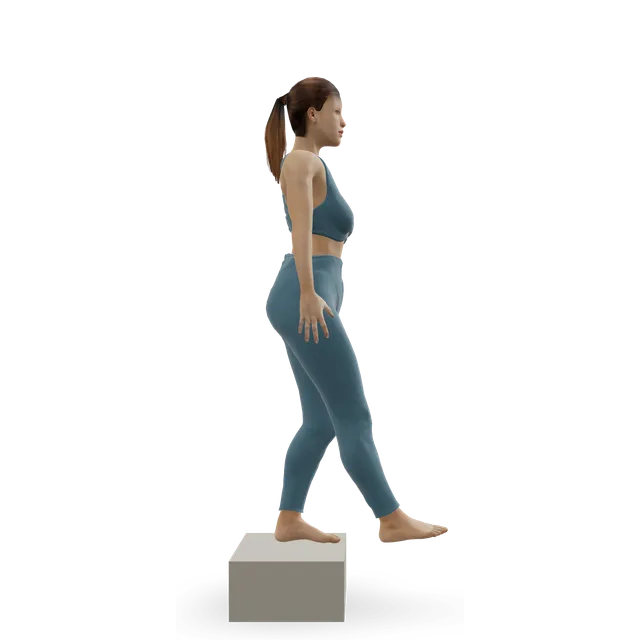
Step-up demonstrated on the 3D figure3D demoStep-upBeginner · A step

3 sets of 8 to 10 each leg, a low step first · As in our knee pain guide

Easier: Low step-up · Harder: Dumbbell step-up

Wall sit demonstrated on the 3D figure3D demoWall sitBeginner · A wall

4 holds of 20 to 45 s at a comfortable depth · As in our knee pain guide. Breathe normally through the hold

Easier: Straight-leg raise · Harder: Spanish squat (band squat hold)

Single-leg stand demonstrated on the 3D figure3D demoSingle-leg standBeginner · A wall

3 holds of 20 to 30 s each leg, a hand near a wall · As in our knee pain guide

Easier: Tandem stance and heel-to-toe walk · Harder: Single-leg reach matrix

Move on when: Our suggestion: no extra swelling the next morning after any session for 2 weeks, walking without a limp, and the knee bends and straightens nearly fully.

Follow along: a timer, a cue and the next move, one step at a time.
Stage 3

Strengthen, then stairs, kneeling and sport come back

From about week 6, two days a week and ongoing, while stairs, kneeling, running and sport come back by the written steps below.

Split squat demonstrated on the 3D figure3D demoSplit squatIntermediate · No equipment

3 sets of 8 each leg, holding a support · As in our knee pain guide; pad the back knee

Easier: Bodyweight squat · Harder: Reverse lunge

Dumbbell goblet squat demonstrated on the 3D figure3D demoDumbbell goblet squatIntermediate · A dumbbell

3 sets of 8 to 12, deeper as it allows · As in our knee pain guide

Easier: Bodyweight squat · Harder: Barbell front squat

Patrick step-down demonstrated on the 3D figure3D demoPatrick step-downIntermediate · A step

3 sets of 8 to 10 each leg · As in our knee pain guide

Easier: Bodyweight squat · Harder: Skater squat

Single-leg calf raise from a step demonstrated on the 3D figure3D demoSingle-leg calf raise from a stepIntermediate · A step + A wall

3 sets of 10 each leg · As in our knee pain guide; face the step and keep a hand on a rail

Easier: Slow calf raise · Harder: Single-leg pogo hops

Treadmill walking demonstrated on the 3D figure3D demoTreadmill walkingBeginner · Cardio machine

Build to 30 minutes on most days · Editorial, as in our inner knee pain guide's last stage; walking outdoors counts the same

Harder: Treadmill jogging

Single-leg hop and stick demonstrated on the 3D figure3D demoSingle-leg hop and stickIntermediate · No equipment

3 sets of 5 each leg · As in our knee pain guide: only if you're going back to sport, and after an injury only once you've been cleared, as the move page says

Easier: Standing broad jump with stuck landing · Harder: Alternate-leg bounding

Move on when: Our suggestion: stairs, kneeling and your usual activities don't bring the swelling back by the next morning. If the knee swells again after a busy day, drop back a stage for a few days rather than stopping, and see a GP if it keeps happening.

Follow along: a timer, a cue and the next move, one step at a time.

What to change for now

What to do for now (written steps)

Our 3D figure can't show these changes. They come from the NHS, NHS inform and the AAOS unless marked as our suggestion.

  • 1. After an injury, for the first 2 to 3 days: protect the knee, rest from what hurts, use ice for up to 20 minutes every 2 to 3 hours, a compression bandage in the day, and raise the leg on a pillow; no heat, alcohol or massage for the first couple of days (the NHS). A bandage or tubular support should fit well but not be too tight, and raising the leg above the level of your heart helps significant swelling (NHS inform).
  • 2. A swollen knee without an injury: move the knee gently for 10 to 20 seconds every hour, raise the leg when you rest, and avoid long spells on your feet for the first day or two (NHS inform); put as little weight on it as you can at first (the NHS).
  • 3. Ice or heat: after an injury, ice wrapped in a towel; for an arthritic knee, whichever helps, for no more than 20 minutes at a time, and not if you have problems with circulation or feeling (NHS inform).
  • 4. A gout attack: take your medicine early, rest and raise the leg, use an ice pack, keep the bedclothes off the joint, and don't put pressure on it (the NHS).
  • 5. Bursitis on the kneecap: no kneeling on it, ice for about 10 minutes every few hours, and extra cushions around the knee at night (the NHS); cycling or a cross-trainer instead of kneeling work (the AAOS).
  • 6. Walking aids: a stick or crutches while it's very swollen, relying on them less as it settles (NHS inform).
  • 7. After a knee replacement: raise the leg as much as possible, don't stand for long periods, and don't sleep with a pillow under the knee (the NHS).

Sources 20, 21, 22, 9, 6, 11, 12, 32

Stairs, kneeling and sport come back (written steps)

No trial has tested how to bring these back after a swollen knee. These steps are our suggestion unless a source is named.

  • 1. Stairs: good leg first going up, sore leg first coming down, with the rail (NHS inform), until the swelling has settled and step-ups are comfortable.
  • 2. Kneeling: last, on a cushion, once the knee bends fully and the swelling hasn't come back after a week of normal activity.
  • 3. Running and sport: after an injury, the ACL, meniscus or kneecap guide's return-to-sport checks; otherwise, walking for 30 minutes without swelling the next morning before you jog.
  • 4. If it swells again: drop back a stage for a few days; swelling that keeps coming back needs a GP.

Source 22

Positions to swap, and why

Habit or positionWhy it mattersInstead
Heat, a hot bath, alcohol or massage in the first days after an injuryThe NHS advises avoiding them for the first couple of days, to help stop swelling.Ice wrapped in a towel, compression and raising the leg.
Keeping the knee completely stillSwelling switches the thigh muscle off, and NHS inform advises moving the knee every hour.Thigh tightening every hour.Try: Quad set (static quads)
Standing or sitting for long with the leg downNHS inform advises raising the leg and avoiding long periods on your feet; after a knee replacement, the NHS says don't stand for long.Raise it when you rest and keep the ankle moving.Try: Ankle circles
A bandage or support so tight it hurts, or left on overnightNHS inform says it should fit well but not be too tight; taking it off at night is our caution.A firm but comfortable bandage in the day.
Kneeling on a swollen kneecapThe NHS says avoid pressure on bursitis.Cushions and breaks from kneeling, or a different task.
Bedclothes pressing on a hot, gouty kneeThe NHS says keep the bedclothes off the joint.A pillow either side to hold the duvet up (our suggestion).
Insisting on having it drainedIn one trial the relief lasted about a week, because the fluid came back, and draining is mainly a test.Treat the cause, and let the clinician decide whether a sample is needed.
Steroid injections every few months as the planNICE says they give 2 to 10 weeks' relief, and in one trial repeated injections led to more cartilage loss with no less pain.Exercise, and weight loss if you need it, as the core.
Running or jumping on a knee that swells after each sessionThe next-morning swelling check says the load is too much (our suggestion).Cycling or walking while strength builds.Try: Recumbent exercise bike
Stretching or rubbing a swollen, throbbing calfIt can be a clot, which needs a same-day check rather than exercise.See the warning signs.

Routines to follow

More moves for this area

Questions people ask

What causes a swollen knee?

After an injury, usually bleeding inside the joint from a torn ligament (often the ACL), a dislocated kneecap or a break, or a meniscus tear. Without an injury, common causes are an arthritis flare, a swollen bursa on the kneecap or a Baker's cyst behind the knee; a hot, red knee can be gout, pseudogout or an infection.

My knee swelled up straight after a fall or a twist: what does that mean?

Swelling within minutes to a few hours usually means bleeding inside the joint, a clinical review says; in 1,145 knees that bled after an injury, half had a torn ACL, and many had a meniscus tear too. Go to A&E if it has changed shape, swelled very quickly or you felt a pop or snap, and get advice from NHS 111 if it swelled straight away after a twist.

Why is my knee swollen with no injury?

From mid-life, a common reason is a flare of osteoarthritis; a soft swelling on the kneecap is usually bursitis, and a lump behind the knee a Baker's cyst. A hot, red, very painful knee without an injury can be gout, pseudogout or an infection, and needs checking the same day.

My knee is hot and swollen: is it serious?

It can be. A hot, red, swollen knee with a high temperature or feeling unwell can be an infected joint, which needs an urgent GP appointment or NHS 111 the same day. Gout and pseudogout look similar, and testing fluid from the knee is how they're told apart.

Should I use ice or heat on a swollen knee?

After an injury, ice wrapped in a towel for up to 15 to 20 minutes, a few hours apart, and no heat for the first couple of days. For an arthritic knee, use whichever helps, for up to 20 minutes, but not if you have problems with circulation or feeling.

Should I rest a swollen knee or keep it moving?

Both: rest it from what makes it worse, but keep it moving. NHS inform suggests moving the knee gently for 10 to 20 seconds every hour and raising the leg when you rest. Swelling switches the thigh muscle off, so thigh tightening starts early.

Should a swollen knee be drained?

Not routinely. Draining is mainly a test for infection or crystals, and in one trial of 167 people the relief lasted only about a week, because the fluid came back. For some attacks of pseudogout, draining with a steroid injection is the treatment.

Will a steroid injection help?

For an arthritic knee, it can ease pain for about 2 to 10 weeks, which can help you get going with exercise. In one trial, injections every 3 months for 2 years led to more cartilage loss without less pain, so they aren't a long-term plan.

How long does a swollen knee take to go down?

It depends on the cause: a gout attack usually lasts 1 to 2 weeks untreated, a pseudogout attack several days to 2 weeks, and bursitis that isn't infected a few weeks. A Baker's cyst can take months, and after an injury it depends on what was hurt. No one can promise a date.

My knee and calf are both swollen: what should I do?

Get a same-day check: a swollen, throbbing calf can be a clot or a burst Baker's cyst. Call 999 if you're also breathless or have chest pain.

Can I exercise with a swollen knee?

Gentle movement and thigh exercises, yes, unless the knee is hot, you have a fever or you've just injured it badly. Build up only as fast as the knee allows: if it's more swollen the next morning, drop back a step.

When should I see a doctor about a swollen knee?

Urgently after an injury if the knee has changed shape, you felt a pop or you can't put weight on it, and for a hot, red knee with a fever. See a GP for a knee that is hot, swollen or tender without an injury, swelling that keeps coming back, or several swollen joints.

Related exercise guides

Other pain guides

Sources

  1. Bunt 2018 · Knee pain in adults and adolescents: the initial evaluation (clinical review, Am Fam Physician)
  2. Olsson 2016 · What MRI found in 1,145 knees that bled into the joint after an injury (cohort study, Osteoarthritis Cartilage)
  3. NHS · Septic arthritis
  4. Margaretten 2007 · Does this adult have septic arthritis? 14 studies, 6,242 people (systematic review, JAMA)
  5. NICE · Gout: diagnosis and management (NG219, guideline)
  6. NHS · Gout (past its review date: reviewed August 2023, review due August 2026)
  7. Arthritis UK · Acute calcium pyrophosphate (CPP) crystal arthritis
  8. Zhang 2011 · European League Against Rheumatism (EULAR) recommendations for calcium pyrophosphate deposition, part I: terms and diagnosis (expert recommendations, Ann Rheum Dis)
  9. NHS · Knee pain
  10. NHS · Rheumatoid arthritis: symptoms (past its review date: reviewed March 2023, review due March 2026)
  11. NHS · Bursitis
  12. AAOS (OrthoInfo) · Prepatellar (kneecap) bursitis
  13. NHS · Baker's cyst
  14. Spencer 1984 · Fluid in the knee switches off the thigh muscle: an experiment in 10 volunteers (experimental study, Arch Phys Med Rehabil)
  15. Rice 2010 · Why the thigh muscle switches off after knee injury, surgery and arthritis (review, Semin Arthritis Rheum)
  16. Bachmann 2004 · The Ottawa knee rule for ruling out a broken bone: 6 studies of 4,249 adults (systematic review, Ann Intern Med)
  17. NHS · DVT (deep vein thrombosis)
  18. NICE · Venous thromboembolic diseases: diagnosis, management and thrombophilia testing (NG158, guideline)
  19. Paschos 2014 · Draining or not draining a recently swollen knee in 167 people (RCT, Knee Surg Sports Traumatol Arthrosc; abstract)
  20. NHS · Sprains and strains
  21. NHS inform · Soft tissue injury advice
  22. NHS inform · Knee problems
  23. National Institute for Health and Care Excellence (NICE) · Osteoarthritis in over 16s: diagnosis and management (NG226, guideline)
  24. Jüni 2015 · Steroid injections for knee osteoarthritis: 27 trials, 1,767 people (Cochrane systematic review)
  25. McAlindon 2017 · Steroid or salt-water injections every 3 months for 2 years in 140 people with knee arthritis (RCT, JAMA)
  26. Zhang 2011 · EULAR recommendations for calcium pyrophosphate deposition, part II: management (expert recommendations, Ann Rheum Dis)
  27. Lawford 2024 · Exercise for knee osteoarthritis: 139 trials, 12,468 people (Cochrane systematic review)
  28. Arthritis UK · Gout
  29. Thomeé 1997 · Treating kneecap pain in 40 young women with a pain-monitoring model (trial, Phys Ther)
  30. NHS inform · Exercises for knee problems (including how to tell if you're exercising at the right level)
  31. Smith 2017 · Should exercise be painful? 7 trials of long-lasting muscle and joint pain (systematic review and meta-analysis, Br J Sports Med)
  32. NHS · Knee replacement: recovery
  33. NHS · Dislocated kneecap
  34. NHS · Pulmonary embolism
  35. NHS · Hip pain in children (irritable hip)
  36. NHS · Growing pains
  37. NHS · Symptoms of bone cancer
  38. NHS · Sciatica

Exercise education, not a diagnosis or treatment plan. It is written from the guidelines and studies listed above; review by a clinician is pending. If your pain follows an injury, is severe, is getting worse, or comes with any warning sign listed on this page, get it assessed. Health disclaimer.