Yoga guide

Restorative yoga: supported poses, how a class works, and what it can do

Restorative yoga is rest in poses so well supported by bolsters, blankets and blocks that no muscle has to work. A session uses a handful of poses held for several minutes each (10 to 15 minutes in the largest trial), often with your eyes covered, and ends with a long rest. It isn't a stretch class or a workout: it's practice at relaxing.

In small trials people found it easy to stick with, and it helped with work stress and mood in some groups. But in the largest trial, which ran for a year, a stretching class did as well or better for stress, and the claims that it resets your nervous system haven't been tested.

This guide covers how a class works, the props, how it differs from yin yoga and yoga nidra, what the trials found and who should adapt it, with a 45-minute sequence and every pose shown in 3D.

The short version

Rest in fully supported poses

Props hold you up so that no muscle has to work. The largest trial describes long rests in supported poses, using props to remove all muscular effort, and the method's own school describes gentle, opening poses rather than stretches.

Sources 1, 2

A few long holds

Trials used 5 to 10 poses a session, and the largest held most poses for 10 to 15 minutes. In another trial, nurses practised the poses at home for 5 to 15 minutes at a time.

Sources 1, 3, 4

Stress: mixed evidence

Four weeks of short home sessions lowered stress scores in 20 night-shift nurses. But in the largest trial, which ran for a year, a stretching class lowered stress, and the stress hormone cortisol, more than restorative yoga did.

Sources 4, 5

Blood sugar: one trial, a small difference

In 180 adults with the metabolic syndrome, a year of restorative yoga lowered fasting blood sugar slightly more than stretching did, with no difference in anything else measured.

Source 1

It's rest, not exercise

Lying still uses about 1 MET (metabolic equivalent: the energy you use at rest), so restorative yoga doesn't count toward your 150 minutes of activity a week. In a weight-loss trial, the diet did the work, whichever yoga style people did.

Sources 6, 7

Some people should adapt it

With glaucoma, change the poses that put your head below your heart, and in later pregnancy avoid lying flat on your back for more than a few minutes. The safety section says how.

Sources 8, 9, 10

What restorative yoga is

Rest, not stretch

The largest trial defines restorative yoga as "prolonged periods of rest in supported poses using props to remove all muscular effort". The method's own school calls it a practice focused on deep relaxation in silence, "using props to support the body in gentle, opening poses rather than stretches".

The British Wheel of Yoga (BWY) describes yin and restorative yoga as static, floor-based practices where you might spend several minutes in a posture, supported by props. A yin yoga school describes restorative yoga as a very gentle practice for people who are injured, stressed or ill, which "does not try to stress the tissues deeply".

Sources 1, 2, 11, 12

Where it comes from

A trial paper traces restorative yoga to B.K.S. Iyengar, who experimented with props so that his students could practise without strain, and says the teacher Judith Hanson Lasater later expanded it. Her own site says she has taught yoga since 1971, and her school's teacher training covers ten core restorative poses. The largest trial took Iyengar and Iyengar-influenced poses from her book.

Sources 4, 13, 14, 1

How a class runs

In the largest trial, 90-minute classes used five main resting poses with variations (forward and backward bends, twists, and inverted and reclining positions), mostly in silence, with the eyes covered by a towel or an eye pillow. A military trial used 5 to 10 poses in an hour, with slow transitions and guided breathing. A sleep trial in cancer survivors finished its gentle hatha classes with supported reclining bound angle, supported child's pose, a lying twist, supported bridge, legs up the wall and a final rest.

A yin yoga school describes restorative classes as small, perhaps four to twelve people, so the teacher can help set up each pose, and quieter than other styles.

Sources 1, 3, 15, 12

Breathing

In the nurses' trial, people breathed slowly and gently through the nose with the mouth closed. You don't need breath holds or special techniques (our suggestion).

Source 4

How hard it is

No one has measured restorative yoga's energy cost, but its poses are lying or sitting still. The Compendium of Physical Activities rates lying quietly at 1.0 MET and meditating at 1.0, and the World Health Organization (WHO) counts anything up to 1.5 METs while sitting or lying as sedentary. In a measured vinyasa class, heart rate was lowest in the opening sequence and the closing restorative one. In energy terms, restorative yoga is rest, which is its purpose.

Sources 6, 16, 17

Props, and what to use at home

What the method uses

Lasater's site lists, for home practice, a mat, a round and a rectangular bolster, 5 blankets, 2 foam blocks, a strap, a yoga chair, a foam roller, a sandbag and an eye bag. Her teacher training asks for 2 bolsters, an eye cover, 2 blocks and 6 firm blankets. You don't need all of it to start.

Sources 18, 14

Household swaps

The BWY notes that plenty of household items can double as yoga props. Our suggestions:

  • A bolster: two firm pillows, or a sofa cushion, wrapped in a blanket.
  • Blankets: folded blankets or large towels, for under your head, knees and hips.
  • Blocks: thick books or firm cushions.
  • A strap: a belt or long scarf.
  • An eye cover: a folded flannel or an eye mask.

Source 11

Setting up a pose

Add support until nothing aches or stretches: under your knees, under your head and under anything that hangs in the air. Cover yourself, because you cool down when you're still, and set a timer so you can stop watching the clock (our suggestions).

Restorative, yin and yoga nidra

Restorative yoga: rest, with no stretch

Props hold you so your muscles can switch off, and there's no stretch at all. Poses are held for several minutes, often with the eyes covered.

Sources 1, 2

Yin yoga: a long, gentle stretch

Yin holds a stretch at your "first stopping point" for 1 to 10 minutes, in the yin school's teaching. The same school says yin challenges the student and deeply stresses the tissues, while restorative yoga doesn't. Our yin yoga guide covers it.

Sources 19, 12

Yoga nidra: guided attention, lying still

Yoga nidra is done in one position, usually lying on your back. A review describes a structured seven-step process: preparation, a resolve, moving your attention around the body, breath awareness, relaxing feelings and emotions, visualisation and a close. Our yoga nidra guide covers it.

Source 20

They combine well

A restorative session can end with a guided yoga nidra in the final rest, and yin and restorative poses mix well in a slow evening session (our suggestions). Our types of yoga guide compares restorative and yin yoga with the other styles.

What the evidence says

How much research there is

A search of a large research database found 12 records with restorative yoga in the title and 17 more that mention it in the summary. Every study of restorative yoga alone is small, from 14 to 180 people, and only one compared it with an equally attentive class over a year.

Sources 21, 1

StressMixed evidence

In 20 night-shift nurses in Japan, 4 weeks of restorative poses at home, for about 5 to 15 minutes at least 3 times a week, lowered work-stress scores from 65.7 to 56.1, against 64.1 with their usual ways of relaxing. No one dropped out.

But in the year-long trial in adults with the metabolic syndrome, the stretching class lowered perceived stress (by 2.0 points more at a year) and cortisol (at 6 months) more than restorative yoga did. The authors credit the group support of the more interactive stretching classes. A study of 25 medical students, who felt more relaxed after weekly classes, had no comparison group.

Sources 4, 5, 22

Blood sugar and the metabolic syndromeEmerging evidence

The metabolic syndrome is a cluster of raised blood pressure, blood sugar, blood fats and waist size. In 180 underactive adults with it, 48 weeks of restorative yoga lowered fasting blood sugar by 0.35 millimoles per litre, against 0.03 with stretching. Nothing else differed: not long-term blood sugar, blood fats, insulin, blood pressure or belly fat. The authors call restorative yoga marginally better than stretching for fasting glucose. An earlier pilot in 26 adults found a trend toward lower blood pressure that wasn't significant.

Sources 1, 23

Mood in cancerMixed evidence

In small studies of women with breast or ovarian cancer (33 to 51 people), restorative classes improved depression, mental health or positive mood, against a waiting list or with no comparison group. Results for tiredness and sleep were inconsistent.

Sources 24, 25, 26

Gentler than vigorous yoga, and easier to keep upEmerging evidence

In 35 sedentary breast and ovarian cancer survivors, restorative yoga three times a week was compared with vigorous, vinyasa-based yoga. More people kept going with restorative yoga (85% against 73% attended enough classes), fewer reported mild to moderate pain (10% against 40%), and thinking skills were better at 24 weeks. Most people who were asked declined to take part (175 of 226), so the volunteers may not represent everyone.

Sources 27, 28

Cancer guidelines on yogaStrong evidence

US cancer guidelines from the American Society of Clinical Oncology (ASCO) and the Society for Integrative Oncology say yoga may also be recommended for tiredness after cancer treatment, and recommend yoga for anxiety during treatment and for low mood during and after it. They mean yoga in general, not restorative yoga in particular. Our exercise and cancer guide has more.

Sources 29, 30

Sleep: one large trial of a combined programmeEmerging evidence

In 410 cancer survivors with poor sleep, 4 weeks of twice-weekly 75-minute classes mixing gentle hatha and restorative poses improved sleep quality more than usual care, and sleeping-pill use fell by 21% a week, against a 5% rise. There was no comparison class to match the attention, and the two styles can't be separated. We found no trial of restorative yoga alone for sleep.

Sources 15, 21

Sticking with itEmerging evidence

In the year-long trial, people attended more restorative classes than stretching classes (67% against 52%) and did more home practice in the first 6 months (85% against 67%), and in cancer survivors more people kept going with restorative than with vigorous yoga. That matters most for people who are exhausted, unwell, older or new to exercise (our reading).

Sources 1, 27

WeightEmerging evidence

In 50 adults with obesity on a 6-month diet and behaviour programme, those who added restorative hatha yoga lost about as much weight as those who added vinyasa (3.4 against 3.8 kg). The diet did the work, and nearly half found the hour-long sessions a barrier.

Source 7

Hot flushesMixed evidence

In 14 women after the menopause, 8 weekly 90-minute classes cut hot flushes by about 31% a week, with no comparison group and no harms reported. Our exercise and menopause guide covers the options with better evidence.

Source 31

What it can't promiseMixed evidence

The method's school says restorative yoga activates the calming (parasympathetic) branch of the nervous system and may lower blood pressure and improve fertility, immunity and digestion. No restorative trial we found has tested these. In the nurses, blood pressure and pulse fell a little over a session but not significantly, and in the year-long trial cortisol fell more with stretching.

Sources 2, 21, 4, 5

How long, and how often

What the trials used

Trials used classes of 60 to 90 minutes, once to three times a week, for 4 to 48 weeks. The largest asked for home practice of at least 30 minutes three times a week; the nurses practised at home for about 5 to 15 minutes at least three times a week.

Sources 1, 4, 3, 15, 25, 28

Our editorial starting point

Two to four poses for 5 to 10 minutes each, 20 to 30 minutes in all, 2 or 3 times a week or on most evenings, or a weekly class of 45 to 60 minutes. Finish with about 10 minutes in corpse pose. These hold times are our suggestion, shorter than the largest trial's 10 to 15 minutes. Set a timer, so you can stop watching the clock and don't sleep for an hour.

Pair it with activity

The NHS recommends 150 minutes of moderate activity a week and strength work on 2 days. Restorative yoga counts toward neither, so pair it with walking and strength exercises.

Sources 32, 16

How to set up supported reclining bound angle

The set-up follows the supported bound angle of the nurses' trial (Miyoshi 2019) and the bolster, belt and blankets of the cancer sleep trial (Mustian 2013). The 5 to 10 minutes is our suggestion: longer than the move page's starting point of 2 to 5 minutes, and shorter than the 10 to 15 of the largest trial (Kanaya 2014).

  1. Lay a bolster, or two firm pillows wrapped in a blanket, lengthwise on your mat, with a folded blanket at the far end for your head.
  2. Sit with your lower back against the near end of the bolster, the soles of your feet together and your knees falling out to the sides.
  3. Slide a cushion or folded blanket under each thigh, so your knees are held and nothing stretches in your groin.
  4. Lie back along the bolster, with your head on the folded blanket a little higher than your chest.
  5. Rest your arms out to the sides, palms up, on cushions if your shoulders lift. Cover your eyes with a folded flannel if you like, and put a blanket over you.
  6. Breathe slowly through your nose, and stay for 5 to 10 minutes.
  7. To come out, press your knees together with your hands, roll onto your side, pause for a few breaths, then sit up slowly.

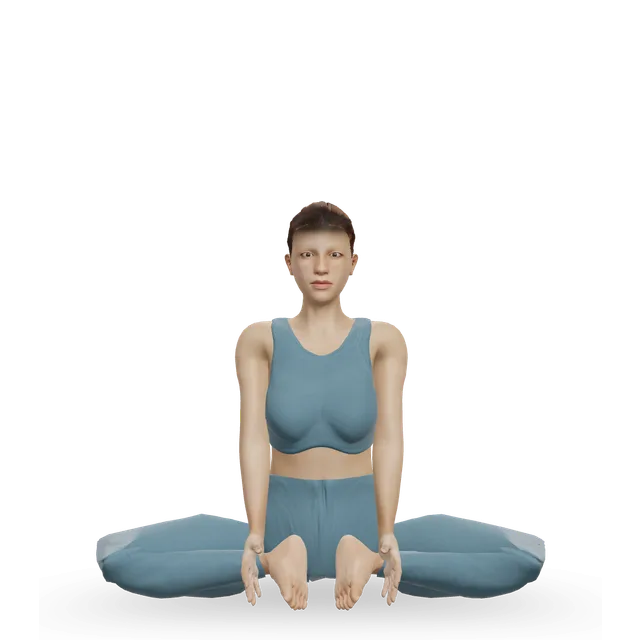
See the movement on the 3D figure: Reclining bound angle pose (Supta Baddha Konasana)

The supported poses

Set each pose up with props until nothing stretches or aches, then stay for 3 to 10 minutes (our suggestion); supported bridge has its own page but no 3D demo yet, and crocodile breathing is a face-down rest if you'd rather not lie on your back.

Breathing to settle

Breathe slowly and gently through your nose, as in the nurses' trial, for 3 to 5 minutes as you arrive (our suggestion), and with glaucoma skip any practice with a breath hold, such as 4-7-8 breathing.

Sessions to follow

Start with the 45-minute restorative sequence. The bedtime routine is a shorter restorative-style wind-down with briefer holds, and the chair yoga workout suits you if getting down to the floor is hard.

Restorative yoga sequence: 45 minutes of supported rest

A 45-minute restorative yoga sequence: five fully supported poses held for 4 to 10 minutes each, with slow breathing and a long final rest.

45 minBeginner6 movesFirm cushion, A wall

Bedtime stretch routine

A slow, 10-minute floor routine to unwind before sleep: child's pose, twists, happy baby and slow breathing.

10 minBeginner7 movesFirm cushion, A wall

Yin yoga for beginners

A 35-minute yin-style session: seated and lying poses held for 2 to 4 minutes with slow breathing, finishing with legs up the wall and a long rest.

35 minBeginner9 movesA wall

Breathing exercises to relax

A 6-minute breathing routine: slow breathing, crocodile breathing, alternate nostril breathing, box breathing and 4-7-8 breathing.

6 minBeginner5 movesNo equipment

Stress relief workout: a 12-minute move, loosen and breathe reset

A 12-minute reset for stressful days: 4 minutes of brisk movement, 3 minutes to loosen your neck, shoulders and back, then 5 minutes of slow breathing.

12 minBeginner10 movesA bench or box, A wall

Trauma-sensitive yoga: a gentle practice where you choose

A gentle 20-minute yoga practice, sitting and standing with your eyes open, where every pose is optional and you can stop at any point.

20 minBeginner11 movesA bench or box

Chair yoga for seniors

A free 20-minute chair yoga class for older adults: slow breathing, gentle seated stretches and twists, standing poses holding the chair, and a calm finish.

20 minBeginner18 movesA bench or box, Something with weight

Who should adapt it

GlaucomaEmerging evidence

Supported bridge and legs up the wall put your head below your heart. The American Academy of Ophthalmology counts bridge pose as an inversion and advises getting your doctor's OK before any pose that places your head below your heart. In a lab study, legs up the wall raised eye pressure within a minute, from about 17 to 21 millimetres of mercury, and it settled within 2 minutes of sitting up.

Ask your eye doctor before legs up the wall. If you do it, keep your hips on the floor and rest your head on a folded blanket, or stay in reclining bound angle instead, and skip supported bridge (our suggestions, in line with our glaucoma guide).

Sources 8, 33, 9

PregnancyStrong evidence

In later pregnancy, the NHS advises avoiding any activity that involves lying flat on your back for more than a few minutes, and the US National Center for Complementary and Integrative Health (NCCIH) advises avoiding poses that involve long periods of being still or lying on your back. From the end of the first trimester, recline on a bolster with your chest well above your hips, or rest on your side with pillows between your knees and under your bump. If you feel dizzy, sick or unwell lying down, roll onto your side. Our pregnancy yoga guide has the details.

Sources 10, 34

Getting up after long holdsStrong evidence

The NHS advises people with low blood pressure to move slowly from lying to sitting to standing. After long lying holds, roll to your side, pause, sit for a few breaths, then stand, especially if you take medicines that lower blood pressure.

Source 35

OsteoporosisStrong evidence

The UK consensus on exercise for osteoporosis advises modifying or avoiding sustained, repeated or end-range forward bending. In child's pose, put the bolster lengthwise under your chest so your back stays long, skip supported seated forward folds, and choose reclining and side-lying poses.

Source 36

Drowsiness and nervesMixed evidence

In a case report, a woman who fell asleep for 4 hours in a seated forward bend after taking a strong painkiller and a sedating antidepressant damaged nerves in both legs. Don't do long holds when you're drowsy from alcohol or sedating medicines, set a timer, and come out at once for tingling or numbness.

Source 37

Very mobile jointsStrong evidence

The NHS advises people with joint hypermobility not to overextend their joints just because they can. The poses are meant to be supported, not stretched: support your thighs in reclining bound angle so your hips don't hang at the end of their range.

Source 38

Panic or flashbacks

Covered eyes and long stillness don't suit everyone. If they bring on panic or flashbacks, keep your eyes open, lie where you can see the door, or sit up and look around the room; our yoga nidra guide and trauma-sensitive yoga session have more.

When to stop, and when to get help

Call 999

For chest pain that feels tight or like squeezing, or that spreads to your arms, neck or jaw, or chest pain with feeling sick or a racing, slow or fluttering heartbeat. In the US, call 911.

Source 39

Check before you start

The NHS advises getting advice from a health professional before following an exercise video if you have a health problem, an injury or any symptoms, have had a recent health event such as a heart attack or operation, or are pregnant or have recently given birth. NCCIH advises people who are pregnant, older or have a health condition to talk to both their doctor and their yoga teacher about their needs.

Sources 40, 34

Stop the pose

Come out of a pose for sharp or increasing pain, tingling, numbness or dizziness, or if it hurts as you come out: the yin school's rule is that pain may mean you went too deep or stayed too long. Add more support and try again, or leave the pose out.

Source 19

See a GP

If tiredness, poor sleep or stress isn't improving after a few weeks of looking after yourself, or comes with weight loss, low mood or anything new. Our exercise for stress and exercise for sleep guides have more on when to get help.

Myths

"Restorative yoga resets your nervous system"Mixed evidence

The method's school says it activates the calming (parasympathetic) nervous system. No restorative trial we found measured that, blood pressure and pulse didn't change significantly over a session in nurses, and cortisol fell more with stretching in the year-long trial. It's relaxing, which is worth having, but "reset" is marketing.

Sources 2, 21, 4, 5

"It boosts fertility, immunity and digestion"Mixed evidence

These are among the benefits the method's school lists. No restorative trial has tested them.

Sources 2, 21

"Restorative yoga is the same as yin yoga"Strong evidence

Yin holds a stretch at your first stopping point; restorative yoga supports you so there's no stretch. The yin school itself says they are different practices.

Sources 19, 12

"Restorative yoga is a workout that helps you lose weight"Emerging evidence

Its energy use is close to lying still, and in a weight-loss trial the yoga style made no difference: the diet did the work.

Sources 6, 7

"It's just lying around, so it can't do anything"Emerging evidence

Small trials found benefits for mood in cancer, work stress in nurses and fasting blood sugar, and people kept it up better than stretching or vigorous yoga. Modest, but not nothing.

Sources 25, 4, 1, 27

"Restorative yoga is always safe"Emerging evidence

It's gentle, but head-down poses matter with glaucoma, lying flat matters in later pregnancy, and falling asleep in a forward fold after sedating medicines has damaged nerves.

Sources 8, 9, 10, 37

Questions people ask

What is restorative yoga?

A style where props such as bolsters, blankets and blocks support you completely, so you can rest in each pose for several minutes with no stretching or effort. Classes use a handful of poses, often with your eyes covered, and finish with a long rest.

How long do you hold restorative yoga poses?

Usually several minutes. The largest trial held most poses for 10 to 15 minutes, and nurses in another trial practised at home for 5 to 15 minutes at a time. Our sequence holds each pose for 4 to 10 minutes, which is our suggestion.

What's the difference between restorative and yin yoga?

Yin holds a gentle stretch for 1 to 10 minutes; restorative yoga props you so there's no stretch at all. Both are slow and floor-based, and our types of yoga guide compares them.

Is restorative yoga the same as yoga nidra?

No. Restorative yoga is a series of supported poses, and yoga nidra is a guided relaxation in seven steps, done lying in one position. A restorative session can end with a yoga nidra in the final rest.

What props do I need for restorative yoga?

A bolster or two firm pillows, three to five folded blankets, a couple of cushions or blocks, a strap and an eye cover. Household items work well; add support until nothing aches or stretches.

Does restorative yoga help with stress?

Possibly, but the evidence is mixed. Night-shift nurses had lower stress scores after 4 weeks of short home sessions, but in a larger, year-long trial a stretching class lowered stress and cortisol more.

Is restorative yoga good for sleep?

In 410 cancer survivors, a programme combining gentle hatha and restorative poses improved sleep quality and cut sleeping-pill use. No trial has tested restorative yoga alone for sleep, and if insomnia lasts, see a GP.

Is restorative yoga exercise, and will it help me lose weight?

No. It uses about as much energy as lying still, so it doesn't count toward your 150 minutes of activity or your strength days. In a weight-loss trial, the diet did the work, whichever yoga style people did.

Is restorative yoga good for beginners?

Yes: it needs no flexibility or fitness, and in trials people kept it up better than stretching or vigorous yoga. It's a good way to start if you're tired, unwell or new to exercise, alongside some walking.

Can I do restorative yoga when pregnant?

Usually yes, with changes. In later pregnancy avoid lying flat on your back for more than a few minutes, so recline on a bolster or rest on your side, and tell your midwife and your teacher that you're pregnant.

Is restorative yoga safe with glaucoma or osteoporosis?

With glaucoma, ask your eye doctor first, and skip or change poses that put your head below your heart, such as supported bridge and legs up the wall with your hips raised. With osteoporosis, keep forward folds short and supported, and choose reclining poses.

How often should I do restorative yoga?

Trials used classes once to three times a week, or short home sessions at least 3 times a week. Our starting point is 20 to 30 minutes, 2 or 3 times a week or on most evenings.

Sources

  1. Kanaya 2014 · Restorative yoga or stretching for the metabolic syndrome in 180 adults: the PRYSMS trial (RCT, J Diabetes Complications)
  2. Restorative Yoga Teachers Directory (Lasater's school) · What is restorative yoga?
  3. Groessl 2022 · Hatha or restorative yoga for back and neck pain in 49 military personnel (feasibility RCT, Glob Adv Health Med)
  4. Miyoshi 2019 · Restorative yoga for work stress in 20 night-shift nurses (randomised crossover trial, J Occup Health)
  5. Corey 2014 · Restorative yoga or stretching: cortisol, stress and mood over a year in the PRYSMS trial (RCT, Psychoneuroendocrinology)
  6. Compendium of Physical Activities 2024 · Inactivity table
  7. Jakicic 2021 · Restorative hatha or vinyasa yoga in a weight-loss programme: 50 adults (randomised trial, Obesity)
  8. American Academy of Ophthalmology 2015 · Is it alright to do inverted yoga positions if you have glaucoma? (Ask an Ophthalmologist)
  9. Jasien 2015 · Eye pressure in four head-down yoga poses, in people with and without glaucoma (lab study, PLoS One)
  10. NHS · Exercise in pregnancy
  11. British Wheel of Yoga · Finding your yoga
  12. Clark 2012 · Yin yoga or restorative yoga? (yinyoga.com, a yin yoga school)
  13. Judith Hanson Lasater · Official site and biography
  14. lasater.yoga · Relax and Renew yearlong training: the ten core restorative poses
  15. Mustian 2013 · Gentle hatha and restorative yoga for sleep in 410 cancer survivors: the YOCAS trial (RCT, J Clin Oncol)
  16. Bull 2020 · World Health Organization 2020 guidelines on physical activity and sedentary behaviour (BJSM)
  17. Cheruka 2023 · Oxygen use and heart rate in different vinyasa sequences: 40 practitioners (lab study, Int J Yoga Therap)
  18. Judith Hanson Lasater · Props: her list for restorative practice at home
  19. yinyoga.com · What is yin yoga? (a yin yoga school, updated March 2020)
  20. Ghai 2026 · Effects of yoga nidra on stress, anxiety and depression (systematic review and meta-analysis, Ann N Y Acad Sci)
  21. Europe PMC · Records with restorative yoga in the title (12) or only in the abstract (17); none a restorative-only sleep trial (23 October 2026)
  22. Thompson 2023 · Restorative yoga for the well-being of 25 medical students (study without a control group, J Educ Health Promot)
  23. Cohen 2008 · Restorative yoga in 26 adults with the metabolic syndrome (randomised pilot trial, Metab Syndr Relat Disord)
  24. Danhauer 2008 · Restorative yoga for 51 women with ovarian or breast cancer (pilot study without a control group, J Soc Integr Oncol)
  25. Danhauer 2009 · Restorative yoga for 44 women with breast cancer (randomised pilot study, Psychooncology)
  26. Taylor 2018 · Restorative yoga for 33 African-American breast cancer survivors (randomised pilot study, J Racial Ethn Health Disparities)
  27. Lapen 2018 · Restorative or vigorous yoga for 35 sedentary breast and ovarian cancer survivors (feasibility trial, Int J Yoga Therap)
  28. Deng 2022 · Vigorous or restorative yoga and thinking skills in sedentary breast and ovarian cancer survivors (randomised pilot trial, Integr Cancer Ther)
  29. Bower 2024 · Management of fatigue in adult survivors of cancer (ASCO and Society for Integrative Oncology guideline update, J Clin Oncol)
  30. Carlson 2023 · Integrative care of anxiety and depression in adults with cancer (Society for Integrative Oncology and ASCO guideline, J Clin Oncol)
  31. Cohen 2007 · Restorative yoga for hot flushes in 14 postmenopausal women (pilot study, Maturitas)
  32. NHS · Physical activity guidelines for adults aged 19 to 64
  33. Weiner 2019 · Glaucoma and exercise: what to tell your patients (American Academy of Ophthalmology, EyeNet)
  34. NCCIH 2023 · Yoga: effectiveness and safety (US National Center for Complementary and Integrative Health)
  35. NHS · Low blood pressure (hypotension)
  36. Brooke-Wavell 2022 · Strong, steady and straight: UK consensus statement on physical activity and exercise for osteoporosis (BJSM)
  37. Cramer 2013 · Adverse events with yoga: 76 published cases (systematic review of case reports and case series, PLoS One)
  38. NHS · Joint hypermobility syndrome
  39. NHS · Heart attack: symptoms
  40. NHS · Vinyasa flow yoga video, with its exercise safety advice

Exercise education, not a personal prescription, and clinical review of these guides is pending. If you are pregnant, have a health condition such as glaucoma, high blood pressure or osteoporosis, or have had recent surgery, check with a doctor, midwife or physiotherapist before starting, and stop for sharp or increasing pain. Health disclaimer.