Pain guide · Knee pain

Osgood-Schlatter disease: knee pain in active children and teenagers

Osgood-Schlatter disease is pain and swelling at the bony bump just below the kneecap, where the kneecap tendon pulls on a growth area of the shin bone. It mostly affects active 10 to 15 year olds during growth spurts. It isn't dangerous, but it can drag on: in one study more than a third still had pain two years later.

This guide is written for teenagers and their parents. It starts with the warning signs, then gives the best-tested plan: about 4 weeks of cutting back what hurts while keeping the thigh strong, then an 11-step ladder back to sport, with a pain rule that tells you when to move up a step.

When to get help first

Exercise is for pain that has been checked or is clearly mild and settling.

Get urgent medical help if

  • A child or teenager with sudden pain in the hip, thigh or knee, or who is limping or cannot put weight on one leg: ask for an urgent GP appointment or call NHS 111 the same day. Hip problems in children can be felt only in the thigh or knee. In 10 to 16 year olds, a slipped growth plate at the top of the thigh bone can show up as knee or thigh pain with a limp.
  • After a jump, landing or fall: a pop or sudden severe pain at the bump, and the knee will not straighten or take weight, or is badly swollen or has changed shape. Get it checked the same day: the bump itself can break away.
  • A hot, red or swollen knee with sudden severe pain, a very high temperature, or feeling hot, cold or shivery. This can be a joint infection.
  • The knee locks, gives way or clicks painfully. Painless clicking is normal.

See a doctor or physiotherapist if

  • Pain just below the kneecap that keeps coming back with sport, or knee pain that has not improved within a few weeks of cutting back. A GP or physiotherapist can confirm what it is.
  • Any of the NHS reasons to see a GP about a child's leg pain: pain in one leg or one joint, pain in the morning or when walking or taking part in activities, pain bad enough to stop them walking or make them limp, a rash, swelling or unusual bruising on the legs, leg pain with a high temperature, unusual tiredness, or not eating or losing weight.
  • Bone pain that is constant or worse at night, or a lump or swelling that keeps growing.
  • Pain that makes sport no fun, or makes your child want to stop, even after cutting back.

Understand it

What it isStrong evidence

The kneecap tendon attaches to a bony bump at the top of the shin, called the tibial tuberosity. In growing children that bump sits on a growth area of softer cartilage. Repeated pulling from running, jumping, kicking and kneeling irritates it, and the bump can swell and grow. It is usually in one knee, sometimes both.

It is a growth-area overuse problem, in the same family as heel pain in active children (Sever's disease). Despite the word disease, it isn't an infection and it isn't dangerous.

Sources 1, 2, 3

Who gets itStrong evidence

About 1 in 10 adolescents: 9.8% of 956 Brazilian 12 to 15 year olds had it. In Dutch general practice, 3.8 in every 1,000 young people aged 8 to 18 were newly diagnosed each year, more boys (4.9) than girls (2.7). It peaked at age 12 in boys and 11 in girls.

Sources 4, 5

Sport and growthEmerging evidence

Sport is the main link. In a Finnish study, 21% of students who were active in sport at 13 had had it, against 4.5% of inactive students. Girls who specialised in one sport had about 4 times the risk of girls who played several, and young athletes who did more than twice as many hours of organised sport as free play had more serious overuse injuries.

In a Danish study, teenagers with Osgood-Schlatter and pain-free teenagers were all highly active, yet those with it reported long-standing knee pain and poorer knee function that affected sport and quality of life. These are links, not proof of cause.

Sources 6, 4, 7, 8, 9

How it's recognisedStrong evidence

From the story and a tender bump: pain on the bump that is worse during and after sport and when kneeling, sometimes with swelling and a hard lump, and pain when the knee straightens against resistance. X-rays are not needed unless something doesn't fit, such as an injury, a hot swollen knee, night pain or a limp.

Pain at the lower tip of the kneecap in a growing child is a related problem (Sinding-Larsen-Johansson). Pain around or behind the kneecap is runner's knee; the same Danish group used the same cutting-back approach for it in 151 adolescents.

Sources 1, 2, 10, 11

How long it lastsEmerging evidence

Many guides say it settles within months, or once growth finishes (around 14 in girls and 16 in boys), and the bump may stay after the pain has gone. Most do improve, but not always quickly.

In a Danish group followed for 2 years, 37% still had pain from it, and more than 1 in 5 had stopped sport because of knee pain. In another hospital group, 60% of those who replied still had pain at a median of almost 4 years. In a survey of adults treated for it in hospital as teenagers, 85% still had a prominent bump and 73% still had some pain or problems there, and longer, more painful courses went with worse knee health. Only about a third replied, and all had been treated in hospital, so these figures over-represent the hard cases.

In an older follow-up of untreated knees, most people felt no limit on their activity, but 60% still could not kneel without discomfort.

Sources 12, 13, 14, 15, 1, 16

Why it's thought to happenMixed evidence

A common explanation is that bones grow faster than muscles in a growth spurt, so the tendon pulls harder. Tight front-thigh muscles were strongly linked with it in one population study, but a systematic review calls the causes controversial, and Cochrane notes the tight-muscle theory is proposed rather than proven.

Sources 16, 17, 4, 3

What helps, and how strong the evidence is

Cutting back, then building strength: most improved in the main studyEmerging evidence

In 51 adolescents aged 10 to 14, a 12-week programme of cutting back, pain monitoring, strengthening and a step-by-step return to sport was followed by 80% reporting improvement at 12 weeks and 90% at 12 months. Thigh strength rose by about a third, and no one used painkillers at 12 weeks (12% did at the start).

The return to sport was slower: 16% were back by 12 weeks, 67% by 6 months and 69% by a year, though for fewer hours than before, and about 4 in 10 were completely pain-free at 12 weeks and at a year. There was no comparison group, so some of the improvement may be natural recovery. In a later analysis, 89% of those not improved after 4 weeks had improved by a year, so it is worth keeping going.

Sources 10, 18

No treatment has strong trial evidenceStrong evidence

A 2026 Cochrane review found only 3 small randomised trials for Osgood-Schlatter, testing injections or iontophoresis (a medicine passed through the skin with a mild electric current), all with very low certainty. It found no published trial of exercise. A randomised trial of a self-management programme of exercise, education and cutting back has finished, but we found no published results when we checked in October 2026.

Sources 3, 19, 20

Sport doesn't cause lasting damage, but strong pain is a signalEmerging evidence

The American Academy of Orthopaedic Surgeons says taking part in sport will not cause long-term damage, and UK children's physiotherapists say most children can keep going with the right balance of activity and rest. An NHS leaflet adds: don't push into strong pain.

Long, painful courses went with worse knee health in adulthood, which is a reason to manage the load rather than play through high pain.

Sources 1, 2, 16, 14

Stretches and straps: optionalMixed evidence

Stretches for the front and back of the thigh are widely advised, and tight front-thigh muscles are linked with Osgood-Schlatter, but no trial has shown that stretching treats it. No trial has tested straps or braces either. A strap just below the kneecap is fine to try for comfort during sport.

Sources 4, 19, 1, 3

Injections and surgery are rarely neededMixed evidence

Sugar-water (dextrose) injections did better than usual care in one trial of 54 young athletes, but no better than salt-water injections in another, and pooled results are uncertain.

Surgery is kept for pain that persists after growth has finished, usually from a loose fragment of bone. In 107 young Finnish military recruits followed for a median of 10 years after surgery, 87% had no restrictions and 75% were back to their previous level of sport, though only 38% could kneel completely pain-free. Most surgical studies report some complications.

Sources 21, 22, 23, 24, 25

How much pain is OK while you exercise?

Keep it at 2 out of 10 to move up a stepEmerging evidence

Rate the knee from 0 to 10 during activity, straight after, and the next morning. In the tested programme, 0 to 2 is the "OK zone": move up a step on the ladder only when pain stays at 2 or less at all three points, and go one step down if it suddenly gets worse.

Day to day, don't push into strong pain: an NHS leaflet says try not to go over 5. The aim is a dull ache at most, gone soon after sport.

This rule is stricter than the knee pain rule for adults (up to 5 out of 10 is acceptable there), which suits a growth area. It comes from one study without a comparison group and has not been compared with other rules. If pain flares with a growth spurt, go back to the easiest exercises until it settles, then build up again.

Sources 10, 16, 1

The exercise plan: 4 stages

Start at the first stage. Each move opens a full guide with a 3D demo.

Stage 1

Settle: ease off and keep the thigh strong

About weeks 1 to 4. Cut back the sport and activities that bring on the familiar pain, and keep the thigh working. The doses are the tested programme's: holds every day, bridges every other day.

Wall sit demonstrated on the 3D figure3D demoWall sitBeginner · A wall

10 holds of 30 s, every day · Shallow: back to the wall, knees only slightly bent, heels pressed down so the thigh tightens. This is our reading of the leaflet's position; press less hard if it hurts

Easier: Straight-leg raise · Harder: Spanish squat (band squat hold)

Quad set (static quads) demonstrated on the 3D figure3D demoQuad set (static quads)Beginner · No equipment

10 holds of 30 s each leg, every day · Lying down, if the wall hold hurts (our swap)

Harder: Straight-leg raise

Glute bridge demonstrated on the 3D figure3D demoGlute bridgeBeginner · No equipment

3 sets of 10, every other day · Push through the heels; don't arch your back

Easier: Pelvic tilt into bridge · Harder: Glute kickback (quadruped hip extension)

Treadmill walking demonstrated on the 3D figure3D demoTreadmill walkingBeginner · Cardio machine

Keep walking for getting about and fitness · Any walking counts, if it stays at 2 out of 10 or less

Harder: Treadmill jogging

Stationary cycling demonstrated on the 3D figure3D demoStationary cyclingBeginner · Cardio machine

Keep cycling the same way · Or ride a bike outdoors

Harder: Air bike intervals

Move on when: After about 4 weeks, when everyday activity stays at 2 out of 10 or less during, straight after and the next morning.

Follow along: a timer, a cue and the next move, one step at a time.
Stage 2

Build: wall squats, then slow squats

From about week 5, every other day. Start the activity ladder: light walking and cycling, then harder cycling, then slow running and stairs, one step at a time.

Wall sit demonstrated on the 3D figure3D demoWall sitBeginner · A wall

Wall squats: 5 reps, sliding down only as far as the pain rule allows and holding up to 20 s · Once all 5 reach a right angle for 20 s, add a rep each session, up to 10

Easier: Straight-leg raise · Harder: Spanish squat (band squat hold)

Bodyweight squat demonstrated on the 3D figure3D demoBodyweight squatBeginner · No equipment

Then 10 slow squats: 3 s down, hold 10 s, 3 s up · To a right angle or as far as is comfortable; add a set each session up to 4 sets of 10

Easier: Sit squat (partial squat) · Harder: Dumbbell goblet squat

Treadmill jogging demonstrated on the 3D figure3D demoTreadmill joggingIntermediate · Cardio machine

Slow running, ladder step 3 · Only once the slow squats stay at 2 or less

Easier: Treadmill walking · Harder: Sprint intervals

Move on when: 4 sets of 10 slow squats, slow running and stairs all stay at 2 out of 10 or less, during and the next morning.

Follow along: a timer, a cue and the next move, one step at a time.
Stage 3

Strengthen: lunges, then skipping and jumping

Every other day. Lunges build one leg at a time, and the ladder moves on to medium-pace running, skipping and jumping.

Split squat demonstrated on the 3D figure3D demoSplit squatIntermediate · No equipment

Lunges: 1 set of 8 to 10 each leg, adding a set each session up to 4 · 3 s down, 2 s hold, 3 s up. The leaflet gives no rep count, so 8 to 10 is our starting point

Easier: Bodyweight squat · Harder: Reverse lunge

Skipping demonstrated on the 3D figure3D demoSkippingBeginner · No equipment

Short blocks, ladder step 6 · Only once you can do the lunges

Harder: Alternate-leg bounding

Move on when: Skipping and jumping stay at 2 out of 10 or less during, straight after and the next morning.

Follow along: a timer, a cue and the next move, one step at a time.
Stage 4

Return to sport

Speed, turns and landings, then back to training and matches in steps. Keeping the strength work going twice a week is our suggestion, and the knee control warm-up suits this stage.

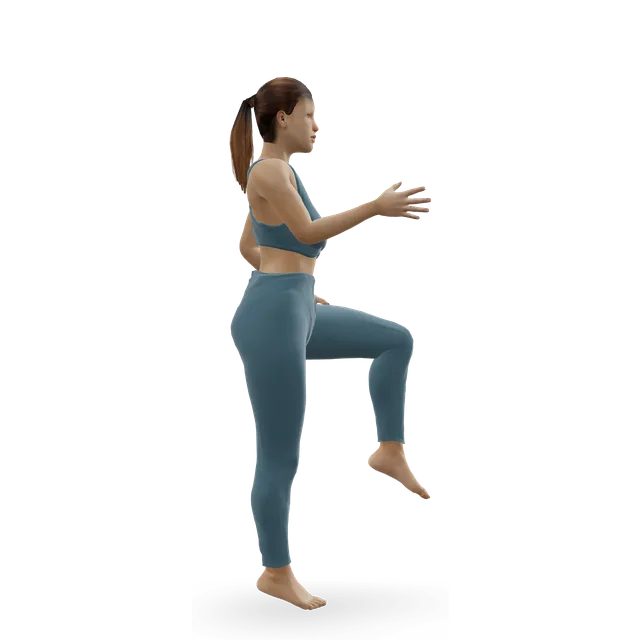
Shuttle runs demonstrated on the 3D figure3D demoShuttle runsAdvanced · No equipment

Fast running with turns and jumps, ladder step 8 · Wide, unhurried turns first

Easier: Treadmill jogging

Move on when: Then the ladder's last steps: warm-up plus half a training session, then a full session, then matches once full training has stayed at 2 out of 10 or less for two weeks in a row. Drop back a step if pain flares.

Follow along: a timer, a cue and the next move, one step at a time.

What to change for now

Cut back, don't stop

Most children can keep some sport going: less running and jumping, shorter sessions or more breaks, and swimming or cycling for fitness. Training is often easier than matches. If pain is strong or has gone on for months, the tested programme takes about 4 weeks off the sport that hurts and uses the ladder to come back.

Stopping everything isn't a quick fix either: in an older study of young athletes, the complete break from training averaged about 3 months, and full training was held back for about 7 months.

Sources 2, 16, 10, 6

Growth spurts and variety

Pain can come back with the next growth spurt: drop back to the easy exercises, then build up again. Playing one sport all year, with far more organised training than free play, is linked with more overuse injuries; our guide to exercise for children covers variety and training hours.

Sources 16, 8, 7

Ice, painkillers and stretches

Ice wrapped in a cloth for up to 20 minutes after activity can ease it. Use painkillers as advised by a pharmacist or GP, and don't give aspirin to anyone under 16 unless a doctor prescribes it. Stretches for the front and back of the thigh are optional; an NHS leaflet suggests 4 holds of 30 s each leg.

Sources 1, 2, 26, 27

Positions to swap, and why

Habit or positionWhy it mattersInstead
Playing full games and training through strong painIn the tested programme, pain above 2 out of 10 means drop back a step; an NHS leaflet says try not to go over 5.Shorter sessions, more breaks, and the activity ladder.
Lots of jumping, sprinting and kicking during a flareRunning and jumping sports put extra stress on the bump.Swimming or cycling for fitness.
Kneeling straight on the bumpThe bump is tender to kneel on, and kneeling can stay uncomfortable for years.Kneel on a cushion, or half-kneel on the other knee; wear knee pads for sport.
Deep, fast or loaded squats too earlyThe tested programme starts with holds and wall squats, then slow squats.Wall holds first, then slow squats within the pain rule.
Stopping all activity for monthsRest-only care still took months, and thigh strength drops.Keep walking or cycling and do the strength stages.
One sport all year with little free playLinked with more overuse injuries, including Osgood-Schlatter.Mix sports and keep plenty of free play.

Which stretch suits which pain

Hold 2 to 3 times for 20 to 30 seconds, a mild stretch, never sharp.

StretchReasonable forTake care or skipWhy
Standing Quad StretchA tight front of the thigh, once the knee has settledEase off if bending the knee fully presses on the bumpTight front-thigh muscles go with Osgood-Schlatter, but no trial shows stretching treats it. An NHS leaflet suggests 4 holds of 30 s each leg.
Side-lying quad stretchThe same stretch lying downUse a strap if the full knee bend pinchesNo standing balance needed.
Supine hamstring stretch with a strapA tight back of the thighEase off if it brings on tingling down the legAdvised alongside the front-thigh stretch by orthopaedic and NHS leaflets; untested on its own.

Routines to follow

More moves for this area

Questions people ask

What is Osgood-Schlatter disease?

It's pain and swelling at the bony bump just below the kneecap, where the kneecap tendon pulls on a growth area of the shin bone. It mostly affects active 10 to 15 year olds during growth spurts, and it hurts with running, jumping, kicking and kneeling. Despite the name, it isn't an infection or anything dangerous.

How long does Osgood-Schlatter last?

Often months, and sometimes years: in one Danish study more than a third still had pain 2 years later. With a structured plan of cutting back and strengthening, 90% had improved by a year. Many find the pain goes as growth finishes, while the bump stays.

Can my child keep playing sport?

Usually, at a level that keeps pain mild: less running and jumping, shorter sessions or more breaks, and swimming or cycling for fitness. If pain is strong or has gone on for months, the best-tested approach takes about 4 weeks off the painful sport, then climbs an 11-step ladder back. Sport does not cause lasting damage.

Which exercises help, and which should we avoid?

Thigh holds against a wall and glute bridges first, then wall squats, slow squats and lunges, every other day. Nothing is banned for good, but cut back jumping, sprinting and kneeling on the bump during a flare. Move up a step only when pain stays at 2 out of 10 or less.

Should the exercises hurt?

A little is fine. The tested programme moves up a step only when pain is 2 out of 10 or less during, straight after and the next morning, and goes back a step if it flares. An NHS leaflet says try not to go above 5.

Do knee straps or braces help?

No trial has tested them for Osgood-Schlatter. A strap just below the kneecap is reasonable to try for comfort during sport, but it isn't a treatment.

Does my child need an X-ray?

Usually not: it is diagnosed from the story and a tender bump. A doctor may arrange one if something doesn't fit, such as an injury, a hot swollen knee, night pain or a limp.

Will the bump go away?

Often not completely: the bump may stay after the pain has gone. In a survey of adults treated for it in hospital as teenagers, 85% still had a prominent bump, and kneeling on it can stay uncomfortable for years.

Can adults have Osgood-Schlatter?

It starts in adolescence, but symptoms can carry on into adulthood; a hospital survey found many adults still had pain at the bump. If a loose fragment of bone keeps causing pain after growth has finished, surgery to remove it helped most people in long-term follow-up.

Is it caused by doing too much sport?

Sport is the main link: it was 21% in sporty teenagers against 4.5% in inactive ones, and girls who played only one sport had about 4 times the risk. Variety and plenty of free play go with fewer overuse injuries.

What about ice and painkillers?

Ice wrapped in a cloth for up to 20 minutes after activity can ease it. Use painkillers as advised by a pharmacist or GP. Children under 16 shouldn't be given aspirin unless a doctor prescribes it.

When should we see a GP?

If pain below the kneecap keeps coming back with sport, or isn't improving within a few weeks. Get help the same day for a limp or sudden hip, thigh or knee pain, a hot swollen knee, or a pop after which the knee won't straighten.

Related exercise guides

Other pain guides

Sources

  1. AAOS OrthoInfo · Osgood-Schlatter disease (knee pain)
  2. Association of Paediatric Chartered Physiotherapists · Osgood Schlatter / traction apophysitis (patient leaflet, 2024)
  3. Williams 2026 · Non-surgical treatment for growth-plate (apophyseal) injuries of the leg in children (Cochrane review)
  4. de Lucena 2011 · Osgood-Schlatter and its associated factors in 956 Brazilian adolescents (cross-sectional study, AJSM)
  5. van Leeuwen 2022 · Incidence and management of Osgood-Schlatter disease in general practice (cohort, Br J Gen Pract)
  6. Kujala 1985 · Osgood-Schlatter's disease in adolescent athletes: incidence and duration (retrospective study, AJSM)
  7. Hall 2015 · Single-sport specialisation and front-of-knee pain in adolescent female athletes (J Sport Rehabil)
  8. Jayanthi 2015 · Sport specialisation, training hours and injury in young athletes (case-control study, AJSM)
  9. Rathleff 2020 · Pain, sport and knee function in adolescents with Osgood-Schlatter or kneecap pain (matched cross-sectional study, JOSPT)
  10. Rathleff 2020 · Activity modification and knee strengthening for Osgood-Schlatter disease, with its patient leaflet and activity ladder (cohort of 51 adolescents, Orthop J Sports Med)
  11. Rathleff 2019 · Activity modification and load management for adolescents with kneecap pain (151 adolescents, AJSM)
  12. Holden 2021 · Is the prognosis of Osgood-Schlatter poorer than anticipated? (cohort followed for 2 years, Orthop J Sports Med)
  13. Guldhammer 2019 · Osgood-Schlatter disease 4 years after diagnosis (retrospective study, Orthop J Sports Med)
  14. Krommes 2025 · Long-term knee health in adults who had Osgood-Schlatter as teenagers (national cohort, Sports Med)
  15. Krause 1990 · Natural history of Osgood-Schlatter disease (follow-up of 69 untreated knees, J Pediatr Orthop)
  16. Sherwood Forest Hospitals NHS · Osgood Schlatter's disease (patient leaflet, 2025)
  17. Lucenti 2022 · Causes and risk factors of Osgood-Schlatter disease (systematic review, Children)
  18. Rathleff 2024 · Improvement after 4 weeks and outcomes after 52 weeks in adolescent knee pain (cohort, Orthop J Sports Med)
  19. Neuhaus 2021 · Non-surgical treatment options for Osgood-Schlatter disease (systematic review, Phys Ther Sport)
  20. Krommes 2024 · The SOGOOD trial protocol: self-management vs usual care for Osgood-Schlatter (BMC Sports Sci Med Rehabil)
  21. Topol 2011 · Dextrose injections for persistent Osgood-Schlatter disease (RCT, Pediatrics)
  22. Nakase 2020 · Dextrose vs placebo injections for Osgood-Schlatter disease (double-blind RCT, Arch Orthop Trauma Surg)
  23. Rhim 2025 · Dextrose injection for Osgood-Schlatter disease (systematic review and meta-analysis, Diagnostics)
  24. Pihlajamäki 2009 · Long-term results of surgery for unresolved Osgood-Schlatter disease in young men (J Bone Joint Surg Am)
  25. Ndjonko 2026 · Treatments for Osgood-Schlatter disease (systematic review, Orthop J Sports Med)
  26. NHS · Growing pains
  27. University Hospitals Plymouth NHS · Osgood Schlatters disease (patient information)
  28. NHS · Knee pain
  29. NHS · Hip pain in children (irritable hip)
  30. AAOS OrthoInfo · Slipped capital femoral epiphysis
  31. Milner 2024 · Fractures of the bony bump below the knee in young people with and without Osgood-Schlatter (J Pediatr Orthop)
  32. NHS · Bone cancer: symptoms

Exercise education, not a diagnosis or treatment plan. It is written from the guidelines and studies listed above; review by a clinician is pending. If your pain follows an injury, is severe, is getting worse, or comes with any warning sign listed on this page, get it assessed. Health disclaimer.