Full stands in 30 seconds, arms crossed
Count how many times you come to a full stand from a 43 cm (17 inch) armless chair in 30 seconds, with your arms crossed against your chest. If you need your arms to stand, the score is 0.
Fitness test
Sit in an armless chair about 43 cm (17 inches) high, cross your arms over your chest, and count how many times you can stand up fully and sit back down in 30 seconds. Enter your count with your age and sex. From 60 to 94, the scorer shows whether you're below, within or above the usual range for your age, from a study of 7,183 American adults; the bottom of that range is the US Centers for Disease Control and Prevention's (CDC's) below-average line. From 20 to 59, it shows Danish averages instead. The test measures leg strength, and leg strength can be built at any age. Have someone stand next to you while you test, and if you've fallen in the past year, mention it to your GP whatever your score.
Enter your sex, age and the number of full stands you made in 30 seconds, counting a last stand if you were over halfway up. Tick the box if you needed your arms, and choose your chair's seat height.
13stands
Within the usual range for women aged 70 to 74: 10 to 15.
| Age | Women | Men |
|---|---|---|
| 60 to 64 | 12 to 17 | 14 to 19 |
| 65 to 69 | 11 to 16 | 12 to 18 |
| 70 to 74your age | 10 to 15 | 12 to 17 |
| 75 to 79 | 10 to 15 | 11 to 17 |
| 80 to 84 | 9 to 14 | 10 to 15 |
| 85 to 89 | 8 to 13 | 8 to 14 |
| 90 to 94 | 4 to 11 | 7 to 12 |
These norms come from 7,183 US adults aged 60 to 94, tested in a 43 cm armless chair with their arms crossed. A different chair, or using your arms, changes the score. A change of 2 or 3 stands between tests is more than everyday variation.
A lower score is a reason to build leg strength, not a diagnosis. The CDC treats a below-average score as one sign of falls risk, but on its own the test hasn't been shown to predict falls. If you've fallen in the past year, feel unsteady, or get dizzy when you stand up, ask your GP about a falls check.
You need a sturdy chair with a straight back and no arms, its seat about 43 cm (17 inches) from the floor, a wall to push it against, a timer, and someone to time you and stand beside you. The figure stands up without crossing its arms; in the test, keep yours crossed on your chest.
Loading the 3D figure…
The movement on the figure: Sit to stand from a chair
Count how many times you come to a full stand from a 43 cm (17 inch) armless chair in 30 seconds, with your arms crossed against your chest. If you need your arms to stand, the score is 0.
The usual range, the middle half of people, runs from 12 to 17 stands for women aged 60 to 64 and 14 to 19 for men, down to 4 to 11 for women and 7 to 12 for men at 90 to 94.
The CDC says a below-average score "indicates a risk for falls". On its own, though, the test hasn't been shown to predict falls, and the UK's National Institute for Health and Care Excellence (NICE) advises against using falls risk prediction tools to predict a person's risk of falling.
In older adults, the score tracked leg-press strength and came out much the same on two different days.
Source 6
Under 60, no norms use the test's 43 cm chair. Healthy Danish adults on a slightly higher 45 cm chair averaged about 22 to 28 stands from 20 to 59, depending on age and sex.
Strength training made older adults markedly better at getting out of a chair. Sit-to-stands, knee straightening, calf raises and step-ups, about three times a week, are the moves.
Stands in 30 seconds. From 60 to 94, the scorer places you below, within or above the usual range for your age and sex; from 20 to 59, it shows the Danish average for your age and sex.
The 25th to 75th percentile, the middle half of people, from the Senior Fitness Test norms (Rikli and Jones 1999):
7,183 community-living adults aged 60 to 94, tested at 267 sites in 21 US states and recruited where they could be reached rather than at random. A 2024 review lists the numbers in each group, from 192 men aged 85 and over to 1,298 women aged 70 to 74. Scores fell with age, and men scored higher than women on the strength tests.
We could read only the 1999 paper's summary, so the table comes from the Rehabilitation Measures Database's reprint. A second reprint matches it in every cell but one, giving 16 rather than 15 as the top of the range for women aged 70 to 74; the scorer uses 15.
Each bottom edge is exactly the CDC's below-average line, so "below the usual range" and the CDC's "below average" mean the same thing (our reading: the CDC form names no source). The CDC's lines run from under 12 stands for women and under 14 for men at 60 to 64, down to under 4 and under 7 at 90 to 94. Other percentiles, such as the middle score, differ between the reprints we could read, so the scorer doesn't show them.
The Copenhagen Sarcopenia Study tested 1,305 healthy Danes aged 20 to 93, invited from a random population sample, on an armless 45 cm chair with their arms crossed. Average stands, with the span of about two-thirds of people (the average plus or minus 1 standard deviation, our arithmetic, in whole stands):
Source 7
Their chair was 2 cm higher, and seat height changes the score. The Danes in their 60s and 70s averaged near or above the top of the American usual ranges, so the two sets aren't mixed (our reading). In 81 healthy adults aged 18 to 35, recruited on a US college campus and tested on a 45 cm chair after a short practice, the average was 33 stands.
In 2013, Rikli and Jones proposed scores linked with staying physically independent into later life, from 2,140 "moderate-functioning" older adults in their database and long-term studies of ageing: 15 stands for women and 17 for men at 60 to 64, down to 9 for both at 90 to 94. We could read only the paper's summary, and the values come from a reprint, so the scorer leaves them out.
Scores on two days, 2 to 5 days apart, agreed well: reliability 0.84 in men and 0.92 in women, where 1 is perfect agreement. Tested by video call in 50 older adults, the smallest change beyond measurement error was under 2.4 stands, and in 65 people with hip osteoarthritis, 2 to 2.6 more stands was a major improvement. So a change of 2 or 3 stands between tests is more than everyday variation (our reading).
In 76 community-living adults averaging 70, the score correlated 0.78 (men) and 0.71 (women) with leg-press strength for their body weight, and it was lower in older and less active people. The CDC gives its purpose as testing "leg strength and endurance".
"A below average score indicates a risk for falls", says the test's form in the CDC's STEADI (Stopping Elderly Accidents, Deaths and Injuries) toolkit, which helps clinicians screen and assess older adults' risk of falling. That's the CDC's rule for flagging people for a fuller check.
Source 1
A review of falls tests in community-living older adults found only one small study of the 30-second version, and it looked back at past falls rather than forward: too little to judge the test as a predictor (our reading). NICE advises against using falls risk prediction tools to predict a person's risk. A low score is a reason to build leg strength and, if you've fallen or feel unsteady, to ask about a falls check.
Across 5 studies of 28,036 people with average ages over 70, the slowest quarter at standing up five times had about twice the risk of dying during follow-up of the fastest quarter (hazard ratio 1.96, allowing for age, sex and body size). That's an association, from a different chair test, and it may reflect overall health; no trial has shown that raising your score adds years.
Source 16
In a Cochrane review, strength training gave older adults a moderate to large improvement in getting out of a chair (11 trials) and a large gain in strength (73 trials), mostly training 2 to 3 times a week at high intensity. The Otago home programme for falls builds sit-to-stands, knee straightening and calf raises into three sessions a week.
The Danish averages used a 45 cm chair, and the young American adults had a practice and two tries, so neither matches the test's 43 cm chair and single try exactly. They show roughly where healthy adults sit, not a cut-off.
If you need your arms, start with sit-to-stands pushing on your thighs and use your hands less as it gets easier. Sit-to-stands, up to 10, slowly (Otago); from week 7 of our seniors plan, stand up briskly and sit down slowly. Knee straightening, up to 10 each leg, up for a count of 3 and down for 5 (Otago). Calf raises, 10 to 20, holding support (Otago). Step-ups, up to 5 each leg (NHS), building to 8 to 12 (editorial). Wall sits of 20 to 30 seconds and goblet squats, 2 to 3 sets of 8 to 12 (editorial), are for when sit-to-stands feel easy. Train about three times a week, and test again every 4 weeks, as our seniors plan suggests.
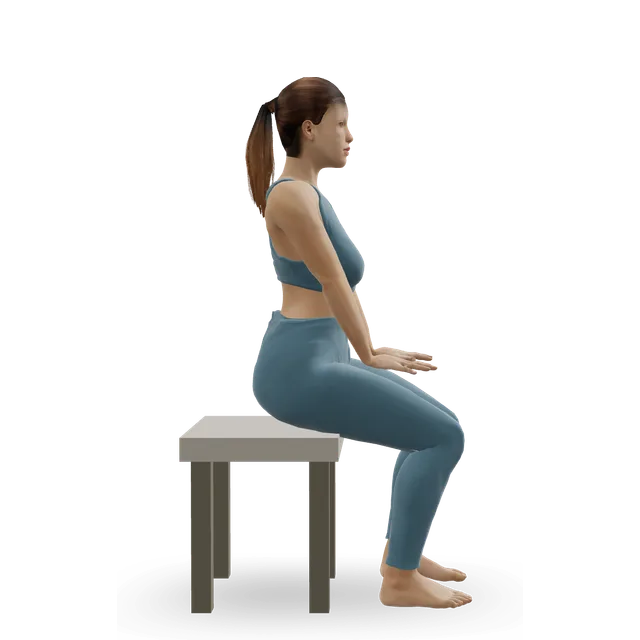 3D demoSit to stand, pushing on the thighsBeginner · A bench or box
 3D demoSit to stand from a chairBeginner · A bench or box
 3D demoSeated knee extension (chair)Beginner · A bench or box + Something with weight
 3D demoSlow calf raiseBeginner · A wall
 3D demoLow step-upBeginner · A step
 3D demoStep-upBeginner · A step
 3D demoWall sitBeginner · A wall
 3D demoDumbbell goblet squatIntermediate · A dumbbell
The seniors' strength and balance session is the one to do three times a week. The low-impact leg and beginner lower body workouts suit you once sit-to-stands feel easy; both include moves on the floor, so you need a safe way down and up. If standing is hard, start with the chair workout, which builds some strength but not balance.
A 40-minute strength and balance session for over-65s, built from the Otago home programme and NHS exercises, using a chair, a counter and a step.
40 minBeginner18 movesA bench or box, Something with weightA gentle leg strength routine with no jumping: sit-to-stands, step-ups, wall sits, bridges and calf raises.
20 minBeginner7 movesA bench or box, A stepLearn to squat, hinge and lunge: a 25-minute beginner lower body workout with bridges, clamshells and calf raises.
25 minBeginner11 movesA wall, A bench or boxA 20-minute seated workout for older adults who cannot stand for long: marching, leg and arm strength, posture, and sit-to-stands that lead back to standing.
20 minBeginner11 movesA bench or box, Something with weightThe seniors plan has you count your chair stands every 4 weeks to track your progress. The plans are for people who are independent and steady on their feet; if you're frail or have fallen, start with the chair workout and ask your GP about a falls service.
A 12-week exercise plan for over-65s: strength and balance three times a week, short balance sessions and daily walks, based on falls-prevention trials.
3 training days40 minBeginner2 days a weekYour first four weeks: two, then three short strength sessions a week at home plus walks, building gently to a full routine.
2 training days20 minBeginner3 days a weekA weekly plan for women over 50: strength, bone-loading and balance on 3 days plus walking, built on UK osteoporosis consensus advice.
3 training days45 minBeginner3 days a weekA 3-day strength plan for men over 40 with power and bone work, two cardio days and mobility, built on research on ageing muscle.
3 training days45 minBeginnerThe test stops and scores 0. Practise sit-to-stands pushing on your thighs, or the chair workout, and test again in 4 weeks.
Source 1
The PAR-Q+ (Physical Activity Readiness Questionnaire for Everyone) asks whether you've lost your balance because of dizziness, or lost consciousness, in the past 12 months; if you have, check with your GP before testing. Test only with someone beside you, as the CDC advises, and ask your GP about a falls check; in some areas you can refer yourself to a falls service.
Chair height and some positions may be limited for a while. Ask your surgical team or physiotherapist first; our hip and knee replacement guides cover the stages of recovery.
Stop. The PAR-Q+ asks about bone, joint or soft tissue problems that being more active could make worse. Our knee and hip arthritis guides cover exercise that suits you.
Source 17
The PAR-Q+ advises talking with your doctor or midwife first, and the norms weren't built for pregnancy (our reading). Our exercise in pregnancy guide covers staying active.
Source 17
The norms start at 60 and the Danish averages at 20, so there's nothing to compare with under 20. Our guide to exercise for children and teenagers covers fitness at that age.
Stop at once for chest pain, dizziness or severe breathlessness, or if a knee or hip hurts sharply, and don't restart the test that day (our suggestion, from the Otago booklet's stop signs). If you can't stand without your arms, the test ends there with a score of 0.
Call 999 (911 in the US) for any of these, and don't drive yourself to A&E:
Get advice soon for any of these:
Make an appointment if:
Feeling your muscles working, or slight soreness the next day, is normal.
Source 10
The CDC treats it as one sign of falls risk, worth a fuller check. But there's too little research to judge the test as a predictor on its own, and NICE advises against using falls risk prediction tools to predict a person's risk.
The norms were measured with arms crossed, so needing your arms scores 0. Pushing on your thighs is a good way to practise, though.
Source 1
Anyone can do it, but the matched norms start at 60. Younger adults' figures come from smaller studies on a slightly higher chair.
Strength training markedly improved getting out of a chair in older adults, across 11 trials.
Source 9
Slower chair rising goes with higher death rates, but that's an association, measured with a different chair test, and no trial has shown that raising your score adds years.
Source 16
Sit in the middle of an armless chair about 43 cm (17 inches) high, back straight, feet flat, arms crossed at the wrists against your chest. On "Go", stand up fully and sit back down as many times as you can in 30 seconds; if you're over halfway up when time runs out, that counts. Have someone stand beside you and do the timing.
For women, the usual range runs from 12 to 17 stands at 60 to 64, down to 4 to 11 at 90 to 94; for men, from 14 to 19 down to 7 to 12. That's the middle half of 7,183 American adults in the Senior Fitness Test norms. Enter your score to see where you sit for your age.
The CDC treats a score below the usual range as one sign of a higher falls risk, worth a fuller check. On its own the test hasn't been shown to predict falls, so it isn't a diagnosis. It is a clear reason to build leg strength.
In the test, needing your arms scores 0, because the norms were measured with arms crossed. Start with sit-to-stands pushing on your thighs, use your hands less as it gets easier, and test again in 4 weeks.
Not with the test's chair. Healthy Danish adults on a slightly higher 45 cm chair averaged about 26 to 28 stands in their 20s and 30s and about 22 to 23 in their 50s, and the scorer shows their average for your age and sex. Treat those figures as a rough guide.
Yes. Seat height changes the score, so test on a chair about 43 cm (17 inches) high, as the norms used, and use the same chair each time. A sturdy chair without arms, pushed against a wall so it can't slide, is what the test calls for.
A change of 2 or 3 stands between tests is more than everyday variation. In people with hip osteoarthritis, about 2 to 2.6 more stands was a major improvement.
Practise sit-to-stands, knee straightening, calf raises and step-ups, about three times a week, as in the Otago falls programme. In trials of strength training, older adults got markedly better at getting out of a chair. Test again every 4 weeks.
People who were slower at standing up five times had higher death rates in later years. That's an association: it may reflect overall health, and no trial has shown that raising your score adds years.
No. Getting down to the floor and up again is a different test, the sitting-rising test, scored on how much support you use. Our sitting-rising test page covers it.
Fitness tests for adults compared with published norms, not a diagnosis, and clinical review of these pages is pending. Check with a GP before a hard test if you have a heart condition, high blood pressure, chest pain, dizziness or breathlessness when active, and have someone with you for the balance, walking and floor tests if you've fallen or feel unsteady. Health disclaimer.





