Best of 3 tries, up to 45 seconds
Barefoot, arms crossed, the raised foot near your standing ankle. The norms stopped every try at 45 seconds.
Source 1
Fitness test
Stand barefoot next to a kitchen counter, cross your arms, lift one foot so it rests near your other ankle, and time how long you can hold it, up to 45 seconds. Take the best of three tries and enter it with your age: the scorer compares it with 549 healthy adults aged 18 to 99, and from 18 to 79 says whether it's within the usual range for your age. Balance falls with age, so the comparison is always with people your age. If you've fallen recently or feel unsteady, use the 4-stage version from the US Centers for Disease Control and Prevention (CDC) instead, with someone beside you.
Choose "One leg" and enter your age and your best of 3 tries with your eyes open; once that's 30 seconds or more, you can add your best with your eyes closed. If you're unsteady, choose the 4-stage test and pick the hardest position you held for 10 seconds.
25seconds
Healthy adults aged 60 to 69 averaged 32 seconds. Yours is within the usual range for your age or above it (16 seconds or more).
These averages come from 549 healthy adults at one US military hospital, tested barefoot with arms crossed, best of 3 tries, stopping at 45 seconds. Shoes, arm position and the number of tries change the time. Your time varies a lot from try to try; in one study the smallest real change was 24 seconds, so look at the trend over months.
You need bare feet, a non-slip floor, a kitchen counter or the corner of a room within reach, a chair behind you, and a timer; a helper makes the timing easier.
Loading the 3D figure…
The movement on the figure: Single-leg stand
Barefoot, arms crossed, the raised foot near your standing ankle. The norms stopped every try at 45 seconds.
Source 1
Healthy adults' best time with eyes open averaged about 45 seconds under 40, 32 in their 60s, 22 in their 70s and 9 from 80, so compare yourself with your age group.
Source 1
In older adults, a time had to change by about 24 seconds before the change was clearly real. Take the best of 3, and watch the trend over months.
Source 2
In 1,702 people aged 51 to 75, those who couldn't stand 10 seconds on one leg were more likely to die over about 7 years. No trial shows that practising it adds years.
Source 3
Feet side by side, then half a step, then heel to toe, then one foot, holding each for 10 seconds with someone beside you.
Source 4
Balance and functional exercise cut the rate of falls by 24% in trials. The NHS one-leg stand is 3 holds of 5 to 10 seconds on each side, with your fingertips on a wall.
Seconds, best of 3 tries, each stopped at 45. The scorer shows the averages to the whole second, and the usual range from 18 to 79.
Average and standard deviation (SD) for everyone in each age group; men and women didn't differ significantly:
Source 1
Much harder at every age, so the scorer shows only the average for your age group:
Source 1
549 healthy adults aged 18 to 99 (258 women, 291 men), volunteers at a US military medical centre in 2004, many of them patients or their family members. People with known balance problems, nerve damage in the feet, or leg or back problems needing treatment were left out. The scorer uses this table because it's a large set of norms by age, with eyes open and closed, from a method published in full.
Source 1
The paper labels the spread "SE" (standard error), but a standard error that large is impossible on a test that stops at 45 seconds, so the values must be SDs (our reading). The authors say a score 1 to 2 SD below the average "may indicate a possible balance impairment" worth a closer look, alongside the rest of an examination. The scorer's line is 1 SD below the average, with eyes open; below it is "below the usual range for your age", and at or above it is "within the usual range or above". Times are in whole seconds, so below the range means:
Source 1
Under 40, most healthy adults held the full 45 seconds, so the line sits just under it, and at any age a time near the line can move by many seconds from one session to the next. Treat being below the line as a prompt to practise and test again, not a diagnosis (our reading).
Two testers timing the same tries agreed almost perfectly (0.994 with eyes open and 0.998 with eyes closed, where 1 is perfect). But a person's own time changes a lot between sessions: in 25 adults aged 60 to 89, the smallest real change was 24.1 seconds, and by video call the one-leg stand varied more than the timed up and go or the chair stand. Take the best of 3, and look at the trend over months (our reading).
It shows how long you can hold still on one leg with your eyes open or closed. It doesn't measure your balance while you walk, turn or get jostled (our reading).
Source 1
In healthy adults over 50, one-leg standing time changed more per decade than walking or strength measures. In the norms, the eyes-open average fell from about 41 seconds in the 50s to 9 from 80.
Springer found no significant difference between men and women, and in adults over 50, sex made no difference to how balance declined with age.
In 1,702 Brazilians aged 51 to 75, mostly men, the 20.4% who couldn't stand 10 seconds on one leg had 1.84 times the risk of dying over a median of 7 years, after allowing for age, sex, body mass index and illnesses: 17.5% of them died, against 4.6% of those who could. The authors note that recent falls and physical activity weren't controlled for. A summary of the study describes a slightly different stance from Springer's, with the raised foot behind the standing leg, arms by the sides and up to three tries. That's an association, and no trial shows that practising it adds years.
In 316 healthy over-60s, those who couldn't stand 5 seconds on one leg had about twice the risk of a fall that caused an injury over 3 years (relative risk 2.13), but not of falls in general. In pooled studies, under 6.5 seconds raised a 30% chance of falling to 45%. No single test predicts falls well: the UK's National Institute for Health and Care Excellence (NICE) says gait and balance tests help in observing problems but don't predict a person's risk of falling.
In a review of physical capability and mortality, poorer standing balance went with higher death rates in all 5 studies that measured it, though not all significantly, and the studies measured balance too differently to pool.
Source 13
Balance and functional exercise cut the rate of falls by 24%, with high certainty. The World Falls Guidelines recommend it 3 or more times a week, made harder over at least 12 weeks.
From the CDC's STEADI (Stopping Elderly Accidents, Deaths and Injuries) form: eyes open, no stick or frame, and someone beside you. In the scorer, choose "4-stage test" and pick the hardest position you held.
Loading the 3D figure…
The movement on the figure: Tandem stance and heel-to-toe walk
Easiest first, always next to a counter or wall. Semi-tandem stands, 10 seconds with a hand on the counter, then without. Heel-to-toe stands, 10 to 30 seconds, then 5 to 10 heel-to-toe steps (our seniors workout). One-leg stands, 3 holds of 5 to 10 seconds each leg with your fingertips on the wall (NHS), building to 30 seconds (editorial). Side-stepping, 10 steps each way (NHS). Heel walks, 10 steps (our seniors workout), and tree pose, 20 seconds each side (our balance routine). Calf raises, 10 to 20, holding support (Otago). As you improve, take your hand off one finger at a time (Otago), and close your eyes only when one-leg standing is easy. The balance board is for when 30 seconds on one leg feels comfortable: 3 holds of 20 to 30 seconds with support near (editorial).
 3D demoSemi-tandem stanceBeginner · A wall
 3D demoTandem stance and heel-to-toe walkBeginner · A wall
 3D demoSingle-leg standBeginner · A wall
 3D demoSide-stepping (sideways walking)Beginner · A wall
 3D demoHeel walkBeginner · No equipment
 3D demoTree pose (Vrksasana)Beginner · No equipment
 3D demoSlow calf raiseBeginner · A wall
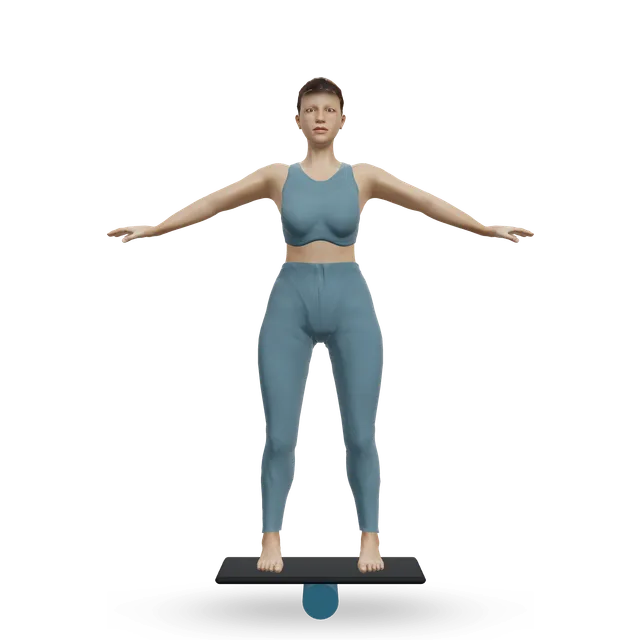 3D demoBalance board standBeginner · Other / check instructions
The 10-minute balance routine is for most days, next to a counter; on its own it's a small dose, so add the seniors' strength and balance session three times a week. The strength and balance workout ends with one-leg stands, and the foot and ankle routine builds your calves, ankles and balance.
Balance practice in 10 minutes: tandem stance, single-leg stands, marches, heel walks, tree pose and floor transfers.
10 minBeginner7 movesA wall, A bench or boxA 40-minute strength and balance session for over-65s, built from the Otago home programme and NHS exercises, using a chair, a counter and a step.
40 minBeginner18 movesA bench or box, Something with weightStrength and balance in one session: squats, Romanian deadlifts, push-ups, rows, step-ups, back extensions, carries and single-leg balance.
45 minBeginner14 movesA wall, A dumbbellA 15-minute barefoot routine for stronger toes, arches, calves and ankles, finishing with balance. You need only a towel, a wall and a resistance band.
15 minBeginner11 movesA wall, Other / check instructionsThe seniors plan builds balance three times a week with short practice on other days. Its 30-second one-leg target is editorial; this test shows where you start.
Use the 4-stage test, with someone holding your arm until you're steady. The PAR-Q+ (Physical Activity Readiness Questionnaire for Everyone) asks whether you've lost your balance because of dizziness, or lost consciousness, in the past 12 months; if you have, check with your GP first.
People with nerve damage in the feet were left out of the norms. Practise with a hand on the counter, and ask your GP or podiatrist about it.
Source 1
That can be a sign of gluteal tendon pain. Our hip bursitis guide covers it.
Healthy adults over 60 averaged only 2 to 4 seconds with their eyes closed. Stick to eyes open, with support near.
Source 1
Standing on one leg loads the injured ankle. Our sprained ankle guide has a staged plan back to balance work.
A clinic balance test for vertigo or after a head injury is a different thing. See your GP (our reading).
Grabbing the counter, or uncrossing your arms, ends that try. Stop for the day if you feel dizzy or faint, or get chest pain or severe breathlessness (our suggestion, from the Otago booklet's stop signs).
Call 999 (911 in the US) for any of these, and don't drive yourself to A&E:
Get advice soon for any of these:
Make an appointment if:
Feeling your muscles working, or slight soreness the next day, is normal.
Source 16
In one study of 51 to 75-year-olds, those who couldn't were more likely to die during follow-up, but recent falls and physical activity weren't controlled for. It marks people to look after, not a fate.
Source 3
Balance training prevents falls, but no trial has shown that it lowers death rates.
The best-studied norms stopped at 45 seconds, and healthy 70 to 79-year-olds averaged about 22 seconds.
Source 1
There was no significant difference in the largest norms study, or in how balance declined with age in adults over 50.
A person's time can vary by about 24 seconds between sessions. Take the best of 3.
In the largest norms study, healthy adults' best of three tries with eyes open averaged about 45 seconds under 40, 41 to 42 seconds from 40 to 59, 32 in their 60s, 22 in their 70s and 9 from 80. Compare yourself with your age, not with a single target.
Barefoot, next to a counter, cross your arms, look at a spot on the wall and lift one foot so it's near but not touching your other ankle. Time until you uncross your arms, touch down, move your standing foot, or reach 45 seconds. Do three tries and keep the best.
In a study of 1,702 people aged 51 to 75, those who couldn't stand 10 seconds on one leg were more likely to die over the next 7 years, even allowing for age and illnesses. That's an association, not a sentence. It's a good reason to practise balance, and to tell your GP if you've also fallen or feel unsteady.
No trial has shown that. Balance practice does reduce falls: programmes built on balance and functional exercise cut falls by about a quarter.
It's much harder: healthy adults averaged about 15 seconds under 40, 8 in their 50s and 2 to 4 seconds from 60. Only try it once eyes-open standing is easy, with a counter right beside you. The scorer offers it once your eyes-open time is 30 seconds or more.
Not in the largest norms study, where men and women scored much the same at every age. In another study of adults over 50, sex made no difference to how balance declined with age.
One-leg balance varies a lot from try to try; in one study of older adults, a time had to change by about 24 seconds before the change was clearly real. Take the best of three, and look at the trend over months.
Yes, if you stand within reach of a counter or in a corner with a chair behind you, on a non-slip floor; grabbing the counter ends that try. If you've fallen or feel unsteady with your feet together, have someone beside you and use the 4-stage test.
The CDC's version: feet side by side, then one foot half a step ahead, then heel to toe, then one foot, holding each for 10 seconds with someone beside you. Not being able to hold the heel-to-toe stand for 10 seconds is its sign of a higher falls risk. Choose it in the scorer if you're unsteady.
Practise one-leg stands, heel-to-toe standing and walking, and side-stepping next to a counter, 3 or more times a week for at least 12 weeks, taking your hand away one finger at a time. Our balance routine takes 10 minutes.
Fitness tests for adults compared with published norms, not a diagnosis, and clinical review of these pages is pending. Check with a GP before a hard test if you have a heart condition, high blood pressure, chest pain, dizziness or breathlessness when active, and have someone with you for the balance, walking and floor tests if you've fallen or feel unsteady. Health disclaimer.









