Small trials, short-term relief
One session eased long-term neck pain more than a heat pad a week later, in 48 people. One or two sessions eased neck and low back pain more than waiting, over about a week.
Fascia guide
Gua sha is scraping: a smooth-edged tool stroked over oiled skin until small red spots appear. Those spots are tiny bleeds from capillaries, and the technique sets out to make them.
In a few small trials, one or two sessions eased neck and low back pain for about a week. No trial has compared gua sha with a convincing fake, it didn't change back fascia more than a hot pack, and facial gua sha's promises of sculpting and lymph drainage have no controlled evidence.
This guide covers what gua sha does, what the trials found, facial gua sha, how to do it gently if you want to, who should skip it, and what helps more.
One session eased long-term neck pain more than a heat pad a week later, in 48 people. One or two sessions eased neck and low back pain more than waiting, over about a week.
No trial has used a convincing sham (fake) treatment. In back pain, the extra relief over a hot pack was small or absent, and a 2010 review called the evidence insufficient.
The spots, called sha, are blood leaking from capillaries into the skin. They're made on purpose and fade in about 2 to 5 days.
In a 2025 trial, the sheet of fascia across the lower back thinned no more with gua sha than with a hot pack.
Source 6
One 8-week trial with no untreated group found face measurements changed by 2 to 3 mm. Research hasn't tested the de-puffing claim.
Scraping the front of the neck caused throat swelling in a reported case. Use a clean tool on healthy skin, skip it with a bleeding disorder or broken skin, and ask first if you take blood thinners.
Gua sha is press-stroking: a smooth-edged tool (a spoon, coin, horn, jade or steel) stroked in one direction over oiled skin to raise small red spots (petechiae) and bruising on purpose. It's also called coining, scraping or spooning.
The spots are blood leaking from capillaries into the tissue under the skin. Trials describe them lasting 2 to 5 days, a gua sha author says 3 to 4 days, and Henry Ford Health, a US hospital system, says redness or bruising clears over 1 to 2 weeks.
In 11 healthy volunteers, blood flow in the skin rose fourfold for about 7.5 minutes and stayed raised for the 25 minutes measured. Tenderness eased at the scraped spot and elsewhere, which blood flow couldn't explain. There was no comparison group.
Source 12
In mice, scraping switched on an enzyme (heme oxygenase-1) that breaks down the leaked blood and protects cells, for several days. In older people with back pain, markers of inflammation drifted down, but no outcome differed from a hot pack.
In 32 people with long-term low back pain (27 finished), 4 weekly sessions thinned the thoracolumbar fascia, the sheet across the lower back, on ultrasound scans. A hot pack did the same: the difference between them was a quarter of a millimetre and could easily be chance.
Source 6
Physiotherapists and others use steel tools in the same way, called instrument-assisted soft tissue mobilisation (IASTM), such as the Graston technique.
Source 15
In 48 people with long-term neck pain, one session of gua sha was compared with a heat pad. A week later, pain was about 30 points out of 100 lower with gua sha, and neck function and quality of life were better. People knew which treatment they'd had, and nobody was followed for longer.
Source 1
One session eased pain at a week in 39 people with neck or low back pain, and two sessions eased long-term low back pain in 50 people, compared with waiting. No serious side effects were reported.
In older people with back pain, gua sha didn't differ from a hot pack in any outcome. In 32 people over 4 weeks, it eased pain 0.67 points out of 10 more than heat, and disability by about 1 point on a 100-point scale: both small.
A review of 10 back pain trials (627 people) found courses of scraping eased pain moderately in the short term, but a single session wasn't better than the comparison, only 3 trials followed people for 1 to 3 months, and quality was low. An earlier review of 7 trials called the evidence insufficient. A larger trial of 156 people combined cupping, scraping and a medicated balm, so it can't show what scraping alone does.
In 36 people with heel pain, one session of gua sha plus exercise eased pain more at a week than two other hands-on techniques. The 2023 US physiotherapy guideline for heel pain notes the changes didn't reach a size patients notice. Stretching the sole and calf has stronger support: the guideline's top grade, for short- and long-term pain.
Added to other treatment, instrument scraping made no meaningful difference to pain, function or range of movement across 46 trials (very low certainty). Another review of 11 trials found a moderate easing of pain. In neck pain, it beat doing nothing but not other physiotherapy.
In a trial, 34 women aged 20 to 50 used gua sha or a facial roller for 10 minutes, 5 times a week, for 8 weeks. Distances measured across the face shrank by 2.2 to 2.4 mm with gua sha and 2.8 to 3.3 mm with the roller. Without an untreated group, the changes can't be separated from time, measuring error or shifts in fluid.
Source 8
Five minutes with a facial roller raised blood flow in that cheek for at least 10 minutes in 12 people, and 5 weeks of daily use improved that cheek's response to heat in 14 people.
Source 23
Cleveland Clinic says research doesn't address the claim that facial gua sha reduces puffiness. UK advertising rules need robust evidence for lymphatic drainage claims, and even for lymphoedema after breast cancer, the National Institute for Health and Care Excellence (NICE) found the evidence on lymph-drainage massage too uncertain to recommend it.
Long-term vigorous facial massage with a hard wooden block tore a neck muscle (the platysma) in one reported case, and the neck arteries tore after a facial massage in another. Keep facial gua sha light.
Our editorial starting point, with sources for the safety points and the trial doses:
Strengthening, neck control exercises, and yoga or Pilates all reduced long-term neck pain against no treatment, and even 2 minutes a day of band training helped office workers with sore necks and shoulders. Exercise reduced long-term low back pain across 249 trials, and NICE puts it first for back pain.
Doses are our editorial starting point, from the Build stage of our neck pain guide; strengthening reduced long-term neck pain in trials (de Zoete 2020). Stop for dizziness, changes in your vision, or tingling into an arm.
Loading the 3D figure…
The movement on the figure: Isometric neck holds (four-way)
Strength first, 2 to 3 days a week; the two stretches at the end are for comfort.
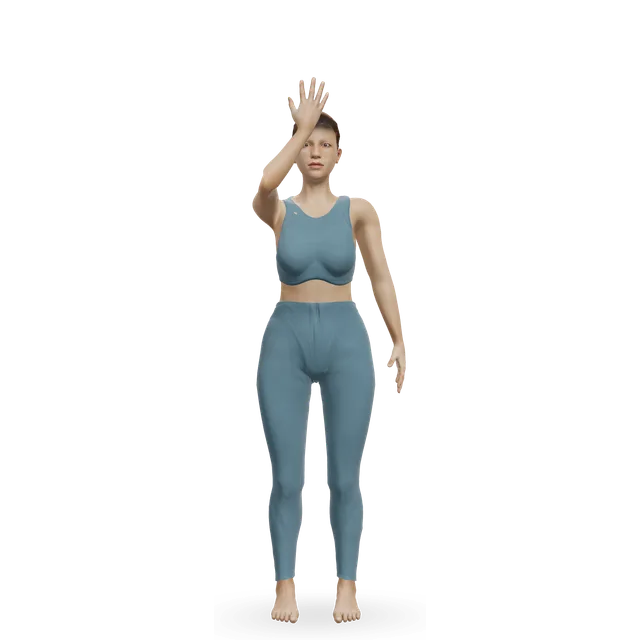 3D demoIsometric neck holds (four-way)Beginner · No equipment
 3D demoChin tuckBeginner · No equipment
 3D demoChin tuck with head liftIntermediate · No equipment
 3D demoProne Y-T-W raisesBeginner · No equipment
 3D demoBand pull-apartIntermediate · A band
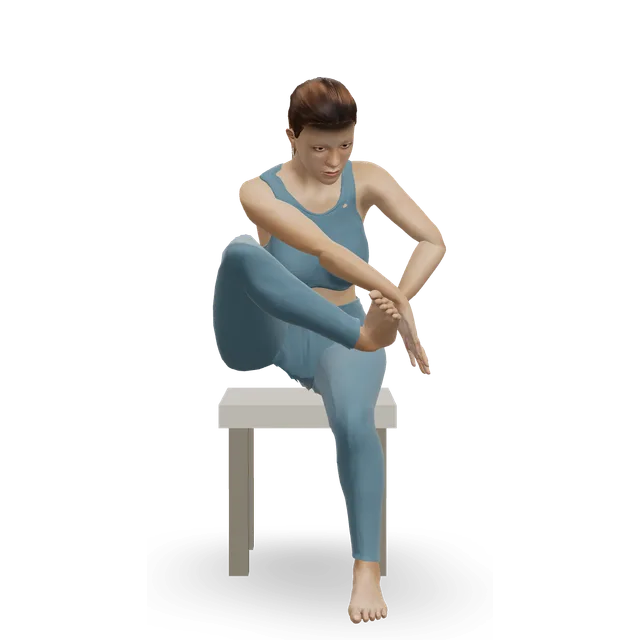
 3D demoThoracic rotationBeginner · No equipment
 3D demoLevator Scapulae StretchBeginner · No equipment
 3D demoUpper trap releaseBeginner · No equipment
Move gently, then build strength 2 to 3 days a week.
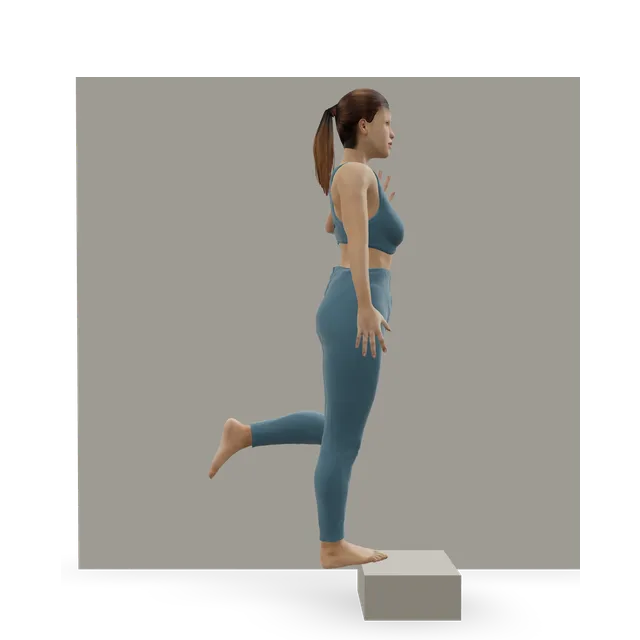
Stretch the sole and calf daily (the heel pain guideline's top grade) and do the heel raises every other day.
For a stiff neck, start with the neck and shoulder strength routine 2 to 3 days a week.
Deep neck holds and shoulder-blade strength in under 20 minutes: one of the best-supported kinds of exercise for a stiff, sore neck.
18 minBeginner11 movesA band, An anchor pointA 12-minute routine for a stiff upper back and rounded shoulders: chin tucks, wall angels, Y-T-W raises and open books.
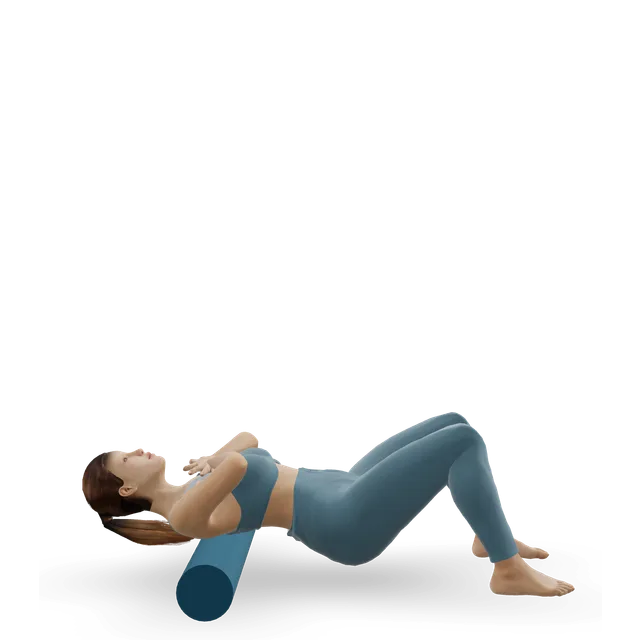
12 minBeginner8 movesA foam roller, A wallA 15-minute routine that moves your neck, upper back and lower back through bending, arching, side bending and twisting, then holds the spine steady.
15 minBeginner12 movesNo equipmentGentle rolling for the upper back and lats, rotation and segmental spine work, then two easy strength moves. Exercise is what back-pain guidelines recommend.
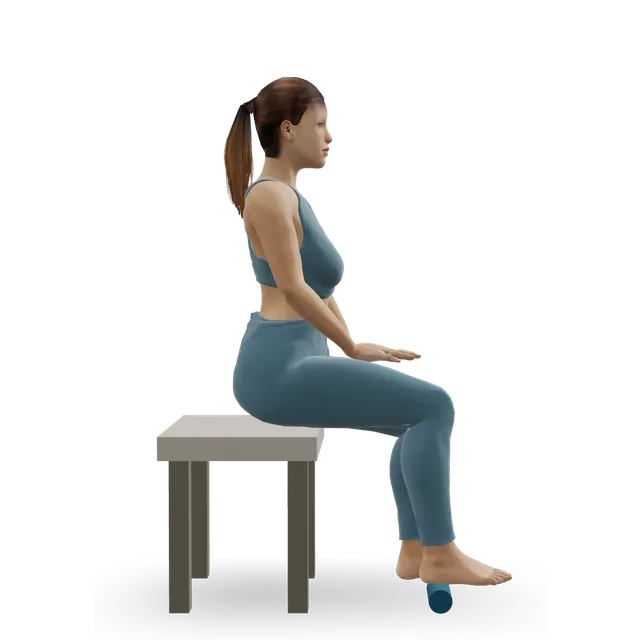
15 minBeginner11 movesA foam rollerPlantar fascia and calf stretches, a gentle foot roll and the towel heel raise: the exercises the 2023 heel pain guideline supports.
8 minBeginner7 movesA bench or box, A massage ballThe cautions with the clearest reasons:
US hospital guidance (it doesn't give evidence) also lists cancer, chemotherapy, a pacemaker or defibrillator, organ failure, diabetes, poor circulation, nerve damage, anaemia, undiagnosed lumps, and giving blood in the last 2 months. Ask a doctor first if any of these apply to you.
Expect soreness and some bruising or skin discolouration. Reported cases include:
Scraping can draw blood and fluid through the skin, so a reused tool needs high-level disinfection. Better still, keep your own and don't share it.
The Chartered Society of Physiotherapy (CSP) says cupping and gua sha aren't regarded as physiotherapy treatments because they lack an evidence base, and one NHS trust excludes gua sha from practice.
Get help straight away if:
Source 34
Fascia thickness changed no more than with heat, and we found no trial on cellulite. Bruising the skin isn't the same as changing it: see the fascia blasting verdict.
Source 6
The one trial had no untreated group and found changes of 2 to 3 mm, research hasn't tested the de-puffing claim, and claims about lymph drainage need evidence that doesn't exist.
The marks are blood leaking from capillaries under the pressure of the tool. They show where you scraped, not what was inside you.
The burn case often cited was fire cupping, which uses a flame. Gua sha uses no heat or flame.
Source 13
In small trials, one or two sessions eased long-term neck and low back pain for about a week compared with heat or waiting. No trial has used a convincing fake, and against heat the difference was small.
The red spots are tiny bleeds from capillaries, and the technique makes them on purpose. They usually fade within a few days. On the face, bruising means too much pressure.
One 8-week trial found face measurements shrank by 2 to 3 mm, but it had no untreated group to compare with. Expect small, temporary changes, not a new jawline.
Research hasn't tested the puffiness claim, and claims about lymph drainage need evidence that doesn't exist. Even for lymphoedema, NICE found lymph-drainage massage too uncertain to recommend.
No. In a 2025 trial, the fascia across the lower back changed no more with gua sha than with a hot pack. Fascia changes with loading over weeks, which the fascia exercises guide covers.
On the body, let the marks fade before scraping the same area again; trials used one or two sessions about a week apart. The facial trial used 10 gentle minutes, 5 times a week.
Usually, if it's gentle, on healthy skin, with a clean tool you don't share. Never scrape the front of your neck: throat swelling has been reported.
Skip it with a bleeding disorder or broken, fragile or sunburnt skin, and don't scrape near a known or suspected blood clot. Ask your doctor first if you take blood thinners, and your midwife if you're pregnant.
Both scrape the skin, but gua sha uses a smooth tool on oiled skin and has a few small trials, while fascia blasting has no independent ones. Neither breaks up fascia or cellulite.
Graston is a clinical version of instrument scraping that uses steel tools. Most reviews found it adds little to other treatment, though one found a moderate easing of pain.
Any smooth, rounded edge: a smooth spoon works as well as a jade or steel tool. Keep it clean and use it only on yourself.
Movement education, not medical advice. Stop for sharp or increasing pain, numbness or tingling, and get individual advice if you are pregnant, after an injury or surgery, or managing a health condition. Health disclaimer.