Pain guide · Shoulder pain

Exercises after rotator cuff repair surgery: the sling, the recovery stages and the warning signs

A rotator cuff repair stitches a torn shoulder tendon back onto the bone, usually through keyhole surgery. The tendon then has to heal onto the bone, so recovery is slow: a sling for the first weeks, movement with help, then lifting the arm yourself and, from about 3 months, building strength. One NHS hospital says most people notice an improvement by 3 to 6 months and keep improving for up to 18 months, though the shoulder may never be quite as strong above shoulder height.

Your surgical team's protocol comes first: hospitals differ on the sling, the limits and when each exercise starts, and the size of your tear matters. This page sets out the usual stages from NHS hospital plans, with a 3D demo of each move, what trials found about moving early, what a re-tear on a scan does and doesn't mean, and the warning signs.

When to get help first

Exercise is for pain that has been checked or is clearly mild and settling.

Get urgent medical help if

  • Call 999: shoulder or arm pain with chest pain that feels tight or squeezing, or chest pain that spreads to your arms, neck or jaw, especially with shortness of breath, sweating or feeling sick. It could be a heart attack.
  • Arm pain or swelling with breathlessness or chest pain: call 999 or go to A&E, and do not drive yourself. It can be a blood clot that has reached the lungs.
  • A high temperature, or feeling hot, cold or shivery; or a wound that is red, hot, swollen or oozing: contact your surgical team, ask for an urgent GP appointment or get help from NHS 111. These can be signs of an infection. If you feel unwell and the wound looks infected, go to A&E.
  • Throbbing pain and swelling in the arm, with red, blue or darker skin and swollen veins: ask for an urgent GP appointment or get help from NHS 111. It could be a blood clot.
  • Same day (your surgical team or NHS 111): once the nerve block has worn off, usually within a day or two, your arm or hand stays numb, you have pins and needles that don't go away or weakness you can't explain, or your hand turns cold, pale or blue.
  • Same day (your surgical team): a sudden sharp pain with a clear loss of strength, or losing movement you had got back, especially after a fall, a jerk or catching something heavy. The repair may have torn again.
  • Same day (GP or NHS 111): throbbing pain and swelling in one leg, usually the calf or thigh, with red, blue or darker skin or swollen veins. It could be a blood clot (deep vein thrombosis, DVT), which is more likely while you're moving about much less than usual or after a hospital stay.

See a doctor or physiotherapist if

  • The shoulder is getting stiffer rather than freer, or night pain is getting worse rather than better after the first few weeks: tell your physiotherapist or surgical team. About 1 in 20 people develop a painful stiff (frozen) shoulder after a repair, which improves over months with physiotherapy, one NHS hospital says.
  • Pain from an exercise that stays intense for more than about 30 minutes, even after you've made it gentler: ask your physiotherapist.
  • You're not sure what your limits are, or you're not reaching the stage your team expected: ask them rather than guess.
  • Months after the operation, pain or weakness that is getting worse rather than better: contact your surgical team or GP.

Understand it

What the operation does

The torn tendon, most often the supraspinatus on top of the shoulder, is sewn back onto the bone with small anchors that carry stitches. It is usually keyhole surgery under a general anaesthetic, often as a day case, with a nerve block that can leave the arm numb and heavy for up to 2 days. Sometimes the tear is too big, or the tendon too fragile, to repair fully, and only part of it can be reattached.

Open, mini-open and keyhole repairs give similar results, according to the American Academy of Orthopaedic Surgeons (AAOS). In the UK Rotator Cuff Surgery trial (UKUFF), 273 people aged 50 and over at 19 NHS hospitals had an open or a keyhole repair, and their shoulder scores were the same at 2 years. Other procedures are often done at the same time, such as fixing the biceps tendon (a biceps tenodesis), which brings its own limits: one NHS plan avoids bending the elbow against resistance for 8 weeks.

Sources 1, 2, 3, 4, 5

What recovery usually looks like

One NHS hospital calls it a good operation for pain relief that is less reliable at improving movement, and says it won't restore normal strength to the arm. It is "not a quick fix": most people notice an improvement by 3 to 6 months, the shoulder feels almost normal by 9 to 12 months, and it keeps improving for up to 18 months, with strength improving for up to 2 years. The AAOS says most people have useful movement and enough strength by 4 to 6 months.

In the UKUFF trial, shoulder scores rose from about 26 to about 42 out of 48 by 2 years, and 85% of people said their shoulder was better. The same NHS hospital says about 1 in 5 people still have some symptoms, and most never get completely normal strength above shoulder height.

Sources 1, 3, 4

Re-tears are commonStrong evidence

A repaired tendon doesn't always heal fully onto the bone. Across 31 higher-quality studies, scans found the tendon had come away again in about 15% to 21%; across 30 studies of 13,161 people, it ranged from 5% to 43%. In a trial of 206 people, a full-thickness tear was there at a year in 30% of one group and 33% of the other. In UKUFF, in people aged 50 and over, it was 39% to 46%.

The risk rises with age and with the size of the tear: it roughly doubles from about 15% at 50 to over 30% at 70. In UKUFF's scans, 66% of small and 68% of medium tears had healed at a year, against 47% of large and 27% of massive ones.

Sources 6, 7, 8, 4, 9, 10

What a re-tear on a scan does and doesn't meanEmerging evidence

People with a re-tear score lower on average, by about 8 points on a 100-point shoulder score, and are weaker lifting the arm out to the side, but in a review of studies their pain wasn't clearly higher. In UKUFF, people with a re-tear still did better than those whose tear couldn't be repaired, and those whose repair healed did best. The AAOS says re-tears often don't cause more pain or loss of function, and another operation is needed only for severe pain or loss of function.

So a re-tear on a scan describes the tendon, not how well you will do. A sudden loss of strength after a fall or a jerk is different: tell your team the same day.

Sources 11, 4, 3

If you had a decompression, not a repair

Shaving bone from under the roof of the shoulder (a subacromial decompression) is a different operation. In a UK trial of 313 people whose cuff wasn't torn through, it did no better than a placebo operation, and recovery from it doesn't need the protections on this page. Our shoulder impingement guide covers it. A tear that can't be repaired is sometimes treated with a reverse shoulder replacement, which has its own guide.

Source 12

What helps, and how strong the evidence is

Moving early is safe, and adds a little movementStrong evidence

In a 2021 review of 20 trials (1,841 people), starting rehabilitation early gave a little more movement in the first months (about 7 to 8 degrees more lifting the arm forwards at 6 weeks and 3 months, and about 1 degree at a year), no difference in pain or function at most points, and no more re-tears. Most trials were at high or unclear risk of bias, and most of their early programmes moved the arm for people rather than having them use it.

A review of 8 studies (756 people) that tested early active movement found more movement in the first 6 months, slightly worse shoulder-related quality of life at 6 weeks, and no difference in healing; the authors judged that none of the differences mattered in practice. An older review of 12 trials found a slightly higher re-tear rate with early rehabilitation that could have been chance, so a small rise can't be ruled out. A 2025 review of 11 trials found early exercise cut post-operative stiffness by about two-thirds.

Sources 13, 14, 15, 16

Two well-known trials: no difference by 1 to 2 yearsEmerging evidence

In a trial of 206 people (average age 56), weaning off the sling and doing pain-free active movement in the first 6 weeks gave better lifting at 6 weeks than 6 weeks in a sling, and no differences in movement, pain, strength or quality of life after that, up to 2 years. The authors suggest allowing pain-free active movement in the first 6 weeks.

In a trial of 124 people under 65 with tears smaller than 3 cm, early movement with help gave better lifting and turning at 3 months than 6 weeks immobilised, and the same function and strength from 6 months to 2 years; 92% of repairs had healed. Both trials were mostly small and medium tears.

Sources 8, 17

A UK trial is testing early, self-directed recoveryEmerging evidence

In the RaCeR pilot trial (Rehabilitation after Rotator Cuff Repair), 73 adults at 5 NHS hospitals in England were advised either to take the sling off as soon as they could and move as their symptoms allowed, or to wear it for 4 weeks. The early group spent much more time out of the sling, and there were 7 full-thickness re-tears in the early group against 11 in the sling group. As a pilot, it was set up to test whether a full trial could work, not to show which approach is better.

The full RaCeR 2 trial, with 638 people, compares that approach with the NHS standard of a sling for at least 4 weeks; its results aren't out yet. Meanwhile, in a survey of 76 UK shoulder surgeons, 87% agreed there is real uncertainty about the best approach, and in a survey of 129 clinicians, most still advised 4 to 6 weeks in a sling, active movement from 4 to 6 weeks, and resisted exercise and driving from 7 to 12 weeks.

Sources 18, 19, 20, 21

The sling: plans differ, and a pillow brace adds nothingEmerging evidence

NHS hospitals' plans range from 4 weeks in a sling to up to 6 weeks, day and night, and the AAOS gives 4 to 6 weeks. A US therapists' consensus (read as a summary) describes 2 weeks of strict immobilisation, then protected movement with help from weeks 2 to 6, active movement after that, and strengthening from week 12. Timings vary with the size of the tear and your surgeon's protocol, which comes first.

In 4 trials (224 people), an abduction brace, a sling with a pillow holding the arm a little away from the body, gave no better pain, function or healing than a simple sling. Use what your team gives you.

Sources 1, 5, 2, 3, 22, 23

Keep pendulums smallEmerging evidence

In a laboratory study of 13 healthy people, large pendulum swings, about 50 cm across, and even having a drink made the supraspinatus and infraspinatus work at more than 15% of their maximum, and large swings worked the supraspinatus harder than small ones, about 20 cm across. The authors suggest larger swings may load the tendon more than is wise early after a repair, so small, relaxed swings moved by your body are the safer choice.

Source 24

Getting back to work and sportEmerging evidence

Across 13 studies of 1,224 people, about 62% returned to their previous level of work, at about 8 months on average, and fewer of those in physically demanding jobs. Across 25 studies of 859 people, about 85% returned to sport and about 66% to the same level, after 4 to 17 months; only about half of competitive athletes got back to the same level. A 2023 review of 11 studies found return-to-sport rates of 50% to 100%. These are observational studies, mostly from specialist centres.

Sources 25, 26, 27

How much pain is OK while you exercise?

Aching is normal; intense pain that lasts means do lessEmerging evidence

In the early stages, aching, discomfort and stretching feelings are normal. If an exercise brings intense pain that lasts more than about 30 minutes, do it less forcefully or less often, and talk to your physiotherapist if that doesn't help, as one NHS hospital advises. Do short sessions of 5 to 10 minutes, about 4 times a day, and take painkillers or use an ice pack for 5 to 10 minutes beforehand if it helps. Don't push through sharp pain, and never force a stretch.

Once you're strengthening, a working ache that settles within about 30 minutes and is no worse the next morning is fine. In a UK trial of early rehabilitation, people progress within their own pain and tolerance. The 30-minute figure is one hospital's and the next-morning check is our suggestion: neither has been tested as a rule.

Stop and contact your team for a sudden sharp pain with a loss of strength, a pop, or losing movement you had got back.

Sources 1, 2, 19

The exercise plan: 4 stages

Start at the first stage. Each move opens a full guide with a 3D demo.

Stage 1

In the sling: hand, wrist, elbow, neck and shoulder blades (from the day of surgery, as your team allows)

As your team allows, from the day of surgery. Wear the sling day and night for as long as your team says: from 4 weeks to up to 6 weeks in NHS plans. Take it off only to wash, dress and do your exercises. Keep the hand, wrist, elbow and neck moving, in short sessions 3 or 4 times a day. Your team decides when the shoulder itself starts to move: some NHS plans add gentle movement with help from the first days, below shoulder level, and others wait 3 to 6 weeks. Ice for 5 to 15 minutes at a time, wrapped in a cloth, and walk every day.

Ball squeeze demonstrated on the 3D figure3D demoBall squeezeBeginner · Other / check instructions

10 squeezes of a soft ball or rolled sock, 3 to 4 times a day · The sling can stay on. NHS Lothian's frequency; the count is editorial

Harder: Band finger extension

Wrist & forearm flow demonstrated on the 3D figure3D demoWrist & forearm flowBeginner · No equipment

Wrist bends and palm-up, palm-down turns, 10 of each, 3 to 4 times a day · With the elbow bent at your side. NHS Lothian's frequency; the count is editorial

Harder: Wrist flexor stretch

Elbow bend and straighten (elbow range of motion) demonstrated on the 3D figure3D demoElbow bend and straighten (elbow range of motion)Beginner · No equipment

5 times, building up, 3 to 4 times a day · Upper arm by your side. After a biceps tenodesis, follow your team. One NHS hospital's dose

Harder: Dumbbell biceps curl

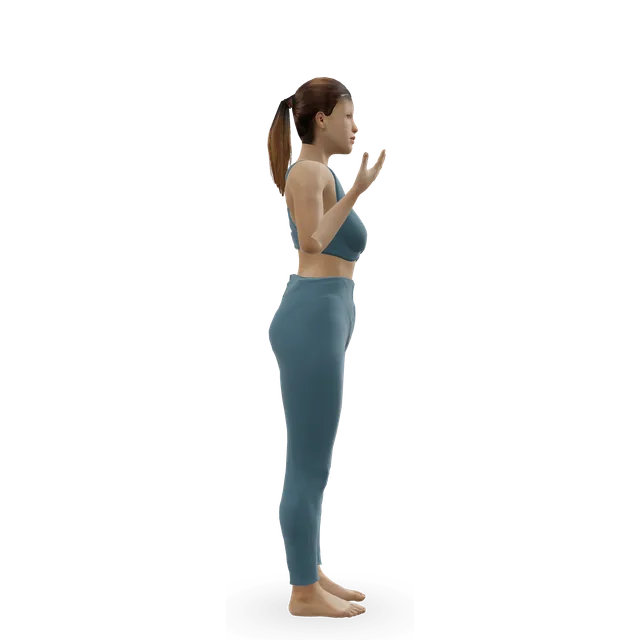
Neck CARs demonstrated on the 3D figure3D demoNeck CARsBeginner · No equipment

Gentle separate turns and tilts, not full circles: 5 each way, 3 to 4 times a day · One NHS hospital's neck exercises

Seated upper-back lift (sit tall, shoulders back) demonstrated on the 3D figure3D demoSeated upper-back lift (sit tall, shoulders back)Beginner · A bench or box

Draw the shoulder blades gently back and down, hold 3 to 5 s, 10 times, 3 to 4 times a day · The operated arm stays resting in the sling. One NHS hospital's count

Easier: Elbows back · Harder: Prone Y-T-W raises

Move on when: Your team says the shoulder can start moving with help: from the first days in some NHS plans, about 2 weeks in the US therapists' consensus, and 3 to 6 weeks in others. Many people do stages 1 and 2 together.

Follow along: a timer, a cue and the next move, one step at a time.
Stage 2

Movement with help, below shoulder height at first (as your team allows)

As your team allows. Let gravity, a table or your good arm do the work, inside the range your team sets, often below shoulder height at first. Keep doing the stage 1 moves. Don't force a movement or push into a stretch. Many NHS leaflets use a lying arm raise, with your good arm lifting the operated one; the 3D figure doesn't show it yet, so the table slide stands in for it here, and its steps are in the notes below.

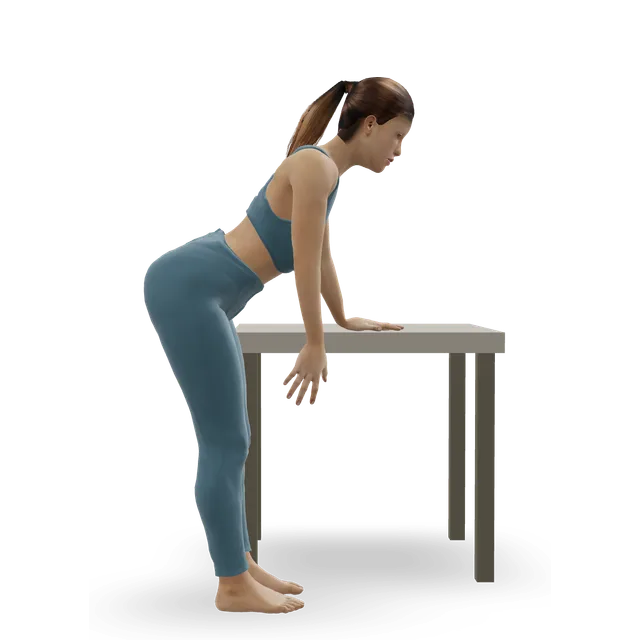
Pendulum exercise (Codman's pendulum) demonstrated on the 3D figure3D demoPendulum exercise (Codman's pendulum)Beginner · A bench or box

Small, relaxed swings forwards and backwards, 10 times, 3 to 4 times a day · Lean on a table with the good hand and let your body move the arm. One NHS hospital's dose

Harder: Table slide (seated forward reach)

Table slide (seated forward reach) demonstrated on the 3D figure3D demoTable slide (seated forward reach)Beginner · A bench or box

5 slow slides, building to 10, 3 to 4 times a day · Standing in for the lying assisted arm raise, with a cloth under the hand and no weight through the arm. One NHS hospital's dose for the raise

Easier: Pendulum exercise (Codman's pendulum) · Harder: Overhead lat stretch at a bench

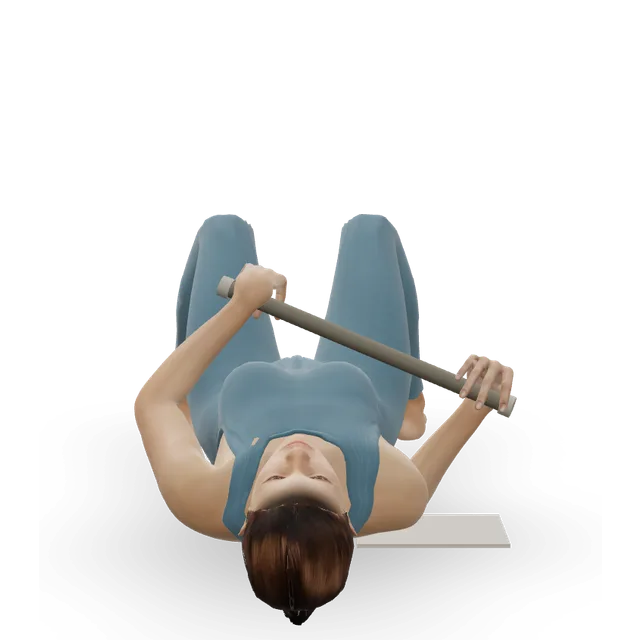
Stick-assisted external rotation (lying) demonstrated on the 3D figure3D demoStick-assisted external rotation (lying)Beginner · Other / check instructions

5 slow repetitions, building up, 3 to 4 times a day · Elbow tucked in on a folded towel, and only to your team's limit, which may be stricter after a repair of the front tendon (subscapularis). One NHS hospital's dose

Harder: Standing band external rotation

Move on when: Your team allows you to start lifting the arm with your own muscles: from about 4 to 6 weeks in NHS plans, and about 6 weeks in the US consensus. The assisted movements should feel comfortable, and the shoulder shouldn't be getting stiffer.

Follow along: a timer, a cue and the next move, one step at a time.
Stage 3

Lifting the arm yourself, and gentle holds (often from about 4 to 6 weeks, as your team allows)

As your team allows. Start lying down, where gravity helps: help the arm up to point at the ceiling, then hold it there yourself and make small arcs. Then lift it sitting and standing, below shoulder height first. Add gentle holds against your other hand (steps in the notes below), which the NHS standard plan in a UK trial starts at about 6 weeks. Use the arm for light tasks at waist level, then a little further from the body. Still no lifting with that arm, not even a kettle, and no pushing up from a chair.

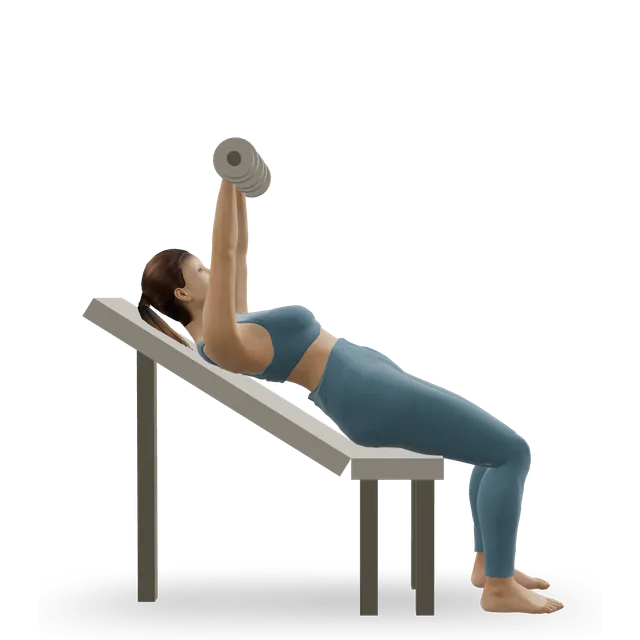
Dumbbell shoulder-blade punch demonstrated on the 3D figure3D demoDumbbell shoulder-blade punchBeginner · A dumbbell + A bench or box

No weight: lying on your back, help the arm up to point at the ceiling, hold it there yourself, reach the hand a little higher and lower it, then make small arcs; 5 to 10 times, 3 to 4 times a day · One NHS hospital's lying lift. The figure uses an incline bench and dumbbells; here, lie on a bed with no weight

Harder: Scapular push-up (push-up plus)

Scaption raise demonstrated on the 3D figure3D demoScaption raiseBeginner · A dumbbell

No weight, thumbs up, below shoulder height at first, 10 slow repetitions, once or twice a day · Editorial dose

Easier: Band lateral raise · Harder: Smith machine upright row

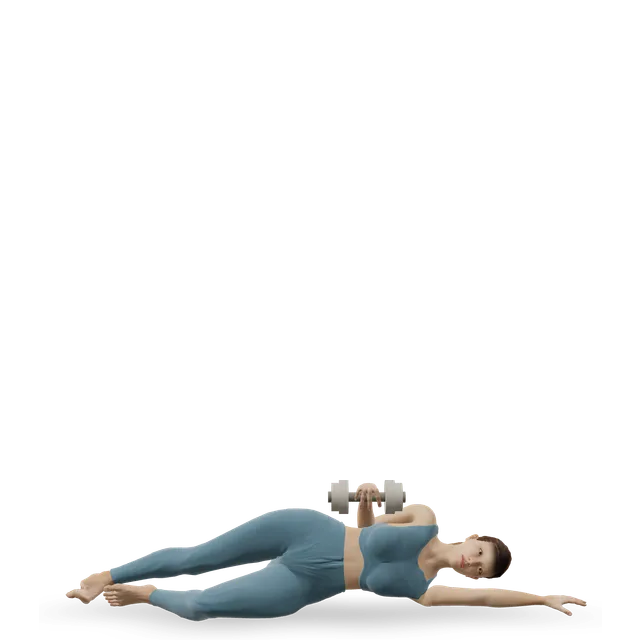
Side-lying external rotation demonstrated on the 3D figure3D demoSide-lying external rotationBeginner · A dumbbell

No weight at first: operated arm on top, elbow on a folded towel against your side, 10 slow repetitions, once or twice a day · Editorial dose

Easier: Standing band external rotation · Harder: Cuban rotation

Table slide (seated forward reach) demonstrated on the 3D figure3D demoTable slide (seated forward reach)Beginner · A bench or box

Reach a little further as it gets easier, with a 10 to 20 s hold at the far end · The move page's dose

Easier: Pendulum exercise (Codman's pendulum) · Harder: Overhead lat stretch at a bench

Move on when: You can lift the arm to shoulder height smoothly without hitching your shoulder up, the holds are comfortable, and your team agrees. Strengthening often starts at about 8 to 12 weeks, or from 12 weeks.

Follow along: a timer, a cue and the next move, one step at a time.
Stage 4

Strength, little and often (often from about 8 to 12 weeks, as your team allows)

As your team allows. Build strength slowly with light bands and weights and more repetitions, 2 to 3 times a week, keeping loads below shoulder height and close to your body at first; that frequency is our suggestion. Strength can keep improving for up to 2 years. Plan heavier jobs and sport with your team: in NHS plans, heavy lifting and manual work from 4 to 6 months, front crawl from about 12 weeks, golf from about 6 months and contact sport at about 9 to 12 months.

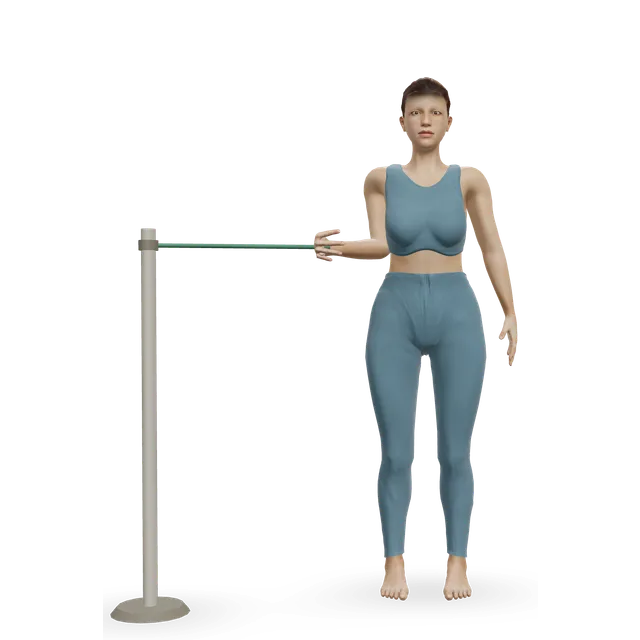
Standing band external rotation demonstrated on the 3D figure3D demoStanding band external rotationBeginner · A band + An anchor point

Lightest band, elbow tucked in, 2 to 3 sets of 10 to 15, 2 to 3 times a week · Resisted work within your pain limits is the last stage of the NHS standard plan in a UK trial; the sets are editorial

Harder: Side-lying external rotation

Band internal rotation demonstrated on the 3D figure3D demoBand internal rotationBeginner · A band + An anchor point

Lightest band, 2 to 3 sets of 10 to 15, 2 to 3 times a week · After a subscapularis repair, only when your team allows. Editorial dose

Harder: Side-lying external rotation

Band row demonstrated on the 3D figure3D demoBand rowBeginner · A band + An anchor point

Light band, 2 to 3 sets of 10 to 15 · The elbows stop at your sides at first. Editorial dose

Harder: Supported single-arm dumbbell row

Scaption raise demonstrated on the 3D figure3D demoScaption raiseBeginner · A dumbbell

0.5 to 1 kg, to shoulder height, 2 sets of 10 to 15 · Editorial weight

Easier: Band lateral raise · Harder: Smith machine upright row

Side-lying external rotation demonstrated on the 3D figure3D demoSide-lying external rotationBeginner · A dumbbell

0.5 to 1 kg, 2 sets of 10 to 15 · Editorial weight

Easier: Standing band external rotation · Harder: Cuban rotation

Wall push-up demonstrated on the 3D figure3D demoWall push-upBeginner · A wall

Hands at chest height, a small range, 2 sets of 10 · Only once your team allows weight through the arm. Editorial dose

Harder: Push-up

Move on when: This is the long-term programme. Add repetitions before weight, one change at a time. Work above shoulder height comes last: one NHS hospital says sustained or powerful overhead work, such as hedge trimming or racket sports, can take several months to feel comfortable.

Follow along: a timer, a cue and the next move, one step at a time.

What to change for now

Typical precautions, which your team may change

These come from NHS hospital leaflets, and your own team's list comes first. Most are about protecting the repair for the first 6 to 12 weeks.

  • No lifting with the operated arm, not even a kettle, for 8 to 12 weeks, and nothing heavy, such as digging or manual work, for 4 to 6 months.
  • Don't use the arm with the elbow away from your body for the first 3 to 6 weeks: one NHS hospital says this may damage the repair.
  • No pushing up from a chair, bed or bath with that arm: until 12 weeks in one plan, with care for 3 months in another.
  • Don't lie on the operated side for 6 weeks, and don't let the elbow drop across the front of your body at night.
  • Wear the sling at night as well as by day for as long as your team says.

Sources 1, 5, 2

Typical timings, which your team may change

These come from NHS hospital leaflets, and they differ. Your own team's timings come first.

  • Sling: from 4 weeks to up to 6 weeks, day and night.
  • Driving: never in a sling, which NHS leaflets say is illegal; usually between 6 and 12 weeks, once you can control the car safely. You don't need to tell the Driver and Vehicle Licensing Agency (DVLA) unless your recovery is likely to affect your driving for more than 3 months, but you must stay insured.
  • Work: leaflets differ on desk work, from about 3 weeks for work close to the body in one hospital's plan to 6 to 8 weeks in another's. Most people are back within 2 months; heavy or overhead work can take 3 to 6 months.
  • Swimming: a gentle modified stroke at 6 to 8 weeks and front crawl from about 12 weeks.
  • Golf: from about 6 months. Contact sport: at about 9 to 12 months.

Sources 1, 5, 2, 28

Sleeping

Wear the sling at night for as long as your team says. Lying on your back with a small towel or pillow under the upper arm is often the most comfortable. If you lie on your good side, rest the operated arm on pillows in front of you so the elbow doesn't drop across your body.

Sources 1, 2

The lying assisted arm raise (written steps)

Many NHS leaflets use this as the first arm lift. Do it only when your team includes it, and only to the height they allow. The 3D figure doesn't show it yet; the table slide works a similar range sitting up.

  • 1. Lie on your back on a bed with your knees bent and a pillow under your head. Get into position without pushing up through the operated arm.
  • 2. Hold the wrist of the operated arm with your good hand. Keeping the operated elbow bent at first makes it easier.
  • 3. Let the good arm lift the operated arm slowly towards the ceiling, keeping the operated arm as relaxed as you can.
  • 4. Stop at the height your team allows, short of a stretch, and lower slowly.
  • 5. 5 times, building up, 3 to 4 times a day: one NHS hospital's dose.

Source 1

Gentle holds against your other hand (written steps)

These keep the shoulder muscles working without moving the joint. One NHS hospital adds them in its second phase, once you're told you can start, and the NHS standard plan in a UK trial uses them at about 6 to 8 weeks. Do them only if your team gives them to you.

  • 1. Lie on your back, or sit or stand, with the operated elbow bent to a right angle and tucked against your side.
  • 2. Hold the wrist of the operated arm with your good hand.
  • 3. Turning in: try to move the operated hand in towards your tummy, but stop it moving with your good hand. Hold 5 seconds.
  • 4. Turning out: try to move the operated hand outwards, again stopping it with your good hand. Hold 5 seconds.
  • 5. Use gentle effort: 5 of each, building gradually to 20, as one NHS hospital advises. After a repair of the front tendon (subscapularis), leave out the turning-in hold until your team says.

Sources 1, 19

Positions to swap, and why

Habit or positionWhy it mattersInstead
Lifting with the operated arm, even a full kettle (example)One NHS hospital says no lifting with that arm for 8 to 12 weeks while the tendon heals onto the bone.Use the other hand, and keep tasks light and at waist level once you're out of the sling.
Pushing up from a chair, bed or bath with the operated arm (example)It loads the repair, and NHS plans avoid it for up to 12 weeks.Stand up using your legs, with the good hand helping.Try: Sit to stand from a chair
Big, fast pendulum swingsIn a lab study, large swings made the healing tendon work at more than 15% of its maximum.Small, relaxed swings moved by your body, and only if your team includes them.
Forcing a stretch to get the range backNHS leaflets say don't force it, and moving earlier or harder adds only a few degrees.Slow movement with help, inside your limits, such as the table slide.Try: Table slide (seated forward reach)
Lying on the operated side in the first 6 weeks (example)NHS leaflets advise against it.Lie on your back with a pillow under the upper arm, or on the other side with the arm on pillows in front of you.
Driving in a sling (example)NHS leaflets say it's illegal, and most people drive again at 6 to 12 weeks.Lifts or public transport until the sling is off and you can control the car.
Curls and other resisted elbow bending after a biceps tenodesis (example)One NHS plan avoids bending the elbow against resistance for 8 weeks after this extra procedure.Ask your team when to start, and bend and straighten the elbow without a weight meanwhile if they agree.Try: Elbow bend and straighten (elbow range of motion)
Swimming before your team agreesNHS plans start a gentle modified stroke at 6 to 8 weeks and front crawl at about 12 weeks.Walking meanwhile.Try: Treadmill walking
Sudden, forceful movements with a weight, or heavy overhead work early (hedge trimming, decorating, racket sports)One NHS hospital asks you to avoid sudden, forceful movements with weight, and says overhead work can take months to feel comfortable.Slow, controlled band work below shoulder height, as in stage 4.Try: Standing band external rotation

Routines to follow

More moves for this area

Questions people ask

How long does it take to recover from rotator cuff surgery?

Months, not weeks. One NHS hospital says most people notice an improvement by 3 to 6 months, feel almost back to normal by 9 to 12 months, and keep improving for up to 18 months. In a UK trial of people aged 50 and over, 85% said their shoulder was better at 2 years.

How long will I wear a sling after rotator cuff surgery?

It depends on your hospital and your repair: from 4 weeks to up to 6 weeks, day and night, in NHS plans. In a trial of 206 people, weaning off the sling early and moving within comfort did as well at 2 years as 6 weeks in it, and a large UK trial is testing this now. Follow your team.

Is it safe to move my arm early after a rotator cuff repair?

Within your team's limits, yes. In 20 trials, starting rehabilitation early gave a little more movement in the first months and no more re-tears, and early exercise reduced stiffness in another review. What to avoid is lifting, pushing up through the arm, and sudden, forceful movements.

What exercises can I do in the first weeks?

From the first day: hand squeezes, wrist and elbow movements, gentle neck turns and tilts, and drawing the shoulder blades back and down, a few times a day. Your team adds movement of the shoulder with help, such as small pendulums, table slides or lifting the arm with your good hand, when it's safe for your repair.

How should I sleep after rotator cuff surgery?

Wear the sling at night for as long as your team says. Lying on your back with a towel or pillow under the upper arm is often the most comfortable. Don't lie on the operated side for about 6 weeks, or let the elbow drop across your body at night.

When can I drive after rotator cuff surgery?

Not in a sling: NHS leaflets say that's illegal. Most people drive again between 6 and 12 weeks, once the sling is off and they can control the car safely, starting with short trips. Check with your team and your insurer.

When can I go back to work after rotator cuff surgery?

Leaflets differ: desk work can start within a few weeks in some NHS plans and at 6 to 8 weeks in others, and one hospital says most people are back within 2 months. Heavy lifting or overhead work can need 3 to 6 months. In a review, about 62% were back at their previous level of work at about 8 months, fewer in heavy jobs.

What if my rotator cuff tears again?

Re-tears are common, from about 15% to over 40% depending on age and tear size, and many cause no extra pain. If you feel a sudden sharp pain with a loss of strength, tell your team the same day. Another operation is needed only for severe pain or loss of function.

When can I swim or play golf after rotator cuff surgery?

NHS plans allow a gentle modified stroke at 6 to 8 weeks and front crawl from about 12 weeks, golf from about 6 months, and contact sport at about 9 to 12 months. In a review, about 85% of sports players returned, two-thirds at the same level.

Why is my shoulder so stiff after rotator cuff surgery?

Some stiffness is normal while the repair is protected, and it eases as the stages progress. About 1 in 20 people develop a painful stiff (frozen) shoulder, which improves over months with physiotherapy; tell your team if it's getting stiffer rather than freer. Early exercise reduced stiffness in trials.

Will my strength come back after rotator cuff surgery?

Mostly, and slowly: strength can keep improving for up to 2 years. One NHS hospital says most people never get completely normal strength above shoulder height. People whose repair healed are stronger on average than those with a re-tear.

Related exercise guides

Other pain guides

Sources

  1. Royal Berkshire NHS · Rotator cuff repair (patient leaflet, 2025)
  2. University Hospital Southampton NHS · Rotator cuff repair: after surgery care (patient information)
  3. AAOS OrthoInfo · Rotator cuff tears: surgical treatment options
  4. Carr 2015 · Open or keyhole rotator cuff repair: the UKUFF trial (RCT of 273, Health Technol Assess)
  5. NHS Lothian · Rotator cuff repair (patient information sheet, 2025)
  6. Longo 2021 · Re-tear rates after rotator cuff surgery (meta-analysis of 31 studies, BMC Musculoskelet Disord)
  7. Pichler 2026 · What predicts healing after keyhole rotator cuff repair (meta-analysis of 30 studies, Orthop J Sports Med)
  8. Sheps 2019 · Early active movement or 6 weeks in a sling after rotator cuff repair (RCT of 206, Arthroscopy)
  9. Rashid 2017 · Age, tear size and healing a year after rotator cuff repair (UKUFF imaging study of 217, Acta Orthop)
  10. Khazzam 2020 · Age and the risk of a re-tear after rotator cuff repair (meta-analysis of 38 studies, JSES Int)
  11. Yang 2017 · What a re-tear means after keyhole rotator cuff repair (meta-analysis, Am J Sports Med)
  12. Beard 2018 · Decompression vs placebo arthroscopy vs no treatment for subacromial pain: CSAW (placebo-controlled RCT, Lancet)
  13. Mazuquin 2021 · Early or delayed rehabilitation after rotator cuff repair (meta-analysis of 20 RCTs, PLoS One)
  14. Silveira 2021 · Early active movement after rotator cuff repair (meta-analysis of 8 studies, JOSPT)
  15. Littlewood 2015 · Rehabilitation after rotator cuff repair (systematic review of 12 RCTs, Shoulder Elbow)
  16. Hao 2025 · Early exercise or immobilisation after rotator cuff repair (meta-analysis of 11 RCTs, BMC Musculoskelet Disord)
  17. Keener 2014 · Early movement or 6 weeks immobilised after rotator cuff repair (RCT of 124, JBJS Am)
  18. Littlewood 2021 · Early patient-directed or standard rehabilitation after rotator cuff repair: the RaCeR pilot (RCT of 73, Clin Rehabil)
  19. Mazuquin 2024 · The RaCeR 2 trial protocol: early patient-directed or standard rehabilitation after rotator cuff repair (BMJ Open)
  20. Mazuquin 2022 · Uncertainty about rehabilitation after rotator cuff repair: a survey of 76 UK shoulder surgeons (Shoulder Elbow)
  21. Littlewood 2021 · Rehabilitation after rotator cuff repair: a survey of 129 clinicians' practice (Musculoskeletal Care)
  22. Thigpen 2016 · Rehabilitation after keyhole rotator cuff repair: the American Society of Shoulder and Elbow Therapists' consensus statement (J Shoulder Elbow Surg)
  23. Gao 2023 · A sling or an abduction brace after rotator cuff repair (meta-analysis of 4 RCTs, Orthop J Sports Med)
  24. Long 2010 · Shoulder muscle activity during pendulum exercises and light activities (JOSPT)
  25. Haunschild 2021 · Return to work after rotator cuff repair (meta-analysis of 13 studies, Am J Sports Med)
  26. Klouche 2016 · Return to sport after rotator cuff repair (meta-analysis of 25 studies, Am J Sports Med)
  27. Alben 2023 · Return to sport after keyhole rotator cuff repair (systematic review of 11 studies, Clin J Sport Med)
  28. DVLA · Assessing fitness to drive: driving after surgery (guidance for professionals)
  29. NHS · DVT (deep vein thrombosis)

Exercise education, not a diagnosis or treatment plan. It is written from the guidelines and studies listed above; review by a clinician is pending. If your pain follows an injury, is severe, is getting worse, or comes with any warning sign listed on this page, get it assessed. Health disclaimer.