Arm-crank intervals (arm bike)
Turning the handles of an arm bike from your chair or wheelchair at a steady effort: cardio that doesn't need your legs. It is the most common aerobic exercise people with a spinal cord injury do outside hospital. In 18 studies it improved fitness after spinal cord injury, and small studies haven't found that it raises the risk of shoulder pain. There is no 3D demo yet: follow the written steps.
Movement guide
Arm-crank intervals (arm bike)
Make it easier or harder
Start where you can move well, then step up.
Easier option
This is already one of the gentlest options for these muscles.
Harder option
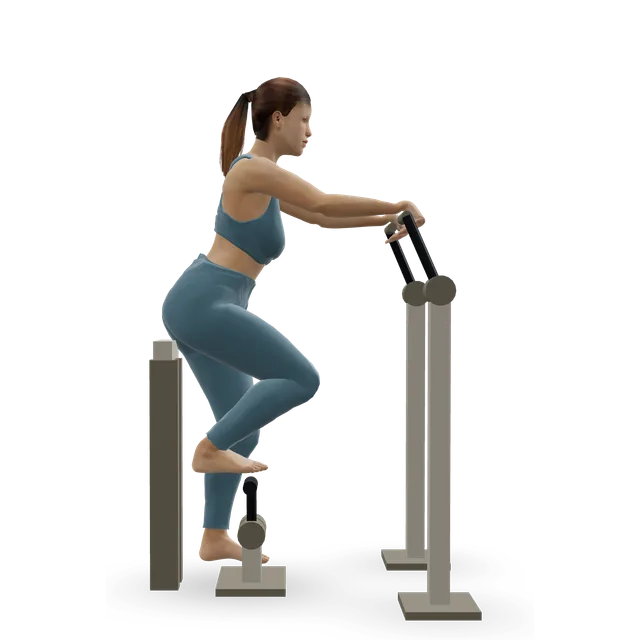 3D demoAir bike intervalsAdvanced · Cardio machine
Similar move, advanced grade.
Source-researched guide. Clinical review is pending.
How to move
- Position your chair or wheelchair facing the arm bike and put the brakes on. Set the handles at or just below shoulder height, close enough that your elbows stay slightly bent at the furthest point.
- Sit tall against the backrest with your feet supported. If your grip is weak, use the strap-in handles or gloves.
- Turn the handles forwards slowly for 2 to 3 minutes to warm up.
- Raise the resistance or speed until you can talk but not sing, and keep a smooth, even rhythm.
- Work for 3 minutes, then turn easily for 1 minute, and repeat; once that feels comfortable, keep going steadily instead.
- Finish with 2 to 3 minutes of easy turning, backwards for the last minute if the machine allows.
Form cues
- Smooth circles, no jerks.
- Shoulders down, chest tall.
- Talk, but don't sing.
- Avoid: leaning forward or sliding in your seat to reach the handles, or setting them above your shoulders.
Practice and cautions
Start with 10 to 20 minutes, twice a week, in 3-minute bouts with 1 easy minute between: our editorial starting point. Build to the spinal cord injury fitness guideline, at least 20 minutes of moderate to vigorous exercise twice a week, then to 30 minutes 3 times a week for heart and metabolic health. Arm-crank trials used 30 to 40 minutes, 3 to 5 times a week, and found moderate-certainty evidence that it improves fitness; its effects on body fat and heart risk are uncertain. In a 9-month trial, arm cranking with strength training twice a week raised arm-cranking power by 81%. Easier: shorter bouts, longer rests or less resistance. Harder: longer steady sessions, harder intervals, or an outdoor hand bike.
If your spinal cord injury is at the sixth thoracic level (T6) or above, empty your bladder first and check that straps and clothing aren't tight. Stop and sit upright if you get a pounding headache, flushing or sweating above your injury, or a stuffy nose, and look for the cause: call 999 if you can't find it or the symptoms don't settle. Below a high injury you may not sweat, so exercise somewhere cool, with a fan, water spray and cold drinks. Your heart rate may not rise much, so judge your effort by talking. Stop for shoulder pain, chest pain, dizziness or unusual breathlessness. This is movement education, not an assessment or treatment prescription. Stop for sharp or increasing pain, dizziness, numbness or tingling; seek individual guidance for symptoms, injury or restrictions.
Sources and review status
Sources support the educational description; they do not establish that this exercise is suitable for you.
- Martin Ginis 2018 · Scientific exercise guidelines for adults with spinal cord injury (international guideline, Spinal Cord) ↗
- Chiou 2022 · Arm-crank exercise in adults with chronic spinal cord injury: 18 studies (systematic review, Frontiers in Physiology) ↗
- Alashram 2024 · Arm crank exercise after spinal cord injury: 7 trials (systematic review, PM&R) ↗
- Hicks 2003 · Nine months of arm cranking and strength training in 34 people with spinal cord injury (randomised controlled trial, Spinal Cord) ↗
- Cratsenberg 2015 · Exercise programmes for shoulder pain in manual wheelchair users: 7 studies (systematic review, Journal of Neurologic Physical Therapy) ↗
- BACPAR 2025 · Physiotherapy before and after a lower limb amputation, 3rd edition (guideline) ↗
- Verschuren 2016 · Exercise and physical activity recommendations for people with cerebral palsy (expert recommendations from the trials, Developmental Medicine and Child Neurology) ↗
- Krassioukov 2021 · Autonomic dysreflexia and other autonomic problems after spinal cord injury (clinical practice guideline, Journal of Spinal Cord Medicine) ↗
- Spinal Injuries Association 2022 · Autonomic dysreflexia (factsheet) ↗
- SCI Guidelines, University of British Columbia · Safety tips for physical activity after spinal cord injury ↗
No variation is labeled clinically validated.
What it works
Muscles
Main: Shoulders, Back. Also: Biceps, Triceps, Chest, Forearms.
Anatomy: Deltoid, Rotator cuff, Supraspinatus, Infraspinatus, Subscapularis, Teres minor.
Equipment
Cardio machine
Level
Beginner. See the easier and harder options above.
Guides that use it
Similar moves

Browse more
Questions people ask
What muscles does the Arm-crank intervals (arm bike) work?
Mainly the shoulders and back, with help from the biceps, triceps, chest and forearms.
What equipment do I need for the Arm-crank intervals (arm bike)?
Cardio machine.
Is the Arm-crank intervals (arm bike) good for beginners?
It is graded beginner, so it suits most people starting out. When it feels easy, try the Air bike intervals.
How do I make the Arm-crank intervals (arm bike) harder?
Progress to the Air bike intervals, or add load, range or slower lowering once your form is solid.