Strength at home
Cerebral palsy strength and balance workout: for people who walk
This follows the structure experts drew from the strength-training trials in cerebral palsy: a few weeks of light, simple exercises first, then functional moves such as sit-to-stands and step-ups, 2 to 3 times a week, for at least 12 to 16 weeks. For the first 2 to 4 weeks, do only the warm-up and the first strength block. Hold a counter, rail or sturdy chair for anything standing. Strength training makes muscles stronger and doesn't make spasticity worse, though how much it changes walking varies from person to person. The moves and doses are our editorial choice within that structure, and your physiotherapist can swap any of them.
Warm-up (about 3 minutes)
- Standing march1 minBeginner · Hip flexors, Abs, Glutes · 3D demoHolding the counter; or march sitting downHarder: Standing band hip flexion
- Thoracic rotation5 each sideBeginner · 3D demoEasier: Side-lying open bookHarder: World's greatest stretch


Simple strength: weeks 1 to 4 on their own (about 7 minutes)
2 rounds · Rest 60 s between rounds
- Seated knee extension (chair)10 each legBeginner · Quads · 3D demoUp for a slow count of 3, down for 5Easier: Quad set (static quads)Harder: Leg extension
- Beginner · Glutes, Hamstrings, Abs · 3D demoEasier: Pelvic tilt into bridgeHarder: Glute kickback (quadruped hip extension)
- Side-lying leg raise10 each sideBeginner · Hip abductors, Glutes · 3D demoEasier: Lateral band walkHarder: Lateral band walk, band at the feet




Functional strength: add from week 3 to 5 (about 10 minutes)
2 rounds · Rest 60 to 90 s between rounds; build to 3 rounds
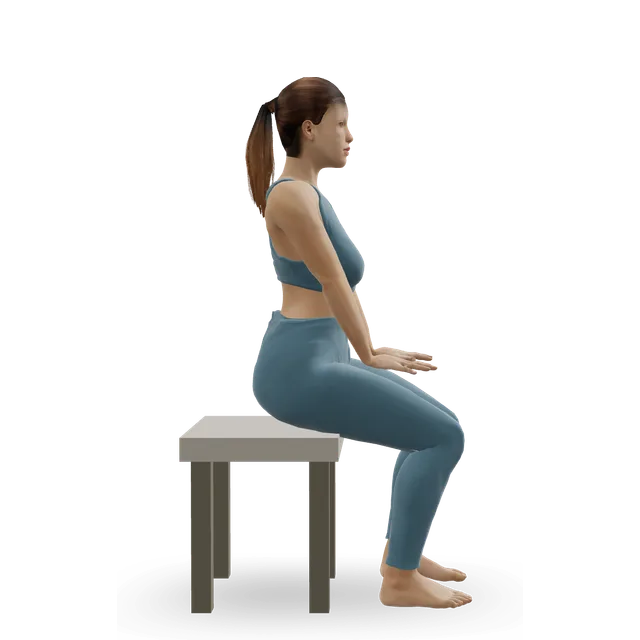
- Beginner · Quads, Glutes, Triceps · 3D demoWhen it's easy, stand up without using your handsHarder: Bodyweight squat
- Low step-up6 to 10 each legBeginner · Quads, Glutes, Hamstrings · 3D demoForwards or sideways onto the bottom stair, holding the railHarder: Step-up
- Slow calf raise10 to 15Beginner · Calves · 3D demoBoth hands on the counterEasier: Seated bent-knee calf raise (soleus raise)Harder: Standing dumbbell calf raise
- Band row10 to 12Beginner · Back, Biceps, Shoulders · 3D demoHarder: Supported single-arm dumbbell row




Balance at the counter (about 3 minutes)
- Semi-tandem stance3 holds of 10 s each sideBeginner · Calves, Hip abductors · 3D demoOne hand on the counterHarder: Tandem stance and heel-to-toe walk
- Side-stepping (sideways walking)10 steps each wayBeginner · Hip abductors, Glutes, Adductors · 3D demoHarder: Lateral band walk


Stretch for comfort (about 3 minutes)
- Wall calf stretch (gastrocnemius)30 to 45 s each sideBeginner · Calves · 3D demoEasier: Seated calf stretch with a towelHarder: Toes-tucked kneeling (toe squat)
- Supine hamstring stretch with a strap30 to 45 s each sideBeginner · Hamstrings, Calves · 3D demoEasier: Leg-up hamstring stretchHarder: Contract-relax hamstring stretch (PNF)


Tips
- Do it 2 to 3 times a week on days that aren't next to each other, for at least 12 to 16 weeks. Strength gains fade quickly if you stop, so keep a shorter version going afterwards.
- Make it harder by adding reps, then a third round, then a light backpack or ankle weight. The trials used 6 to 15 reps a set.
- Fatigue is common with cerebral palsy. On a tired day, do one round; if you need longer to recover than the session took, do less next time.
- Stretches feel good but don't, on their own, stop muscles tightening. Staying strong and active, positioning and any splints your team gives you do more.
- If pain is new or getting worse, or walking is getting harder, see your GP or cerebral palsy team.
- Children: keep it playful, with an adult nearby, and fit it around the programme their physiotherapist set.
- Call 999 for chest pain that feels tight or spreads to your arms, neck or jaw.
The doses are suggested starting points, not a prescription. Choose a range you can control and stop for sharp or increasing pain, numbness or tingling. Get individual advice after an injury or surgery, or if you are pregnant or managing a health condition.
Guides that recommend it
Find more moves like these
More strength at home




Beginner bodyweight workout
A 20-minute full-body workout with no equipment: squats, knee push-ups, bridges, lunges and planks.
20 minBeginner10 movesNo equipment


Full-body bodyweight workout
An intermediate no-equipment workout: push-ups, split squats, single-leg bridges, pike push-ups and core work.
30 minIntermediate11 movesNo equipment


Full-body dumbbell workout
A 35-minute full-body strength workout with dumbbells: goblet squats, presses, rows, Romanian deadlifts and carries.
35 minIntermediate9 movesA band, A dumbbellQuestions people ask
How long does the cerebral palsy strength and balance workout: for people who walk take?
About 25 minutes, including any warm-up and cool-down listed. Shorten it by doing fewer rounds; lengthen it by adding one.
What equipment do I need?
You need: A bench or box, Something with weight, A step, A wall, A band, An anchor point. Each move links to its guide, where you can find an alternative if you are missing something.
Is it suitable for beginners?
It is written for beginners. 7 of its 15 moves have an easier option listed beside them if you need one.
How do I make it easier or harder?
Use the easier or harder option listed under each move, change the number of rounds, or adjust the rest. Progress one change at a time.