Side-lying leg raise
Lying on the side, the straight top leg lifts with the heel leading; on pooled data from 8 studies it works the gluteus medius at a moderate level, about 40% of its maximum, more than clamshells.
Hip abduction family
Side-lying leg raise
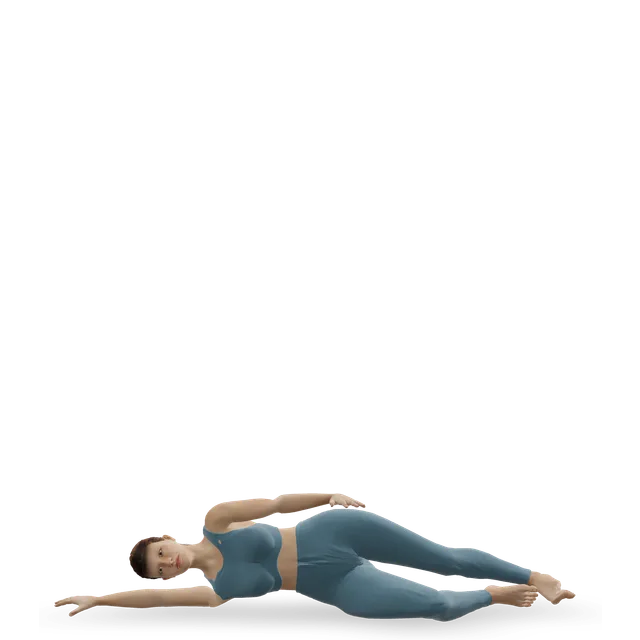
Loading the 3D figure…
Source-researched guide.
How to move
- Lie on your side in one straight line, the head on the outstretched lower arm and the bottom knee bent for balance.
- Lift the top leg to about 30 to 45 degrees with the heel leading and the toes pointing forward, not up, stopping before your pelvis tips.
- Lower it slowly without letting the leg drift in front of the body.
Form cues
- Keep the leg slightly behind the line of the body.
- Don't let your pelvis roll back.
- A light ankle weight makes it harder.
Practice and cautions
No universal dose is assigned. Choose a manageable amount for your current capacity, leave room for controlled repetitions, and allow recovery. A clinician’s individual plan takes priority.
With pain on the outside of the hip, start with lying and standing holds and bridges, and leave side-lying leg raises out while it hurts at night: the trial that did best for this pain didn't use them. When they come back, lie on your good side with a pillow between your knees, keep the top leg level with your hip or slightly behind, keep the lift small, and stop if the bony point on the side of your hip gets sorer or your nights get worse. Letting the leg drift forward or the toes turn upward hands the work to the hip flexors, so keep the leg slightly behind your body line with the heel leading, and don't let your pelvis roll back. This is movement education, not an assessment or treatment prescription. Stop for sharp or increasing pain, dizziness, numbness or tingling; seek individual guidance for symptoms, injury or restrictions.
Sources and review status
Sources support the educational description; they do not establish that this exercise is suitable for you.
- Moore 2020 · Exercises for the gluteus medius and minimus: systematic review and meta-analysis (resisted standing abduction high, about level with resisted side-stepping) ↗
- DiStefano 2009 · Gluteal activation in 12 rehabilitation exercises (EMG, JOSPT) ↗
- McBeth 2012 · Hip muscle activity in 3 side-lying exercises in 20 runners: toes forward worked the gluteus medius most, toes up shifted work to the front of the hip (EMG, J Athl Train) ↗
- Baik 2021 · Rolling the pelvis back during side-lying hip abduction lowered gluteus medius activity, in 21 people with weak hip abductors (EMG, J Athl Train) ↗
- Mellor 2018 · Education plus exercise, a steroid injection or wait and see for outer hip tendon pain: 204 people; the exercise programme used no clamshells (randomised trial, BMJ) ↗
- Mellor 2016 · The LEAP trial protocol for outer hip tendon pain: its exercises were holds, bridges, squats and side steps, with no side-lying leg raise (BMC Musculoskelet Disord) ↗
- NHS inform · Greater trochanteric pain syndrome (avoid lying on the painful side; on the good side, a pillow between the legs; patient information, NHS 24, Scotland) ↗
No variation is labeled clinically validated.
What it works
Muscles
Main: Hip abductors, Glutes.
Anatomy: Gluteus medius, Gluteus minimus, Tensor fasciae latae, Gluteus maximus, Piriformis, Obturator internus.
Equipment
None: body weight and floor space.
Level
Beginner. See the easier and harder options above.
Workouts that use it
- Glute workout at home · 25 min
- Beginner home workout · 20 min
- Beginner Pilates workout · 20 min
- Full-body mat Pilates workout · 30 min
- Pregnancy Pilates workout (no lying on your back) · 20 min
- Kyphosis exercises for seniors: a spine-strengthening routine · 30 min
- Hypermobility exercises: a strength and control routine · 25 min
- PoTS exercises: a lying and seated starter session · 30 min
Show all 40 workoutsShow fewer workouts
- Stump exercises after a leg amputation: above and below knee · 20 min
- Cerebral palsy strength and balance workout: for people who walk · 25 min
- Return to running after birth: readiness checks and strength · 25 min
- Strength workout for horse riders: core endurance, hips, legs and back · 40 min
- Strength workout for roller skaters: legs, hips, ankles, wrists and how to fall · 40 min
- Pilates for knee pain: a 25-minute class with no kneeling · 25 min
- Pilates glute workout: a 25-minute mat class (with a band if you have one) · 25 min
- Lateral pelvic tilt routine: side-hip strength and control · 25 min
- Glute session A: bridges to hip thrusts, split squats and side-hip work · 20 min
- Hip and core control routine: even strength around the pelvis · 25 min
- Mat Pilates after a hip replacement: a 25-minute return class with no deep hip bends · 25 min
- Seat-and-symmetry Pilates for horse riders: a 25-minute mat and standing class · 25 min
- Knee release routine: roll, stretch, strengthen · 15 min
- Gentle postnatal Pilates: a 20-minute class from about 6 weeks after birth, with an early stop point and caesarean options · 20 min
- Chair-to-mat Pilates for bigger bodies: a 30-minute class standing, at a chair and on the mat, with a chair-only option · 30 min
- Hip strengthening workout: bridges, side hips, single-leg control and balance · 30 min
- Yoga for shin splints: a 25-minute class with calf, shin and hip strength, and no jumping · 25 min
- Knees-over-toes Pilates: a 25-minute class for the side hips, the feet and knee tracking · 25 min
- Impact-free Pilates for shin splints: a 25-minute class for calf and shin endurance, the hips and one-leg balance · 25 min
- Yoga for IT band syndrome: a 25-minute class for side-hip strength and one-leg control, with no cross-body stretches · 25 min
- Ankle weight leg workout: knees, hips and glutes at home · 25 min
- Pinch-free Pilates for a hip labral tear or impingement: a 25-minute class for hip strength in every direction · 25 min
- Low-impact Pilates for lipoedema (lipedema): a 25-minute leg and hip strength class with no jumping or kneeling · 25 min
- Floor Pilates for PoTS: a 20-minute class that never asks you to stand · 20 min
- Floor yoga for PoTS: a 25-minute lying, side-lying and seated class with one slow stand at the end · 25 min
- Tendon-friendly Pilates for jumper's knee: a 25-minute class with the loading plan's holds built in, shallow knee bends and no jumping · 25 min
- Knee-kind Pilates after ACL surgery: a 25-minute class in three stages, with no kneeling until you're cleared · 25 min
- Every-direction hip Pilates for arthritis: a 25-minute class with no deep bends and a flare-day stop point · 25 min
- Pilates after a groin strain: a 25-minute class with squeezes, side-lying work and side planks, and no wide-legged stretching · 25 min
- Hip Pilates: a 25-minute class for strength, range and control in every direction · 25 min
- Tendon-friendly yoga for jumper's knee: a 25-minute class with the loading plan's holds built in, shallow knee bends, no kneeling and no jumping · 25 min
- Hips-to-calves Pilates: a 30-minute lower body class with a harder option for every move · 30 min
Pain guides that use it
Part of a staged plan, with when to get help first.
- SI joint pain: exercises, belts and what the evidence really shows
- Exercises for hip pain, and when to get it checked
- Hip arthritis exercises: a staged plan that follows the guidelines
- Hip bursitis and gluteal tendinopathy: exercises that help, and positions to avoid
- Piriformis syndrome (deep gluteal syndrome): what helps, and what it might really be
- Exercises for knee pain: what helps, and a plan to follow
- Runner's knee (patellofemoral pain): exercises that help
- Exercises for knee arthritis (osteoarthritis)
Show all 53 pain guidesShow fewer pain guides
- IT band syndrome: exercises for outer knee pain
- Meniscus tear exercises: when exercise is the first treatment
- Shin splints exercises: settle, strengthen, return to running
- Exercises after a hip replacement, and what hip precautions mean
- Baker's cyst (a swelling behind the knee): what helps, and when it's urgent
- Chronic ankle instability: exercises for an ankle that keeps rolling
- Stress fractures of the foot, shin, thigh and hip: recovery and getting back to running
- Exercises after a broken ankle: a stage-by-stage recovery plan
- Tailbone pain (coccydynia): what helps, what the evidence shows, and when to get it checked
- Snapping hip: why your hip clicks or pops, and exercises that help
- Exercises after a broken leg (tibia and fibula): the recovery stages and warning signs
- Broken foot (metatarsal fracture): fifth metatarsal and Jones fractures, recovery and exercises
- Lisfranc injury (midfoot sprain or fracture): diagnosis, treatment and recovery
- Exercises after meniscus surgery: recovery after a trim or a repair
- Recovery after bunion surgery: the post-op shoe, swelling and exercises
- Exercises after hip arthroscopy: recovery after impingement or labral surgery
- Knee bursitis (housemaid's knee): what helps, and when it's infected
- Meralgia paresthetica: a burning, numb outer thigh, what helps and when it's your back
- Avascular necrosis of the hip: causes, stages, treatment and safe exercise
- Hip pointer: a bruised hip bone, the teenage fractures that mimic it, and getting back to sport
- Fat pad impingement (Hoffa's syndrome): pain below the kneecap when the knee straightens fully
- Perthes disease: when the ball of a child's hip loses its blood supply, and how it regrows
- Slipped upper femoral epiphysis (SUFE or SCFE): an urgent teenage hip problem, surgery and sport
- Broken heel (calcaneus fracture): weight limits, surgery or not, and walking again
- Freiberg's disease: pain under the second toe joint, offloading, and getting back to sport and dance
- In-toeing (pigeon toes) in children: what's normal at each age, and when to see a GP
- Exercises after ankle ligament surgery: recovery after a Broström repair or reconstruction
- Exercises after knee cartilage surgery: microfracture, cell transplants (ACI) and grafts
- Knee pain when squatting: what's likely, what to change today and how to build back to depth
- Hip pain when cycling: groin, outer hip or buttock, what to change on the bike and how to build back
- Hip pain at night: lying on your side, the outer hip, arthritis and the warning signs
- Knee pain when kneeling: the kneecap, bursitis, knee replacements, knee pads and how to build back
- Knee pain when walking: where it hurts, arthritis, the kneecap, shoes, sticks and how to build back
- Outer knee pain: the IT band, the outer ligament, the meniscus, the nerve and how to build back
- Outer hip pain: the tendons and bursa, the IT band, the back or the hip joint, and how to build back
- Knee pain when sitting or standing up: the kneecap, arthritis, the back of the knee and what helps
- Knee pain after a workout or leg day: soreness or an injury, the moves behind it, and training again
- Knee pain in pregnancy: the kneecap, weight and looser joints, swelling, exercise by trimester
- Knee pain when crossing your legs: the kneecap, the outer knee, the meniscus, a nerve and what helps
- Knee pain on the leg press: the kneecap, the tendon, depth, foot position, lockout and what helps
- Knee pain on the leg extension: the kneecap, the tendons, range, the pad and what helps
- Hip pain on the leg press: the pinch in the hip crease, depth, foot position, the groin and swaps
- Knee pain when hiking: going downhill, the kneecap and the outer knee, poles, pack weight and pace
- Hip pain after dancing: the front of the hip, the groin, snapping, turnout and kicks, and what helps
- Back pain from horse riding: sitting trot, saddle and stirrups, the tailbone, the yard and falls
Guides that use it
- Pilates guide
- Pilates for beginners guide
- Pilates for back pain guide
- Pilates for seniors guide
- Pilates in pregnancy guide
- Pilates for hypermobility guide
- Pilates for knee pain guide
- Pilates for hip pain guide
Show all 88 guidesShow fewer guides
- Pilates for glutes guide
- Pilates after a hip replacement guide
- Pilates after a knee replacement guide
- Pilates for horse riders guide
- Pilates for fertility guide
- Postnatal Pilates guide
- Pilates for plus-size bodies guide
- Pilates for piriformis syndrome guide
- Pilates for knock knees guide
- Pilates for shin splints guide
- Pilates for IT band syndrome guide
- Pilates for hip bursitis guide
- Pilates for a hip labral tear guide
- Pilates for a meniscus tear guide
- Pilates for lipoedema guide
- Pilates for POTS guide
- Pilates for patellar tendinopathy guide
- Pilates after spinal fusion guide
- Pilates after ACL surgery guide
- Pilates for knee arthritis guide
- Pilates for hip arthritis guide
- Pilates for a groin strain guide
- Pilates for your hips guide
- Pilates for hip dips guide
- Pilates for the lower body guide
- Pilates for the thighs guide
- Yoga for hip pain guide
- Hip-opening yoga guide
- Yoga for glutes guide
- Yoga for piriformis syndrome guide
- Yoga after a hip replacement guide
- Yoga for hip bursitis guide
- Yoga for shin splints guide
- Yoga for IT band syndrome guide
- Yoga for a meniscus tear guide
- Yoga for PoTS guide
- Yoga for Down syndrome guide
- Yoga for knock knees guide
- Yoga for patellar tendinopathy guide
- Yoga for hip mobility guide
- Hip joint guide
- IT band guide
- Kinesiology tape guide
- Hips guide
- Glutes guide
- Knees guide
- Cellulite guide
- Hypermobility guide
- Lipoedema guide
- Exercise in pregnancy
- Exercise after giving birth
- Exercise for arthritis
- Exercise for hypermobility
- Exercise for PoTS
- Exercise for lipoedema (lipedema)
- Exercise for endometriosis
- Exercise after an amputation
- Exercise with cerebral palsy
- Exercise for Down syndrome
- Exercise for psoriatic arthritis
- Exercise for sarcopenia
- Knock knees guide
- Bow legs guide
- Lateral pelvic tilt guide
- Leg length discrepancy guide
- Pelvic rotation guide
- Glute bridges guide
- How to grow your glutes guide
- Hip abduction machine guide
- Clamshells guide
- Band walks guide
- Side-lying leg raises guide
- Single-leg glute bridge guide
- Hip dips guide
- Hip fat guide
- Strengthen your knees guide
- Strengthen your hips guide
- Ankle weights guide
- Horse riding guide
- Roller skating guide
Similar moves
Browse more
Questions people ask
What muscles does the Side-lying leg raise work?
Mainly the hip abductors and glutes.
What equipment do I need for the Side-lying leg raise?
No equipment: your body weight and a little floor space.
Is the Side-lying leg raise good for beginners?
It is graded beginner, so it suits most people starting out. When it feels easy, try the Lateral band walk, band at the feet.
What is an easier alternative to the Side-lying leg raise?
Try the Lateral band walk or the Standing band hip abduction. Both are written steps in the same progression.
How do I make the Side-lying leg raise harder?
Progress to the Lateral band walk, band at the feet or the Side plank with leg lift. Follow that guide’s technique and any stated timing.