Pain guide · Knee pain

Fat pad impingement (Hoffa's syndrome): pain below the kneecap when the knee straightens fully

Behind and below the tendon under your kneecap sits a cushion of fat, the infrapatellar or Hoffa's fat pad. It's packed with nerves, so when it gets pinched, usually as the knee straightens fully or is pushed back past straight, it can cause a sharp, pinching pain under and either side of the tendon. Stairs, standing with your knees locked back and the very end of straightening are the usual triggers. It's uncommon, and it's usually considered once more common causes of pain at the front of the knee have been looked at.

No trial has tested a treatment, so this guide sets out what expert reviews advise: take the pinch out for a few weeks, with taping if a physiotherapist offers it and no forced straightening, build thigh and hip strength in the middle of the range, then bring full straightening back. It also explains why scans often show fat pad changes in knees that don't hurt, and when injections or keyhole surgery are considered.

When to get help first

Exercise is for pain that has been checked or is clearly mild and settling.

Get urgent medical help if

  • A hot, red or swollen knee with sudden severe pain, a very high temperature, or feeling hot, cold or shivery. This can be a joint infection.
  • You cannot move the knee or put any weight on it, or it is very painful, badly swollen or has changed shape.
  • You hurt your knee and cannot take 4 steps, or you are 55 or over and hurt it in a fall: get it checked the same day for a broken bone.
  • The knee is locked and you cannot fully straighten it. The fat pad can pinch, but a knee that won't straighten needs checking for a torn meniscus or a loose fragment.
  • Leg pain or swelling with breathlessness or chest pain: call 999 or go to A&E, and do not drive yourself. It can be a blood clot that has reached the lungs.

See a doctor or physiotherapist if

  • Knee pain that has not improved within a few weeks of looking after it at home. Many areas offer NHS physiotherapy without a GP referral.
  • The knee gives way, the whole knee swells, or it catches: that isn't typical of fat pad pain. Get it checked for a ligament or meniscus injury.
  • A soft swelling on the front of the kneecap after kneeling, or heat and redness over it: that's bursitis, which can be infected. Our knee bursitis guide covers it.
  • No clear improvement after about 3 months of a good rehab programme: ask about a referral to discuss other options, such as an injection or surgery.
  • Pain at the front of the knee and stiffness after knee surgery or a knee replacement that isn't improving as your team expects: tell them. Scarring of the fat pad is one cause.

Understand it

What it is

The infrapatellar fat pad, also called Hoffa's fat pad, fills the front of the knee behind and below the tendon under the kneecap. It sits inside the joint capsule but outside the joint lining, and it's richly supplied with blood vessels and nerves. Fat pad impingement (Hoffa's syndrome, or Hoffa's disease) is pain from the pad being pinched, usually between the kneecap, the thigh bone and the shin as the knee straightens. Albert Hoffa described it in 1904.

Two other fat pads at the front of the knee can be pinched too: one above the kneecap, behind the quadriceps tendon, and one in front of the thigh bone. Radiologists use 'impingement' for swelling in any of them.

Sources 1, 2, 3, 4

Why it can hurt so much

In one surgeon's test on his own knees, without anaesthetic, probing the fat pad, the lining at the front and the capsule gave severe, precisely located pain, while the cartilage behind the kneecap gave none. Injecting salt water into the fat pad causes pain at the front of the knee in healthy volunteers, and in one study it delayed and reduced thigh muscle activity on stairs.

Sources 5, 3

How it feels, and what sets it off

A sharp or burning pain beneath and either side of the tendon below the kneecap, worse at full straightening or when the knee is pushed back past straight, on stairs, after long standing and sometimes when the knee is held bent. There may be puffiness either side of the tendon.

Described causes include a direct blow, and scarring after an injury or knee surgery. Reviews advise avoiding over-straightening in long-term management, which suggests that repeatedly pushing the knee back plays a part, though that hasn't been proven.

Sources 2, 1, 3

How it's recognised

It's often diagnosed after more common causes of pain at the front of the knee have been considered, such as runner's knee, jumper's knee, a meniscus tear and bursitis, and it's easily missed. A clinician looks for tenderness either side of the tendon and pain when the knee is pushed fully straight.

Hoffa's test (pressing either side of the tendon with the knee bent, then straightening it) is widely used, but nobody has published how accurate it is, and it was positive in 17 of 44 healthy young adults in a 2026 study. In one surgical series of 18 people, it was positive in 83%.

Sources 3, 2, 6

How common it is

Nobody knows how common it is in the general population. In keyhole surgery series, fat pad impingement on its own was uncommon, and it was found more often alongside other damage, such as a meniscus or ligament tear. A 2026 review of 137 studies of fat pad problems found surgery reported more often than physiotherapy, and few tested treatment programmes.

Sources 3, 2, 7

What a scan does and doesn't meanEmerging evidence

MRI (magnetic resonance imaging) is the usual scan when one is needed, mostly to rule out other problems. But fat pad changes are common in knees that don't hurt, as the list below shows. Swelling in the upper outer part of the fat pad goes with a high-riding or outward-tracking kneecap (9 studies), and in 63 teenage competitive skiers scanned twice it was seen in 23 knees at the start and 34 knees 4 years later. Fat pad size and blood flow didn't differ between people with kneecap pain and people without.

So a report of fat pad oedema (swelling) describes the fat pad. Whether it's causing your pain is decided by the examination and the story.

  • Fat pad oedema in 75% of 24 college basketball players' pain-free knees before a season, and 81% after it.
  • Bright areas in the fat pad in 33% of 43 healthy adults, 37% of 35 people with kneecap pain and 73% of 22 with knee arthritis; only in arthritis did those areas show the extra blood flow that suggests inflammation.
  • 'Hoffa's synovitis' in 23% of 230 knees of inactive adults without symptoms.
  • Fat pad oedema in 11 of 1,910 13-year-olds in a population study.

Sources 7, 1, 8, 9, 10, 11, 12, 4, 13, 14, 3

What helps, and how strong the evidence is

No trial has tested any treatmentEmerging evidence

A 2025 appraisal by an NHS physiotherapist found no studies from 2015 to 2025 comparing physiotherapy with and without a steroid injection, and concluded there is 'currently no evidence supporting the best conservative management' of fat pad impingement. Her service manages it with physiotherapy (leg strengthening and work on how you move), a scan if the diagnosis is unclear, and a possible guided steroid injection, decided together with the patient.

A 2016 review by NHS surgeons found only five observational studies of treatment, and a 2026 review of 137 studies found few tested programmes and no standard approach. Everything that follows is expert opinion and small studies without a comparison group.

Sources 15, 3, 7

What expert reviews advise: unload it, strengthen around itEmerging evidence

Expert reviews advise physiotherapy first: taping by a physiotherapist to unload the fat pad, avoiding over-straightening, thigh exercises with your feet on the floor or a footplate to improve control, and strengthening the buttock muscles at the side of the hip and stretching the front of the hip to reduce the knee falling inwards. A UK review describes a strong consensus for physiotherapy before any operation.

Some lab work supports starting away from full straightening: in 13 healthy adults, thigh holds with the knee bent only 5° stiffened and flushed the fat pad more than holds at 30°, and the space in front of the fat pad changes most between straight and 30° of bend under load. The plan follows this advice. It's expert opinion and lab studies in healthy people, not trials.

Sources 1, 3, 16, 17

Taping: a support while strength builds, not a fixMixed evidence

No trial has tested taping for fat pad pain. Physiotherapists use it to unload the fat pad while you build strength, and some people find it eases the pain. For kneecap pain in general, an expert consensus panel was uncertain whether taping helps, while it strongly supported exercise for the hip and knee together.

Sources 1, 18, 19

Injections: sometimes used when other treatment hasn't helped, on limited evidenceEmerging evidence

Some clinicians offer an injection into the fat pad, usually a steroid with local anaesthetic and sometimes guided by ultrasound, when rehab hasn't helped. No trial has tested it for fat pad impingement, and the NHS appraisal found no studies to guide it. Reports without a comparison group describe relief, but follow-up was short.

In a placebo-controlled trial of 60 people with knee arthritis, a different problem, steroid injected into the fat pad didn't reduce pain more than salt water. In a study of people with suspected fat pad pain, people improved after either platelet-rich plasma (PRP) or standard care, and changes in fat pad size didn't match how their symptoms changed.

Sources 15, 3, 20, 21

Surgery: considered after at least 3 months of good rehabEmerging evidence

Keyhole removal of the pinched or scarred part of the fat pad is considered when symptoms continue after at least 3 months of physiotherapy. In 18 people (median age 22), pain fell from about 7 to 2.4 out of 10 at 2 years and was 3.7 at about 12 years, with no complications and no extra arthritis on X-ray. Earlier series of 11 and 34 people also improved.

None of these had a comparison group, so it's unclear how much of the improvement was the surgery. Removing the whole fat pad during a knee replacement is a different question, with conflicting results.

Sources 2, 22, 3, 1

Other treatments: little to showEmerging evidence

In one trial in healthy students, hands-on treatment of the fat pad had only limited immediate effects on how it moved. Electrotherapy, such as ultrasound or TENS (transcutaneous electrical nerve stimulation), isn't recommended for kneecap pain and hasn't been tested for fat pad impingement.

Sources 23, 18

How much pain is OK while you exercise?

The knee rule, aiming low, with no sharp pinch at the end of straightening (borrowed)Emerging evidence

No study has tested a pain rule for fat pad impingement, so this one is borrowed from our knee guides. Rate the pain from 0 to 10 during and after exercise: in the pain-monitoring model used in knee trials, 0 to 2 counts as safe, up to 5 as acceptable and above 5 as too much. Aim for 0 to 3 most of the time. In a meta-analysis, exercising into some pain did no worse than pain-free exercise.

A sharp, pinching pain below the kneecap as the knee straightens is the exception: stop that exercise a few degrees short of straight for now (our suggestion, following the expert advice).

By the next morning, the area either side of the tendon should be no sorer or puffier than usual. If it is, shorten the range or drop back a step.

Catching, locking, giving way or new swelling of the whole knee isn't part of the rule: stop and get it checked.

Sources 24, 25, 26, 1, 16

The exercise plan: 3 stages

Start at the first stage. Each move opens a full guide with a 3D demo.

Stage 1

Settle: take the pinch out (about weeks 0 to 2)

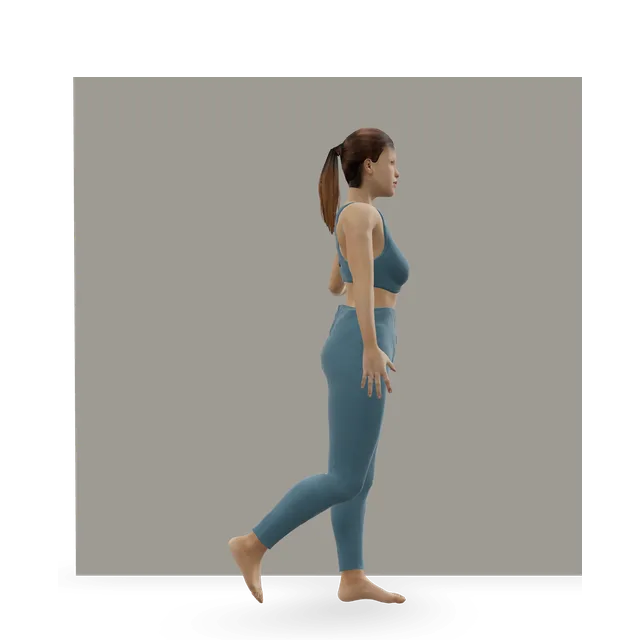
Stand with soft knees rather than pushed back (the steps are in the notes below the plan). Leave out exercises and stretches that force the knee fully straight, stop just short of locking out, and set the bike saddle so the knee stays slightly bent at the bottom. Ice wrapped in a towel can ease a flare. Strength work 3 days a week. Doses are borrowed from our knee guides or the move pages and are editorial in origin.

Wall sit demonstrated on the 3D figure3D demoWall sitBeginner · A wall

4 holds of 20 to 45 s · Knees bent about 30° to 60°, away from full straightening. The knee hub's dose

Easier: Straight-leg raise · Harder: Spanish squat (band squat hold)

Sit to stand from a chair demonstrated on the 3D figure3D demoSit to stand from a chairBeginner · A bench or box

3 sets of 8 to 12 · Stand up to soft knees, without snapping them back. The knee hub's dose

Harder: Bodyweight squat

Clamshell demonstrated on the 3D figure3D demoClamshellBeginner · No equipment

3 sets of 12 to 15 each side · Hip strength. Our runner's knee guide's dose

Harder: Lateral band walk

Side-lying leg raise demonstrated on the 3D figure3D demoSide-lying leg raiseBeginner · No equipment

3 sets of 12 each side · Skip it if the outer hip is sore. The knee hub's dose

Easier: Lateral band walk · Harder: Lateral band walk, band at the feet

Stationary cycling demonstrated on the 3D figure3D demoStationary cyclingBeginner · Cardio machine

10 to 20 min, easy · Saddle set so the knee stays slightly bent at the bottom of the stroke

Harder: Air bike intervals

Move on when: Walking, stairs and standing still are within the pain rule, and standing with soft knees is becoming a habit.

Follow along: a timer, a cue and the next move, one step at a time.
Stage 2

Build: thigh and hip strength in the middle of the range (about weeks 2 to 6)

2 to 3 strength days a week, with your feet on the floor or a footplate, as the expert reviews advise. Finish every repetition at soft knees.

Leg press demonstrated on the 3D figure3D demoLeg pressBeginner · Strength machine

3 sets of 10 to 12 · From a comfortable depth to just short of straight, without locking. Editorial dose

Harder: Bodyweight squat

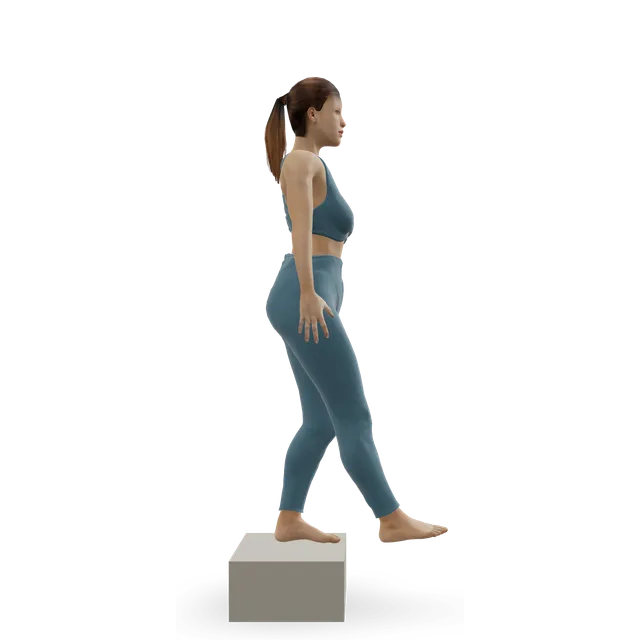
Step-up demonstrated on the 3D figure3D demoStep-upBeginner · A step

3 sets of 8 to 10 each leg · Low step first; finish tall with a soft knee. The knee hub's dose

Easier: Low step-up · Harder: Dumbbell step-up

Split squat demonstrated on the 3D figure3D demoSplit squatIntermediate · No equipment

3 sets of 8 each leg · The knee hub's dose

Easier: Bodyweight squat · Harder: Reverse lunge

Lateral band walk demonstrated on the 3D figure3D demoLateral band walkBeginner · A band

3 sets of 12 steps each way · Band above the knees. Our runner's knee guide's dose

Easier: Hip abduction machine · Harder: Lateral band walk, band at the feet

Standing hamstring curl demonstrated on the 3D figure3D demoStanding hamstring curlBeginner · A wall

3 sets of 10, holding 5 s at the top · The hamstrings help control the end of straightening. The move page's dose

Harder: Slider hamstring curl

Single-leg stand demonstrated on the 3D figure3D demoSingle-leg standBeginner · A wall

3 holds of 30 s each leg · Standing knee soft. The knee hub's dose

Easier: Tandem stance and heel-to-toe walk · Harder: Single-leg reach matrix

Move on when: 3 sets of 12 sit-to-stands and 10 step-ups on each leg feel fine without the pinch, and the knee has settled by the next morning.

Follow along: a timer, a cue and the next move, one step at a time.
Stage 3

Bring back full straightening, then load (about weeks 6 to 12)

Bring back the last part of straightening a few degrees at a time, then heavier single-leg work, landing and running. Doses are our knee guides', the move pages' or editorial. If there's no clear improvement after about 3 months of doing this well, ask about a referral.

Seated knee extension (chair) demonstrated on the 3D figure3D demoSeated knee extension (chair)Beginner · A bench or box + Something with weight

3 sets of 10 to 15 each leg · Start in the bent half (from 90° to about 30°), adding the last part of straightening gradually while it doesn't pinch. The move page's dose; the range steps are editorial

Easier: Quad set (static quads) · Harder: Leg extension

Patrick step-down demonstrated on the 3D figure3D demoPatrick step-downIntermediate · A step

3 sets of 8 to 10 each leg · The knee hub's dose

Easier: Bodyweight squat · Harder: Skater squat

Single-leg Romanian deadlift demonstrated on the 3D figure3D demoSingle-leg Romanian deadliftAdvanced · A dumbbell

3 sets of 8 each leg · Standing knee soft. The knee hub's dose

Easier: Dumbbell Romanian deadlift

Snapdown to athletic landing demonstrated on the 3D figure3D demoSnapdown to athletic landingBeginner · No equipment

2 to 3 sets of 5 · Land on soft knees, before jumping sports. Editorial dose

Harder: Box drop landing

Treadmill jogging demonstrated on the 3D figure3D demoTreadmill joggingIntermediate · Cardio machine

Walk-jog intervals on the flat · If you run. Editorial

Easier: Treadmill walking · Harder: Sprint intervals

Move on when: Full straightening, standing and daily life are comfortable. Then go back to sport, keeping two strength sessions a week.

Follow along: a timer, a cue and the next move, one step at a time.

What to change for now

Standing with soft knees

Standing with your knees pushed back as far as they go puts the fat pad in the pinching position. These steps are our suggestion, in line with the reviews' advice to avoid over-straightening and the NHS advice not to overextend your joints.

  • 1. Stand with your feet hip-width apart and your weight spread across the whole foot.
  • 2. Notice whether your knees are pushed back as far as they will go.
  • 3. Unlock them very slightly: a millimetre or two, not a bend anyone could see.
  • 4. Feel the front of the thigh switch on gently, and keep breathing.
  • 5. Practise for a minute at a time when you're standing still, such as in a queue or at the cooker.
  • 6. If you feel faint while standing, cross your legs or rock up and down on your toes, as the NHS advises.

Sources 1, 27, 28

Taping

If a physiotherapist offers taping, its purpose is to unload the fat pad while you build strength. We don't teach a technique here: no taping method has been tested for fat pad pain, and for kneecap pain in general the evidence on tape is uncertain.

Sources 1, 18

Leg extensions, quad sets and stretches

Thigh work near full straightening is where the fat pad is squeezed most. For now, do leg extensions in the bent half of the range, tighten the thigh with a small rolled towel under the knee rather than pressing the back of the knee hard into the floor, and leave out stretches that prop the heel up and push the knee straight. These are our suggestions, from lab studies in healthy people.

Sources 16, 17

When to ask about more

If there's no clear improvement after about 3 months of a good programme, ask about a referral. Surgeons in the published series operated only after at least 3 months of physiotherapy, and a UK review describes a strong consensus for physiotherapy first.

Sources 2, 3

After knee surgery or a knee replacement

Scarring of the fat pad after an operation can cause pain at the front of the knee and stiffness. Tell your surgical team if pain at the front of the knee isn't improving as expected; this plan isn't a substitute for their rehab.

Source 1

Positions to swap, and why

Habit or positionWhy it mattersInstead
Standing with the knees locked or pushed backOver-straightening pinches the fat pad, and expert reviews advise avoiding it.Soft knees: the steps are in the notes above.
Snapping into lockout at the top of leg presses, squats and step-upsSame reason; the move pages' own cues say not to lock the knees.Finish each repetition just short of straight for now.Try: Wall sit
Quad sets pressing the back of the knee hard into the floorTightening the thigh with the knee nearly straight stiffened and flushed the fat pad more than at 30° of bend in healthy adults.Wall holds at 30° to 60°, or a quad set over a small rolled towel.Try: Wall sit
The leg extension machine through full straightening, early onLoad near full straightening is where the fat pad is squeezed.Seated knee extensions in the bent half of the range, adding the last part in stage 3.Try: Seated knee extension (chair)
Knee hangs and stretches that force the knee straightThey push the knee into the pinching position (our reasoning).Heel slides and gentle movement.Try: Supine heel slide
A bike saddle so high that the knee straightens fully at the bottomFull straightening on every pedal stroke (our reasoning, and the move page's cue).Set the saddle so the knee stays slightly bent.
Locking the knees as each pedal goes back on the ellipticalThe move page's own caution.Keep the knees soft.
Relying on tape aloneNo trial supports it; tape is a support while strength builds.Tape, if a physiotherapist offers it, plus the strength stages.Try: Wall sit
Asking for an MRI to find the fat padFat pad changes are common in knees without pain.An examination first; scans to rule out other causes.

Routines to follow

More moves for this area

Questions people ask

What is fat pad impingement?

The fat pad behind and below your kneecap tendon gets pinched, usually as the knee straightens fully or is pushed back. Because the pad is packed with nerves, that can be very painful. It's also called Hoffa's syndrome or Hoffa's disease.

Where is the pain?

Under and either side of the tendon below the kneecap. It's worst at the very end of straightening, when you stand with the knee pushed back, and on stairs, sometimes with puffiness either side of the tendon.

How is it diagnosed?

From the story and an examination, usually after more common causes such as runner's knee, jumper's knee and a meniscus tear have been considered. Hoffa's test is commonly used, but its accuracy hasn't been measured, and it was positive in 17 of 44 healthy young adults.

My MRI shows fat pad oedema. What does that mean?

It describes the fat pad, not necessarily your pain. Fat pad oedema showed up in 75% to 81% of pain-free college basketball players' knees, and similar bright areas in a third of healthy adults. Your examination and symptoms decide whether it matters.

What exercises help?

Thigh and hip strength, starting in the middle of the range (wall holds, sit-to-stands, step-ups, bridges and hip exercises), then bringing back the last part of straightening gradually. No trial has tested a programme, so the plan follows expert advice.

What should I avoid?

For a few weeks: locking or pushing your knees back when standing, snapping into lockout in exercises, the leg extension machine through full straightening, and stretches that force the knee straight. Bring them back gradually once it settles.

Does taping help?

Physiotherapists use tape to unload the fat pad while you build strength, and some people find it helps. No trial has tested it, and even for kneecap pain in general, the evidence on tape is uncertain.

Should I have an injection?

Some clinicians offer a steroid injection into the fat pad when rehab hasn't helped. The evidence is limited: no trial has tested it for fat pad impingement, and an NHS appraisal found no studies to guide it, so it's a decision to make with your clinician.

Will I need surgery?

Rarely. Keyhole removal of part of the fat pad is considered if symptoms continue after at least 3 months of good rehab. In small series without a comparison group, pain fell and stayed lower for years.

How long does it take?

There are no good studies of recovery time. Give a structured programme about 3 months before deciding it isn't working.

Is it runner's knee or bursitis?

Runner's knee hurts around or behind the kneecap with squats and stairs, and bursitis is a soft swelling on the front of the kneecap after kneeling. Fat pad pain sits either side of the tendon below the kneecap and is worst as the knee straightens fully. Each has its own guide.

Can standing with locked knees cause it?

Reviews advise avoiding over-straightening, which suggests that repeatedly pushing the knee back plays a part, but it hasn't been proven as a cause. Standing with soft knees is an easy change while it settles.

Related exercise guides

Other pain guides

Sources

  1. Dragoo 2012 · Evaluation and treatment of disorders of the infrapatellar fat pad (review, Sports Med)
  2. Park 2025 · Keyhole removal of the fat pad for impingement: results after at least 10 years (case series, Medicina)
  3. Mace 2016 · Infrapatellar fat pad syndrome: anatomy, function, treatment and dynamics (review by NHS surgeons, Acta Orthop Belg)
  4. Jarraya 2018 · Fat pad impingement on MRI and kneecap tracking (review, Magn Reson Med Sci)
  5. Dye 1998 · Mapping what the inside of the knee feels without anaesthetic (case study, AJSM)
  6. Komatsu 2026 · Hoffa's test and fat pad stiffness in healthy young adults (elastography study, Cureus)
  7. Verrier 2026 · Diagnosis and treatment of infrapatellar fat pad disorders (systematic mapping review, PM R)
  8. Pappas 2016 · MRI of pain-free knees in college basketball players before and after a season (cohort, Clin J Sport Med)
  9. de Vries 2020 · Blood flow in fat pad signal changes in knee arthritis and kneecap pain (MRI study, Eur Radiol)
  10. Horga 2020 · MRI findings in 230 knees of adults without symptoms (cross-sectional study, Skeletal Radiol)
  11. Kemmeren 2024 · MRI findings in 3,800 adolescent knees in a population study (cross-sectional study, AJSM)
  12. Kim 2020 · Upper outer fat pad oedema and kneecap maltracking (meta-analysis, AJR)
  13. Feuerriegel 2024 · Upper outer fat pad oedema in teenage alpine skiers over 4 years (cohort, Insights Imaging)
  14. van der Heijden 2021 · Fat pad volume and blood flow in kneecap pain (case-control MRI study, Quant Imaging Med Surg)
  15. Hallam 2025 · Physiotherapy with or without a steroid injection for fat pad impingement (Keele critically appraised topic, NHS physiotherapist)
  16. Nakanishi 2025 · Knee angle and fat pad blood flow during thigh holds (lab study, J Phys Ther Sci)
  17. Dragoo 2010 · Mechanics of the front of the knee on open MRI (lab study, Clin Biomech)
  18. Collins 2018 · Consensus statement on exercise therapy and physical interventions for patellofemoral pain (BJSM)
  19. Crossley 2016 · Patellofemoral pain consensus statement, part 2: exercise, taping, bracing and foot orthoses (BJSM)
  20. Zhang 2026 · Steroid injection into the fat pad for knee osteoarthritis (RCT, JAMA Netw Open)
  21. Gürsoy 2025 · Fat pad volume and outcomes after standard care or PRP for front-of-knee pain (retrospective study, Medicine)
  22. Ogilvie-Harris 1994 · Keyhole removal of the fat pad for Hoffa's disease (case series, Arthroscopy)
  23. Asano 2026 · Manual therapy on the infrapatellar fat pad in healthy students (RCT, J Phys Ther Sci)
  24. Thomeé 1997 · Treating patellofemoral pain in young women with a pain-monitoring model (Phys Ther)
  25. Ageberg 2010 · NEMEX-TJR neuromuscular training for severe hip or knee osteoarthritis, and its pain rule (BMC Musculoskelet Disord)
  26. Smith 2017 · Should exercises be painful in chronic musculoskeletal pain? (meta-analysis, BJSM)
  27. NHS · Joint hypermobility syndrome
  28. NHS · Fainting
  29. NHS · Knee pain
  30. NHS · DVT (deep vein thrombosis)

Exercise education, not a diagnosis or treatment plan. It is written from the guidelines and studies listed above; review by a clinician is pending. If your pain follows an injury, is severe, is getting worse, or comes with any warning sign listed on this page, get it assessed. Health disclaimer.