Pain guide · Knee pain

Knee pain when crossing your legs: the kneecap, the outer knee, the meniscus, a nerve and what helps

Knee pain when you cross your legs, on a chair or sitting cross-legged on the floor, usually comes from the position rather than damage. An ache around the kneecap after a long sit is typical of kneecap pain; pain on the joint line in a deep floor sit, sometimes catching, points to the meniscus; a stiff ache from your mid-40s to arthritis; and tingling down the outer shin, or a foot that catches, to a nerve just below the outer knee that long crosses can squeeze. Crossing your legs hasn't been shown to harm healthy knees.

This guide starts with the signs that need help, from the National Health Service's 111 line (NHS 111) for a hot, swollen knee or one that locks, to a same-day check for a swollen calf or a foot that won't lift, and a general practitioner (GP) if it isn't settling. It then sorts the causes by where it hurts and how you cross, explains the evidence on floor sitting, the lotus position and the nerve, and why a scan rarely helps, shows how to sit for now, and gives a three-stage plan with a 3D demo of every move that ends by bringing the crossed positions back.

When to get help first

Exercise is for pain that has been checked or is clearly mild and settling.

Get urgent medical help if

  • Get advice from NHS 111 now: a hot, red or swollen knee with sudden severe pain, a very high temperature (although not everyone has one), or feeling hot, cold or shivery. This can be a joint infection.
  • Get advice from NHS 111 now: the knee locks, gives way or clicks painfully. Painless clicking is normal.
  • Get advice from NHS 111 now: after a twist, your knee won't go fully straight, or something blocks the last part of straightening, even if you can still walk on it. A torn piece of meniscus caught in the joint can do this, and it needs checking promptly.
  • Get advice from NHS 111 now: you cannot move the knee or put any weight on it, or it is very painful, badly swollen or has changed shape.
  • Call 999 or go to A&E if you heard a crack when you were injured, the knee has changed shape or points at an odd angle, the leg below it is numb or tingling, or the skin has changed colour or is cold to touch. You may have broken a bone. Don't drive yourself.
  • You hurt your knee and cannot take 4 steps, or you are 55 or over and have injured it: get it checked the same day for a broken bone.
  • Same day (urgent GP appointment or NHS 111): throbbing pain in one leg (rarely both), usually the calf or thigh; swelling in one leg (rarely both); red, blue or darkened skin; or swollen veins; or sudden worse pain and swelling around a lump at the back of the knee (a possible clot or a burst Baker's cyst).
  • Ask for an urgent GP appointment or get help from NHS 111 for pain or swelling in your leg that suddenly gets worse; swelling, bruising and warm skin on your leg; red or darkened skin on your leg; or swelling in your leg that gets harder or softer. These can be a burst Baker's cyst or a blood clot.
  • Call 999 or go to A&E if breathing suddenly becomes difficult, if pain in your chest or upper back comes on suddenly with breathlessness or a very fast heartbeat, or if someone passes out. Do not drive yourself. It can be a blood clot that has reached the lungs.
  • Same day (urgent GP appointment or NHS 111): new difficulty lifting the front of your foot or toes (foot drop), or a foot that slaps down or catches as you walk, especially if it is getting worse. Weakness in both legs, or with numbness around the genitals or bottom or bladder or bowel changes, is the 999 emergency above.
  • Call 999 or go to A&E: back or leg symptoms with numbness around the genitals or bottom, new trouble controlling your bladder or bowels, or severe or worsening weakness or numbness in both legs.
  • Call 999, even if the symptoms stop: sudden weakness or numbness down one side of the body, a drooping face, an arm you can't lift, or slurred speech. These are signs of a stroke, and a sudden foot drop can be part of one.
  • Call 999 or go to A&E if your child gets sudden pain in their hip, knee or thigh (hip problems can sometimes be felt in the thigh or knee) or cannot put any weight on their leg. If your child is limping, ask for an urgent GP appointment or get help from NHS 111 the same day. This applies to teenagers too, and in some children knee pain is the only sign.

See a doctor or physiotherapist if

  • Tingling or numbness down the outer shin or on the top of your foot, without an injury or weakness, after sitting with your legs crossed, kneeling or squatting for a long time: change position, and see a GP if it doesn't settle. Difficulty lifting the front of your foot is the same-day line above.
  • Losing weight quickly, after weight-loss surgery, with a weight-loss medicine or on a strict diet, and a numb outer shin or top of the foot after sitting with your legs crossed: stop crossing your legs while you're losing weight, and see a GP if it doesn't settle. A foot that catches or won't lift is the same-day line above. Rapid weight loss makes this nerve easier to squeeze.
  • Knee pain that has not improved within a few weeks of looking after it at home. Many areas offer NHS physiotherapy without a GP referral.
  • Kneecap pain that hasn't improved within 6 weeks of changing your activities and doing the exercises, or that gets worse: talk to a GP or physiotherapist.
  • Catching, locking or swelling at the joint line that hasn't settled after about 3 months of exercise and other non-surgical care: ask your GP or physiotherapist about a specialist review. A magnetic resonance imaging (MRI) scan may be considered then.
  • Your knee is hot, swollen or tender, especially if you can't remember injuring it: contact your GP practice, or NHS 111 if it's closed. A hot knee with a very high temperature is urgent (above).
  • Swelling in several joints, or morning stiffness that lasts more than 30 minutes: see a GP. It can be an inflammatory arthritis such as rheumatoid arthritis rather than osteoarthritis.
  • A lump anywhere on your body and you don't know what it is, or a lump that is solid, painless, hard to move and keeps growing. Get it checked by a GP.
  • Bone pain that is constant or worse at night, especially with a lump, unexplained weight loss, fever or tiredness, or a past history of cancer.

Where does it hurt?

Location narrows the likely causes; it does not diagnose.

Around or behind the kneecap after sitting with the knee bent for a while, sore as you straighten it or stand up, also on stairs and squatting

Usually kneecap (patellofemoral) pain, often called runner's knee.

Read: Runner's knee →
Tingling, numbness or burning down the outer shin or on top of the foot after sitting knee over knee, easing when you uncross

Pressure on the nerve just below the outer knee. Change position, and see the warning signs if it doesn't settle.

Read: Foot drop →
A foot that catches, slaps or won't lift after long crosses, kneeling or squatting, or while losing weight fast

The peroneal nerve below the outer knee: get it checked the same day, as the warning signs say.

Read: Foot drop →
The outer side of the knee with an ankle on the other knee (the figure 4) or sitting cross-legged, after a blow to the inside of the knee or a twist

The outer ligament (LCL, lateral collateral ligament) or the back outer corner of the knee.

Read: LCL sprain →
The outside of the knee building during runs, rides or hikes, at the same point each time

IT band (iliotibial band) syndrome. Crossing your legs isn't a known trigger; our outer knee pain guide maps the outer knee.

Read: IT band syndrome →
The inner or outer joint line in a deep cross-legged bend, sometimes catching, or the knee won't fully straighten when you get up

Possibly the meniscus. A knee that won't straighten needs advice from NHS 111 now.

Read: Meniscus tear →
The inner side, where the knees press together, from mid-life, stiff after rest

Arthritis, which is most often on the inner side, or the inner meniscus.

Read: Inner knee pain →
A tender spot on the inner shin a few centimetres below the joint

Pes anserine pain.

Read: Pes anserine pain →
Fullness or tightness behind the knee in a deep bend, sometimes a soft lump

A Baker's cyst, or the back of the meniscus. A calf that suddenly becomes painful, swollen or red needs a same-day check.

Read: Baker's cyst →
A stiff ache from your mid-40s, stiff for under 30 minutes in the morning, worse after rest

Knee arthritis.

Read: Knee arthritis →
The knee and the groin or thigh together, or a stiff hip that makes crossing hard

The hip, felt in the knee.

Read: Hip arthritis →
A child or teenager with knee or thigh pain and a limp, the knee itself looking normal

Possibly the hip: get it checked the same day, as the warning signs say.

Read: Knee pain in children →
Knee pain when you sit in general, drive or stand up from a chair

Our knee pain when sitting guide covers chairs, the car and getting up.

Read: Knee pain when sitting →
The outside of the hip, not the knee, when you cross your legs

Usually the gluteal tendons.

Read: Outer hip pain →
A hot, red, swollen knee with a high temperature

Possibly an infection or gout: get advice from NHS 111 now, as the warning signs say.

Read: Swollen knee →

Understand it

Three ways to cross your legs, and what each does to the kneeEmerging evidence

Knee over knee on a chair keeps the top knee bent for as long as you sit, and the back of it rests on the bottom knee, pressing on the outer calf just below the top knee, where a nerve runs. An ankle on the other knee (the figure 4) lets the top knee bow outwards, which stretches the ligament on the outer side. Sitting cross-legged on the floor bends the knee furthest: about 130 to 135 degrees, with the shin turned in on the thigh, in two lab studies of young, healthy adults, and the lotus position goes further still.

That is our reading of the angle studies and the anatomy; no study has tested pain in each position. The NHS says a meniscus tear can come from a minor twist and makes the knee hard to bend, and a deep bend with a turned shin is the kind of load that can bother a worn or torn meniscus (our reading).

Sources 1, 2, 3, 4

The nerve below the outer knee: the best-known linkStrong evidence

The NHS lists "crossing your legs, kneeling or squatting for long periods of time" among the causes of injury to the nerve that lifts the foot. The common peroneal (fibular) nerve winds round the bony bump just below the outer knee, with little padding over it, and it is the commonest trapped nerve in the leg. It usually shows as numbness or a weak, dropping foot rather than knee pain: pain was uncommon (16.5%) in a series of 116 cases.

In 69 people with this nerve problem across 11 Italian centres, prolonged postures were the cause in 23.1%, surgery in 20.3% and weight loss in 14.5%. Rapid weight loss makes the nerve easier to squeeze: in 380 published cases after weight loss, leg crossing or similar postures were recorded in about 9%, and two men losing weight quickly on a weight-loss medicine developed foot drop within days of habitual leg crossing. These are case series, not population counts, so how often crossing causes it isn't known.

Sources 5, 6, 3, 7, 8, 9, 10

Kneecap pain and long bendsStrong evidence

Kneecap (patellofemoral) pain is defined by pain around or behind the kneecap with weight-bearing on a bent knee, such as squatting and stairs; pain on sitting, or on straightening the knee after sitting, is a supporting sign rather than an essential one. Of 458 people with kneecap pain, 54% reported problems with long sits, and NHS inform lists "pain after maintaining a sitting position for a period of time, such as driving or at the cinema". So a knee-over-knee cross or a floor sit can bring it on, and the pain often comes as you straighten up afterwards.

Sources 11, 12, 13

Floor sitting, the lotus position and the meniscusMixed evidence

Does sitting on the floor wear knees out? The studies disagree. Floor sitting wasn't linked with knee arthritis in Tehran or Jakarta, and lotus sitting wasn't in 261 Thai monks, but lotus and squatting went with painful arthritis in a sample of 576 Thai villagers; long daily squatting has the more consistent (still weak) link. The meniscus root tear often blamed on floor sitting was linked with being a woman, heavier and bow-legged in 476 Korean knee operations, not with lotus or squatting. All of these studies asked people to recall a lifetime of habits, so none can show cause and effect.

For the lotus position, the evidence is thin: lotus and half lotus were linked with 5.3% of named injuries in an Australian yoga survey, people who do yoga had more meniscus injuries in observational studies (mostly one study of scan findings in Chinese women), and the US National Center for Complementary and Integrative Health advises beginners to avoid the lotus position. A review still says "There is no need to discourage yoga practice for healthy people".

Sources 14, 15, 16, 17, 18, 19, 20, 21, 22, 23

Other causes: the outer ligament, a Baker's cyst, arthritis and the hipEmerging evidence

IT band syndrome is described in runners (5% to 14% of them), and no source links it to crossing your legs. A Baker's cyst, a fluid-filled lump behind the knee, is commoner from 35 to 70, usually comes from arthritis or an injury, and can make the knee tight and hard to bend. Arthritis is diagnosed from 45 by its pattern: pain with activity and morning stiffness of 30 minutes or less.

The hip can show up as knee pain. Crossing bends and turns the hip, and in 60 people waiting for a hip replacement, 47% had pain below the knee; Arthritis UK says knee pain can be the only sign of a hip problem. In a child or teenager, knee or thigh pain with a limp needs a same-day check.

Sources 24, 25, 26, 27, 28, 29, 30

What tests show, and what they don'tStrong evidence

The National Institute for Health and Care Excellence (NICE) says don't routinely use imaging to diagnose osteoarthritis. Meniscus tears are common in knees that don't hurt: in 991 people aged 50 to 90, 61% of those with a tear on MRI (magnetic resonance imaging) had no knee pain in the past month. An MRI matters when surgery is being considered.

An ultrasound scan can confirm a Baker's cyst, though cysts are common chance findings (9.1% of leg vein scans), and a scan of the leg veins rules a clot in or out. For the nerve, nerve conduction tests, not a scan, find where it's squeezed and help predict recovery.

Sources 27, 31, 25, 32, 33, 7, 34, 35

How it usually goesEmerging evidence

A leg that goes to sleep and clears when you uncross is pressure that recovers. Even true compression palsies mostly recover: about 90% regained good strength by a mean of about 9 months in one series, and 29 of 30 after weight loss within 3 weeks to 3 months. In 40 young women with kneecap pain, 85% were back in sport without pain a year after a 12-week programme, though in a smaller group followed for 5 to 8 years, more than half still had symptoms. Worn meniscus tears did as well with exercise as with surgery at 2 years, and a Baker's cyst "can take a few months to a few years to get better", the NHS says. NHS inform expects new knee pain to begin to settle within 6 weeks. No one can promise a date.

Sources 9, 35, 10, 36, 37, 38, 25, 39

What helps, and how strong the evidence is

"Never cross your legs" isn't supportedEmerging evidence

No study shows that crossing your legs harms a healthy knee, vein or artery. The NHS lists being a woman, older, overweight or pregnant, standing or sitting a lot, family history and a past clot as reasons for varicose veins, not crossing your legs, and its advice for clots is to avoid sitting still for long periods. Crossing at the knee raised a blood pressure reading by about 3 to 10 mmHg while crossed in two studies of 111 and 283 people; crossing at the ankles didn't.

What is supported: long, still crosses can squeeze the nerve below the outer knee, more often during rapid weight loss, long immobility or an epidural in labour. The sensible message is to change position often, not to never cross.

Sources 40, 33, 41, 42, 5, 9, 43

Hip and knee strengthening for kneecap painStrong evidence

Across 14 trials of 673 people with kneecap pain, hip and knee strengthening together reduced pain more than no training (3.3 points on a 0 to 10 scale) and more than knee strengthening alone (1.5 points), and the benefit lasted after the programmes. In 54 sedentary women, adding hip strengthening gave better function at 3, 6 and 12 months. The trials were small and varied, so the size of the effect is uncertain, but the direction is consistent.

Sources 44, 45, 36

Exercise for arthritis and worn meniscus tearsStrong evidence

NICE says offer everyone with osteoarthritis exercise tailored to them, such as muscle strengthening and general fitness, and warns that joint pain may rise at first. In 140 adults with a worn meniscus tear, 12 weeks of supervised exercise did as well as keyhole surgery over 2 years.

Sources 27, 38, 31

Outer knee pain: hip strengthening, mostly in runnersEmerging evidence

For IT band pain, hip strengthening is the usual treatment: 22 of 24 runners were pain-free and running after 6 weeks in one uncontrolled series, and pain fell by 27% to 100% across 13 small studies. This evidence is from runners, not from people whose outer knee hurts when they cross their legs.

Sources 24, 46, 47

Changing how you sit hasn't been testedEmerging evidence

No trial has tested a way of sitting for knee pain. The advice on this page is health-service and expert advice: NHS inform suggests reducing "the amount of time you sit still" with kneecap pain, an NHS trust suggests a pillow between your knees in bed, a case series says "Patients should avoid prolonged leg crossing", and a US health agency advises beginners to avoid the lotus position.

Sources 13, 48, 3, 21

How much pain is OK while you exercise?

0 to 5 out of 10, and no worse the next morningEmerging evidence

This guide uses the knee hub's rule: rate your knee pain from 0 to 10 during and after exercise. In the pain-monitoring model used in knee trials, 0 to 2 counts as safe, up to 5 as acceptable and above 5 as too much; aim for 0 to 3, with up to 5 fine for joint pain such as arthritis and kneecap pain if the knee is back to its usual level by the next morning. NHS inform's knee exercises use the same band (0 to 3 minimal, 4 to 5 acceptable, 6 to 10 excessive) and say stop if an exercise makes your symptoms worse or causes new pain. In long-lasting pain, exercise that allowed some pain did no worse than pain-free exercise, and NICE warns that joint pain may rise when you start.

For crossing your legs (our suggestion, built on the same rule): a cross you can hold at 0 to 3 out of 10 that settles within a few minutes of uncrossing is fine for now; bring longer crosses, the figure 4 and floor sitting back one at a time, keeping the next morning no worse. Numbness or tingling isn't a pain-rule question: uncross straight away, and if it doesn't clear, or your foot catches, see the warning signs. Catching, a knee that won't straighten, or new swelling: stop and get it checked.

Sources 36, 49, 50, 51, 27

The exercise plan: 3 stages

Start at the first stage. Each move opens a full guide with a 3D demo.

Stage 1

Settle: change how you sit, and switch the thigh and hip on

About the first 2 weeks: short crosses or none, feet flat when it's sore, a cushion on the floor and a pillow between your knees in bed (the written steps below), with the thigh and hip muscles working in easy ranges. With a numb shin or a foot that catches, the nerve needs pressure off it, not exercise through it: follow our foot drop guide. With a diagnosed condition, or after a knee or hip replacement, that guide's or your team's plan comes first.

Quad set (static quads) demonstrated on the 3D figure3D demoQuad set (static quads)Beginner · No equipment

Hold 10 s: 2 to 3 at a time, building to sets of 8, 2 to 3 times a day · NHS inform's static quad exercise, with its pacing

Harder: Straight-leg raise

Supine heel slide demonstrated on the 3D figure3D demoSupine heel slideBeginner · No equipment

Bend as far as is comfortable, hold 2 s: 2 to 3 at a time, building to sets of 8, up to 2 sets of 15 · NHS inform's lying knee bend, with its pacing (the move page's own dose is 10 slow repetitions once or twice a day)

Harder: Hip windshield wipers

Straight-leg raise demonstrated on the 3D figure3D demoStraight-leg raiseBeginner · No equipment

Hold 5 s: 2 to 3 at a time, building to sets of 8, up to 2 sets of 15 · NHS inform's lying leg raise, with its pacing

Easier: Quad set (static quads) · Harder: Leg extension

Side-lying leg raise demonstrated on the 3D figure3D demoSide-lying leg raiseBeginner · No equipment

On your good side, a pillow between your knees, hold a few seconds: 2 to 3 at a time, building to sets of 8, up to 2 sets of 15 · NHS inform's side lying leg lift for kneecap pain, with its pacing. Keep the leg in line with your body. Early after an LCL sprain, leave this one out: it puts the injured leg on top (our LCL guide)

Easier: Lateral band walk · Harder: Lateral band walk, band at the feet

Clamshell demonstrated on the 3D figure3D demoClamshellBeginner · No equipment

3 sets of 12 to 15 each side · As in our runner's knee and knee pain when sitting guides (editorial). Lift only as far as your pelvis stays still, as the move page says

Easier: Supine isometric hip abduction (belt press) · Harder: Lateral band walk

Seated knee extension (chair) demonstrated on the 3D figure3D demoSeated knee extension (chair)Beginner · A bench or box + Something with weight

3 sets of 10 to 15 each leg, 2 to 3 days a week · The move page's dose, an editorial starting point. From 90 to about 45 degrees if the kneecap hurts, as the move page says

Easier: Quad set (static quads) · Harder: Leg extension

Move on when: Short crosses, or sitting with your feet flat, and getting up after a sit stay within the pain rule, the knee straightens fully, and it's no worse the next morning (editorial).

Follow along: a timer, a cue and the next move, one step at a time.
Stage 2

Build: hip and thigh strength standing

About weeks 2 to 6, 2 or 3 strength days a week: standing strength with the knee over the middle of the foot, and the outer hip muscles that NHS inform's kneecap programme and the trials train.

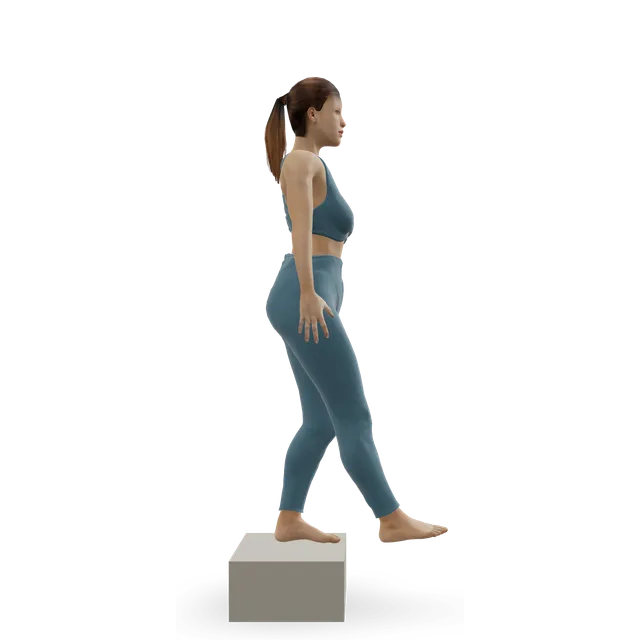
Step-up demonstrated on the 3D figure3D demoStep-upBeginner · A step

Lead with the sore leg onto a low step: 2 to 3 at a time, building to sets of 8, up to 2 sets of 15; then a medium step · NHS inform's step-up for kneecap pain, with its pacing. Hold a rail while you learn it

Easier: Low step-up · Harder: Dumbbell step-up

Sit to stand from a chair demonstrated on the 3D figure3D demoSit to stand from a chairBeginner · A bench or box

3 sets of 8 to 12, from a higher seat at first, then a lower one · As in our knee pain when sitting guide (editorial)

Easier: Sit to stand, pushing on the thighs · Harder: Bodyweight squat

Lateral band walk demonstrated on the 3D figure3D demoLateral band walkBeginner · A band

3 sets of 12 steps each way, the band above the knees · As in our runner's knee guide; the band above the knees is our LCL guide's caution

Easier: Hip abduction machine · Harder: Lateral band walk, band at the feet

Wall sit demonstrated on the 3D figure3D demoWall sitBeginner · A wall

4 holds of 30 s, shallow · As in our runner's knee guide. With pain behind the kneecap, keep the bend small, as the move page says

Easier: Straight-leg raise · Harder: Spanish squat (band squat hold)

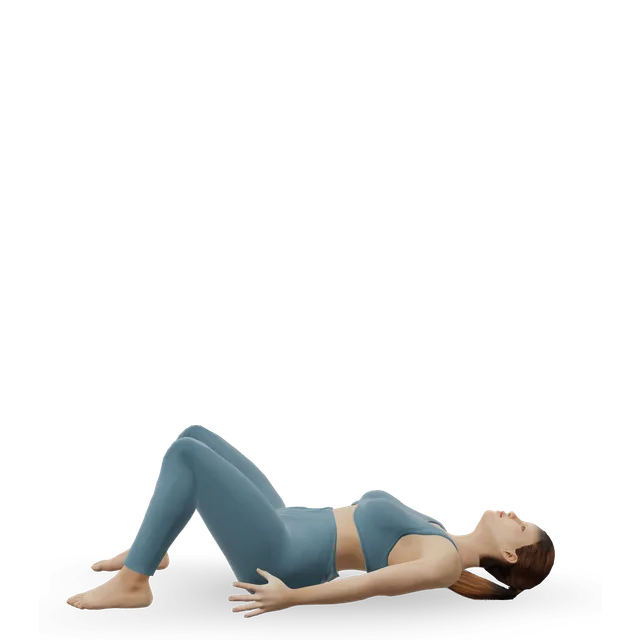
Glute bridge demonstrated on the 3D figure3D demoGlute bridgeBeginner · No equipment

3 sets of 12 · As in our runner's knee guide (editorial)

Easier: Pelvic tilt into bridge · Harder: Single-leg glute bridge

Single-leg stand demonstrated on the 3D figure3D demoSingle-leg standBeginner · A wall

3 holds of 30 s each leg, near a support · As in our runner's knee guide (editorial)

Easier: Tandem stance and heel-to-toe walk · Harder: Single-leg reach matrix

Move on when: 3 sets of 10 step-ups each leg and 3 sets of chair stands from a normal chair pass the pain rule with no swelling the next morning, and an hour's sitting with breaks is comfortable (editorial).

Follow along: a timer, a cue and the next move, one step at a time.
Stage 3

Single-leg control, then bring back the crossed positions

From about week 6, 2 or 3 days a week: single-leg strength, then, if you want them, longer crosses, the figure 4 and floor sitting, one at a time. No study has tested a return to crossed positions, so how they come back is our suggestion.

Split squat demonstrated on the 3D figure3D demoSplit squatIntermediate · No equipment

3 sets of 8 to 10 each leg · As in our runner's knee guide. Pad the back knee and shorten the range rather than push through knee pain, as the move page says

Easier: Bodyweight squat · Harder: Reverse lunge

Patrick step-down demonstrated on the 3D figure3D demoPatrick step-downIntermediate · A step

3 sets of 8 to 10 each leg · As in our runner's knee guide (editorial)

Easier: Bodyweight squat · Harder: Skater squat

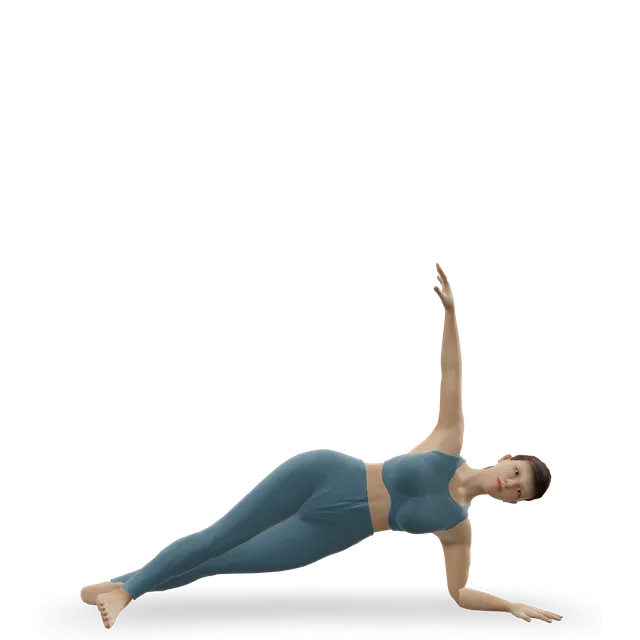
Side plank with leg lift demonstrated on the 3D figure3D demoSide plank with leg liftAdvanced · No equipment

3 sets of 8 to 10 each side · As in our IT band and outer knee pain guides (editorial)

Easier: Side plank · Harder: Copenhagen plank

Reclined figure four (eye of the needle, Sucirandhrasana) demonstrated on the 3D figure3D demoReclined figure four (eye of the needle, Sucirandhrasana)Beginner · No equipment

2 to 3 holds of 20 to 30 s each side, lying on your back · NHS inform's stretch holds; the position, a way to practise the figure 4 with the leg unloaded, is our suggestion. Hold behind the thigh and never press on the crossed knee, as the move page says. Not early after an LCL sprain, and check with your surgeon after a hip replacement

Harder: Pigeon preparation (Eka Pada Rajakapotasana prep)

Easy pose (Sukhasana) demonstrated on the 3D figure3D demoEasy pose (Sukhasana)Beginner · No equipment

1 to 3 minutes on a firm cushion, knees below your hips, changing which shin is in front; build up over weeks · Editorial: the move page gives no dose. Sit up on a blanket or cushion if your knees float high, as the move page says, and stand up if a leg goes numb

Harder: Pigeon preparation (Eka Pada Rajakapotasana prep)

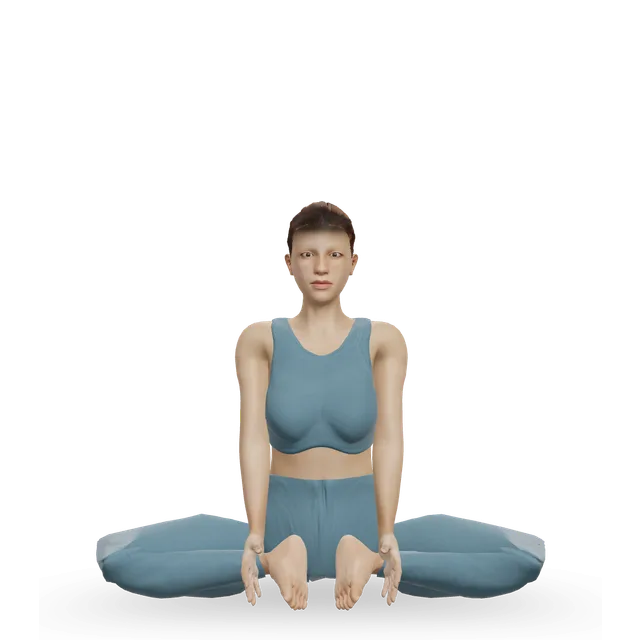
Bound angle pose (Baddha Konasana) demonstrated on the 3D figure3D demoBound angle pose (Baddha Konasana)Beginner · No equipment

3 slow holds of 20 to 30 s, sitting on a cushion, feet away from your hips · NHS inform's stretch holds; the position is editorial. Don't push your knees down with your hands, as the move page says

Harder: Pigeon preparation (Eka Pada Rajakapotasana prep)

Move on when: These pass the pain rule for 2 weeks: then add a longer knee-over-knee cross, then the figure 4, then longer floor sitting, keeping the next morning no worse and uncrossing at the first tingle (editorial). The lotus position comes last, if at all, and not with a replaced knee or known meniscus damage, as our lotus move page and yoga for knee pain guide say.

Follow along: a timer, a cue and the next move, one step at a time.

What to change for now

Sitting, the floor and bed for now (written steps)

Our 3D figure can't show these. They come from NHS pages, NHS inform, an NHS trust leaflet and case reports; where a step is our suggestion, it says so. None has been tested in a trial.

  • 1. Break up long sits: NHS inform suggests reducing "the amount of time you sit still" with kneecap pain, and the NHS says get up and move around every hour or so.
  • 2. While it's sore, sit with both feet flat. If you cross, cross at the ankles rather than the knees (our suggestion; crossing at the ankles didn't change blood pressure readings either).
  • 3. Knee over knee: keep it short, swap legs, and uncross at the first tingle in your shin or foot (our suggestion, from case reports).
  • 4. The figure 4: leave it out for the first weeks after an outer ligament (LCL) sprain, as our LCL guide says, and bring it back last.
  • 5. On the floor: sit on a firm cushion or folded blanket so your knees settle below your hips, sit for short spells, change which leg is in front, and kneel up or move to a chair when it aches (our suggestion, as our easy pose page says).
  • 6. The lotus position: leave it out while your knee hurts, and never force the second foot up. A US health agency advises beginners to avoid it.
  • 7. In bed: an NHS trust leaflet says "a pillow between your knees may help you feel more comfortable".
  • 8. While losing weight quickly (after weight-loss surgery, on a weight-loss medicine or a strict diet), don't sit with your legs crossed: a case series says "Patients should avoid prolonged leg crossing".
  • 9. After a knee or hip replacement, follow your team's advice on crossing your legs.
  • 10. Keep moving: NHS inform says after 48 hours "try to use your leg more - exercise really helps your knee and can relieve pain".

Sources 13, 33, 3, 9, 41, 21, 48, 39

Positions to swap, and why

Habit or positionWhy it mattersInstead
Long, still knee-over-knee crossesThey can squeeze the nerve below the outer knee, the NHS says.Short crosses, swapping legs, or crossing at the ankles.
Ignoring a leg that goes numb or tinglesIt's pressure on the nerve, which usually recovers when the pressure comes off.Uncross and stand up at the first tingle.
The figure 4, or sitting cross-legged, early after an LCL sprainThese positions bow the knee outwards, the stress the outer ligament resists (our LCL guide).Both feet flat, and a hamstring stretch with a strap.Try: Supine hamstring stretch with a strap
Long floor sitting or the lotus position with a catching or swollen kneeA deep bend with a turned shin loads the meniscus (our reading).A chair, or a high cushion for short spells.Try: Easy pose (Sukhasana)
Pushing your knees down in bound angleIt forces the stretch; the move page says let gravity and time do the work.Sit on a cushion and let your knees settle.
Sitting for hours with the knee bentLong sits are a known trigger for kneecap pain.Straighten the leg and stand up regularly.Try: Seated knee extension (chair)
Resting completelyNHS inform says use your leg more after the first 48 hours.The stage 1 moves and short walks.Try: Quad set (static quads)
Foam rolling or stretching the IT band as the fixNothing shows it changes the band, and IT band pain isn't linked to crossing.Hip strengthening.Try: Clamshell
Crossing your legs while losing weight fastCase series describe foot drop after habitual crossing during rapid weight loss.Feet flat until your weight is steady.

Routines to follow

More moves for this area

Questions people ask

Why does my knee hurt when I cross my legs?

Crossing keeps the knee bent, presses one knee on the other and, in some positions, bows the knee outwards or turns the shin. An ache around the kneecap after a while points to kneecap pain, pain on the joint line in a deep bend to the meniscus, a stiff ache from mid-life to arthritis, and tingling down the outer shin to the nerve below the outer knee.

Why does the outside of my knee hurt when I cross my legs?

With an ankle on the other knee, gravity bows the top knee outwards, which stretches the outer ligament, so a recent LCL sprain can hurt there. Tingling or burning on the outer shin is more likely the nerve being pressed. IT band pain is a runner's and cyclist's problem rather than a sitting one.

Why does the inside of my knee hurt when I sit cross-legged?

From mid-life, the inner side is where arthritis and worn meniscus tears are most often found, and floor sitting combines a deep bend with a turned shin. Sit on a cushion or a chair for now, and get it checked if it catches or won't straighten.

Why does my knee hurt after sitting cross-legged on the floor?

Sitting cross-legged bends the knee to about 130 to 135 degrees, much deeper than a chair. Kneecap pain often hurts as you straighten up after a sit, and arthritis is stiff after rest. A firm cushion under your hips and shorter spells usually help.

Is crossing your legs bad for your knees?

Not for healthy knees, as far as the evidence goes: no study shows it causes damage. Long, still crosses can squeeze the nerve below the outer knee, so change position often and uncross if a leg goes numb.

My leg goes numb when I cross my legs. Should I worry?

Usually not, if it clears within minutes of uncrossing: it's pressure on the nerve below the outer knee. If your foot catches or won't lift, get it checked the same day, and if it comes with a drooping face, arm weakness or slurred speech, call 999.

Why does the back of my knee hurt when I cross my legs?

Fullness or tightness behind the knee in a deep bend can be a Baker's cyst, which is commoner from 35 to 70. If your calf suddenly becomes painful, swollen or red, get a same-day check, because a burst cyst and a blood clot look alike.

Can my hip cause knee pain when I cross my legs?

Yes: crossing bends and turns the hip, and in people with hip arthritis, almost half had pain below the knee. Groin pain or a stiff hip with the knee pain points to the hip. In a child with a limp, get a same-day check.

Is sitting cross-legged bad for arthritis?

The evidence is mixed: floor sitting wasn't linked with knee arthritis in most studies, but it was in one Thai village sample. Go by comfort, sit on a cushion, and keep moving, which NICE says helps arthritis.

Do I need a scan?

Usually not: arthritis is diagnosed without one, and MRI shows meniscus tears in many knees that don't hurt. A foot that catches needs a nerve test rather than a scan, and a scan helps when surgery is being considered.

What exercises help knee pain when crossing my legs?

Hip and knee strengthening together, as for kneecap pain, where it beat knee exercises alone in 14 trials: quad sets, side-lying leg lifts, step-ups and chair stands, as NHS inform's programme uses. The plan on this page builds them in stages, then brings the crossed positions back.

When should I see a doctor?

Get advice from NHS 111 now for a hot, swollen knee with a high temperature, or a knee that locks or gives way. Get a same-day check for a swollen, painful calf or a foot that won't lift, and see a GP or physiotherapist if knee pain hasn't improved within a few weeks. In the US, call 911 where this page says 999.

Related exercise guides

Other pain guides

Sources

  1. Kapoor 2008 · Hip and knee angles in cross-legged sitting in 44 adults (lab study, J Arthroplasty)
  2. Zhou 2013 · Hip and knee movement in cross-legged sitting in 40 healthy adults (lab study, Prosthet Orthot Int)
  3. Tanyous 2026 · Foot drop from leg crossing after rapid weight loss (case series of 2, Case Rep Neurol)
  4. NHS · Meniscus tear (knee cartilage damage)
  5. NHS · Foot drop
  6. Poage 2016 · Peroneal nerve palsy: evaluation and management (review, J Am Acad Orthop Surg)
  7. Katirji 1988 · Common peroneal nerve palsy: 116 lesions with nerve tests (case series, Neurology)
  8. Aprile 2005 · Peroneal nerve palsy in 69 people across 11 Italian centres: causes and effects (multicentre study, J Peripher Nerv Syst)
  9. Cucu 2025 · Peroneal nerve palsy after rapid weight loss: a case and 380 published cases (case report and literature review, Nutrients)
  10. Cruz-Martinez 2000 · Peroneal nerve palsy after weight loss in 30 people (case series, J Peripher Nerv Syst)
  11. Crossley 2016 · Patellofemoral pain consensus statement, part 1: terms, definitions, examination, natural history and kneecap arthritis (consensus statement, Br J Sports Med)
  12. Collins 2016 · Pain during long sitting in 458 people with kneecap pain (cohort study, J Orthop Sports Phys Ther)
  13. NHS inform · Patellofemoral pain syndrome
  14. Dahaghin 2009 · Squatting, sitting on the floor and cycling as risk factors for knee arthritis in Tehran (case-control study, Arthritis Rheum)
  15. Hidayat 2026 · Daily activities, floor sitting and knee arthritis in 534 adults in Jakarta (community study, Indian J Community Med)
  16. Tangtrakulwanich 2006 · Floor activities, lotus sitting and knee arthritis in 261 Thai Buddhist monks (cross-sectional study, J Med Assoc Thai)
  17. Tangtrakulwanich 2007 · Habitual floor activities and knee arthritis in 576 Thai villagers (cross-sectional study, Clin Orthop Relat Res)
  18. Zhang 2004 · Squatting and knee arthritis on X-ray in Beijing: the Beijing Osteoarthritis Study (population study, Arthritis Rheum)
  19. Hwang 2012 · Risk factors for meniscus root tears in 476 Korean knee operations (cohort study, Am J Sports Med)
  20. Penman 2012 · Yoga in Australia: a national survey of 2,567 practitioners (survey, Int J Yoga)
  21. NCCIH 2023 · Yoga: effectiveness and safety (US National Center for Complementary and Integrative Health)
  22. Cramer 2018 · Injuries and other adverse events with yoga practice (systematic review of observational studies, J Sci Med Sport)
  23. Zhu 2012 · Yoga and meniscus injury in women: 273 cases and 546 controls (nested case-control study, Chin J Traumatol)
  24. van der Worp 2012 · Iliotibial band syndrome in runners (systematic review, Sports Med)
  25. NHS · Baker's cyst
  26. Frush 2015 · Baker's cyst: diagnosis and surgery (review, Sports Health)
  27. NICE NG226 · Osteoarthritis in over 16s: diagnosis and management (2022)
  28. Khan 2004 · Where people waiting for a hip replacement feel their pain: 60 people (descriptive study, Ann R Coll Surg Engl)
  29. Arthritis UK · Hip pain
  30. NHS · Hip pain in children (irritable hip)
  31. Englund 2008 · Meniscus tears on MRI in 991 middle-aged and older adults (population study, N Engl J Med)
  32. Daniels 2022 · Popliteal cysts are not a risk factor for a DVT, across 357,703 leg vein scans (retrospective study, J Thromb Thrombolysis)
  33. NHS · DVT (deep vein thrombosis)
  34. Masakado 2008 · Nerve tests in diagnosing peroneal nerve palsy (review, Keio J Med)
  35. Bsteh 2013 · Outlook after compression palsies of the radial and peroneal nerves (case series of 83, Eur J Neurol)
  36. Thomeé 1997 · Treating patellofemoral pain in young women with a pain-monitoring model (Phys Ther)
  37. Lankhorst 2016 · What predicts a poor outcome 5 to 8 years after patellofemoral pain (BJSM)
  38. Kise 2016 · Exercise vs keyhole meniscus surgery in 140 middle-aged adults, 2-year follow-up (RCT, BMJ)
  39. NHS inform · Knee problems
  40. NHS · Varicose veins
  41. Adiyaman 2007 · Crossing the legs and blood pressure readings in 111 people (measurement study, Blood Press Monit)
  42. Pinar 2010 · Crossing the legs and blood pressure readings in 283 people with high blood pressure (measurement study, J Clin Nurs)
  43. Ogawa 2024 · Peroneal nerve palsy after sitting cross-legged in labour (case report, JA Clin Rep)
  44. Nascimento 2018 · Hip and knee strengthening for pain at the front of the knee: 14 trials, 673 people (systematic review and meta-analysis, JOSPT)
  45. Fukuda 2012 · Adding hip strengthening for kneecap pain in 54 sedentary women, 1-year follow-up (RCT, J Orthop Sports Phys Ther)
  46. Fredericson 2000 · Hip abductor weakness and hip strengthening in 24 runners with IT band syndrome (case series, Clin J Sport Med)
  47. Sanchez-Alvarado 2024 · Treatments for iliotibial band syndrome in runners (systematic review of 13 studies, Frontiers in Sports and Active Living)
  48. Leicestershire Partnership NHS Trust · Knee pain (physiotherapy patient leaflet, 2026)
  49. NHS inform · Exercises for knee muscle and joint problems
  50. NHS inform · Exercises for patellofemoral knee pain
  51. Smith 2017 · Should exercises be painful in chronic musculoskeletal pain? (systematic review and meta-analysis, Br J Sports Med)

Exercise education, not a diagnosis or treatment plan. It is written from the guidelines and studies listed above; review by a clinician is pending. If your pain follows an injury, is severe, is getting worse, or comes with any warning sign listed on this page, get it assessed. Health disclaimer.