Strength at home
Pulmonary hypertension exercises at home: a gentle 15-minute session
This is for people with pulmonary hypertension (PH) who are stable on treatment and whose PH centre agrees they can exercise at home; the centre's limits come first. It follows one NHS trust's leaflet (Royal Brompton Hospital, 2026): mild to moderate effort, about 3 out of 10 for breathlessness, light weights or a light band, nothing heavy, nothing lifted overhead, and never holding your breath. Two of these a day, or one plus a walk, builds towards the 30 minutes a day the leaflet suggests. Supervised exercise training is what guidelines recommend first: use this alongside or after a supervised programme. The doses are our editorial starting point.
Seated warm-up (about 4 minutes)
- Ankle circles10 each wayBeginner · Calves, Shins · 3D demoSeated. Or pump your ankles: pull your toes up, then point them down, 10 timesHarder: Ankle CARs (controlled articular rotations)
- Shoulder rolls10 each wayBeginner · Shoulders, Back, Neck · 3D demoSeated and slow; gentle shrugs work tooHarder: Shoulder CARs (controlled articular rotations)
- Seated march1 minBeginner · Hip flexors, Quads, Abs · 3D demoEasy: you can chatHarder: Standing march
- Seated march1 minBeginner · Hip flexors, Quads, Abs · 3D demoA little brisker, or stand and march holding a counterHarder: Standing march



Walk (about 6 minutes)
- Treadmill walking5 minBeginner · Quads, Calves, Glutes · 3D demoWalk round the house or garden, or march on the spot holding a counter. Moderately breathless, about 3 out of 10: you can still chat. Slow down if you can only say one word at a timeHarder: Treadmill jogging
- Standing march1 minBeginner · Hip flexors, Abs, Glutes · 3D demoSlower, letting your breathing settleEasier: Seated marchHarder: Standing band hip flexion


Light strength (one round; a second on good days)
- Beginner · Quads, Glutes, Hamstrings · 3D demoBreathe out as you stand; push on your thighs if you need to; stand up slowlyEasier: Sit to stand, pushing on the thighsHarder: Bodyweight squat
- Band row8 to 10Beginner · Back, Biceps, Shoulders · 3D demoA light band at chest height; breathe out as you pull; never strainHarder: Supported single-arm dumbbell row
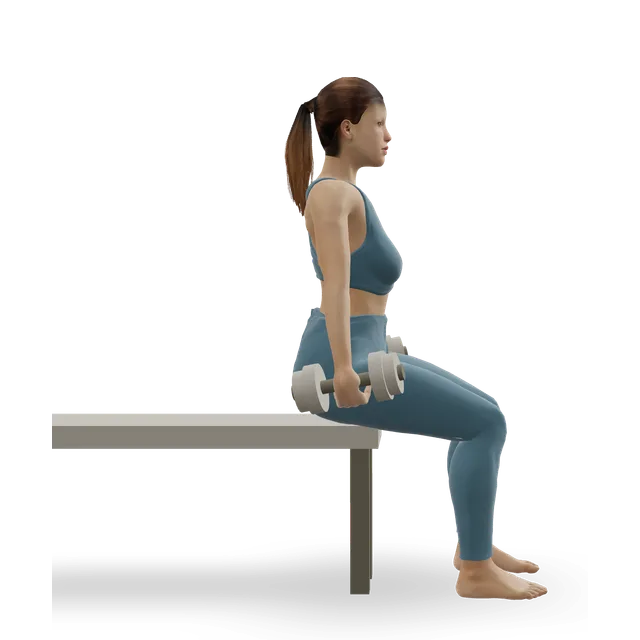
- Seated dumbbell curl8 to 10Beginner · Biceps, Forearms · 3D demo0.5 to 1 kg, or tins or water bottles; keep breathingHarder: Dumbbell biceps curl
- Seated knee extension (chair)8 each legBeginner · Quads · 3D demoStraighten slowly, lower more slowlyEasier: Quad set (static quads)Harder: Leg extension



Cool-down (about 3 minutes)
- Beginner · 3D demoSitting, gentle, with no holdsEasier: Breath reachHarder: Crocodile breathing (prone diaphragmatic breathing)


Tips
- Only for people stable on treatment whose PH centre agrees, and the centre's limits come first: nothing overhead, nothing heavy, and no holding your breath. Check again after any change to your medicines.
- Don't start if it's very hot, you feel unwell or particularly tired, or you've had a recent infection.
- Stop completely if you get extreme breathlessness (you can't talk), chest pain or palpitations, or feel dizzy or faint. If you feel faint, lie down with your legs raised. Call 999 if someone faints while exercising, and tell your PH centre about any faint or near-faint.
- Have someone at home with you if you can.
- Drink enough water, within any fluid limit your team has set, and avoid caffeinated energy drinks.
- Don't lie down straight after: sit for the breathing, and stand up slowly.
- If you use oxygen, use it as prescribed.
- Build up by about a tenth a week, towards 30 minutes a day on most days.
The doses are suggested starting points, not a prescription. Choose a range you can control and stop for sharp or increasing pain, numbness or tingling. Get individual advice after an injury or surgery, or if you are pregnant or managing a health condition.
Guides that recommend it
Find more moves like these
More strength at home




Beginner bodyweight workout
A 20-minute full-body workout with no equipment: squats, knee push-ups, bridges, lunges and planks.
20 minBeginner10 movesNo equipment


Full-body bodyweight workout
An intermediate no-equipment workout: push-ups, split squats, single-leg bridges, pike push-ups and core work.
30 minIntermediate11 movesNo equipment


Full-body dumbbell workout
A 35-minute full-body strength workout with dumbbells: goblet squats, presses, rows, Romanian deadlifts and carries.
35 minIntermediate9 movesA band, A dumbbellQuestions people ask
How long does the pulmonary hypertension exercises at home: a gentle 15-minute session take?
About 15 minutes, including any warm-up and cool-down listed. Shorten it by doing fewer rounds; lengthen it by adding one.
What equipment do I need?
You need: A bench or box, Cardio machine, A band, An anchor point, A dumbbell, Something with weight. Each move links to its guide, where you can find an alternative if you are missing something.
Is it suitable for beginners?
It is written for beginners. 4 of its 11 moves have an easier option listed beside them if you need one.
How do I make it easier or harder?
Use the easier or harder option listed under each move, change the number of rounds, or adjust the rest. Progress one change at a time.