Breathing & recovery
Exercises after heart surgery: the first 6 weeks at home
Based on the exercises NHS heart surgery units give people going home after a bypass or valve operation through the breastbone; it hasn't been tested as a programme. Do the breathing and circulation moves several times a day at first, the shoulder moves 2 or 3 times a day, and walk every day, building up slowly. Raising your arms without holding anything is fine. When you stand up, lift, push or pull, keep your upper arms close to your sides, as if inside a tube. Stop anything that hurts or makes your breastbone click, and where your hospital's breastbone rules differ, follow theirs. It isn't for after TAVI (transcatheter aortic valve implantation), which has its own advice.
Breathing and circulation (sitting upright)
- Lateral breathing (Pilates breathing)4 slow breathsBeginner · Abs · 3D demoIn through your nose so your lower ribs widen, out through your mouth. Every half hour while you're awake at first. To cough, cross your arms over your chest or hug a pillowHarder: Roll-up (Pilates)
- Ankle circles1 minBeginner · Calves, Shins · 3D demoCircle or pedal both anklesHarder: Ankle CARs (controlled articular rotations)
- Quad set (static quads)5 to 10 each legBeginner · Quads · 3D demoTighten the front of your thigh by pressing the back of your knee down, hold a moment, then relaxHarder: Straight-leg raise



Shoulders and posture (sitting tall, no weights)
- Shoulder rolls5 to 10 backwardsBeginner · Shoulders, Back, Neck · 3D demoRoll your shoulders, not your elbows. Then shrug your shoulders up towards your ears and relax, 5 to 10 timesHarder: Shoulder CARs (controlled articular rotations)
- Breath reach5 to 10 each armBeginner · 3D demoSlowly raise one arm above your head and lower it, then the other. Fine as long as you're not holding, lifting or pushing anythingHarder: Slow breathing (6 breaths a minute)
- Seated upper-back lift (sit tall, shoulders back)5 holds of 5 sBeginner · Back, Shoulders, Neck · 3D demoSit upright and gently draw your shoulder blades down and togetherEasier: Elbows backHarder: Prone Y-T-W raises



Legs
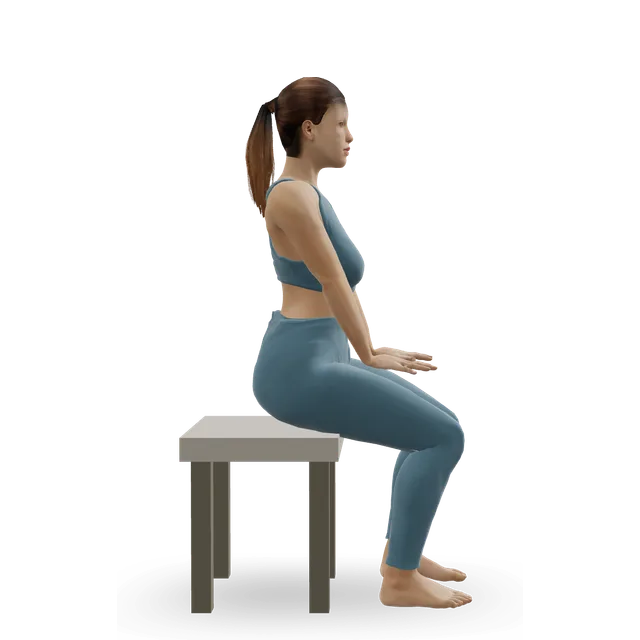
- Beginner · Quads, Glutes, Triceps · 3D demoHands on your thighs and upper arms close to your sides as you stand, or arms crossed over your chest if your hospital prefers. Breathe out as you riseHarder: Bodyweight squat
- Beginner · Calves · 3D demoHold a worktop with both hands, elbows by your sidesEasier: Seated bent-knee calf raise (soleus raise)Harder: Standing dumbbell calf raise

Walk
- Treadmill walking5 min at firstBeginner · Quads, Calves, Glutes · 3D demoFrom your third day home, no more than 5 minutes. Add 5 minutes every 2 or 3 days, aiming for 30 minutes of brisk walking, 5 days a week, by 6 weeksHarder: Treadmill jogging

Tips
- Do the breathing and circulation moves every half hour while you're awake in the first days, the shoulder moves 2 or 3 times a day, and walk every day.
- When you lift, push or pull, keep your upper arms close to your body and let pain guide you. Your hospital may set weight limits: follow them.
- Avoid any movement that causes pain or clicking in your breastbone, and tell your GP (general practitioner) if your breastbone clicks or grinds.
- Walk at a pace where you feel a little warm and moderately short of breath, but can still speak in full sentences.
- Call your care team, a GP or NHS 111 for a wound that's red, sore, swollen or oozing, a high temperature, or palpitations.
- Call 999 for chest pain that feels tight or like squeezing, or spreads to your arms, neck or jaw, severe difficulty breathing, or a face that has dropped on one side or difficulty speaking or moving an arm or leg.
- After about 6 weeks, or once your cardiac rehab assessment is done, move on to the cardiac rehab exercises at home, with your team's agreement.
The doses are suggested starting points, not a prescription. Choose a range you can control and stop for sharp or increasing pain, numbness or tingling. Get individual advice after an injury or surgery, or if you are pregnant or managing a health condition.
Guides that recommend it
Find more moves like these
More breathing & recovery




Bedtime stretch routine
A slow, 10-minute floor routine to unwind before sleep: child's pose, twists, happy baby and slow breathing.
10 minBeginner7 movesFirm cushion, A wall



Breathing exercises to relax
A 6-minute breathing routine: slow breathing, crocodile breathing, alternate nostril breathing, box breathing and 4-7-8 breathing.
6 minBeginner5 movesNo equipment


Postnatal exercises
A gentle 25-minute routine for the first weeks after birth: pelvic floor, breathing, tummy and hip exercises on the floor, sit-to-stands and a walk.
25 minBeginner12 movesA bench or box, Cardio machineQuestions people ask
How long does the exercises after heart surgery: the first 6 weeks at home take?
About 15 minutes, including any warm-up and cool-down listed. Shorten it by doing fewer rounds; lengthen it by adding one.
What equipment do I need?
You need: A bench or box, A wall, Cardio machine. Each move links to its guide, where you can find an alternative if you are missing something.
Is it suitable for beginners?
It is written for beginners. 2 of its 9 moves have an easier option listed beside them if you need one.
How do I make it easier or harder?
Use the easier or harder option listed under each move, change the number of rounds, or adjust the rest. Progress one change at a time.