Cardio & conditioning
Beginner jump rope workout
Short rounds with equal rest are how to start skipping: your calves and Achilles tendons do most of the work, and they need a few weeks to catch up with your lungs. Size your rope first: stand on the middle and pull the handles up to between your chest and your armpits, then choose the length that lets you clear it comfortably. Do this 2 or 3 times a week with a day off between at first, our editorial suggestion, and lengthen the rounds every two weeks as the notes say.
Warm-up
- Standing march2 minBeginner · Hip flexors, Abs, Glutes · 3D demoEasy pace, arms swingingEasier: Seated marchHarder: Standing band hip flexion
- Beginner · Calves, Shins · 3D demoTiny, quiet bounces off your ankles, without the rope: the same low hop you'll use with itHarder: Pogo hops


Rope rounds
5 rounds · Rest 30 s: walk about
- Intermediate · Calves, Quads, Shoulders · 3D demoLow, quiet bounces on the balls of your feet, turning the rope from your wrists. Tripped? Start again calmly. Weeks 3 and 4: 45 s on, 45 s rest. Weeks 5 and 6: 60 s on, 60 s restEasier: Ankle bounces (mini pogo)Harder: Double-unders (jump rope)
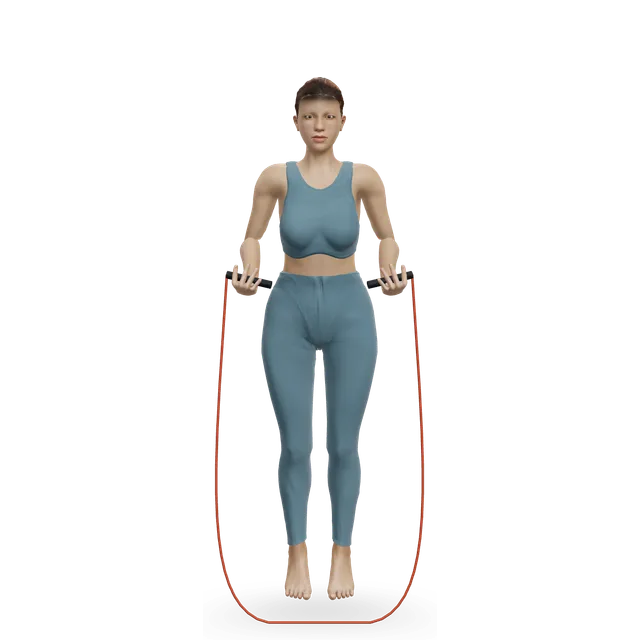
Calves and shins
- Slow calf raise2 × 15Beginner · Calves · 3D demoAbout 3 seconds up and 3 downEasier: Seated bent-knee calf raise (soleus raise)Harder: Standing dumbbell calf raise
- Tibialis raise2 × 15Beginner · Shins · 3D demoBack near a wall, lift your toes towards your shins and lower slowlyHarder: Single-leg tibialis raise


Cool-down
- Wall calf stretch (gastrocnemius)30 s each sideBeginner · Calves · 3D demoBack knee straightEasier: Seated calf stretch with a towelHarder: Heel-on-step calf and hamstring stretch
- Soleus wall stretch30 s each sideBeginner · Calves · 3D demoBack knee bentEasier: Seated calf stretch with a towelHarder: Toes-tucked kneeling (toe squat)


Tips
- 2 or 3 sessions a week, with a day off between at first. In a trial, inactive adults who skipped 10 minutes every weekday from the start had more injuries and drop-outs than joggers.
- Add no more than a few minutes of rope in all each week. After week 6, our suggestion is rounds of 2 to 3 minutes with a minute's rest.
- Calf soreness is fine if it stays at 5 out of 10 or less and has settled by the next morning. A sudden pop at the back of your ankle, with pain or not being able to stand on tiptoe, needs same-day help (NHS 111, or urgent care in the US).
- Wear cushioned trainers, and skip on a wooden floor, a gym mat or rubber rather than concrete.
- If you leak when you skip, build up pelvic floor exercises first and see a GP or pelvic health physiotherapist. In pregnancy, don't start skipping new.
- Once your rounds are easy, add a harder session once or twice a week, as our HIIT guide suggests: 9 rounds of 2 minutes at a pace where you can say only a few words, with 1 minute easy between, the session used in a trial in young adults.
The doses are suggested starting points, not a prescription. Choose a range you can control and stop for sharp or increasing pain, numbness or tingling. Get individual advice after an injury or surgery, or if you are pregnant or managing a health condition.
Guides that recommend it
Find more moves like these
More cardio & conditioning



HIIT workout at home
A 20-minute no-equipment HIIT workout: jumping jacks, jump squats, mountain climbers, burpees, skips and bear crawls.
20 minIntermediate10 movesNo equipment

Plyometric workout
An advanced jump training session: pogo hops, box jumps, split squat jumps, broad jumps and depth jumps.
30 minAdvanced8 movesA bench or box, A step

Easy cardio workout
A steady 30 to 45 minute cardio session at talk-but-not-sing pace: walk, cycle, row or cross-train, counting toward weekly activity guidelines.
40 minBeginner3 movesCardio machine, A wallQuestions people ask
How long does the beginner jump rope workout take?
About 20 minutes, including any warm-up and cool-down listed. Shorten it by doing fewer rounds; lengthen it by adding one.
What equipment do I need?
You need: A jump rope, A wall. Each move links to its guide, where you can find an alternative if you are missing something.
Is it suitable for beginners?
It is written for beginners. 5 of its 7 moves have an easier option listed beside them if you need one.
How do I make it easier or harder?
Use the easier or harder option listed under each move, change the number of rounds, or adjust the rest. Progress one change at a time.