Strength at home
Step-up workout: from the bottom stair to a loaded box
Step-ups train one leg at a time, mostly your glutes and the front of your thighs, and the step's height sets how hard they are. Start on the bottom stair with a hand on the rail. Raise the step as it gets easy, then hold dumbbells and drop back to a lower step. In trials, stepping onto rising step heights built thigh muscle and stair climbing in older women, and heavy step-ups built strength like squats in young rugby players. Do it once or twice a week; the doses are our starting point.
Warm-up
- Standing march2 minBeginner · Hip flexors, Abs, Glutes · 3D demoEasier: Seated marchHarder: Standing band hip flexion
- Standing hip CARs2 circles each legBeginner · Glutes, Hip flexors, Hip abductors · 3D demoEasier: Hip circles on all foursHarder: 90/90 hip lift-off
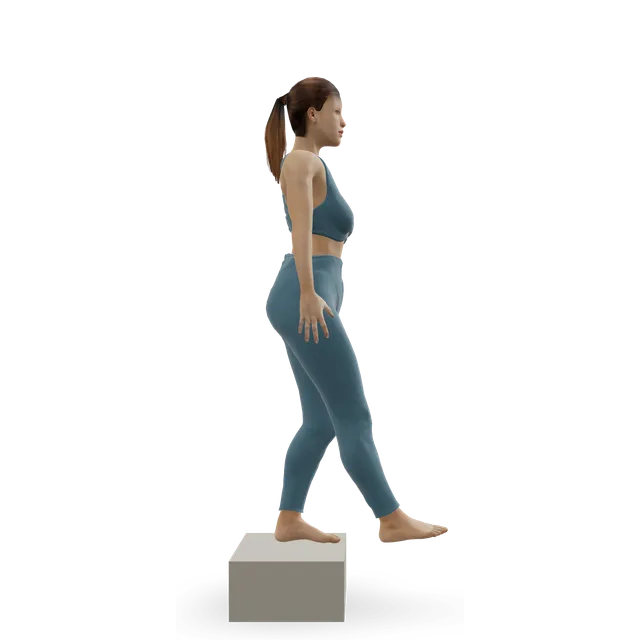
- Low step-up8 each legBeginner · Quads, Glutes, Hamstrings · 3D demoThe bottom stair, a hand on the railHarder: Step-up



Main sets
Rest 90 s between sets
- Step-up3 sets of 8 to 12 each legBeginner · Glutes, Quads, Hamstrings · 3D demoFinish one leg, then the other, and lower slowly, trailing foot first. Pick a step that keeps your knee below hip height. When every set reaches 12, raise the step; once it's at knee height, hold dumbbells on a lower stepEasier: Low step-upHarder: Dumbbell step-up
- Split squat2 sets of 8 to 12 each legIntermediate · Quads, Glutes, Hamstrings · 3D demoA hand on a wall is fineEasier: Bodyweight squatHarder: Reverse lunge
- Patrick step-down2 sets of 8 slow reps each legIntermediate · Quads, Glutes, Hip abductors · 3D demoOn the bottom stair, lower the free heel towards the floor over 3 s. Leave it out if the front of your knee hurts on stairsEasier: Bodyweight squatHarder: Skater squat


Finisher
Rest 60 s between sets
- Single-leg calf raise from a step2 sets of 10 to 15 each legIntermediate · Calves · 3D demoOn the same step, a hand on the railEasier: Slow calf raiseHarder: Single-leg pogo hops
- Stair climbing3 or 4 climbs of 30 to 60 s, walking down slowly between them (optional)Intermediate · Quads, Glutes, Calves · 3D demoHold the rail on the way downEasier: Treadmill walkingHarder: Sprint intervals


Cool-down (optional)
- Standing quad stretch30 s each sideBeginner · Quads, Hip flexors · 3D demoEasier: Side-lying quad stretch with a strapHarder: Couch stretch

Tips
- In your first two weeks, stop every set with 3 or 4 reps to spare. After that, stop 2 to 3 reps short of failure.
- Height before weight: raise the step a few centimetres at a time. When you add dumbbells, go back to a lower step and build up again.
- Pain at the front of your knee: stay on the bottom stair, step down with the working foot first, and keep the pain to 0 to 2 out of 10, up to 5 if it settles by the next morning.
- With one dumbbell, hold it in the hand opposite your working leg (our suggestion).
- Pregnant, with pelvic girdle pain: if stairs hurt, swap the step-ups for sit-to-stands.
- Use the stairs or a stable, non-slip step or box, never a chair that can tip.
The doses are suggested starting points, not a prescription. Choose a range you can control and stop for sharp or increasing pain, numbness or tingling. Get individual advice after an injury or surgery, or if you are pregnant or managing a health condition.
Guides that recommend it
Find more moves like these
More strength at home




Beginner bodyweight workout
A 20-minute full-body workout with no equipment: squats, knee push-ups, bridges, lunges and planks.
20 minBeginner10 movesNo equipment


Full-body bodyweight workout
An intermediate no-equipment workout: push-ups, split squats, single-leg bridges, pike push-ups and core work.
30 minIntermediate11 movesNo equipment


Full-body dumbbell workout
A 35-minute full-body strength workout with dumbbells: goblet squats, presses, rows, Romanian deadlifts and carries.
35 minIntermediate9 movesA band, A dumbbellQuestions people ask
How long does the step-up workout: from the bottom stair to a loaded box take?
About 30 minutes, including any warm-up and cool-down listed. Shorten it by doing fewer rounds; lengthen it by adding one.
What equipment do I need?
You need: A wall, A step. Each move links to its guide, where you can find an alternative if you are missing something.
Is it suitable for beginners?
It is written for beginners. 8 of its 9 moves have an easier option listed beside them if you need one.
How do I make it easier or harder?
Use the easier or harder option listed under each move, change the number of rounds, or adjust the rest. Progress one change at a time.