Facial exercise plus massage
Face yoga means making and holding facial movements, sometimes against your fingers, and massaging the face and neck. A yoga researcher points out that it isn't a documented style of yoga, and is closer to massage.
Yoga guide
Face yoga means facial exercises and self-massage done to change how your face looks. The best-known study found fuller cheeks, and an estimated age about 3 years younger, after 20 weeks of daily practice, but it had no comparison group, only 16 women finished, and the programme's founder was an author. Reviews in 2014 and 2025 call the evidence insufficient.
There's no good evidence that it removes wrinkles or face fat. Gentle versions seem safe, but wide jaw opening and chewing exercises can strain the jaw, and facial exercises after Bell's palsy are a different, specialist treatment. This guide goes through the studies claim by claim, what dermatologists say slows skin ageing, a gentle 10-minute routine in written steps, and who should skip it.
Face yoga means making and holding facial movements, sometimes against your fingers, and massaging the face and neck. A yoga researcher points out that it isn't a documented style of yoga, and is closer to massage.
Of 27 women aged 40 to 65 who started a 20-week programme, 16 finished. Their cheeks were rated fuller and they looked about 3 years younger in photographs, but there was no comparison group, and the programme's founder was one of the authors.
Source 3
A 2014 review found 9 studies, none with a comparison group and random allocation. A 2025 review of 12 studies (321 women) found small changes in particular areas and called the evidence insufficient.
In the main study, forehead lines, crow's feet and the folds beside the mouth didn't change, and exercising one part of the body doesn't burn the fat over it.
Dermatologists advise sun protection every day, not tanning, not smoking, and avoiding repetitive facial expressions.
Source 6
After Bell's palsy, facial exercises are specialist rehabilitation, and forceful exercises can encourage unwanted linked movements. A face that droops on one side, with weakness in an arm or trouble speaking, is a 999 call.
Face yoga means repeated facial movements, often held or done against light finger pressure, plus self-massage of the face and neck, practised to change how the face looks. The best-known study taught 32 exercises done against resistance; a 2025 programme ran from slow breathing and neck stretches through lip, cheek, eye, eyebrow and forehead exercises, with massage. A yoga researcher says it is closer to massage than to traditional yoga.
Tighter skin, fewer lines, lifted cheeks and jowls, a sharper jawline and a slimmer face are common claims, and some say it works like a natural facelift. The rest of this guide sets each against the studies.
Jade rollers and gua sha (scraping the skin with a smooth-edged tool, often stone) are massage tools. Mewing means holding the tongue pressed against the roof of the mouth to try to reshape the jaw. Myofunctional therapy is exercise for the lips, tongue and chewing muscles, used by speech therapists.
Twenty-seven women aged 40 to 65 had two 90-minute training sessions in 32 facial exercises, then practised for 30 minutes a day for 8 weeks and every other day until week 20; 16 finished. Two doctors rating their photographs blind scored the upper cheeks fuller (1.8 to 1.1 on a 0 to 4 scale, where 0 is best) and the lower cheeks fuller (1.6 to 0.9), and their estimated age fell from 50.8 to 48.1 years.
There was no comparison group, neither the women nor the instructor were blinded, 11 women dropped out, and the founder of the exercise programme was one of the authors.
Source 3
Forehead lines, frown lines, crow's feet, the folds from nose to mouth (nasolabial folds), marionette lines, the jawline and the neck didn't change significantly. Lines around the lips when moving tended to get worse, though not significantly.
Source 3
In 18 people, 7 weeks of daily facial exercises made only the area above the upper lip more often judged younger, and the authors wrote: "It cannot be concluded that facial exercises are effective."
Source 11
A 2014 review found 9 studies, none with a comparison group and random allocation, mostly with unblinded ratings, and called the evidence insufficient. A 2025 review of 12 studies in 321 women aged 30 to 70, including 5 randomised trials, found improvements "confined to localized regions" such as the cheeks, jawline and around the eyes, measured in many different ways, and said the evidence is still insufficient. A 2024 review of 21 studies of facial exercise and myofunctional therapy reported improvements, but with little agreement on how to measure them.
In 12 women, 8 weeks of face yoga (2 supervised and 5 home sessions a week, about 30 minutes each) lowered tone and stiffness in the forehead and eye muscles and raised them in a cheek muscle and a muscle under the chin. In 50 women, a mouth-held exercise device used for 30 seconds twice a day for 8 weeks enlarged a cheek muscle and a muscle under the chin. Neither study had a comparison group, and changes in muscle don't show that people look younger.
In 90 people with a jaw joint disorder (temporomandibular disorder, TMD), a 6-week face yoga programme, like dry needling, eased pain and improved jaw movement compared with a control group. We could read only the summary, so the exercises used aren't known.
Source 13
One uncontrolled study found fuller cheeks and an estimated age 2.7 years younger after 20 weeks, and a small controlled study found a difference only above the upper lip. Without a comparison group, changes in photographs, make-up, weight or season can't be ruled out (our reading).
Not supported: lines and folds didn't change in the main study. The American Academy of Dermatology (AAD) advises avoiding repetitive facial expressions, because if you contract the same muscles over many years, the lines "become permanent".
Cheek fullness improved in the uncontrolled study, but the jawline and the neck didn't change significantly.
Source 3
Not supported. No study has measured face fat after face yoga; a device study found smaller lower-face measurements but had no comparison group; and across 13 studies (1,158 people), training one part of the body didn't reduce the fat over it. The main face yoga study found fuller cheeks, not thinner ones.
The muscles do change with training, in small studies without comparison groups, but whether that changes how you look hasn't been tested.
Five minutes with a roller raised blood flow in the cheek for at least 10 minutes, in 12 people. In 34 women, 10 minutes of roller or gua sha massage 5 times a week for 8 weeks changed facial contour measurements by 2 to 3 millimetres, but there was no group without massage. A 2025 review says "Claims of significant long-term structural changes remain unproven".
In a CT (computed tomography) scan study of 5 adults, twice-daily self-massage for 2 weeks shifted cheek tissue by a few millimetres. Facial Palsy UK describes gentle massage with the pads of the fingers over the brow, temples, cheek, chin and neck for people recovering from Bell's palsy.
One woman tore a neck muscle (the platysma) after long-term, vigorous facial massage with a hard wooden block. Use light pressure, and don't press hard tools into your neck.
Source 17
The American Academy of Dermatology lists these ways to reduce premature skin ageing:
Source 6
The AAD says cosmetic treatments such as botulinum toxin injections and fillers can reduce the appearance of wrinkles, and that a board-certified dermatologist can tell you what results to expect. No study has compared them with face yoga.
Source 18
The 2025 face yoga programme began with breathing, neck stretches and holds, shoulder rolls and neck massage. Use these instead, which avoid pulling your head into a stretch: 1 to 2 minutes of slow breathing, 10 slow shoulder circles each way, and the neck movements one at a time (our editorial starting point).
 3D demoSlow breathing (6 breaths a minute)Beginner · No equipment
 3D demoShoulder rollsBeginner · No equipment
 3D demoNeck CARs (controlled articular rotations)Beginner · No equipment
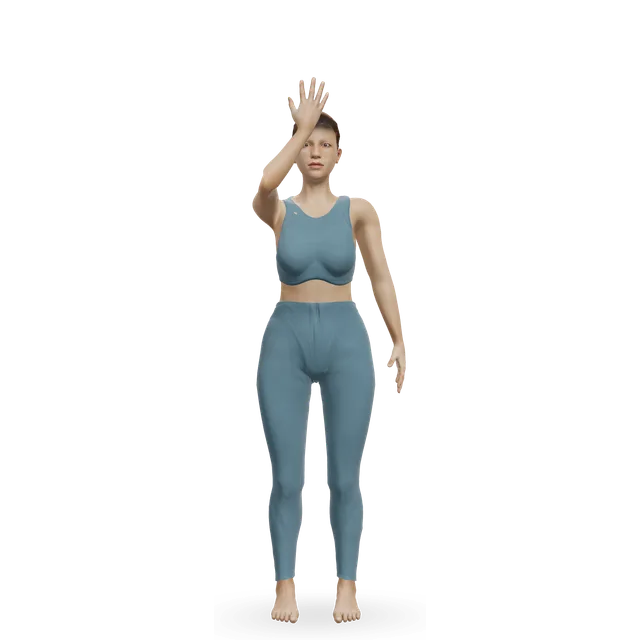 3D demoIsometric neck holds (four-way)Beginner · No equipment
 3D demoChin tuckBeginner · No equipment
 3D demoUpper trap releaseBeginner · No equipment
Our 3D figure has no facial expressions, so these steps are written out.
The exercise names and repetitions come from the 2025 face yoga study's programme, which rested 6 seconds between repetitions. The wording of each step is ours, written to keep your jaw relaxed and nothing forced. Do the neck warm-up above first.
The routine takes 5 to 10 minutes. Once a day for 8 to 12 weeks is our editorial starting point; the studies used about 30 minutes a day. If you want to judge it, take photographs in the same light at the start and the end.
Temporomandibular disorder causes pain around the jaw, ear and temple, clicking, and difficulty opening the mouth. For jaw pain, the NHS advises soft food, not chewing gum, not yawning too wide, not clenching your teeth, and massaging the painful jaw muscles. One trial found a face yoga programme eased jaw pain, but its exercises aren't described in the summary we could read, so follow our jaw pain guide for jaw exercises.
Bell's palsy is temporary weakness or lack of movement that usually affects one side of the face. Facial Palsy UK says "it is important not to try to make your face move by doing forceful facial exercises", because they can encourage synkinesis (miswiring of the nerves, so parts of the face move together), and "Never attempt to carry out exercises without professional help". It advises avoiding chewing gum and generic facial-strengthening exercises, and to "Be cautious about movement exercises advocated online".
Gentle fingertip massage is preferable to forceful exercise, and movement exercises should come from a specialist facial therapist. Our exercise for Bell's palsy guide covers what helps.
The NHS says to ask for an urgent GP appointment or get help from NHS 111 if you have symptoms of Bell's palsy, because "treatment for Bell's palsy is more effective if started early (within 72 hours)".
Source 8
The NHS says to call 999 (911 in the US) if:
Source 8
If you have symptoms of Bell's palsy, such as weakness on 1 side of your face or not being able to move 1 side of your face, a drooping eyelid or corner of your mouth, drooling, a dry mouth, loss of taste, or a dry or watering eye. Treatment works best if it starts within 72 hours.
Source 8
These are the same signs as our jaw pain guide:
Source 19
Jaw pain, clicking or stiffness that hasn't settled after a few weeks of self-care, or is affecting your eating, sleep or work: see a GP or dentist.
Source 19
Stop any face exercise that makes your jaw ache, click, lock or feel tired, any massage that leaves your skin red, sore or broken, and any tool that bruises (our suggestion).
If you're recovering from Bell's palsy or another facial palsy, get exercises from a specialist facial therapist: Facial Palsy UK says its own self-help stretches "should not be done by anyone who has had their facial palsy less than three months". With a jaw joint disorder, wait until your jaw has settled, and ask a dentist or physiotherapist. After cosmetic injections or facial surgery, ask the practitioner first, and skip massage over broken or inflamed skin (our suggestion).
One uncontrolled study found fuller cheeks and an estimated age 2.7 years younger after 20 weeks. Reviews call the evidence insufficient.
Lines and folds didn't change in the main study, and lip lines when moving tended to get worse. Dermatologists advise avoiding repetitive facial expressions.
Exercising one area doesn't burn the fat over it, no study has measured face fat after face yoga, and the jawline and neck didn't change significantly in the main study.
No study has tested it. After facial palsy, forceful or generic facial exercises can make unwanted linked movements worse, so see a specialist facial therapist.
Small, short studies show more blood flow and changes of a few millimetres, and "Claims of significant long-term structural changes remain unproven".
A 2025 review found the claims rest on anecdote or low-level evidence.
Source 2
The reviewed studies reported no side effects, and a news feature on face yoga said there seem to be "no negative health consequences". But wide mouth opening and chewing exercises go against NHS jaw advice, jaw injuries raise the risk of a jaw joint disorder, and forceful massage with a hard tool tore a neck muscle in one case.
A yoga researcher says it isn't a documented style of yoga and is closer to massage, though some programmes add breathing and relaxation.
Possibly a little for fuller cheeks, but the evidence is weak. In the best-known study, 16 women who did 20 weeks of exercises had fuller cheeks and looked about 3 years younger in photographs, but there was no comparison group, and the programme's founder was an author.
No. Reviews in 2014 and 2025 found the studies too small and poorly controlled to show that facial exercises work.
There's no good evidence it does: forehead lines, crow's feet and the folds beside the mouth didn't change in the main study. Dermatologists recommend daily sun protection, not smoking and avoiding repetitive facial expressions instead.
Not as far as studies show: the jawline and neck didn't change significantly in the main study. A chin tuck can help how you hold your head, but exercises don't remove fat from one area.
No study has shown it. Exercising one part of the body doesn't burn the fat over it, and the main face yoga study found fuller cheeks, not thinner ones.
In the main study, change was measured after 20 weeks of 30 minutes a day, then every other day, and estimated age had moved only about a year by week 8. Take photographs in the same light before and after if you want to judge it.
The studies used about 30 minutes a day; 5 to 10 gentle minutes a day for 8 to 12 weeks is a reasonable trial. Stop anything that makes your jaw ache or click.
Gentle movements and light massage seem safe, and the studies reported no side effects. Avoid opening your mouth very wide, chewing exercises and forceful massage with hard tools, which can strain the jaw or injure muscles.
They haven't been compared in a trial. Dermatologists list botulinum toxin injections and fillers as treatments that can reduce the appearance of wrinkles, while the face yoga evidence comes from small studies without comparison groups.
Small studies found more blood flow and changes of a few millimetres in facial contour, without a group that had no massage. Lasting lifting or slimming is unproven.
No: facial exercises after Bell's palsy are a different, specialist treatment. Facial Palsy UK warns that forceful or generic face exercises can encourage unwanted linked movements, so get exercises from a specialist facial therapist.
One trial found a face yoga programme eased jaw pain and improved movement in people with a jaw joint disorder, but its exercises aren't described in the summary. Follow NHS jaw advice (no wide yawning, no chewing gum, gentle massage of the sore muscles) and see our jaw pain guide.
Exercise education, not a personal prescription, and clinical review of these guides is pending. If you are pregnant, have a health condition such as glaucoma, high blood pressure or osteoporosis, or have had recent surgery, check with a doctor, midwife or physiotherapist before starting, and stop for sharp or increasing pain. Health disclaimer.