Pain guide · Knee pain

Knee pain when running: what's likely, what to change in your running today and how to build back

Knee pain is the commonest running injury. Where it hurts and when in the run point to the likely cause: around the kneecap (runner's knee), the outside of the knee (the iliotibial, or IT, band), one point below the kneecap (a tendon) or the joint line (a meniscus). The usual first step is to change how you run for a while rather than stop, and running doesn't wear out healthy knees.

Some knee pain needs checking first, and a problem in the hip can show up as knee pain. This guide covers those warning signs, a map of where it hurts, what to change in your running today, how much pain is fine, and a three-stage plan back through hip and knee strength to the walk-jog programme an NHS sports medicine service uses, with a 3D demo of every move.

When to get help first

Exercise is for pain that has been checked or is clearly mild and settling.

Get urgent medical help if

  • Same day: a pop or tearing feeling at the front of the knee after a fall, stumble, jump or landing, then you can't straighten the knee or lift the straight leg off the bed, there's a dent above or below the kneecap, or the kneecap sits higher or lower than on the other side. Go to A&E or an urgent treatment centre, or get help from NHS 111. A torn quadriceps or patellar tendon does best when it's repaired soon.
  • You cannot move the knee or put any weight on it, or it is very painful, badly swollen or has changed shape.
  • The knee locks, gives way or clicks painfully. Painless clicking is normal.
  • A hot, red or swollen knee with sudden severe pain, a very high temperature, or feeling hot, cold or shivery. This can be a joint infection.
  • You hurt your knee and cannot take 4 steps, or you are 55 or over and hurt it in a fall: get it checked the same day for a broken bone.
  • Same day, and stop running now: groin or front-of-hip pain in a runner, sometimes felt in the thigh or knee, that builds with running, hurts with every step or at night, or hurts when the hip is turned to the end of its range. Keep weight off the leg, using crutches if you have them, and get an urgent GP appointment or help from NHS 111 the same day: a stress fracture of the hip (femoral neck) needs urgent imaging.
  • Throbbing pain and swelling in one calf or thigh with red or darkened skin or swollen veins, or sudden worse pain and swelling around a lump at the back of the knee (a possible clot or a burst Baker's cyst).
  • Leg pain or swelling with breathlessness or chest pain: call 999 or go to A&E, and do not drive yourself. It can be a blood clot that has reached the lungs.
  • Back or leg symptoms with numbness around the genitals or bottom, new trouble controlling your bladder or bowels, or severe or worsening weakness or numbness in both legs.

See a doctor or physiotherapist if

  • Knee pain that has not improved within a few weeks of looking after it at home. Many areas offer NHS physiotherapy without a GP referral.
  • Pain in one spot on the top of the shin bone, just below the knee, that you can point to with a fingertip, worse with impact and later present at rest or at night: a possible stress fracture. Stop running and jumping until it has been checked.
  • Numbness, tingling or weakness that travels down the leg from the back. That points to a nerve (sciatica) rather than the knee.
  • Tendon pain above or below the kneecap and you take steroid tablets or have steroid injections, use anabolic steroids, have kidney disease, gout, rheumatoid arthritis, lupus or diabetes, or have recently taken a fluoroquinolone antibiotic: tell your GP or physiotherapist and build up more gradually. These can weaken the tendon.
  • A child or teenager with pain at a bump just below the kneecap or at its lower tip, worse with squats, jumps and kneeling: see our Osgood-Schlatter and Sinding-Larsen-Johansson guides, and get it checked if it is getting worse.

Where does it hurt?

Location narrows the likely causes; it does not diagnose.

Around or behind the kneecap, hard to point to

Builds during runs and is often worse downhill, on stairs, squatting and after long sits with your knees bent: usually kneecap pain (patellofemoral pain), often called runner's knee. Painless clicking is normal.

Read: Runner's knee →
The outside of the knee, over the bony point

Comes on at about the same distance or time in each run, is often sharp, is worse downhill and eases when you stop: usually iliotibial (IT) band syndrome.

Read: IT band syndrome →
One point at the lower tip of the kneecap

Worse with faster running, hills, jumping and landing, and it builds with how hard the thigh muscles work: patellar tendon pain (jumper's knee).

Read: Jumper's knee →
One point at the top edge of the kneecap

Builds over weeks and is worse with deep bending, jumping and kneeling: quadriceps tendon pain. A pop with a dent and a knee you can't straighten is a tear: see the warning signs.

Read: Quadriceps tendinopathy →
The joint line, on the inner or outer side

After a twist, or coming on gradually from about your mid-30s, with swelling later that day, catching, locking or a knee that won't fully straighten: often a meniscus tear.

Read: Meniscus tear →
The inner shin, just below the knee

Tender on the bone below the joint, worse on stairs and getting up from a chair, often with knee arthritis or knock knees: pes anserine pain.

Read: Pes anserine pain →
Both knees, a stiff ache, from your mid-40s

Worse getting going and after long runs, with morning stiffness of 30 minutes or less: often knee arthritis, which is diagnosed without an X-ray.

Read: Knee arthritis →
Below the kneecap, either side of the tendon

Worst as the knee straightens fully, sometimes with puffiness either side of the tendon: possibly fat pad impingement.

Read: Fat pad impingement →
Behind the knee

A lump points to a Baker's cyst. Throbbing pain and swelling in the calf needs a same-day check for a clot: see the warning signs.

Read: Baker's cyst →
One spot on a bone at the top of the shin

You can point to it with a fingertip, it builds over runs, and later it aches at rest or at night: a possible stress fracture. Stop running and get it checked.

Read: Stress fracture →
The thigh or knee, with groin pain, in a runner

Pain that builds with running, then hurts at rest or at night, can be a stress fracture of the hip felt in the thigh or knee. Stop running and get it checked the same day.

Read: Stress fracture →
A teenager with a tender bump just below the kneecap

Worse with running, jumping and kneeling in a growing child: Osgood-Schlatter disease.

Read: Osgood-Schlatter →
A teenager with pain at the lower tip of the kneecap

The same kind of growth-area pain one step higher up: Sinding-Larsen-Johansson syndrome.

Read: Sinding-Larsen-Johansson →
Pins and needles or numbness down the leg

Points to a nerve in the lower back rather than the knee: sciatica.

Read: Sciatica →

Understand it

Who gets it, and what usually lies behind itEmerging evidence

Across 13 studies that followed runners over time, new runners had about 18 running injuries per 1,000 hours of running and more experienced recreational runners about 8. The knee was the commonest site: about a quarter of new running injuries in one review, and 40% of women's and 31% of men's running injuries in another. Kneecap pain was the commonest knee diagnosis, then IT band syndrome, with meniscus injuries and patellar tendon pain behind them.

A previous injury was the strongest risk factor for the next one. In 5,205 adult runners, single runs more than 10% longer than their longest run of the past 30 days went with more injuries, while week-to-week increases didn't. That is a link, not proof, and a beginners' programme built on the 10% a week rule injured as many new runners as a quicker one (about 1 in 5 in each group, 532 people). When knee pain starts, we look first for a recent long run well beyond the usual, more hills or speed, new shoes or a return after a break (our suggestion; no study has tested this as a checklist).

Sources 1, 2, 3, 4, 5, 6, 7

Why running loads the knee, and what changes the loadEmerging evidence

Each running step loads the leg with about 2 to 3 times your body weight, against about 1 to 1.5 times when walking (a lab study of 12 men). That is why a knee can hurt when you run but not when you walk.

In lab studies of healthy runners, taking 5 to 10% more steps a minute at the same pace lowered the load absorbed at the knee, and in a computer model 10% more steps cut the pressure behind the kneecap by about 10%. The IT band is pressed against the bone near foot strike, with the knee bent about 20 to 30°; running downhill lands with a straighter knee, which is why downhills often bring IT band pain on, and narrower steps raised IT band strain in a lab study. Downhill running also asks the thigh muscles for heavy braking work. These are lab measures, not injury outcomes.

Sources 8, 9, 10, 11, 12, 13

When a scan helps, and what it can't tell youStrong evidence

Kneecap, IT band and tendon pain are diagnosed from the story and an examination: tendon changes on scans also turn up in people whose pain comes from somewhere else. Scans of knees without pain often show changes: cartilage defects in 11% of people under 40 and 43% from 40, and meniscus tears in 4% and 19%. In 991 adults aged 50 to 90, 61% of those with a meniscus tear had no knee pain, aching or stiffness in the previous month.

Most of 82 middle-aged adults training for a first marathon had signs of damage on magnetic resonance imaging (MRI) before they started, without symptoms. A report has to match your symptoms before it explains them. If a stress fracture is possible, the first X-ray can look normal (as many as two-thirds of hip stress fractures in one review), so a clinician may arrange an MRI scan.

Sources 14, 15, 16, 17, 18

How it usually goesEmerging evidence

In 254 new runners whose injuries were checked by physiotherapists, half had recovered by about 10 weeks; the middle time to recovery was 77 days for kneecap pain and 88 days for IT band syndrome, from small numbers. Some got back within days or weeks and some took many months, so no one can promise a date.

In a trial of 69 runners with kneecap pain, all three groups improved at 4, 8 and 20 weeks, and the advice they all had was about how to change their running.

Sources 19, 20

What helps, and how strong the evidence is

Changing how you run did as well as adding exercise or gait retrainingEmerging evidence

In a trial of 69 runners with kneecap pain, education on symptoms and training did as well on its own as with added exercise or with gait retraining, over 20 weeks. The advice was to run more slowly, spread your running across the week, use run-walk intervals, and avoid running downhill and down stairs. The exercises did build strength and the retraining did change how people ran, but neither added pain relief.

It was one small trial, and in kneecap pain, so we borrow its advice for other running knee pain (our suggestion).

Sources 20, 21

Hip and knee strengthening is the core treatmentStrong evidence

In a Cochrane review of 31 trials (1,690 people), exercise reduced kneecap pain during activity by about 1.5 points out of 10 in the short term against no exercise, and hip plus knee exercise reduced it by a further 2.2 points against knee exercise alone (3 trials, 104 people). The trials were small and low quality, but the results were consistent.

Two international consensus statements recommend exercise, with hip and knee work combined in preference to knee work alone. An NHS leaflet for kneecap pain starts with 3 sets of 8 to 12, including mini squats to less than 30° of knee bend.

Sources 22, 23, 24, 25

Hip strength for IT band painEmerging evidence

Across 13 small studies (201 runners), strengthening the muscles on the outside of the hip was the commonest treatment for IT band syndrome, with pain falling by 27 to 100% over 2 to 8 weeks; the studies were too different to pool. In 24 distance runners with the condition, the sore side's hip muscles were weaker, and a successful return to running went with regaining that strength over 6 weeks. That was a case series without a comparison group.

Sources 26, 27

A slightly quicker step eases the load on the kneeEmerging evidence

This is mostly lab work in healthy runners: 5 to 10% more steps a minute at the same pace lowered the load at the knee. Trials in people with knee pain are small. In 30 runners with kneecap pain, 2 weeks of retraining (a quicker step, or softer landings) eased running pain by about 3 points out of 10 at 6 months against no retraining, and 12 runners in a case series ran further without pain after one session with a metronome. A review of reviews found short-term gains in pain and function.

But in the 69-runner trial, education alone did as well as education plus gait retraining, and a meta-analysis calls the evidence on pain very limited; a quicker step also felt harder and more awkward at first. It's worth trying, not a cure.

Sources 9, 10, 28, 29, 30, 20, 31

A staged programme helps patellar tendon painEmerging evidence

In the largest trial (76 people), a staged programme of holds, then slow strength work, then springy loading including running drills, then sport, with pain kept at 3 out of 10 or less, improved a tendon score by 28 points against 18 with painful eccentric squats at 24 weeks. More returned to sport (43% against 27%), though that difference could be chance. A review warns that tendon rehab can be slow and sometimes frustrating.

Sources 32, 14

Shoes and insoles: comfort firstEmerging evidence

No type of running shoe has been shown to prevent injuries, and choosing shoes by foot shape made no difference in 3 trials of 7,203 military recruits. In 927 new runners in neutral shoes, feet that rolled in weren't injured more. One blinded trial of 372 runners is the exception: motion-control shoes lowered injuries, but only in runners whose feet rolled in, while another trial found shoes prescribed by foot type led to more missed training. Comfort is a sensible guide: runners who rated their shoes well cushioned and liked them had fewer injuries in one analysis.

For kneecap pain, ready-made arch-support insoles are recommended for short-term relief, though the average benefit is small and not everyone gains.

Sources 33, 34, 35, 36, 37, 38, 23

Running doesn't wear out healthy kneesEmerging evidence

In pooled studies, recreational runners had less hip and knee arthritis (3.5%) than people who didn't run (10.2%), though competitive runners had more (13.3%). In 1,203 people aged 50 or over with knee arthritis, those who chose to run had no faster X-ray changes and no more new knee pain, and their pain eased more often. In 3,804 marathon runners, years of running and weekly distance didn't predict arthritis, while age, body weight, past knee injury or surgery and family history did.

Sources 39, 40, 41

How much pain is OK while you exercise?

0 to 2 is safe, up to 5 is acceptableEmerging evidence

This guide uses the knee hub's pain rule, for the exercises and for running. Rate your knee pain from 0 to 10 during and after exercise. In the pain-monitoring model used in knee trials, 0 to 2 counts as safe, up to 5 as acceptable and above 5 as too much. Aim for 0 to 3 most of the time.

By the next morning your knee should be back to its usual level. If it isn't, drop back one step next time (a shorter run, more walking breaks, fewer sets), not to nothing. Over the weeks, pain should hold steady or ease (our suggestion, as in the knee hub's rule).

For context, trials that let people keep running set their own limits: 3 out of 10 in the largest patellar tendon trial and 4 out of 10 in a hamstring tendon trial. With pain at one point just below the kneecap, keep it to 3 or less, as the tendon trial did.

The NHS running page says not to run with knee pain, and this site's running plans say to stop if a pain is sharp, makes you limp or change how you run, or builds as you go. Those stop signs apply here. Sharp, catching or giving-way pain, or new swelling, is a reason to stop and get it checked. Trials in runners with kneecap pain and Achilles tendon pain let people keep running within limits and found no harm.

Sources 42, 43, 44, 32, 45, 46, 20, 47

The exercise plan: 3 stages

Start at the first stage. Each move opens a full guide with a 3D demo.

Stage 1

Settle: change the running, start loading

About weeks 0 to 2. Keep running only within the pain rule, with the changes in the written steps below, or cycle instead. Strength work 2 to 3 days a week. Doses are editorial starting points unless a source is named.

Clamshell demonstrated on the 3D figure3D demoClamshellBeginner · No equipment

3 sets of 8 to 12 each side · An NHS leaflet's dose for kneecap pain

Easier: Supine isometric hip abduction (belt press) · Harder: Lateral band walk

Glute bridge demonstrated on the 3D figure3D demoGlute bridgeBeginner · No equipment

3 sets of 8 to 12 · An NHS leaflet's dose

Easier: Pelvic tilt into bridge · Harder: Single-leg glute bridge

Seated knee extension (chair) demonstrated on the 3D figure3D demoSeated knee extension (chair)Beginner · A bench or box + Something with weight

3 sets of 10 to 15 each leg, 2 to 3 days a week · The move page's dose. If the full range hurts, work from 90° to about 45° of bend only

Easier: Quad set (static quads) · Harder: Leg extension

Sit squat (partial squat) demonstrated on the 3D figure3D demoSit squat (partial squat)Beginner · No equipment

3 sets of 8 to 12, to less than 30° of knee bend at first · An NHS leaflet's dose and depth for mini squats

Harder: Bodyweight squat

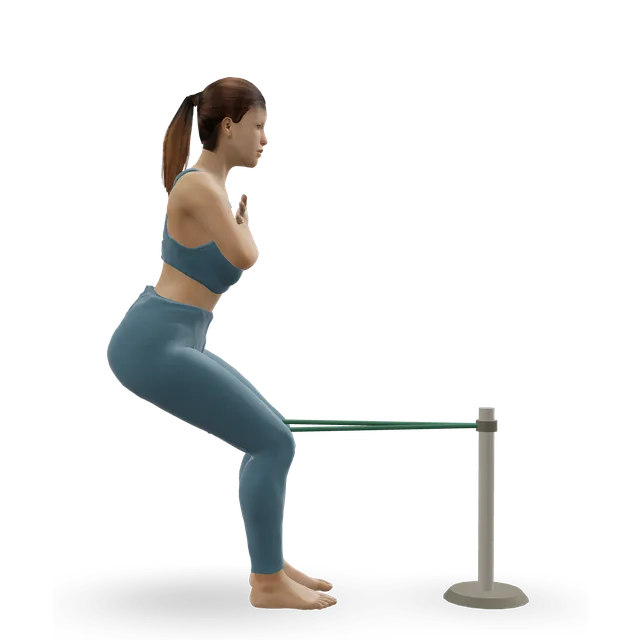
Spanish squat (band squat hold) demonstrated on the 3D figure3D demoSpanish squat (band squat hold)Intermediate · A band + An anchor point

4 to 5 holds of 30 to 45 s, 1 to 2 min rest, once a day · For pain at one point just below the kneecap, kept at 3 out of 10 or less. The move page's dose, modelled on the tendon trial's holds

Easier: Straight-leg raise · Harder: Pistol squat

Stationary cycling demonstrated on the 3D figure3D demoStationary cyclingBeginner · Cardio machine

20 to 30 min, easy to moderate, on days you don't run

Easier: Recumbent exercise bike · Harder: Air bike intervals

Move on when: Daily activities and these exercises stay within the pain rule, and easy flat running or brisk walking leaves the knee no worse the next morning, for a week.

Follow along: a timer, a cue and the next move, one step at a time.
Stage 2

Build: hip and knee strength on one leg

About weeks 2 to 6, 2 to 3 days a week: the combined hip and knee work the consensus statements recommend for kneecap pain. Running carries on within the pain rule. Doses are editorial, as in the runner's knee guide.

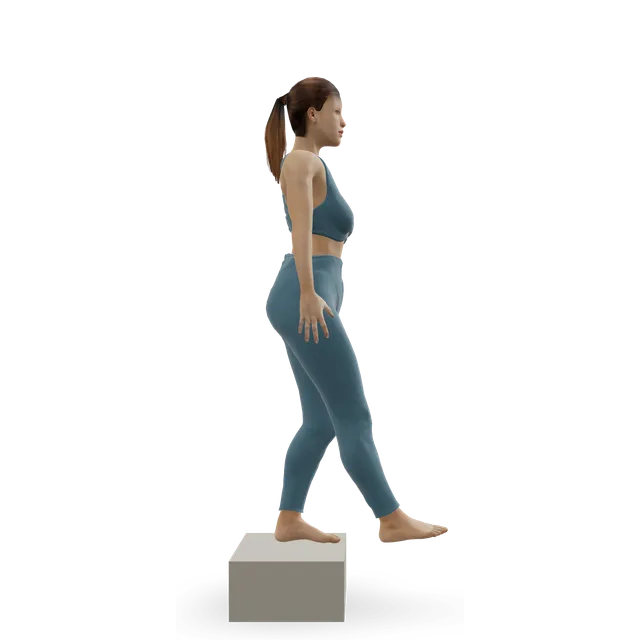
Step-up demonstrated on the 3D figure3D demoStep-upBeginner · A step

3 sets of 10 each leg · Low step, then medium

Easier: Low step-up · Harder: Dumbbell step-up

Patrick step-down demonstrated on the 3D figure3D demoPatrick step-downIntermediate · A step

3 sets of 8 to 10 each leg · Low step first

Easier: Bodyweight squat · Harder: Skater squat

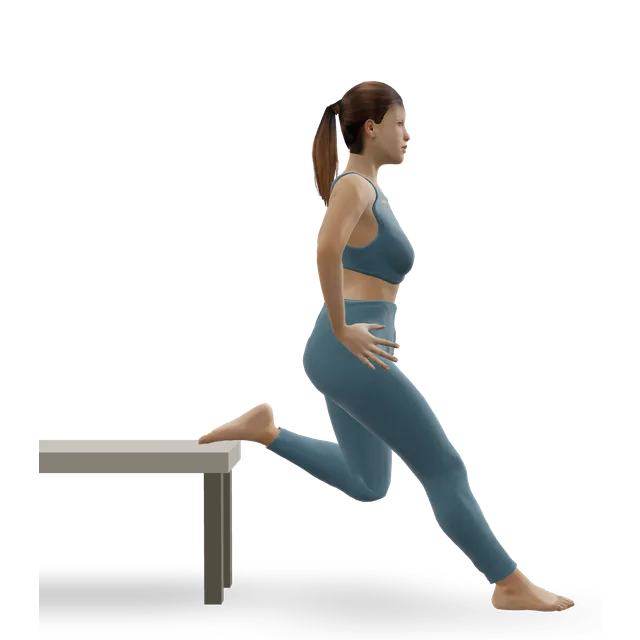
Split squat demonstrated on the 3D figure3D demoSplit squatIntermediate · No equipment

3 sets of 8 to 10 each leg · To a depth within the pain rule

Easier: Bodyweight squat · Harder: Reverse lunge

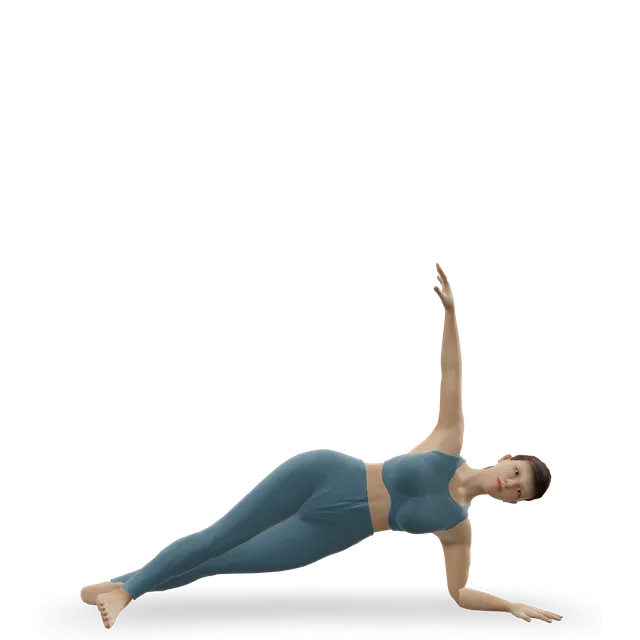
Knee side plank demonstrated on the 3D figure3D demoKnee side plankBeginner · No equipment

3 holds of 20 to 30 s each side · Move to the full side plank when easy

Harder: Side plank

Move on when: Ten slow step-downs from a low step on the sore leg stay within the pain rule, and 30 minutes of brisk walking is pain-free, the starting point of the NHS service's return to running.

Follow along: a timer, a cue and the next move, one step at a time.
Stage 3

Walk-jog back, and keep strong

About 6 weeks, then ongoing. Running comes back through the NHS Oxford return to running programme, every other day on flat ground, with strength work twice a week. If you've kept running through stages 1 and 2, start at the level you can manage within the pain rule (our suggestion).

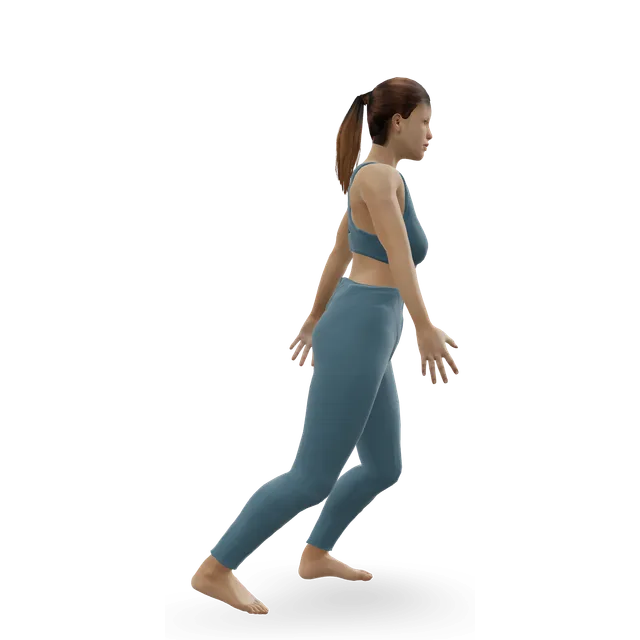
Treadmill jogging demonstrated on the 3D figure3D demoTreadmill joggingIntermediate · Cardio machine

Every other day for 30 min: week 1, jog 1 min and walk 1 min; week 2, jog 2 and walk 1; week 3, jog 4 and walk 1; week 4, jog 9 and walk 1; week 5, jog 15 and walk 1; week 6, jog 30 min · The NHS service's programme: move up a level after a week without pain, and down a level if you get pain. Flat ground outdoors counts. Try 5 to 10% more steps a minute

Easier: Treadmill walking · Harder: Sprint intervals

Single-leg Romanian deadlift demonstrated on the 3D figure3D demoSingle-leg Romanian deadliftAdvanced · A dumbbell

3 sets of 8 each leg · Fingertips on a wall at first

Easier: Dumbbell Romanian deadlift

Side plank with leg lift demonstrated on the 3D figure3D demoSide plank with leg liftAdvanced · No equipment

3 sets of 8 to 10 each side · For outer knee pain, as in the IT band guide

Easier: Side plank · Harder: Copenhagen plank

Move on when: From week 7, add no more than about 10% a week (30 minutes one week, 33 the next), and don't increase distance and time in the same week, as the NHS service advises. Bring back hills, downhills and speed last, one at a time (our suggestion), and keep two strength sessions a week.

Follow along: a timer, a cue and the next move, one step at a time.

What to change for now

What to change in your running today (written steps)

Our 3D figure can't show these changes. They come from a trial of runners with kneecap pain, an NHS service's return to running programme, a large study of runners' training and lab studies in healthy runners, so keep what passes the pain rule.

  • 1. Run more slowly, spread your running across the week, use run-walk intervals, and leave out running downhill and down stairs for now: the advice in the 69-runner kneecap pain trial.
  • 2. Cut back to what you can run within the pain rule. No source gives a figure; about half your usual weekly running, at an easy pace on the flat, is our suggestion.
  • 3. Run every other day while it settles, with at least one rest day a week (the NHS service's tips).
  • 4. Keep each run within your longest pain-free run of the past month. In 5,205 runners, single runs more than 10% longer than the longest of the past 30 days went with more injuries.
  • 5. Before adding pace or distance, do a similar run at least 3 or 4 times (the NHS), and don't increase distance and time in the same week (the NHS service).
  • 6. With IT band pain, stop before the point in the run where it usually starts, and walk the downhills (our suggestion, from the pattern described in runners with the condition). If your feet land almost on one line, slightly wider steps may help: narrower steps raised IT band strain in a lab study of healthy runners.
  • 7. Try 5 to 10% more steps a minute at the same pace. Count your steps for 30 seconds on an easy run and double it, or read it from a running watch, then run to a metronome app set about 5% higher (the counting tip is our suggestion). It may feel awkward and harder at first.

Sources 21, 20, 48, 6, 46, 11, 12, 9, 31

Shoes, insoles, straps and painkillers

Shoes: choose by comfort, not foot type. Don't switch to minimalist shoes or a forefoot landing to fix the knee: changing how your foot lands moves load to the ankle and calf, makes running less efficient at first, and has no injury studies behind it, and runners who switched to minimalist shoes had more injuries. The NHS service suggests replacing trainers every 300 to 500 miles.

Insoles, tape and straps: ready-made arch-support insoles can ease kneecap pain in the short term for some people, and tape or a brace may help alongside exercise, but on their own their benefit is uncertain. In our view they're fine for comfort, but they aren't a treatment by themselves.

Painkillers: in 3,913 marathon runners, those who took painkillers before the race had about 5 times more problems, and 9 went to hospital. Don't take painkillers to run through pain (our suggestion); ask a pharmacist about pain relief.

Sources 33, 37, 38, 49, 50, 51, 48, 23, 24, 52

Injections and surgery

For a worn meniscus tear in mid-life, 12 weeks of supervised exercise did as well as keyhole surgery at 2 years in 140 adults. Kneecap pain is treated with exercise and changes to running; the consensus statements we used don't recommend surgery for it, and we found no trial supporting surgery for IT band pain in runners.

Sources 53, 23, 24

Positions to swap, and why

Habit or positionWhy it mattersInstead
Running downhill and down stairsThe kneecap pain trial's advice left them out, and downhill running lands with a straighter knee, the classic trigger for IT band pain.Walk the downhills and choose flat routes for now.Try: Treadmill jogging
Fast running, intervals and sprintsRunning more slowly was part of the advice that worked for kneecap pain, and tendon load rises with speed and jumping.Easy, conversational running until the last stage.Try: Treadmill jogging
One long run far beyond the restSingle runs more than 10% longer than your longest run of the past 30 days went with more injuries in a large study.Spread your running across the week, and keep the long run within about 10% of your longest recent one.
Box jumps and jump training with tendon pain below the kneecapSpringy loading came third in the largest tendon trial's stages, after holds and slow strength work.Holds now; hops come back last.Try: Spanish squat (band squat hold)
Deep walking lunges while it's soreThe load on the kneecap and its tendons rises with knee bend (the knee squatting guide's reasoning; editorial).A split squat to a depth within the pain rule.Try: Split squat
Rolling or stretching the IT band hard, as the fixWe found no trial showing that rolling or stretching the band fixes IT band syndrome; the treatment studies built hip strength instead. If the outside of the hip also hurts, leave both out, as the hip bursitis guide advises.Hip strength work. Gentle rolling is fine if it feels good, as the IT band guide says.Try: Side plank with leg lift
Switching to a forefoot landing or minimalist shoes to fix the kneeIt moves load to the calf and Achilles, and runners who switched to minimalist shoes had more injuries.Try a slightly quicker step instead.
Painkillers before a run or raceMarathon runners who took them before the race had about 5 times more problems.Keep runs within the pain rule, and ask a pharmacist about pain relief.

Routines to follow

More moves for this area

Questions people ask

Can I keep running with knee pain?

Often, yes, if it stays within the pain rule: 0 to 2 out of 10 is safe and up to 5 acceptable, aiming for 0 to 3 most of the time, with the knee back to normal by the next morning. In a trial of runners with kneecap pain, advice to run more slowly, spread runs across the week, use run-walk and skip downhills helped as much as exercise or gait retraining. Stop and get it checked for sharp pain, swelling, locking or giving way.

Why does my knee hurt when I run but not when I walk?

Each running step loads the leg with about 2 to 3 times your body weight, against about 1 to 1.5 times when walking. Faster running, downhills and long runs add more for some parts of the knee. It's a sign the knee needs less load for a while, not a sign of damage.

What does pain on the outside of the knee mean?

Pain over the bony point on the outer knee that comes on at about the same point in each run, and is worse downhill, is usually IT band syndrome. Strengthening the hip muscles is the common thread in the treatment studies. Our IT band guide has the details.

Why does my knee hurt running downhill?

Running downhill lands with a straighter knee, the position in which the IT band is pressed against the bone, and the thigh muscles do heavy braking work. Walk the downhills for now and choose flat routes, then bring downhills back last.

Should I change my running form?

A slightly quicker step, 5 to 10% more steps a minute at the same pace, lowers the load on the knee in lab studies and eased pain in two small studies. But in a trial of 69 runners, adding gait retraining to advice on training added nothing. Don't switch to landing on your forefoot, which moves the load to the calf and Achilles.

Do I need new running shoes or insoles?

Choose shoes that feel comfortable: matching shoes to foot type didn't prevent injuries in large trials. Ready-made arch-support insoles can ease kneecap pain in the short term for some people. Our suggestion is to change one thing at a time.

Will running give me knee arthritis?

In pooled studies, recreational runners had less hip and knee arthritis than people who didn't run. In people who already had knee arthritis, running didn't speed up X-ray changes or bring new pain.

Do I need a scan?

Usually not: kneecap, IT band and tendon pain are diagnosed from where it hurts and an examination. Scans of knees that don't hurt often show changes, so a report can mislead. After a twist with swelling or locking, or if one spot on a bone hurts, a clinician may arrange one.

Should I wear a knee strap or tape?

On their own, their benefit is uncertain. Alongside exercise, some people find tape or a brace helps them keep moving, which is fine.

How long until I can run normally again?

It varies, and no one can promise a date. In one study of new runners, the middle time to recovery was about 11 weeks for kneecap pain and about 12 weeks for IT band syndrome. Many people keep running, adjusted, the whole way through.

Can I take painkillers before a run?

In a study of marathon runners, those who took painkillers before the race had about 5 times more problems, and some needed hospital care. Ask a pharmacist about pain relief, and don't use it to run through pain.

Related exercise guides

Other pain guides

Sources

  1. Videbæk 2015 · Running injuries per 1,000 hours in different types of runners (systematic review and meta-analysis, Sports Medicine)
  2. Kakouris 2021 · Running injuries by body site and diagnosis (systematic review, Journal of Sport and Health Science)
  3. Francis 2019 · Running injuries by sex, body site and diagnosis (systematic review, Journal of Sports Science and Medicine)
  4. van Poppel 2021 · Risk factors for overuse injuries in short- and long-distance runners (systematic review, Journal of Sport and Health Science)
  5. Senthil 2026 · Risk factors for knee injuries in runners (systematic review of 20 studies, Orthopaedic Journal of Sports Medicine)
  6. Frandsen 2025 · Single running sessions and injury risk in 5,205 runners (cohort, BJSM)
  7. Buist 2008 · A graded beginners' programme built on the 10% rule (RCT of 532 new runners, AJSM)
  8. Nilsson 1989 · Ground forces at different speeds of walking and running (lab study of 12 men, Acta Physiologica Scandinavica)
  9. Heiderscheit 2011 · Step rate and joint loading in 45 runners (lab study, Medicine & Science in Sports & Exercise)
  10. Lenhart 2015 · Step rate and pressure behind the kneecap during running (computer model, Journal of Biomechanics)
  11. Orchard 1996 · Biomechanics of IT band friction syndrome in runners (kinematic and cadaver study, AJSM)
  12. Meardon 2012 · Step width and IT band strain in 15 runners (lab study, Sports Biomechanics)
  13. Lu 2025 · Uphill and downhill running: biomechanics and physiology (review, Frontiers in Bioengineering and Biotechnology)
  14. Malliaras 2015 · Patellar tendinopathy: diagnosis and load management (clinical commentary, JOSPT)
  15. Culvenor 2019 · MRI changes in knees without pain or injury (systematic review and meta-analysis of 63 studies, BJSM)
  16. Englund 2008 · Meniscal findings on MRI in 991 middle-aged and older adults (population study, NEJM)
  17. Horga 2019 · Knee MRI before and after a first marathon in 82 adults (cohort, BMJ Open Sport & Exercise Medicine)
  18. Robertson 2017 · Femoral neck stress fractures in sport (current concepts review, Sports Medicine International Open)
  19. Nielsen 2014 · Time to recovery in 254 injured new runners (cohort, PLoS One)
  20. Esculier 2018 · Education, exercise or gait retraining for 69 runners with kneecap pain (RCT, BJSM)
  21. ClinicalTrials.gov · Rehabilitation for recreational runners with patellofemoral pain (trial registration NCT02352909)
  22. van der Heijden 2015 · Exercise for patellofemoral pain (Cochrane review of 31 trials)
  23. Crossley 2016 · Patellofemoral pain consensus statement, part 2: physical treatments (consensus, BJSM)
  24. Collins 2018 · Consensus statement on exercise and physical treatments for patellofemoral pain (consensus, BJSM)
  25. Sherwood Forest Hospitals NHS · Patellofemoral pain syndrome (patient leaflet, 2025)
  26. Sanchez-Alvarado 2024 · Conservative treatments for IT band syndrome in runners (systematic review of 13 studies, Frontiers in Sports and Active Living)
  27. Fredericson 2000 · Hip abductor weakness in 24 distance runners with IT band syndrome (case series, Clinical Journal of Sport Medicine)
  28. de Souza Júnior 2024 · Two gait retraining programmes for 30 runners with kneecap pain (RCT, PLoS One)
  29. Bramah 2019 · A 10% higher step rate in 12 runners with kneecap pain (case series, AJSM)
  30. Petri 2026 · Gait retraining for kneecap pain in runners (umbrella review of 8 reviews, Sports Medicine Open)
  31. Anderson 2022 · Changing running step rate: injury, performance and biomechanics (systematic review and meta-analysis, Sports Medicine Open)
  32. Breda 2021 · Progressive tendon-loading exercise or eccentric exercise for patellar tendon pain (RCT of 76, BJSM)
  33. Relph 2022 · Running shoes for preventing running injuries in adults (Cochrane review)
  34. Nielsen 2014 · Foot pronation and injury in 927 new runners in neutral shoes (cohort, BJSM)
  35. Malisoux 2016 · Motion-control or standard shoes in 372 recreational runners (blinded RCT, BJSM)
  36. Ryan 2011 · Shoes prescribed by foot posture in 81 women runners (RCT, BJSM)
  37. Nigg 2015 · Running shoes and running injuries: the comfort filter (narrative review, BJSM)
  38. Malisoux 2025 · Perceived shoe cushioning, comfort and injury in 527 runners (secondary analysis of an RCT, European Journal of Sport Science)
  39. Alentorn-Geli 2017 · Recreational and competitive running and hip and knee arthritis (systematic review and meta-analysis, JOSPT)
  40. Lo 2018 · Running in 1,203 people with knee arthritis (cohort, Clinical Rheumatology)
  41. Hartwell 2024 · Running history and hip and knee arthritis in 3,804 marathon runners (survey, Sports Health)
  42. Thomeé 1997 · A treatment approach with pain monitoring for kneecap pain in 40 young women (RCT, Physical Therapy)
  43. Ageberg 2010 · The NEMEX training programme and its pain-monitoring scale (feasibility study, BMC Musculoskeletal Disorders)
  44. Smith 2017 · Painful or pain-free exercise for long-lasting pain (systematic review and meta-analysis of 7 trials, BJSM)
  45. Rich 2025 · Physiotherapy or shockwave therapy for hamstring tendon pain at the sitting bone (RCT of 100, AJSM)
  46. NHS · Knee pain and other running injuries
  47. Silbernagel 2007 · Continued running and jumping with a pain-monitoring model in Achilles tendon pain (RCT of 38, AJSM)
  48. Oxford University Hospitals NHS · Return to Running Programme (OxSport patient leaflet, 2024)
  49. Anderson 2020 · Changing foot strike when running: benefits and risks (systematic review and meta-analysis, Sports Medicine)
  50. Ryan 2014 · Minimalist shoes and injury in 99 runners (RCT, BJSM)
  51. Río 2027 · Injury risk when switching to minimalist shoes (systematic review and meta-analysis of 7 studies, Gait & Posture)
  52. Küster 2013 · Painkillers before a marathon and problems in 3,913 runners (cohort, BMJ Open)
  53. Kise 2016 · Exercise or keyhole surgery for a degenerative meniscal tear in 140 adults (RCT, BMJ)
  54. NHS · Knee pain

Exercise education, not a diagnosis or treatment plan. It is written from the guidelines and studies listed above; review by a clinician is pending. If your pain follows an injury, is severe, is getting worse, or comes with any warning sign listed on this page, get it assessed. Health disclaimer.