Pain guide · Back pain

Lower back pain when cycling: reach, saddle and bars, back and hip strength, and how to build back

Lower back pain is one of the commonest complaints on the bike, and it is usually ordinary back pain rather than damage: high-volume riders' discs looked healthy on scans, and a stationary bike programme helped people with long-lasting back pain. What usually lies behind it is time spent bent forward: a long, low reach, more riding than your back is used to, and back muscles that tire.

Some back pain needs help first. Numbness around your genitals or bottom, new trouble peeing or pooing, or weakness or numbness in both legs is a 999 call. This guide covers those signs and how saddle pressure differs, what to change on the bike (reach, bar height, saddle tilt and how often you move), how much pain is fine, and a three-stage plan for back and hip strength and endurance, with a 3D demo of every move.

When to get help first

Exercise is for pain that has been checked or is clearly mild and settling.

Get urgent medical help if

  • Call 999 or go to A&E: loss of feeling or numbness around the genitals or bottom, new trouble peeing or controlling your bladder or bowels, changes in genital sensation during sex or problems with erections or orgasm, or pain, tingling, weakness or numbness in both legs. These are signs of cauda equina syndrome, which needs treating in hospital urgently. Don't drive yourself.
  • Numbness in the saddle area that doesn't clear after a ride needs checking urgently, and with any of the signs above it is the 999 emergency. Numbness that clears soon after a ride, with none of those signs, is usually pressure from the saddle (our suggestion).
  • Call 999 or go to A&E: back pain with chest pain, or back pain that started after a serious accident, such as a car crash.
  • Call 999: sudden, severe pain in the tummy or back, which can come with breathlessness, pale or grey skin, or collapse. It can be a burst abdominal aortic aneurysm, most common in men aged 65 or over and in people who smoke or used to smoke.
  • Same day: leg weakness that is getting worse.
  • Same day (urgent GP appointment or NHS 111): new difficulty lifting the front of your foot or toes (foot drop), or a foot that slaps down or catches as you walk, especially if it is getting worse. Weakness in both legs, or with numbness around the genitals or bottom or bladder or bowel changes, is the 999 emergency above.
  • Same day (GP or NHS 111): back pain and you feel hot, cold, shivery or generally unwell, or severe pain that starts suddenly or is getting worse quickly.
  • Same day (GP or NHS 111): pain in the lower back or side with a high temperature, burning or stinging when you pee, or needing to pee more often. It can be a kidney infection.
  • Same day: you have or have had cancer, and new back pain that is severe and doesn't let up, is getting steadily worse, is worse at night and disturbs your sleep, is worse when you cough, sneeze or strain, or comes with tenderness over the spine. Contact your cancer team or GP urgently. With cancer, new weakness, difficulty walking, numbness or bladder or bowel problems are an emergency.

See a doctor or physiotherapist if

  • Back pain that hasn't improved after a few weeks of looking after it at home, stops you doing day-to-day activities, or worries you.
  • Pain that doesn't improve with rest or is worse at night, or pain that is worse when you sneeze, cough or poo.
  • Unexplained weight loss, or a lump, swelling or change in the shape of your back.
  • Pain at the top of the back, between the shoulders, rather than in the lower back.
  • Pain, tingling or numbness spreading below the knee that isn't settling after a few weeks, is getting worse or stops your normal activities: see a GP.
  • Back pain that started before 45 and has lasted more than 3 months, especially if it wakes you in the second half of the night, comes with buttock pain, eases with movement or within 48 hours of anti-inflammatories, or you have psoriasis or a parent, sibling or child with spondyloarthritis. These can point to inflammatory back pain (axial spondyloarthritis, such as ankylosing spondylitis); the National Institute for Health and Care Excellence (NICE) refers people with four or more of these features to a rheumatologist.
  • Saddle numbness that keeps coming back on most rides despite standing more often, raising the bars and trying another saddle, or any change in erections or sexual sensation: see a GP (our suggestion).

Where does it hurt?

Location narrows the likely causes; it does not diagnose.

Low back, across or to one side, building through a long ride

Eases off the bike, with no leg symptoms, and is often stiff the next morning: ordinary low back pain. This guide's plan fits.

Read: Back pain →
Low back, came on suddenly

Lifting the bike, a pothole or nothing in particular, sore to move, sometimes with the muscles tightening into a spasm: often called a pulled muscle.

Read: Back spasm and pulled back muscle →
Down one leg, below the knee, with tingling, numbness or weakness

The leg often hurts more than the back: sciatica, often from a disc. Shorten or stop any ride that sends it further down the leg.

Read: Sciatica →
A scan report says bulging or herniated disc

Disc bulges are common in people without back pain. If leg pain is the main problem, read about sciatica; if the back hurts most, treat it as back pain.

Read: Herniated or bulging disc →
Low on one side, by the dimple at the back of the pelvis

Worse on stairs, standing on one leg or turning in bed: possibly the sacroiliac (SI) joint.

Read: SI joint pain →
Low back, for more than 3 months, or it keeps coming back

Good and bad days and flare-ups: long-lasting (chronic) back pain.

Read: Chronic low back pain →
Buttocks and legs when you stand or walk, eased by sitting or bending forward

Often fine on the bike, which keeps you bent forward: possibly lumbar spinal stenosis. You may be able to cycle further than you can walk.

Read: Lumbar spinal stenosis →
Between the shoulder blades, or the mid back

On long rides, often with the neck and shoulders: upper back pain. Our upper back and shoulder pain when cycling guide covers it on the bike.

Read: Upper back pain when cycling →
After a crash

Back pain after a serious accident is a 999 call. Sudden mid or low back pain after a minor fall from about 50, or with long-term steroid tablets, can be a spinal fracture.

Read: Spinal compression fracture →
Numbness in the saddle area

Pressure from the saddle is common in riders. Numbness that doesn't clear after a ride, or that comes with the warning signs, needs checking urgently: see the saddle note below.

Understand it

Who gets it, and what usually lies behind itEmerging evidence

In the one study of professional road riders (109 riders), 58% had had low back pain in the past year. In 1,274 Italian amateurs, 26.5% had it in the past year, and among 1,521 riders who went to bike-fit services, 29.2% reported it, slightly more often in mountain bikers, younger riders and heavier riders. It is usually ordinary low back pain, often a strained muscle or with no clear cause, and the National Health Service (NHS) says it usually improves within a few weeks.

These are associations from surveys, not proof of cause. A past bout of back pain went with about 4 times the odds; riding 160 kilometres (about 100 miles) or more a week went with 3.6 times the odds in 66 club riders; and coached or planned training went with about half the odds. In 40 men, a 3-hour ride raised back pain by the same amount on a road bike and a mountain bike, which the authors put down to the rider more than the bike.

Sources 1, 2, 3, 4, 5, 6

Why the riding position mattersEmerging evidence

In reviews of small studies, lower handlebars went with more rounding at the base of the spine, and a lower, further grip went with more rounding of the lower back (16 studies). Riders whose back pain comes on with a rounded position sat more rounded throughout a 2-hour outdoor ride, and their pain rose. Off-road racers with back pain had thinner deep trunk muscles and less back endurance, with no difference in strength or flexibility.

These are small studies and associations. One older lab study found lower bars didn't change the lower back's curve, and in static photos, body position didn't separate riders with and without back pain. Our reading: a long time bent and stretched forward, with back muscles that tire, is the most consistent pattern.

Sources 7, 8, 9, 10, 11, 12, 13, 14

Does cycling harm the back? It seems notEmerging evidence

In 18 high-volume road riders against 18 non-sporting adults, the riders' discs looked better hydrated on magnetic resonance imaging (MRI), their deep hip flexor muscles were bigger and their trunk endurance was better. That was a one-time comparison, not proof.

In 64 adults with long-lasting back pain, 8 weeks of stationary cycling or specific trunk exercises both reduced pain. Trunk exercise did better for disability at 8 weeks, but the groups didn't differ by 6 months.

Sources 15, 16

Saddle numbness, and the emergency signsEmerging evidence

The NHS lists loss of feeling or numbness around the genitals or bottom, new trouble peeing or controlling your bladder or bowels, changes in sexual sensation or function, and pain, tingling, weakness or numbness in both legs as signs of cauda equina syndrome: call 999 or go to accident and emergency (A&E).

Riders also get numbness from saddle pressure. Women who rode had 6.5 to 9.1 times the odds of genital numbness of women who swam or ran. In men, standing for more than a fifth of the ride and bars level with or above the saddle went with less numbness, and in healthy men, saddles without a nose and recumbent bikes lowered pressure on the area. A review suggests standing on the pedals every 10 minutes or so, on indirect evidence.

Our suggestion: numbness that clears soon after a ride, with none of the emergency signs, is usually saddle pressure; numbness that doesn't clear needs checking urgently.

Sources 6, 17, 18, 19, 20

When a scan helpsStrong evidence

The National Institute for Health and Care Excellence (NICE) advises against routine imaging for low back pain, and in specialist care only when the result would change what's done. Scans of people without back pain often show disc degeneration (37% at 20, rising to 96% at 80) and bulges, so a report can mislead. The warning signs are the exception.

Sources 21, 22

How it usually goesStrong evidence

Across 33 studies that followed people with new back pain, average pain fell from 52 out of 100 to 23 at 6 weeks, 12 at 6 months and 6 at a year. It often comes back: in a trial's comparison group, half had another bout that limited their activity within 112 days. No study has followed riders, and no one can promise a date.

Sources 23, 24

What helps, and how strong the evidence is

Exercise helps, and no core method beats anotherStrong evidence

Across 249 trials, exercise reduced long-lasting back pain by about 15 points out of 100 against no treatment, usual care or a placebo, and improved function by about 7. Motor control (core) exercise did no better than other exercise in 29 trials (2,431 people), so choose what you'll keep doing.

Sources 25, 26

Back-muscle endurance and hip strength make sense for riders, untestedEmerging evidence

Riders with back pain had less back-muscle endurance and thinner deep trunk muscles in small studies, so building endurance in the back and trunk is a logical target. No trial has tested it in riders with back pain; in one rider, a programme that retrained how he sat on the bike reduced rounding and pain, a single case summarised in a review.

Sources 11, 7

A higher, shorter reach and moving oftenEmerging evidence

Lower and further bars went with more rounding of the lower back across reviews of small studies; one older study found no change in the lower back's curve. In 66 club riders, preferring the brake hoods came close to a link with back pain, though it wasn't significant. Riders with back pain held a rounded position for the whole of a 2-hour ride.

Raising the bars, shortening the reach and changing position often are sensible, low-risk changes built on these associations; none has been tested in a trial (our summary).

Sources 8, 7, 13, 4, 9

Tilting the saddle nose-down: one uncontrolled studyMixed evidence

In one study of club riders with back pain, tilting the saddle 10 to 15° nose-down was followed by major improvement in over 70%, but there was no comparison group, so time alone could explain some of it. The reports of its result differ: a 2026 review describes 80 riders with 72% fully resolved and 20% much improved, while an earlier review reports 29 of 40 pain-free.

A nose-down saddle also slides you forward onto your hands, which a review names as a risk factor for numb hands. Our suggestion: keep the saddle level, and try a small tilt only if it eases your back without loading your hands.

Sources 27, 28, 7, 29

A bike fit eased back pain over 15 days; no study shows it prevents itEmerging evidence

In a randomised trial of 162 amateur riders, a fit based on three-dimensional motion capture lowered back pain on the bike by about 1.4 points out of 10 at 15 days compared with a posture handout. A review of 3 fitting studies found improvement in all of them, over 30 days to 6 months, but only one was randomised. Across 18 studies, many fit measurements weren't linked with pain, and body position in photos didn't separate riders with and without back pain.

Sources 30, 28, 31, 14

Keep moving: no bed rest, belts or routine scansStrong evidence

Advice to stay active did slightly better than advice to rest in bed (2 trials, 401 people), and the NHS says not to stay in bed for long periods. NICE says not to offer belts, corsets or foot orthotics for low back pain, not to offer paracetamol alone, and to consider an anti-inflammatory at the lowest dose for the shortest time; ask a pharmacist which suits you. NICE also says not to offer spinal injections for low back pain.

Sources 32, 6, 21

Walking and education cut repeat boutsEmerging evidence

In a trial of 701 adults who had recently recovered from back pain, a walking programme with education delayed the next bout that limited activity: a middle time of 208 days against 112 without it. Keeping walking and strength work going after riding returns is our suggestion.

Source 24

How much pain is OK while you exercise?

The back pain ruleEmerging evidence

This guide uses the back hub's rule. Some discomfort during exercise is fine and doesn't mean you are doing damage. Aim for pain you would call mild to moderate, no more than about 5 out of 10. It should settle within an hour or so, and your back should be no worse the next morning. If it is, do less next time (a shorter ride, sitting more upright, fewer reps), not nothing.

Leg symptoms are the exception: shorten or stop any ride or exercise that sends pain, pins and needles or numbness further down your leg. If leg symptoms move back towards your spine, that is a good sign. The NHS sciatica page says that even if moving hurts, it's not harmful.

The NHS says to stop exercises if your pain gets worse and see a general practitioner (GP): that means pain climbing day after day, not the passing discomfort this rule allows. The 5 out of 10 figure matches this site's other pain guides and hasn't been tested in a back pain trial; in trials of long-lasting muscle and joint pain, exercise that allowed some pain did no harm.

On the bike, our suggestion: sit up, change hand position or stand on the pedals for a few strokes when your back starts to ache, and end the ride before the ache builds past 5.

Sources 33, 6, 17

The exercise plan: 3 stages

Start at the first stage. Each move opens a full guide with a 3D demo.

Stage 1

Settle: keep moving

The first days to about 2 weeks. Stay active: walk every day and move gently in the directions that ease it. Ride only if it stays within the pain rule, sitting upright, short and easy. Doses are editorial unless a source is named.

Treadmill walking demonstrated on the 3D figure3D demoTreadmill walkingBeginner · Cardio machine

10 to 30 min a day, building up · Walking outdoors counts. The NHS lists walking among activities that may ease back pain

Harder: Treadmill jogging

Cat-cow demonstrated on the 3D figure3D demoCat-cowBeginner · No equipment

8 waves, slower than feels natural · The move page's dose

Harder: Half lord of the fishes (Ardha Matsyendrasana)

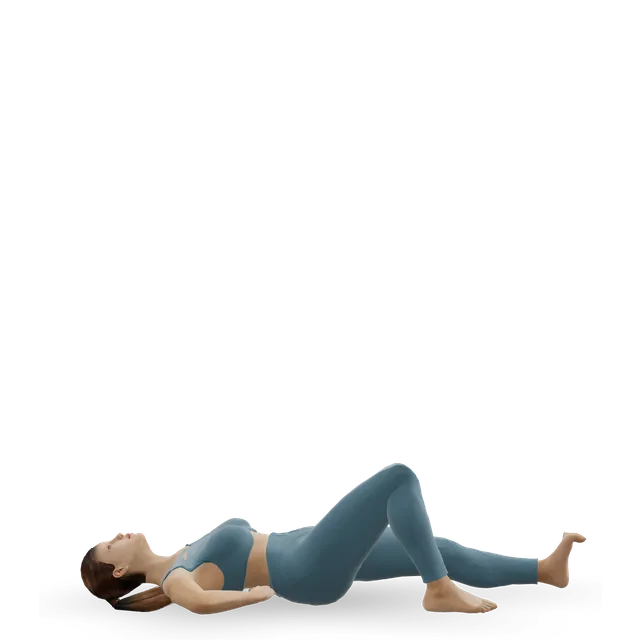
Hip windshield wipers demonstrated on the 3D figure3D demoHip windshield wipersBeginner · No equipment

10 slow passes side to side, 2 rounds · The move page's dose

Easier: Supine heel slide · Harder: 90/90 switch

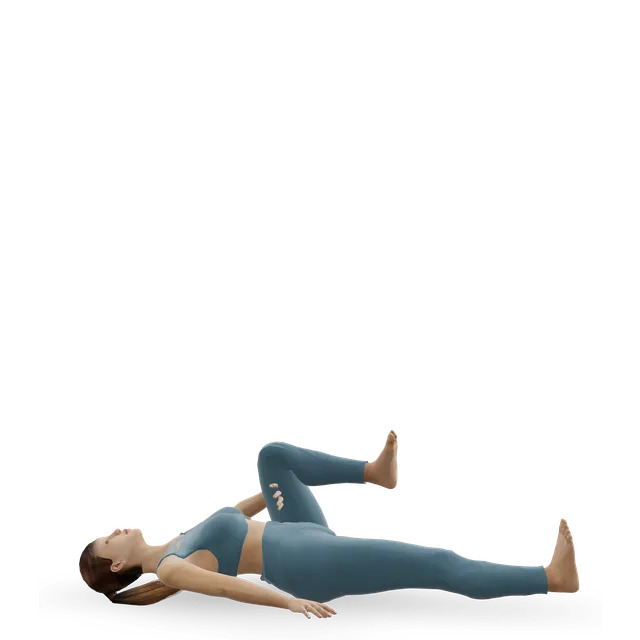
Single knee-to-chest stretch demonstrated on the 3D figure3D demoSingle knee-to-chest stretchBeginner · No equipment

Hold 20 to 30 s, 2 to 4 times each side · The move page's dose

Harder: 90/90 hip lift-off

Sphinx pose (Salamba Bhujangasana) demonstrated on the 3D figure3D demoSphinx pose (Salamba Bhujangasana)Beginner · No equipment

3 holds of 20 to 30 s · Only if leaning back eases your back, as it often does after a long spell bent forward (our suggestion)

Harder: Cobra pose (Bhujangasana)

Move on when: Walking for 20 to 30 minutes feels fine, nothing is spreading down a leg, and your back is settling by the next morning.

Follow along: a timer, a cue and the next move, one step at a time.
Stage 2

Build: strength you'll keep up

About weeks 2 to 6, strength work 2 to 3 days a week and walking or easy upright riding most days. No single core method beats another, so choose what you'll keep doing. Doses are editorial, as in the running back guide.

Dead bug demonstrated on the 3D figure3D demoDead bugBeginner · No equipment

2 to 3 sets of 6 to 8 each side

Easier: Dead bug heel taps · Harder: Forearm plank

Knee side plank demonstrated on the 3D figure3D demoKnee side plankBeginner · No equipment

3 holds of 15 to 30 s each side

Harder: Side plank

Hip-hinge practice demonstrated on the 3D figure3D demoHip-hinge practiceBeginner · No equipment

2 sets of 10 · The bent-forward position you hold on the bike, practised with a neutral back

Harder: Dumbbell Romanian deadlift

Stationary cycling demonstrated on the 3D figure3D demoStationary cyclingBeginner · Cardio machine

15 to 30 min, easy, sitting upright with the bars high · Editorial. A stationary bike programme did as well as specific trunk exercises by 6 months in one trial

Easier: Recumbent exercise bike · Harder: Air bike intervals

Move on when: 30 minutes of easy upright riding or brisk walking stays within the pain rule, and the strength work feels steady.

Follow along: a timer, a cue and the next move, one step at a time.
Stage 3

Build back endurance, and ride again

From about week 6, twice a week, then ongoing: the back and trunk endurance that riders with back pain lacked in small studies, while riding comes back by our suggested steps.

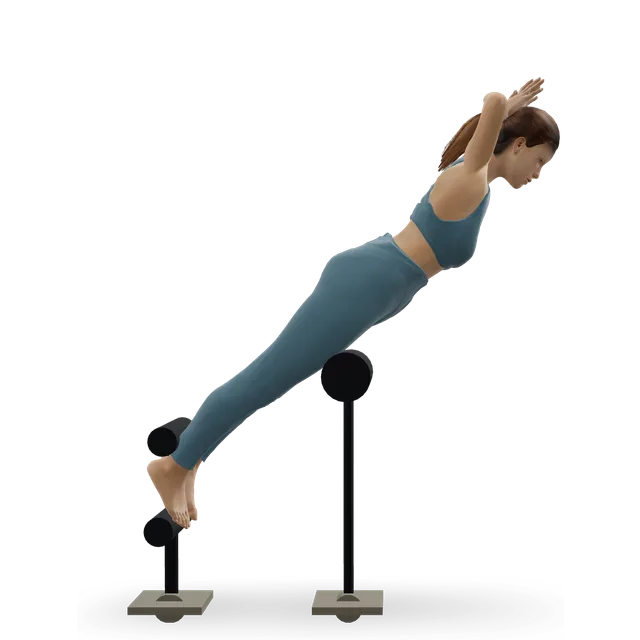
Back extension on a 45-degree bench demonstrated on the 3D figure3D demoBack extension on a 45-degree benchIntermediate · A bench or box

2 sets of 10 to 15, lifting to a straight line, no further · As in the site's strength workout for cyclists

Easier: Ball back extension · Harder: Horizontal back extension (hyperextension, Roman chair)

Side plank demonstrated on the 3D figure3D demoSide plankIntermediate · No equipment

2 to 3 holds of 20 to 40 s each side

Easier: Knee side plank · Harder: Side plank with leg lift

Stationary cycling demonstrated on the 3D figure3D demoStationary cyclingBeginner · Cardio machine

Every other day: 20 to 30 min at an easy effort, hands on the tops, bars raised if you can · Our suggestion. Sit up or stand on the pedals for a few strokes every 10 to 15 minutes. Ride a similar route 3 or 4 times within the pain rule before adding anything, then add time, about 10% a week, before hills or harder efforts

Easier: Recumbent exercise bike · Harder: Air bike intervals

Move on when: Our suggestion: keep adding time, about 10% a week, while the pain rule holds. Bring back the drops, aero bars, long climbs, rough trails and hard efforts last, one at a time, and shorten or stop any ride that sends symptoms down a leg.

Follow along: a timer, a cue and the next move, one step at a time.

What to change for now

What to change on the bike and in your riding today (written steps)

Our 3D figure can't show these changes. They rest on associations and small studies, not trials in riders with back pain, so keep what passes the pain rule.

  • 1. Raise the bars or shorten the reach: spacers under the stem, a shorter or higher stem, or bars with less reach. Lower and further bars went with more rounding of the lower back.
  • 2. Move your hands around, use the higher grips when your back aches, and keep the drops and aero bars for short spells.
  • 3. Sit up, change hand position or stand on the pedals for a few strokes every 10 to 15 minutes on long rides (our suggestion; riders with back pain held a rounded position for the whole of a 2-hour ride, and standing more went with less saddle numbness).
  • 4. Keep the saddle level. Try a small nose-down tilt only if it eases your back without loading your hands; the evidence is one study without a comparison group.
  • 5. Ride shorter for a while. No source gives a figure; about half your usual weekly riding is our suggestion. In 66 club riders, riding 160 kilometres or more a week went with 3.6 times the odds of back pain.
  • 6. Indoors, sit upright with the bars high, or try a recumbent bike (our suggestion).

Sources 8, 7, 4, 9, 20, 19, 27, 29

Bike fits, belts, medicines, injections and surgery

A fit can ease back pain on the bike in the short term; no study shows it prevents back pain. NICE says not to offer belts, corsets, foot orthotics or spinal injections for low back pain. For medicines, ask a pharmacist; NICE suggests an anti-inflammatory at the lowest dose for the shortest time rather than paracetamol alone. Disc and sciatica surgery belong to those guides.

Sources 30, 28, 21, 6

Positions to swap, and why

Habit or positionWhy it mattersInstead
Bed rest, or stopping all activityAdvice to stay active did slightly better than advice to rest in bed, and the NHS says not to stay in bed for long periods.Walk every day.Try: Treadmill walking
Long rides held low and stretched out, in the drops or on aero barsLower, further grips went with more rounding of the lower back.Higher grips, raised bars or a shorter reach, and a change of position every 10 to 15 minutes (our suggestion).
Riding through pain, tingling or numbness that spreads down a legLeg symptoms are the exception to the pain rule.Shorten or stop the ride, and read the warning signs.
A steep nose-down saddle as a quick fixThe evidence is one study without a comparison group, and a nose-down saddle slides weight onto your hands.Keep the saddle level; try a small tilt only if it eases your back without loading your hands.
A back belt or corsetNICE says not to offer belts or corsets for low back pain.Exercise you'll keep doing.
Asking for a scan to find out what's wrongDisc changes are common in people without back pain, and NICE advises against routine imaging.Get checked if a warning sign appears.
Treating the core as the whole answerCore exercise did no better than other exercise in 29 trials.Whatever strength and endurance work you'll keep up.

Routines to follow

More moves for this area

Questions people ask

Why does my lower back hurt when I cycle?

Mostly from holding a bent-forward position for a long time. Lower, longer reaches went with more rounding of the lower back, riders with back pain rounded more and had less back-muscle endurance, and more riding went with more back pain. It's usually ordinary back pain, not damage.

Is cycling good or bad for back pain?

It seems not to harm the back. High-volume riders' discs looked healthier on scans than non-sporting adults', and a stationary bike programme helped long-lasting back pain about as much as specific trunk exercises by 6 months. Set the bike up so you can sit more upright while it settles.

Can I cycle with sciatica or a slipped disc?

Often yes, if it stays within the pain rule and doesn't send symptoms further down your leg. The NHS says to keep moving with sciatica because, even if moving hurts, it's not harmful. Numbness around the genitals or bottom, or bladder or bowel changes, are a 999 emergency.

What should I change on my bike?

Raise the bars or shorten the reach, use the higher grips more, keep the saddle level, and ride shorter for a while. Changing position and standing on the pedals every so often is our suggestion. Most of this rests on associations and lab studies, so keep what helps.

Should my saddle tilt nose-down?

A nose-down tilt was followed by improvement in most riders in one study, but it had no comparison group and the reports of its result differ. It also slides you forward onto your hands. Start level, and try a small tilt only if it helps your back without loading your hands.

Will a bike fit fix my back pain?

In a trial, a fit lowered back pain on the bike by about 1.4 points out of 10 over 15 days. But body position didn't separate riders with and without back pain, so strength, endurance and how much you ride matter too. No study shows a fit prevents back pain.

What exercises help?

Exercise of almost any kind helps long-lasting back pain by a modest amount, and no core method beats another. For riders, back-muscle endurance and hip strength make sense, though they haven't been tested in riders, with walking every day while it settles.

My saddle area goes numb. Should I worry?

Saddle pressure is a common cause: standing on the pedals more and raising the bars went with less numbness in men. Our suggestion: numbness that clears soon after a ride, with no other symptoms, is usually saddle pressure, but numbness that doesn't clear needs checking urgently. With bladder or bowel changes, changes in sexual function, or weakness or numbness in both legs, call 999 or go to A&E.

Is mountain biking worse for the back than road riding?

At bike-fit services, mountain bikers reported back pain slightly more often. But a 3-hour ride raised back pain by the same amount on both bikes in 40 riders, which suggests the rider matters more than the bike.

Do I need a scan?

Not usually. NICE advises against routine scans for back pain, and disc changes are common in people with no pain. The warning signs on this page are what need checking.

Related exercise guides

Other pain guides

Sources

  1. Clarsen 2010 · Overuse injuries in 109 professional road cyclists (cross-sectional study, Am J Sports Med)
  2. Battista 2021 · Low back pain in 1,274 Italian amateur cyclists (cross-sectional study, Sports Med Open)
  3. Pernambuco 2025 · Low back pain in 1,521 cyclists at bike-fit services (cross-sectional study, J Bodyw Mov Ther)
  4. Schultz 2010 · Low back pain and training in 66 recreational cyclists (survey, Int J Exerc Sci)
  5. Garrosa-Martín 2023 · Low back pain after a 3-hour ride on road and mountain bikes in 40 men (randomised study, Int J Environ Res Public Health)
  6. NHS · Back pain
  7. Streisfeld 2017 · Riding position, muscle activity and spine movement in cyclists with and without low back pain (systematic review, Sports Health)
  8. Antequera-Vique 2023 · Cycling and the shape of the spine on and off the bike (systematic review, Sports Biomech)
  9. Van Hoof 2012 · Lower back posture during a 2-hour ride in cyclists with and without low back pain (field study of 17 riders, Man Ther)
  10. Burnett 2004 · Spine movement and trunk muscle activity in cyclists with and without low back pain (pilot study of 18 riders, Man Ther)
  11. Rostami 2015 · Trunk muscles, back endurance and flexibility in 38 off-road cyclists with and without low back pain (study, J Back Musculoskelet Rehabil)
  12. Chen 2012 · Handlebar height and the curves of the neck and lower back in 26 riders (lab study, Work)
  13. Kolehmainen 1989 · Handlebar position, neck posture and load on the neck in 8 men (lab study, Clin Biomech)
  14. Bini 2023 · Pain and body position on the bike in 71 road cyclists (retrospective study, Sports Biomech)
  15. Belavý 2019 · Discs and muscles in 18 high-volume road cyclists and 18 non-sporting adults (cross-sectional MRI study, Med Sci Sports Exerc)
  16. Marshall 2013 · Pilates or stationary cycling for chronic low back pain in 64 adults (randomised trial with 6-month follow-up, Spine)
  17. NHS · Sciatica
  18. Gaither 2018 · Cycling and sexual and urinary function in 3,118 women (cross-sectional study, J Sex Med)
  19. Awad 2018 · Cycling and sexual and urinary function in 3,932 men (cross-sectional study, J Urol)
  20. Litwinowicz 2021 · Ways to reduce saddle pressure on the perineum in healthy men: 22 studies (systematic review and meta-analysis, Sports Medicine)
  21. NICE NG59 · Low back pain and sciatica in over 16s: assessment and management (2016, updated 2026)
  22. Brinjikji 2015 · Spine degeneration on scans of people without back pain (systematic review, AJNR)
  23. da C Menezes Costa 2012 · The prognosis of acute and persistent low back pain (meta-analysis of 33 cohorts, CMAJ)
  24. Pocovi 2024 · WalkBack: walking and education to prevent low back pain coming back (randomised trial of 701, Lancet)
  25. Hayden 2021 · Exercise therapy for chronic low back pain, 249 trials (Cochrane review)
  26. Saragiotto 2016 · Motor control exercise for chronic non-specific low back pain (Cochrane review)
  27. Salai 1999 · Saddle angle and low back pain in recreational cyclists (study without a comparison group, BJSM)
  28. Barrajón 2026 · Bike fitting and low back pain in cyclists (systematic review, Cureus)
  29. Farag 2025 · Common sports-related nerve injuries, including cyclist's palsy (review, Muscle Nerve)
  30. Dias Scoz 2025 · A 3D bike fit vs posture advice in 162 amateur cyclists (randomised trial, Sports Biomech)
  31. Visentini 2022 · Factors linked with overuse injury in cyclists: 18 studies (systematic review, J Sci Med Sport)
  32. Dahm 2010 · Advice to rest in bed vs advice to stay active for low back pain and sciatica (Cochrane review)
  33. Smith 2017 · Should exercises be painful in chronic musculoskeletal pain? (systematic review and meta-analysis, BJSM)

Exercise education, not a diagnosis or treatment plan. It is written from the guidelines and studies listed above; review by a clinician is pending. If your pain follows an injury, is severe, is getting worse, or comes with any warning sign listed on this page, get it assessed. Health disclaimer.