Pain guide · Back pain

Lower back pain when swimming: which strokes, kicks and turns to change, and a plan back

Lower back pain in swimmers usually comes from repeated arching: butterfly, breaststroke with the head held up, head-up kicking on a board, the dolphin kick and turns all add to it, and dryland weights often bring it on. Swimming is also one of the activities the National Health Service (NHS) suggests for back pain, and in a small 2026 study of adults with back pain, backstroke hurt least and breaststroke most.

So the answer is usually to change how you swim, not to stop: backstroke and front crawl, face-in breaststroke, kicking on your back and open turns, with trunk and hip exercises on land. Numbness around the genitals or bottom, or new problems with your bladder or bowels, needs a 999 call or accident and emergency (A&E), and a teenager whose back hurts arching backwards needs a general practitioner (GP) or sports physiotherapist to check for a stress fracture of the spine. This guide covers those signs, what to change in the pool, how much pain is fine and a three-stage plan with a 3D demo of every move.

When to get help first

Exercise is for pain that has been checked or is clearly mild and settling.

Get urgent medical help if

  • Call 999 or go to A&E: loss of feeling or numbness around the genitals or bottom, new trouble peeing or controlling your bladder or bowels, changes in genital sensation during sex or problems with erections or orgasm, or pain, tingling, weakness or numbness in both legs. These are signs of cauda equina syndrome, which needs treating in hospital urgently. Don't drive yourself.
  • Call 999 or go to A&E: back pain with chest pain, or back pain that started after a serious accident, such as a car crash.
  • Call 999: sudden, severe pain in the tummy or back, which can come with breathlessness, pale or grey skin, or collapse. It can be a burst abdominal aortic aneurysm, most common in men aged 65 or over and in people who smoke or used to smoke.
  • Same day: leg weakness that is getting worse.
  • Same day (urgent GP appointment or NHS 111): new difficulty lifting the front of your foot or toes (foot drop), or a foot that slaps down or catches as you walk, especially if it is getting worse. Weakness in both legs, or with numbness around the genitals or bottom or bladder or bowel changes, is the 999 emergency above.
  • Same day (GP or NHS 111): back pain and you feel hot, cold, shivery or generally unwell, or severe pain that starts suddenly or is getting worse quickly.
  • Same day (GP or NHS 111): pain in the lower back or side with a high temperature, burning or stinging when you pee, or needing to pee more often. It can be a kidney infection.
  • Same day: you have or have had cancer, and new back pain that is severe and doesn't let up, is getting steadily worse, is worse at night and disturbs your sleep, is worse when you cough, sneeze or strain, or comes with tenderness over the spine. Contact your cancer team or GP urgently. With cancer, new weakness, difficulty walking, numbness or bladder or bowel problems are an emergency.
  • Same day (GP or NHS 111): back pain in the second or third trimester of pregnancy, or back pain in pregnancy with a fever, vaginal bleeding or pain when you pee. It could be early labour or an infection.

See a doctor or physiotherapist if

  • A teenager in a sport that arches or twists the back, such as gymnastics, dance, diving, butterfly or breaststroke swimming, volleyball, cricket fast bowling, baseball pitching, weightlifting, football or rugby, with back pain that lasts more than a couple of weeks, is worse arching back or stops them training: get it checked by a GP or sports physiotherapist. It can be a stress fracture in the spine.
  • Back pain that hasn't improved after a few weeks of looking after it at home, stops you doing day-to-day activities, or worries you.
  • Pain that doesn't improve with rest or is worse at night, or pain that is worse when you sneeze, cough or poo.
  • Unexplained weight loss, or a lump, swelling or change in the shape of your back.
  • Pain at the top of the back, between the shoulders, rather than in the lower back.
  • Pain, tingling or numbness spreading below the knee that isn't settling after a few weeks, is getting worse or stops your normal activities: see a GP.
  • Back pain that started before 45 and has lasted more than 3 months, especially if it wakes you in the second half of the night, comes with buttock pain, eases with movement or within 48 hours of anti-inflammatories, or you have psoriasis or a parent, sibling or child with spondyloarthritis. These can point to inflammatory back pain (axial spondyloarthritis, such as ankylosing spondylitis); the National Institute for Health and Care Excellence (NICE) refers people with four or more of these features to a rheumatologist.
  • Back pain that comes back each time you build your swimming up, despite changing stroke, kicking on your back and cutting turns: our suggestion is to see a physiotherapist, ideally one who knows swimming.

Where does it hurt?

Location narrows the likely causes; it does not diagnose.

The low back, across or to one side, aching during or after sets

Worse in butterfly, breaststroke or head-up kicking and easing out of the water: ordinary low back pain from repeated arching. This guide covers it, and our back pain guide goes further.

Read: Back pain →
Low back pain that came on suddenly, lifting in the gym or twisting at the wall

With muscle spasm: a strained muscle or ordinary back pain.

Read: Back spasm and pulled back muscle →
A teenager's low back pain that lasts and is worse arching backwards

In butterfly, breaststroke or push-offs, perhaps stopping them training: a possible stress fracture of the spine (spondylolysis). Get it checked.

Read: Spondylolisthesis →
Low back pain worse arching back or twisting, sometimes into the buttock, from mid-life

Often called facet joint pain; a swimming review calls the butterfly version butterfly back.

Read: Facet joint pain →
Pain, tingling or numbness down one leg below the knee

Sciatica, often from a disc. Shorten or stop any stroke, kick or turn that sends it further.

Read: Sciatica →
A scan report that says bulging or worn discs

Common in swimmers and non-swimmers without pain. Our herniated disc guide explains.

Read: Herniated or bulging disc →
Low on one side, by the dimple at the back of the pelvis

Possibly the sacroiliac joint.

Read: SI joint pain →
The back of the pelvis or the pubic bone in pregnancy or after birth

Pelvic girdle pain.

Read: Pelvic girdle pain (SPD) →
Between the shoulder blades, or the mid back, after long sets

Upper back pain. The NHS asks for a GP check for pain between the shoulders.

Read: Upper and mid back pain →
Low back pain for more than 3 months, or that keeps coming back

Long-lasting back pain.

Read: Chronic low back pain →
Low back pain and stiffness that persists in a teenager or young adult

Often worse in the second half of the night: possibly inflammatory back pain. See the see-a-GP signs.

Understand it

Who gets itEmerging evidence

Butterfly carried 2.5 times the risk of low back pain in 341 elite swimmers. Older surveys, as a review summarises them, put back pain at a third to a half of butterflyers and a quarter to a half of breaststrokers, and in one US college team the neck or back was the second commonest injury site after the shoulder. In 88 masters swimmers, 27% had low back pain lasting more than 10 days in a year. We found no study of people who swim for fitness on their own.

Sources 1, 2, 3, 4

Why swimming can hurt the lower backEmerging evidence

Every stroke holds some arch in the lower back to stay streamlined, and reviews describe the arch as greatest in butterfly and breaststroke and in the undulating dolphin kick, with twisting in front crawl and turns. In college men, the 11 with back pain arched more in the dolphin kick than the 21 without, and had stiffer hip flexors and less hip extension.

In a survey of 285 competitive swimmers, more pool training and hypermobility went with more lumbar injuries. Among the 29 with a past lumbar injury, butterfly (86%), dryland strength training (76%) and turns (72%) were the activities most often reported as painful, and paddles and pull buoys the least (14%).

Sources 2, 5, 6, 7, 8, 9

Kickboards: the evidence conflictsMixed evidence

Reviews say a kickboard held out with the head up raises the arms, shoulders and head and arches the lower back, and a return-to-swim protocol lists a stress fracture of the spine among the reasons not to use one. But in the one survey that looked, the 285 competitive swimmers who used kickboards more had fewer lumbar injuries (about 0.6 times the odds). That survey looked back in time, so it can't show cause, and the reviews' warning is expert opinion.

Sources 6, 5, 10, 8

Stress fractures of the spine in young swimmersEmerging evidence

A stress fracture of the bridge of bone at the back of a vertebra (spondylolysis) is less common in swimmers than in divers but not rare: 11.6% of 687 swimmers across 7 studies, against 35.4% of divers, and 41.7% of athletes with low back pain in pooled case series. In four teenage elite swimmers, three of them breaststrokers or butterflyers, the diagnosis took 2 to 7 months in three, and plain X-rays showed only two of the four cracks.

The NHS says these stress fractures are more common in young athletes and gymnasts. A swimming review advises magnetic resonance imaging (MRI) or computed tomography (CT) when an early crack is suspected, about 6 to 12 weeks of rest with or without a brace, and front crawl or backstroke if butterfly and breaststroke still hurt; our spondylolisthesis guide covers the return to sport.

Sources 11, 12, 13, 5, 14

Discs on scansEmerging evidence

Disc wear on scans was commoner in elite than recreational swimmers (68% against 29%), mostly in the lowest disc, but it wasn't linked with their back pain or their stroke. Swimmers had higher odds of disc wear than non-athletes in a university study, and three of four studies found more in competitive swimmers, yet 100 elite swimmers and 96 non-sporting adults had similar disc wear and back pain overall.

Disc wear is common in people without pain and rises with age (37% at 20, 96% at 80), and the National Institute for Health and Care Excellence (NICE) says not to image low back pain routinely. A scan is for the warning signs, a young swimmer with a possible stress fracture, or leg symptoms that aren't settling.

Sources 15, 16, 17, 18, 19, 20

How it usually goesEmerging evidence

The NHS says back pain usually improves within a few weeks but can sometimes last longer or keep coming back. In a swimming trial, disability eased more by 8 weeks with a swimming programme, but the groups had evened out by a year. No study has followed swimmers' back pain, and no one can promise a date.

Sources 21, 22

What helps, and how strong the evidence is

Swimming helps back pain, modestlyEmerging evidence

In 76 adults with long-lasting low back pain, an 8-week individual swimming programme with education, guided by 4 online physiotherapy sessions, beat education alone for disability at 8 weeks (2.5 points on a 24-point scale) but not at a year. Pain fell slightly (0.7 out of 10), an amount that may not matter much, and the swimming group had more minor side effects. Aquatic exercise reduced pain in 8 small trials, and the NHS lists swimming among activities that may help.

But reviews found mostly one-off surveys with no clear pattern linking swimming and back pain either way, and too few trials to judge swimming on its own.

Sources 22, 23, 21, 24, 25, 26

The stroke mattersEmerging evidence

In 30 adults with long-lasting back pain who swam 100 m of each stroke in a random order, backstroke had lower average and worst pain than breaststroke, and front crawl wasn't clearly different from backstroke; the differences were small. Butterfly carried 2.5 times the risk of back pain in elite swimmers and was the commonest trigger in swimmers with a past back injury. Swim England says lifting the head rather than the shoulders to breathe in breaststroke "can lead to back pain".

Sources 27, 1, 9, 28, 29

Exercise helps long-lasting back painStrong evidence

Across 249 trials, exercise reduced long-lasting low back pain by about 15 points out of 100 against no treatment, usual care or placebo, on moderate-certainty evidence. No type clearly beats another, as our back pain guide explains, so choose what you'll keep doing.

Source 30

For swimmers: trunk endurance and hip rangeEmerging evidence

A swimming review advises trunk endurance and control more than heavy strength, and another lists the dead bug and the bird dog among its trunk exercises. In one study, swimmers with back pain had stiffer hip flexors and less hip extension, so hip range work makes sense too (our reasoning). This is low-level evidence and expert advice, not tested in swimmers.

Sources 5, 7, 2

How much pain is OK while you exercise?

The back pain rule, and the stroke that leaves your back easierEmerging evidence

For the exercises, this guide uses the back hub's rule. Some discomfort during exercise is fine, and it does not mean you are doing damage. Aim for pain you would call mild to moderate, no more than about 5 out of 10. It should settle within an hour or so, and your back should be no worse the next morning. If it is worse, do less next time (fewer reps, a smaller range, a lighter load), not nothing.

Leg symptoms are the exception: stop or shrink any movement that sends pain, pins and needles or numbness further down your leg. If leg symptoms move back towards your spine, that is a good sign, even if your back aches a little more for a while.

If pain climbs day after day, or you notice any warning sign, stop and get it checked. The 5 out of 10 figure matches this site's other pain guides and has not been tested in a back pain trial; in trials of long-lasting muscle and joint pain, exercise that allowed some pain did no harm. The NHS says to stop exercises if your pain gets worse and see a GP, which means pain climbing day after day, not the passing discomfort this rule allows.

In the pool (our suggestion): choose the stroke that leaves your back steady or easier, which in a small crossover study was backstroke more often than breaststroke, and shorten or stop any stroke, kick or turn that sends symptoms down a leg.

In the pool, this guide's rule is adapted from one expert commentary written for competitive swimmers coming back after shoulder surgery, so treat it as a sensible guide rather than a tested rule. If the sore area is back to its usual level by the next morning, the next swim can be the same or a little longer.

Soreness that lasts more than an hour after swimming, or into the next day: take a day off swimming, then repeat your last session rather than adding to it. Sore in the warm-up but gone within the first few hundred metres: repeat the same session, and if it comes back during that swim, stop, take 2 days off and come back a little shorter (the protocol cuts 300 yards, about 275 m). Sore in the warm-up and still sore after the first few hundred metres: stop for the day, take 2 days off and come back a little shorter.

Sources 31, 21, 27, 10

The exercise plan: 3 stages

Start at the first stage. Each move opens a full guide with a 3D demo.

Stage 1

Settle: keep moving, change the strokes

The first days to about 2 weeks. Stay active and walk; swim only what stays within the pain rule, in backstroke or front crawl, with open turns and kicking on your back or side, and leave out butterfly, head-up kicking and long underwater dolphin kicks. Doses are editorial unless a source is named.

Treadmill walking demonstrated on the 3D figure3D demoTreadmill walkingBeginner · Cardio machine

10 to 30 min a day, building up · Walking outdoors counts. The NHS lists walking among activities that may ease back pain

Harder: Treadmill jogging

Cat-cow demonstrated on the 3D figure3D demoCat-cowBeginner · No equipment

8 waves, slower than feels natural · The move page's dose

Harder: Half lord of the fishes (Ardha Matsyendrasana)

Hip windshield wipers demonstrated on the 3D figure3D demoHip windshield wipersBeginner · No equipment

10 slow passes side to side, 2 rounds · The move page's dose

Easier: Supine heel slide · Harder: 90/90 switch

Single knee-to-chest stretch demonstrated on the 3D figure3D demoSingle knee-to-chest stretchBeginner · No equipment

Hold 20 to 30 s, 2 to 4 times each side · The move page's dose. A gentle forward bend, which many people whose back hurts arching find easing (our note). Leave it out if bending forward sends pain down a leg, as the move page says

Harder: 90/90 hip lift-off

Pelvic tilt into bridge demonstrated on the 3D figure3D demoPelvic tilt into bridgeBeginner · No equipment

2 sets of 8 to 10 · As in the back pain when cycling guide

Harder: Glute bridge

Move on when: 20 to 30 minutes of walking feels fine, 20 minutes of backstroke or front crawl leaves your back no worse the next morning, and nothing is spreading down a leg.

Follow along: a timer, a cue and the next move, one step at a time.
Stage 2

Build: trunk endurance and hip strength

About weeks 2 to 6, 2 to 3 days a week, with easy swimming on most other days. A swimming review lists the dead bug and the bird dog among its trunk exercises, and swimmers with back pain had stiffer hip flexors. No type of exercise clearly beats another for back pain, so choose what you'll keep doing. Doses are editorial unless a source is named.

Bird dog demonstrated on the 3D figure3D demoBird dogBeginner · No equipment

2 to 3 sets of 6 to 8 each side · As in the back pain when cycling guide. Reach long rather than high so the back doesn't arch, as the move page says

Easier: Bird dog, one limb at a time · Harder: Bear crawl

Dead bug demonstrated on the 3D figure3D demoDead bugBeginner · No equipment

2 to 3 sets of 6 to 8 each side · As in the back pain when cycling guide

Easier: Dead bug heel taps · Harder: Forearm plank

Knee side plank demonstrated on the 3D figure3D demoKnee side plankBeginner · No equipment

3 holds of 15 to 30 s each side · As in the back pain when cycling guide

Harder: Side plank

Glute bridge demonstrated on the 3D figure3D demoGlute bridgeBeginner · No equipment

3 sets of 10 to 12 · As in the back pain when cycling guide

Easier: Pelvic tilt into bridge · Harder: Single-leg glute bridge

Half-kneeling hip flexor stretch demonstrated on the 3D figure3D demoHalf-kneeling hip flexor stretchBeginner · No equipment

3 holds of 30 s each side, pelvis tucked, no arch in the lower back · Editorial. Only if the front of the hip feels stiff and it eases your back. Pad the knee, as the move page says

Harder: Couch stretch

Move on when: 30 minutes of easy swimming in your chosen strokes stays within the pain rule, and the strength work feels steady.

Follow along: a timer, a cue and the next move, one step at a time.
Stage 3

Endurance, and back to all strokes

From about week 6, twice a week, then ongoing: trunk and hip endurance for the streamlined position, with dryland strength brought back carefully, because dryland work was a common trigger. Swimming comes back by the written steps below. A young swimmer with a stress fracture of the spine goes back only when their clinician says so.

Side plank demonstrated on the 3D figure3D demoSide plankIntermediate · No equipment

2 to 3 holds of 20 to 40 s each side · As in the back pain when cycling guide

Easier: Knee side plank · Harder: Side plank with leg lift

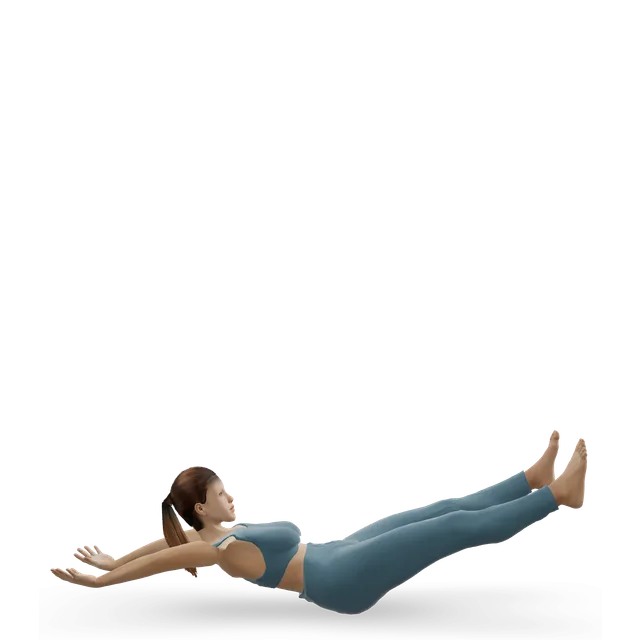
Hollow body hold demonstrated on the 3D figure3D demoHollow body holdIntermediate · No equipment

3 holds of 20 s · As in our dryland workout for swimmers, where it's the streamlined shape on land. Keep the low back pressed down, and rest your head in your hands if your neck does the work, as the move page says

Easier: Dead bug · Harder: Dragon flag

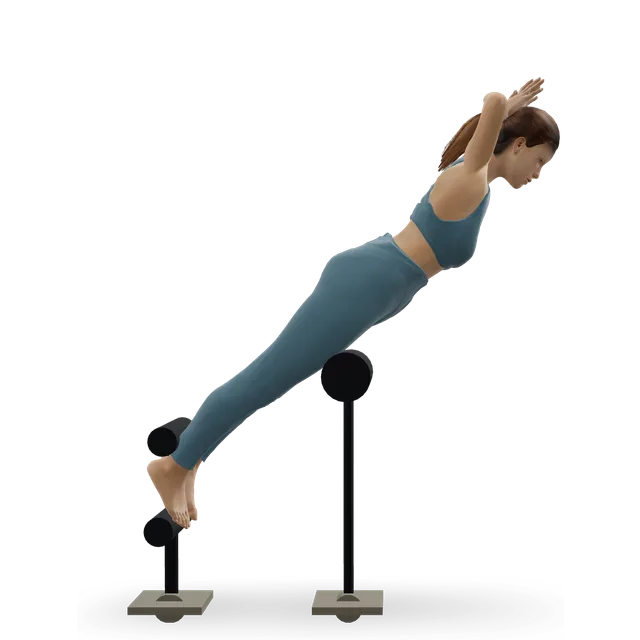
Back extension on a 45-degree bench demonstrated on the 3D figure3D demoBack extension on a 45-degree benchIntermediate · A bench or box

2 sets of 10 to 15, lifting to a straight line, no further · As in the back pain when cycling guide. Move slowly if arching aggravates your back, as the move page says

Easier: Ball back extension · Harder: Horizontal back extension (hyperextension, Roman chair)

Suitcase carry demonstrated on the 3D figure3D demoSuitcase carryIntermediate · A dumbbell + A kettlebell

3 carries of 20 to 30 m each side · As in the back pain when cycling guide

Easier: Farmer's carry · Harder: Overhead carry (waiter's walk)

Kettlebell deadlift demonstrated on the 3D figure3D demoKettlebell deadliftBeginner · A kettlebell

3 sets of 8 to 10 · As in the back pain when cycling guide. A moderate weight, with heavier lifting last and away from hard pool days (our suggestion)

Easier: Hip-hinge practice · Harder: Dumbbell Romanian deadlift

Move on when: Our suggestion: keep adding distance, about 10% a week, while the pain rule holds; then breaststroke with your face in; then tumble turns, a kickboard held low and pull buoy sets, one at a time. Butterfly and long underwater dolphin kicks come back last.

Follow along: a timer, a cue and the next move, one step at a time.

What to change for now

What to change in the pool today (written steps)

Our 3D figure can't show these changes. They come from one small crossover study, surveys of competitive swimmers, Swim England's technique advice and reviews, and where a step is our suggestion, it says so.

  • 1. Stroke: backstroke and front crawl first. In a small crossover study of adults with back pain, backstroke hurt least and breaststroke most. Leave out butterfly first: it carried 2.5 times the risk of back pain in elite swimmers and was the commonest trigger after a back injury.
  • 2. Breaststroke, if you swim it: keep your face in the water and let your head rise with your shoulders to breathe. Swim England says lifting the head rather than the shoulders can lead to back pain.
  • 3. Kicking: the evidence conflicts. Reviews and a return-to-swim protocol say head-up kicking on a board arches the lower back, but in one survey swimmers who used kickboards more had fewer back injuries. Our suggestion: kick on your back or side at first, and if you use a board, hold it low with your face in the water, and keep what passes the pain rule.
  • 4. Pull buoys: a review says they raise the legs and add to the arch, but they were among the least painful activities after a back injury. Use them if they pass the pain rule.
  • 5. Turns: use open turns instead of tumble turns for now (our suggestion), because turns were a common trigger after a back injury. Leave out long underwater dolphin kicks too: a review notes the stress they put on the back muscles.
  • 6. Distance: cut back for now and build up gradually (our suggestion). More pool training went with more lumbar injuries in one survey.
  • 7. Dryland: keep heavy lifting away from hard pool days, and bring it back last (our suggestion). Dryland strength training was the second commonest trigger after a back injury.

Sources 27, 1, 9, 28, 29, 6, 5, 10, 8

Swimming comes back (written steps)

No trial has tested a return after back pain in swimmers. The order follows the stroke study, the survey of triggers and the reviews; the amounts are our suggestion.

  • 1. Backstroke and front crawl first, with open turns and kicking on your back or side.
  • 2. Swim a similar session 3 or 4 times within the pain rule before adding anything; then add distance, about 10% a week, before speed.
  • 3. Breaststroke next, with your face in the water, in short sets.
  • 4. Then tumble turns, a kickboard held low with your face in, and pull buoy sets, one at a time.
  • 5. Butterfly and long underwater dolphin kicks last.
  • 6. A young swimmer recovering from a stress fracture of the spine goes back when their clinician says so; a review suggests front crawl or backstroke first if butterfly and breaststroke still hurt.

Sources 27, 9, 5, 6

Belts, injections and surgery

NICE says not to offer belts or corsets for low back pain; a brace for a young swimmer's stress fracture is a specialist's decision. A swimming review keeps facet joint injections for stubborn facet pain, and says it's rare for a swimmer with a disc problem to need surgery during their swimming career.

Sources 20, 5

Positions to swap, and why

Habit or positionWhy it mattersInstead
Butterfly and long underwater dolphin kicksButterfly carried 2.5 times the risk of low back pain in elite swimmers and was the commonest trigger after a back injury, and swimmers with back pain arched more in the dolphin kick.Backstroke and front crawl.Try: Front crawl (freestyle swimming)
Head-up kicking on a kickboardReviews say it arches the lower back, though one survey found swimmers who used kickboards more had fewer back injuries.Kick on your back or side; if you use a board, hold it low with your face in the water (our suggestion).
Head-up breaststrokeSwim England says lifting the head rather than the shoulders to breathe can lead to back pain.Face in the water, the head rising with the shoulders to breathe.
Tumble turnsTurns were a common trigger in swimmers with a past back injury.Open turns (our suggestion).
Swimming on through pain, tingling or numbness that spreads down a legLeg symptoms are the exception to the pain rule.Shorten or stop that stroke, kick or turn, and read the warning signs.
Heavy back squats and lifting on hard pool daysDryland strength training was the second commonest trigger after a back injury, and activities outside the pool, such as strength training, caused 38% of one college team's injuries.Trunk endurance work now; heavier lifting last, away from hard pool sessions (our suggestion).Try: Dumbbell goblet squat
The sphinx and other arching stretches, if arching backwards brings your pain onRepeated arching is what reviews blame for swimmers' back pain.A gentle knee to chest within comfort.Try: Single knee-to-chest stretch
The superman and other face-down back raises, if arching hurtsThe same reason (our suggestion).The bird dog, reaching long rather than high.Try: Bird dog
Bed rest, or stopping all activityThe NHS says not to stay in bed for long periods.Walk every day.Try: Treadmill walking
A back belt or corsetNICE says not to offer belts or corsets for low back pain.Exercise you'll keep doing.
Asking for a scan to find out what's wrongDisc changes are common in swimmers and non-swimmers without pain, and NICE advises against routine imaging.Get checked if a warning sign appears, or if a young swimmer's back hurts arching backwards.
A teenager training on through back pain that's worse arching backwardsA stress fracture of the spine can be missed for months.A check with a GP or sports physiotherapist.

Routines to follow

More moves for this area

Questions people ask

Why does my lower back hurt when I swim?

Usually from repeated arching: every stroke holds some arch to stay streamlined, and butterfly, breaststroke, the dolphin kick and head-up kicking on a board arch it most, reviews say. Swimmers with back pain arched more in the dolphin kick and had stiffer hip flexors, and butterfly, dryland weights and turns were the commonest triggers after a back injury.

Is swimming good for back pain?

Often, modestly. In 76 adults with long-lasting back pain, a swimming and education programme beat education alone for disability at 8 weeks, though not at a year, and aquatic exercise eased pain in small trials. The NHS lists swimming among activities that may help, so choose the stroke that leaves your back steady or easier.

What is the best swimming stroke for lower back pain?

In 30 adults with back pain who swam 100 m of each stroke, backstroke hurt least and breaststroke most, with front crawl in between and not clearly different from backstroke. Butterfly is the usual aggravator. No stroke suits everyone, so use the pain rule.

Is breaststroke bad for your back?

It can be, mainly when the head is held up: Swim England says lifting the head rather than the shoulders to breathe can lead to back pain. Swim it with your face in, letting your head rise with your shoulders to breathe, or swap to backstroke or front crawl for a while.

Does kicking with a kickboard hurt your back?

It can: reviews say holding a board with the head up arches the lower back, though in one survey swimmers who used kickboards more had fewer back injuries. Kick on your back or side at first, or hold the board low with your face in the water, and keep what passes the pain rule (our suggestion).

Can I swim with a slipped disc or sciatica?

Often, if it eases rather than worsens your symptoms: exercise helps back pain in general, and aquatic exercise helped in small trials. Stop or change any stroke, kick or turn that sends pain, tingling or numbness further down your leg, and see our sciatica and herniated disc guides.

Should I stop tumble turns?

For now, if they hurt: turns were among the commonest triggers in swimmers with a past back injury. Use open turns and bring tumble turns back once your back has settled (our suggestion).

My teenager's back hurts after swimming. Should I worry?

Usually it's a strain. But back pain that lasts more than a couple of weeks, is worse arching backwards, as in butterfly, breaststroke and push-offs, or stops them training needs a GP or sports physiotherapist, because it can be a stress fracture of the spine. In four teenage elite swimmers, the diagnosis took months, and X-rays showed only two of the four cracks.

My scan shows worn discs. Is swimming damaging my back?

Probably not. Elite swimmers had more disc wear than recreational swimmers, but it wasn't linked with their pain, and disc wear is common in people without pain. NICE advises against routine imaging for low back pain.

What exercises help swimmers with back pain?

Exercise of almost any kind helps long-lasting back pain, by about 15 points out of 100 against no treatment. For swimmers, reviews suggest trunk endurance more than heavy strength, plus hip extension range. The plan builds from walking and gentle movement to bird dogs, side planks and the hollow body hold.

When is back pain from swimming serious?

Pain, tingling or numbness in both legs, numbness around the genitals or bottom, or bladder or bowel changes need a 999 call or A&E. Back pain with feeling hot, shivery or unwell, or severe pain that came on suddenly or is getting worse quickly, needs an urgent GP appointment or NHS 111. A teenager's back pain that's worse arching backwards needs a GP check.

Related exercise guides

Other pain guides

Sources

  1. Knobloch 2008 · Breaststroke events and knee overuse injuries in 341 elite swimmers (cohort, Sportverletz Sportschaden; German, English abstract)
  2. Wanivenhaus 2012 · Injuries and prevention strategies in competitive swimmers (review, Sports Health)
  3. Wolf 2009 · Injury patterns in a US college swimming team over 5 seasons (injury records, Am J Sports Med)
  4. Atilla 2020 · Musculoskeletal injuries in 88 masters swimmers in Turkey (survey, Cureus)
  5. Hsu 2024 · Swimming anatomy and lower back injuries in competitive swimmers (narrative review, Sports Health)
  6. Van Dorssen 2015 · The knee and back in swimming (review, Aspetar Sports Med J)
  7. Kitamura 2020 · The dolphin kick, hip flexors and low back pain in college swimmers (cross-sectional study, J Sport Rehabil)
  8. Schwartz 2026 · Training methods and lumbar injuries in 285 competitive swimmers (retrospective survey, Res Sports Med)
  9. Xu 2026 · Training activities that flare back pain in 29 swimmers with a past lumbar injury (survey, Res Sports Med)
  10. Spigelman 2014 · A return to swimming protocol for competitive swimmers (clinical commentary with one case, Int J Sports Phys Ther)
  11. Tawfik 2020 · Pars defects (spondylolysis) in athletes (literature review, Global Spine J)
  12. Nyska 2000 · Spondylolysis in four adolescent elite swimmers (case series, Int J Sports Med)
  13. Li 2023 · Spondylolysis in athletes with low back pain (meta-analysis, Medicine)
  14. NHS · Spondylolisthesis
  15. Kaneoka 2007 · Disc degeneration in elite and recreational swimmers (case-control study, Am J Sports Med)
  16. Hangai 2009 · Disc degeneration in 308 university athletes (cross-sectional study, Am J Sports Med)
  17. Folkvardsen 2016 · Disc degeneration and back pain in 100 elite swimmers (cross-sectional study, Eur Spine J)
  18. Hsu 2024 · Swimming and lumbar disc degeneration (systematic review, PM R)
  19. Brinjikji 2015 · Spine imaging findings in people without back pain (systematic review, Am J Neuroradiol)
  20. NICE NG59 · Low back pain and sciatica in over 16s: assessment and management (2016, updated 2026)
  21. NHS · Back pain
  22. Wareham 2026 · Swimming and education for chronic low back pain: EduSwim (RCT of 76 adults, Br J Sports Med)
  23. Shi 2018 · Aquatic exercise for low back pain (meta-analysis of 8 trials, Am J Phys Med Rehabil)
  24. Wareham 2024 · Swimming for low back pain (scoping review, Musculoskelet Sci Pract)
  25. Oakes 2023 · Recommending swimming to people with low back pain (scoping review, J Bodyw Mov Ther)
  26. Pocovi 2022 · Walking, cycling and swimming for low back pain (systematic review, J Orthop Sports Phys Ther)
  27. Wareham 2026 · Which swimming stroke hurts least with chronic low back pain (randomised crossover study of 30 adults, Ann Phys Rehabil Med)
  28. Swim England · Improving your breaststroke technique (2018)
  29. Swim England · Breaststroke basics: keeping your head down (2014)
  30. Hayden 2021 · Exercise therapy for chronic low back pain (Cochrane review)
  31. Smith 2017 · Should exercise be painful in chronic musculoskeletal pain? (meta-analysis, Br J Sports Med)

Exercise education, not a diagnosis or treatment plan. It is written from the guidelines and studies listed above; review by a clinician is pending. If your pain follows an injury, is severe, is getting worse, or comes with any warning sign listed on this page, get it assessed. Health disclaimer.