Pain guide · Neck pain

Neck pain when turning your head: a stiff neck, a trapped nerve, whiplash, driving and what helps

Pain when you turn your head, look over your shoulder or check a blind spot is one of the commonest neck problems. It's usually ordinary neck pain, often from the small joints and muscles at the side of the neck, and it's rarely caused by anything serious. A neck that locks overnight, a trapped nerve, whiplash and neck arthritis are the other usual causes, and clicking on its own isn't a sign of damage.

A stiff neck with a fever, or neck pain with a sudden, very bad headache, a drooping face, slurred speech or double vision, needs a 999 call or accident and emergency (A&E), and new weakness or numbness in an arm needs a general practitioner (GP). This guide covers those warning signs, how to work out the likely cause, what the National Health Service (NHS) and the Highway Code say about driving when you can't look round, how to set up a screen, and a three-stage plan with a 3D demo of every move that ends with checking over your shoulder again.

When to get help first

Exercise is for pain that has been checked or is clearly mild and settling.

Get urgent medical help if

  • Call 999 or go to A&E: a stiff neck with a fever, especially if bright light hurts your eyes, you have a rash that does not fade when you press a glass on it, or a very high or very low temperature with shivering. These can be signs of meningitis.
  • Call 999 or go to A&E: a headache that came on suddenly and is extremely painful; numbness or weakness in the face or body; a drooping face, or being unable to lift both arms and keep them up; difficulty speaking, swallowing, balancing, walking or remembering; double vision or loss of vision; drowsiness or confusion. A torn neck artery often starts with headache and neck pain, sometimes with dizziness or tingling, so head or neck pain unlike any you have had before needs checking.
  • Call 999 or go to A&E after a neck injury if the person is unresponsive, has severe neck pain or cannot move their head, or fell from a height such as 5 or more stairs. Do not drive yourself. Being 65 or over, a dangerous fall or crash (from more than 1 metre or 5 steps, diving, a high-speed or rollover crash, being thrown from a vehicle, or a bike or horse-riding accident), or tingling in the arms or legs after an injury puts you at high risk of a broken neck: get checked.
  • Call 999 or go to A&E: new problems walking, loss of bladder or bowel control, or a sudden loss of coordination, such as difficulty doing up buttons. These can be signs of pressure on the spinal cord.
  • Call 999: chest pain that spreads to your arm, neck or jaw, especially with breathlessness, sweating or feeling sick. It could be a heart attack.
  • Call 999 or go to A&E: a severe sore throat that quickly gets worse, swelling inside your mouth and throat, difficulty speaking, swallowing or breathing, or you can't open your mouth. It can be quinsy, an abscess from tonsillitis.
  • Same day (urgent GP appointment or NHS 111): severe neck pain that starts suddenly or gets worse quickly; heaviness or weakness in the arms or legs; pins and needles in an arm along with neck or arm pain; or pain between the shoulder blades.
  • Same day: clumsiness, numbness, pins and needles or weakness in one or both arms that is getting worse; problems with balance or walking since the neck pain started; or neck pain with a severe headache.
  • Same day after whiplash: tingling on one or both sides of the body, problems walking or sitting upright, a sudden "electric shock" feeling in the neck and back, or weak hands, arms or legs.
  • Same day (urgent GP appointment or NHS 111): swollen glands in your neck and it's very difficult to swallow, or you have difficulty breathing.
  • Same day: a headache with jaw pain when eating, a sore, tender scalp, or problems with your vision. In people over 50 especially, this can be giant cell arteritis. If you suddenly can't see from 1 or both eyes, call 999 or go to A&E.

See a doctor or physiotherapist if

  • Neck pain or stiffness that has not eased after a few weeks, or after 8 weeks of looking after it yourself; painkillers are not helping; or you are worried. In many areas you can refer yourself to NHS physiotherapy.
  • Pins and needles or a cold arm alongside neck pain, or a new loss of strength or feeling in the arm that you cannot explain (a possible nerve problem).
  • Neck pain with feeling generally unwell, or that started while you were ill with another condition such as rheumatoid arthritis or cancer; or neck pain with blurred vision, ringing in the ears or dizziness.
  • Severe pain that is constant or disturbs your sleep, a fever or unexplained weight loss, or a history of cancer, inflammatory arthritis, tuberculosis (TB), a weakened immune system, neck surgery or a violent injury. Serious causes are very rare, but these need checking.
  • You are over 50 and your shoulders and neck stay stiff for more than 45 minutes each morning (possible polymyalgia rheumatica).
  • You can't turn your head far enough to look round when you drive: don't drive until you can (the NHS says not to drive or cycle while you can't move your neck), and see a general practitioner (GP) if it doesn't ease within a few weeks.
  • A wry neck that isn't improving after a few days, or with numbness or weakness in your hands or feet, severe pain, or pain spreading down your arm into your hand: see a GP.
  • Whiplash that hasn't improved after 1 week, or painkillers that aren't helping: see a GP.
  • Swollen glands in your neck that are getting bigger or haven't gone down within 1 week, feel hard or don't move, or come with night sweats or a very high temperature: see a GP.

Where does it hurt?

Location narrows the likely causes; it does not diagnose.

Stiff and sore at the end of turning one way, often on one side

Sometimes spreading to the top of the shoulder, often with clicking or grinding. Usually ordinary neck pain, often from the small joints at the side of the neck.

Read: Stiff neck and wry neck →
You woke with your head stuck, tipped to one side with your chin turned the other way

A wry neck (acute torticollis): the neck muscles in spasm. It usually eases within a few days to a week.

Read: Stiff neck and wry neck →
Neck pain when you wake up, most mornings

Often the night's position or pillow. Our sleeping guide covers pillows and positions.

Read: Neck pain from sleeping →
Sharp pain, pins and needles or numbness down one arm, worse turning or tipping your head towards the sore side

Points to a trapped nerve in the neck. Both hands clumsy or numb, or trouble with balance, is different and urgent.

Read: Pinched nerve in the neck →
After a car crash, a fall or a sports injury

Whiplash: stiffness and difficulty moving your head, which can start hours later. Check the injury warning signs first.

Read: Whiplash →
A stiff, achy neck that comes and goes, from mid-life

Often called neck arthritis (cervical spondylosis), mostly over 40. Scans show the same changes in many people without pain.

Read: Neck arthritis →
A one-sided headache from the back of the head, brought on by turning or holding a position

It can come from the neck (cervicogenic headache).

Read: Headaches from the neck →
Short, electric-shock pains at the base of the skull or over the back of the head

Possibly an irritated nerve (occipital neuralgia). A new or different headache needs a GP.

Read: Occipital neuralgia →
Sore at a screen or phone, worse turning to a screen set off to one side

Long, still or twisted positions. Our tech neck guide covers screens and phones.

Read: Tech neck →
Turning to look behind you on the bike

Our cycling guide covers bar height and reach, when not to ride, and a plan.

Read: Neck pain when cycling →
Turning to breathe when you swim

Our swimming guide covers breathing, head position and a plan back.

Read: Neck pain when swimming →
Jaw, ear or temple pain when you chew

Usually the jaw joint and chewing muscles.

Read: Jaw pain (TMJ) →
Pain turning your head with a sore throat, painful swallowing or tender lumps in your neck

Often swollen glands from an infection, which usually settle in 1 to 2 weeks. A severe sore throat that gets worse quickly, or trouble swallowing, breathing or opening your mouth, needs urgent help, as the warning signs say.

Dizzy or spinning when you turn your head, look up or roll over in bed

Often an inner-ear problem rather than the neck: see a GP. With numbness, weakness, a drooping face, double vision, or trouble speaking or balancing, call 999.

Neck pain with a sudden, extremely painful headache, or head or neck pain unlike any you've had before

Call 999 or go to A&E, as the warning signs say. A torn neck artery often starts this way.

A stiff neck with a fever, especially if bright light hurts your eyes

Possibly meningitis: call 999 or go to A&E.

Understand it

Why turning your head hurtsStrong evidence

Neck pain is very common: up to 80% of adults have it at some point, an NHS trust says, and "difficulty turning your head or looking up or down" is one of its usual symptoms. The NHS lists the commonest causes as the neck becoming locked in an awkward position while sleeping, long spells sitting at a desk, a pinched nerve and an injury such as whiplash.

Most neck pain isn't serious. NHS inform says it's "rarely caused by any serious disease or damage". The Chartered Society of Physiotherapy (CSP) says that in most cases the exact cause can't be identified, but the most likely one is a strain of one of the small joints on the side of the neck, the facet joints. Discs are less often involved, and nerves less often still.

Sources 1, 2, 3, 4

The small joints at the side of the neck: what the tests showEmerging evidence

Clinicians check these joints by tipping the head back and turning it, which is one reason turning can bring the pain on (our reading). In 125 people referred to a pain clinic, a set of checks that included that movement picked out facet joint pain fairly well (a specificity of 84%), but it hasn't yet been tested in other groups. In 500 people with long-lasting spinal pain at one US pain practice, 55% of those with neck pain had facet joint pain on anaesthetic blocks, and single blocks gave false results 63% of the time.

These are selected clinic groups, and only a block can confirm the source, so for everyday neck pain the honest wording is "often the small joints", not a firm diagnosis. It doesn't change the first treatment.

Sources 5, 6, 4

A wry neckStrong evidence

A wry neck (acute torticollis) is a neck that locks, usually overnight or over a few hours: "the head is tipped to one side, while the chin is turned to the other", because the muscles are in spasm, an NHS trust's emergency department leaflet says. It's a common cause of neck pain in young people, and it often follows an unusual sitting or sleeping position, a long spell at a computer, or carrying a heavy or unbalanced load.

X-rays usually aren't needed. Patient information says it usually improves within 24 to 48 hours but can take up to a week, and most people don't get it again. Both sources advise gentle movement, painkillers and heat, and patient information says not to use a soft collar, which "can actually worsen and prolong the stiffness".

Sources 7, 8, 2

A trapped nerve, whiplash, neck arthritis and headachesStrong evidence

A trapped nerve (cervical radiculopathy) gives sharp arm pain, pins and needles or numbness, often brought on by turning or tipping the head towards the sore side. Clinicians use that movement as a test: in a review of 6 studies, it was fairly good at confirming a trapped nerve but missed many (in most of the studies it was positive in only 30 to 50% of people who had one), and no single test was good at both. In one study of 82 people, a combination of four examination findings was far more convincing than any single test, though the estimate was imprecise. Our pinched nerve guide covers it.

Whiplash gives "neck stiffness and difficulty moving your head" after a crash, a fall or a sports injury, and symptoms can take several hours to start; it usually gets better within 2 to 3 months, the NHS says. Neck arthritis (cervical spondylosis) is common over 40, comes and goes, and is "a normal part of ageing", and many people with it have no symptoms. A one-sided headache that starts at the back of the head and is brought on by neck movement can come from the neck itself (cervicogenic headache), with reduced neck movement as one of its signs.

Sources 9, 10, 11, 12, 13

Clicking, scans and what they meanStrong evidence

Clicking and grinding as you turn your head are common: NHS inform says they "can sound alarming" but are "not usually serious".

Scans are "rarely needed and usually do not change treatment", an NHS trust says, partly because they find changes in most people without any pain. In 1,211 people with no neck symptoms, magnetic resonance imaging (MRI) showed bulging discs in 87.6%, including about three quarters of people in their 20s. The CSP adds that spondylosis on an X-ray isn't strongly linked with pain, so a scan report on its own doesn't explain why your neck hurts.

Sources 3, 1, 14, 4

After an injury: who needs a scanStrong evidence

After a fall or crash, clinicians decide who needs neck imaging with the Canadian C-spine rule, which the National Institute for Health and Care Excellence (NICE) uses. Being 65 or over, a dangerous fall or crash, or tingling in the arms or legs means imaging. With only low-risk features, someone who can turn their neck 45 degrees to the left and right can be cleared without a scan. In the study that built the rule, in 8,924 adults, it picked up every one of the 151 important neck injuries.

It's a clinician's rule, not a self-test. After a neck injury, call 999 if the person is unresponsive, has severe neck pain or can't move their head, or fell from a height such as 5 or more stairs, NHS inform says.

Sources 15, 16, 17

Dizziness when you turn your headStrong evidence

The commonest causes of vertigo (a spinning feeling) are inner-ear problems, the NHS says, including benign paroxysmal positional vertigo (BPPV), "where specific head movements cause vertigo". Its advice is to move your head carefully and slowly, and not to stretch your neck, for example while reaching up to a high shelf. The NHS lists vertigo with double vision or loss of vision, hearing loss, trouble speaking, or weakness, numbness or tingling in an arm or leg as a 999 emergency. NHS inform says contact a GP about neck pain with blurred vision, ringing in the ears or dizziness.

Rarely, a torn neck artery causes neck pain, sometimes with dizziness. In 279 people with one, head or neck pain was the commonest symptom (80.6%), it was usually unlike any headache they'd had before (75.4% of those who'd had headaches), and it rarely eased with their usual painkillers (14.7%). Physiotherapists' international framework says these artery problems are rare but can be recognised from the story. That's why neck pain with numbness, weakness, a drooping face, double vision, or trouble speaking or balancing is a 999 call.

Sources 18, 3, 19, 20

How it usually goesStrong evidence

A wry neck usually eases within a few days to a week. Most new neck pain improves within 6 to 8 weeks, an NHS trust says, and NHS inform says the biggest change comes in the first couple of weeks; the CSP says most neck pain problems get a lot better within three months. Whiplash usually gets better within 2 to 3 months.

Neck pain often comes back: the CSP says about half of people have another episode, and in population studies between half and three quarters of people with neck pain reported it again 1 to 5 years later. Younger people tend to do better, and psychological and social factors predicted the course more than physical findings did. A flare isn't a sign of damage, and no one can promise a date.

Sources 8, 1, 3, 21, 11, 4, 22

What helps, and how strong the evidence is

Keep it moving, little and oftenStrong evidence

The health services agree: keep the neck moving. NHS inform advises moving it for short periods every hour, avoiding staying in one position for too long and carrying on with normal activities, and doesn't recommend a collar unless it's prescribed. The NHS says don't wear a neck collar, "it's better to keep your neck moving", and suggests neck flexibility exercises. An NHS trust says complete rest isn't recommended, though changing or slightly reducing what you do can help early on.

NHS inform's first exercise is a turn: "slowly turn your head to one side as far as is comfortable", hold for 2 seconds and come back, starting with 2 to 3 at a time, every hour or so, and adding 1 or 2 every few days until you reach about 10. This is consistent guidance rather than trial evidence.

Sources 3, 2, 1, 23

Strength for neck pain that lastsEmerging evidence

For neck pain that has lasted, strengthening the neck, shoulders and upper back has the best evidence. A Cochrane review of 27 trials (2,485 people) found moderate-quality evidence that this kind of strength training eased chronic neck pain, a moderate to large effect straight after treatment and in the short term; stretching on its own may not change pain (low-quality evidence). For neck pain that had just started, the review found no trials to judge.

In 198 office workers with frequent neck and shoulder pain, as little as 2 minutes a day of progressive band exercise for the shoulders, 5 days a week, eased pain by 1.4 points out of 10 more than health advice at 10 weeks. A US physiotherapy guideline recommends neck movement exercise with shoulder-blade and arm strengthening early on, and endurance exercise once the pain has settled a little; the CSP says that for pain lasting over 3 months, exercise is the most effective treatment and the type doesn't seem to matter much. These trials were in people with neck pain generally, not pain on turning in particular.

Sources 24, 25, 26, 21

Looking round to drive: the rules, and how much turning it takesEmerging evidence

The NHS says "do not do anything that could be dangerous because you cannot move your neck", for example driving or cycling, and patient information says avoid driving until you can move your neck freely and without pain. The Highway Code asks drivers to "look round to check the blind spots (the areas you are unable to see in the mirrors)" before moving off, warns that mirrors don't cover all areas, asks for a quick sideways glance into the blind spot before changing lanes, and asks you to check the blind spot behind you when reversing. In 60 healthy adults, reversing a car used 92% of their full turning range, more than any of 15 everyday tasks.

Our reading of these GOV.UK and Highway Code pages: you need to be able to look round to drive safely, so if you can't turn your head enough to check over your shoulder, don't drive until you can. GOV.UK says you must tell the Driver and Vehicle Licensing Agency (DVLA) if you have a spinal condition or an injury to your spine that affects your ability to drive, and if you have dizziness that is sudden, disabling or recurrent; the Highway Code says you must report any health condition likely to affect your driving. No study has tested driving with neck pain, so this rests on guidance, not trials.

Sources 2, 8, 27, 28, 29, 30, 31, 32

Manipulation, mobilisation and safetyEmerging evidence

A US physiotherapy guideline recommends upper back (thoracic) manipulation for neck pain with stiffness early on, and lists neck manipulation or mobilisation as options with weaker support; the CSP says they may help with pain relief. They aren't needed for everyone, and the exercise is what lasts.

Serious problems are very rare. In Ontario, the small rise in strokes from the neck arteries after chiropractic visits was matched after GP visits, which suggests people with an early artery tear seek care for its neck pain, rather than the treatment causing it. In 431,492 matched pairs in US health records, artery tears in the following 30 days were no more common after chiropractic neck manipulation than after an ibuprofen prescription. Both studies are observational, and the international framework asks clinicians to check for artery problems first.

Sources 26, 21, 33, 34, 20

Heat, painkillers and collarsEmerging evidence

The NHS suggests paracetamol or ibuprofen, or ibuprofen gel on the neck, and heat or cold: a pack of frozen peas wrapped in a tea towel for 5 minutes, 3 times a day, or a hot water bottle wrapped in a tea towel for 20 minutes, 2 to 3 times a day. Heat is reasonable for comfort, but a 2026 review found only 2 small studies (67 people) and couldn't recommend it for or against.

Collars are advised against for an ordinary stiff neck and a wry neck: the NHS and NHS inform say keep it moving, and patient information says a soft collar can make the stiffness worse and last longer.

Sources 2, 35, 8, 3

Screens and postureEmerging evidence

The Health and Safety Executive (HSE) says put the "computer and screen directly in front of you", with the top of the screen about level with your eyes and about an arm's length away, and keep the screen and keyboard central so you don't twist. With a laptop, raise it and use a separate keyboard and mouse.

Posture plays a smaller part in neck pain than was once thought, the CSP says, though long spells in one position do contribute, and an NHS trust lists them among common triggers. So set the screen up well, but changing position often matters more than holding a perfect posture.

Sources 36, 4, 1

How much pain is OK while you exercise?

The 5 out of 10 rule, and the arm-symptom exceptionEmerging evidence

For the exercises, this guide uses our neck pain guide's rule, from NHS inform's neck exercise advice: rate your pain from 0 to 10. During exercise, 0 to 3 is minimal and 4 to 5 is acceptable; 6 or more is too much. If it goes higher, do fewer repetitions, move more slowly or rest longer between movements.

Exercise should not make your neck worse overall. Soreness from a new exercise should ease quickly, and your neck should be no worse the next morning. Stop any exercise that makes your symptoms worse or causes new pain.

Arm symptoms are the exception: if an exercise sends pain, tingling or numbness further down your arm, or the extra symptoms last more than an hour afterwards, make the movement smaller or leave it out (our neck pain guide's rule). Stop and get checked for dizziness, double vision, slurred speech, trouble swallowing or any of the warning signs above.

Turning in daily life (our suggestion): turning towards the stiff side can feel tight and achy, up to about 5 out of 10. Turn to the edge of the comfortable range and back, little and often, rather than into a sharp catch. Pain that changes from day to day "is not a sign that you're doing damage", an NHS trust says, and the next morning is the test. In long-lasting muscle and joint pain, exercise that allowed some pain did no worse than pain-free exercise.

Sources 23, 1, 37

The exercise plan: 3 stages

Start at the first stage. Each move opens a full guide with a 3D demo.

Stage 1

Settle: keep it turning, little and often

About the first 2 weeks. Turn within the comfortable range every hour or so, as NHS inform advises, and turn your body, chair or feet rather than forcing your neck (the written steps below). Don't drive until you can look round. With a neck locked to one side, follow our stiff neck guide; with arm symptoms, our pinched nerve guide; after a crash or fall, our whiplash guide, once the injury checks are clear. Doses are NHS inform's, a named guide's or the move page's.

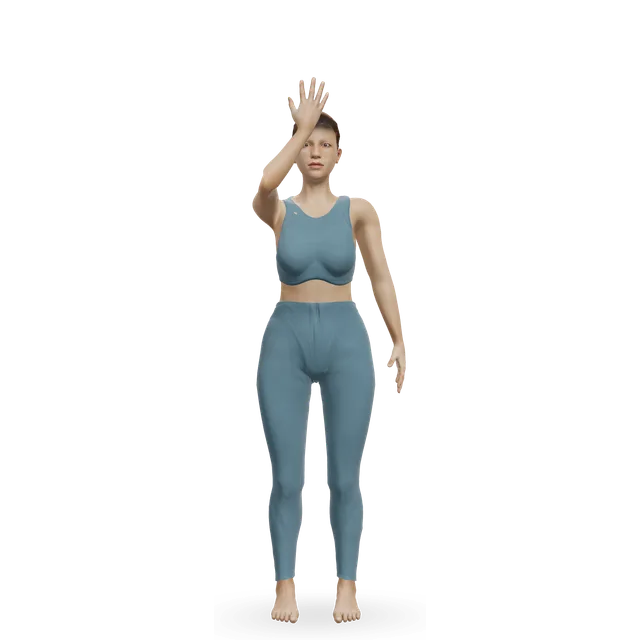
Neck CARs (controlled articular rotations) demonstrated on the 3D figure3D demoNeck CARs (controlled articular rotations)Beginner · No equipment

Separate turns first, then tilts and nods: turn as far as is comfortable, hold 2 s, return. 2 to 3 each way at a time, every hour or so, adding 1 or 2 every few days towards about 10 · NHS inform's turn and pacing, as our neck pain guides use it. Full circles wait until stage 3, as the move page says

Harder: Rabbit pose (Sasangasana)

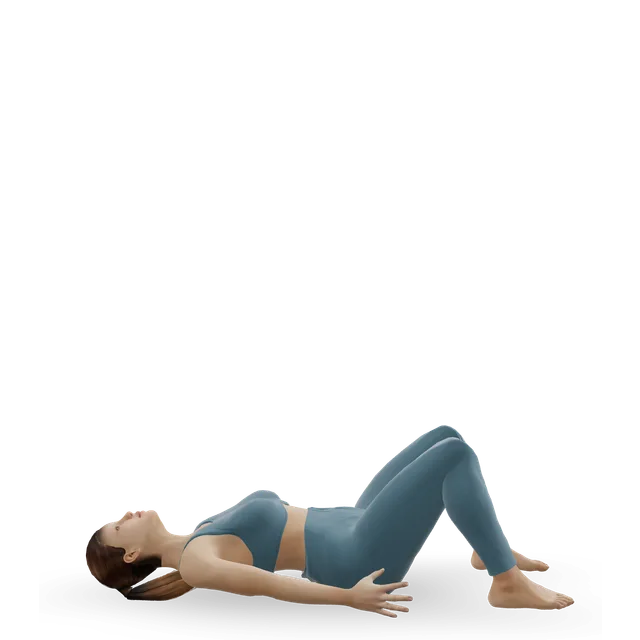
Lying chin tuck demonstrated on the 3D figure3D demoLying chin tuckBeginner · No equipment

5 to 10 gentle holds of up to 10 s, once or twice a day · As in our neck pain guide. It can be done lying in bed on waking

Harder: Chin tuck

Shoulder rolls demonstrated on the 3D figure3D demoShoulder rollsBeginner · No equipment

10 to 15 slow circles each way, once or twice through · The move page's dose, an editorial starting point

Harder: Shoulder CARs (controlled articular rotations)

Thoracic rotation demonstrated on the 3D figure3D demoThoracic rotationBeginner · No equipment

6 rotations per side, moving with the breath · The move page's dose. Turning through the upper back takes some of the turn off the neck (our reasoning)

Easier: Side-lying open book · Harder: World's greatest stretch

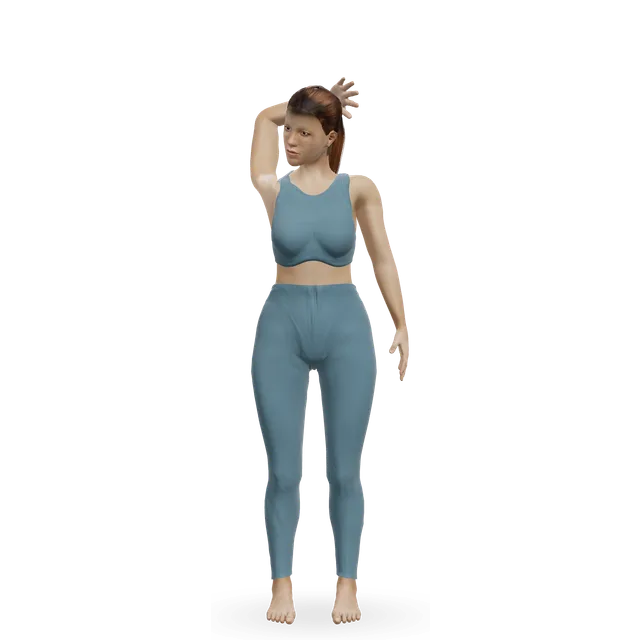
Upper trap release demonstrated on the 3D figure3D demoUpper trap releaseBeginner · No equipment

2 holds of 20 to 30 s each side, only if it eases · As in our stiff neck guide (the move page uses 2 holds of 30 s). The head's weight only, no pulling

Easier: Side neck stretch

Move on when: Turning each way reaches most of your usual range within the pain rule, 10 turns each way are comfortable, and your neck is no worse the next morning (our suggestion).

Follow along: a timer, a cue and the next move, one step at a time.
Stage 2

Build: hold, then strengthen

About weeks 2 to 6: still holds for the neck, then head-lift endurance, and shoulder and upper back strength, which has the best evidence for neck pain that lasts. Neck work daily, shoulder and upper back work 3 days a week (our suggestion). Keep turning through the day.

Isometric neck holds (four-way) demonstrated on the 3D figure3D demoIsometric neck holds (four-way)Beginner · No equipment

3 to 5 holds of 5 to 10 s each direction, light effort, building to 5 holds of 10 s at about half effort · As in our neck pain guide. A turning hold (your hand at your cheek, trying to turn into it without moving) is our suggestion

Easier: Chin tuck · Harder: Chin tuck with head lift

Chin tuck with head lift demonstrated on the 3D figure3D demoChin tuck with head liftIntermediate · No equipment

3 to 5 holds of 5 s, building to 10 holds of 10 s · As in our neck pain guide

Easier: Chin tuck

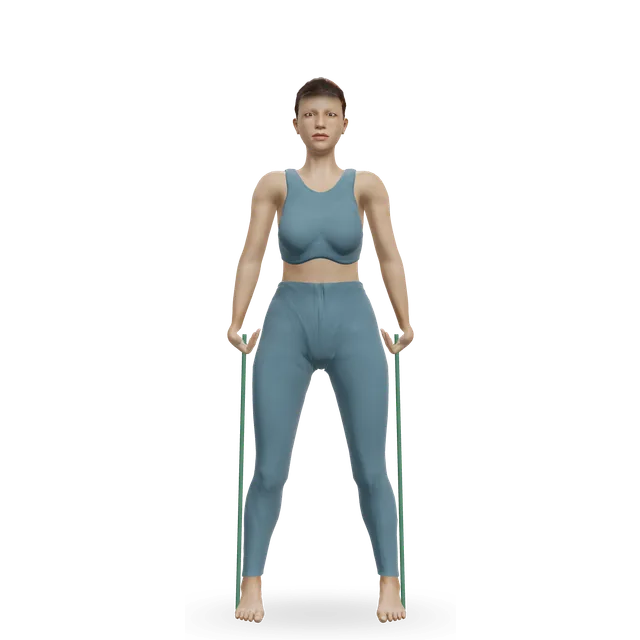
Band lateral raise demonstrated on the 3D figure3D demoBand lateral raiseBeginner · A band

2 minutes a day, 5 days a week, progressing the band · The dose from a trial in 198 office workers with neck and shoulder pain, as our neck pain guides use it

Harder: Dumbbell lateral raise

Band row demonstrated on the 3D figure3D demoBand rowBeginner · A band + An anchor point

3 sets of 10 to 15, stopping 2 to 3 reps short of failure · The move page's dose, an editorial starting point

Harder: Supported single-arm dumbbell row

Side-lying open book demonstrated on the 3D figure3D demoSide-lying open bookBeginner · No equipment

8 to 10 slow openings each side, pausing 2 s at the end · The move page's dose, an editorial starting point. Let your head turn with your chest, within comfort (our suggestion)

Harder: Thoracic rotation

Prone Y-T-W raises demonstrated on the 3D figure3D demoProne Y-T-W raisesBeginner · No equipment

5 to 8 of each shape, 2 rounds · As in our neck pain guide. Keep the neck long, as the move page says

Easier: Wall angel · Harder: Bent-over reverse fly

Move on when: Holds and head lifts are comfortable, turning is full or nearly full through the day, and you can look over each shoulder sitting in a parked car (our suggestion).

Follow along: a timer, a cue and the next move, one step at a time.
Stage 3

Strengthen, and look round again

From about week 6, 2 to 3 days a week, then twice a week for the long term: heavier shoulder and upper back strength, as our neck pain guide's last stage, and full neck circles. Looking round in the car comes back by the written steps below.

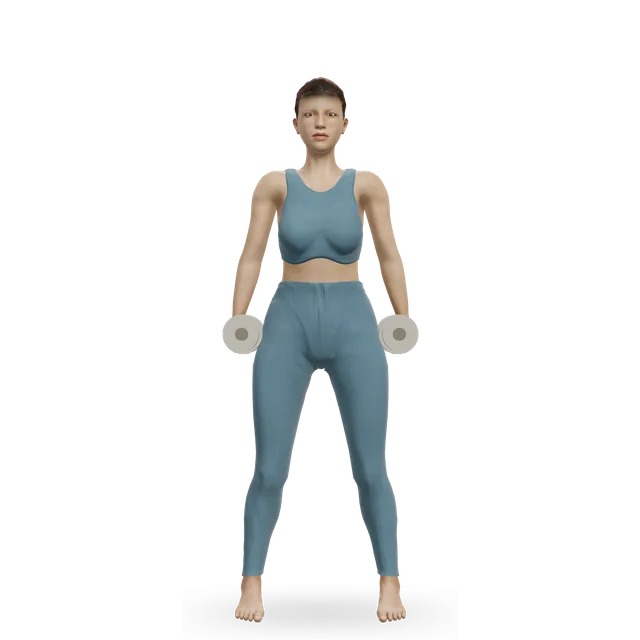
Dumbbell shrug demonstrated on the 3D figure3D demoDumbbell shrugBeginner · A dumbbell

3 sets of 8 to 12, pausing a second at the top · Our neck pain guide's sets and reps, with the move page's pause

Harder: Snatch shrug

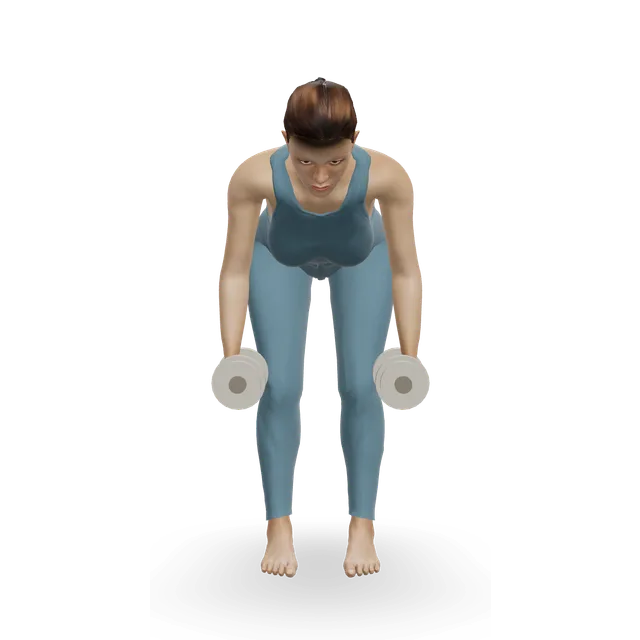
Bent-over reverse fly demonstrated on the 3D figure3D demoBent-over reverse flyIntermediate · A dumbbell

3 sets of 10 to 12 · As in our neck pain guide

Easier: Prone Y-T-W raises · Harder: Barbell rear-delt row

Isometric neck holds (four-way) demonstrated on the 3D figure3D demoIsometric neck holds (four-way)Beginner · No equipment

3 holds of 10 s each direction at moderate effort · As in our neck pain guide's later stage

Easier: Chin tuck · Harder: Chin tuck with head lift

Neck CARs (controlled articular rotations) demonstrated on the 3D figure3D demoNeck CARs (controlled articular rotations)Beginner · No equipment

3 slow circles each way, once or twice a day · The move page's dose, an editorial starting point, as full circles once separate turns are comfortable

Harder: Rabbit pose (Sasangasana)

Move on when: Our suggestion: you can turn your head fully each way without sharp pain, the parked-car check is comfortable, and short drives leave your neck no worse the next morning. Then build up driving by the written steps below. If it flares, drop back a stage for a few days rather than stopping.

Follow along: a timer, a cue and the next move, one step at a time.

What to change for now

Turning, screens and sleep for now (written steps)

Our 3D figure can't show these changes. They come from NHS inform, the NHS, the HSE and an NHS trust; where a step is our suggestion, it says so.

  • 1. Keep your neck moving: short periods every hour, and don't stay in one position for too long (NHS inform). Carry on with your normal activities and stay at work if you can.
  • 2. For now, turn your chair, your feet or your whole body to face the person, the screen or the thing you're reaching for, and let your eyes do some of the looking (our suggestion). Once turning is comfortable again, go back to turning your head normally: it isn't harmful.
  • 3. At a screen, put the computer and screen directly in front of you, the top of the screen about level with your eyes and about an arm's length away, and keep the screen and keyboard central so you don't twist (the HSE). With two screens, put the one you use most straight in front of you; if you use both equally, sit centred between them (our suggestion).
  • 4. Hold your phone or tablet up rather than looking down for long spells, and change position often (our suggestion; our tech neck guide covers this).
  • 5. In bed, use a low, firm pillow so your head is level with your body, don't sleep on your front and don't twist your neck (the NHS). Our neck pain from sleeping guide covers pillows.
  • 6. Heat or cold for comfort: frozen peas in a tea towel for 5 minutes, 3 times a day, or a hot water bottle in a tea towel for 20 minutes, 2 to 3 times a day (the NHS). No collar.
  • 7. If looking up makes you dizzy, don't stretch your neck to reach a high shelf (the NHS); use a step instead (our suggestion).

Sources 3, 2, 36, 1, 18

Driving and cycling (written steps)

No study has tested driving with neck pain. Steps 2 and 3 are our reading of the GOV.UK and Highway Code pages; the rest come from the NHS, patient information and GOV.UK, or are our suggestion, as marked.

  • 1. The NHS says don't do anything that could be dangerous because you can't move your neck, for example driving or cycling. Patient information says avoid driving until you can move your neck freely and without pain.
  • 2. You need to be able to look round to drive safely. The Highway Code asks you to look round for the blind spots your mirrors can't show before you move off, to glance into the blind spot before changing lanes, and to check the blind spot behind you when reversing; reversing uses nearly all of your neck's turning range.
  • 3. So if you can't turn your head enough to check over your shoulder, don't drive until you can.
  • 4. Before you drive, check in the parked car, in your driving position: can you look over each shoulder to the blind spot through the side window, and turn far enough to see out of the rear window, without sharp pain, arm symptoms or dizziness? (Our suggestion.)
  • 5. Set your mirrors before you start, and still look round: parking sensors and cameras help, but they don't replace looking (our suggestion, in line with the Highway Code).
  • 6. GOV.UK says you must tell the DVLA if you have a spinal condition or an injury to your spine that affects your ability to drive, and if you have dizziness that is sudden, disabling or recurrent. If you're not sure whether that applies to you, ask your GP or check GOV.UK.
  • 7. After whiplash with tingling, weakness or an "electric shock" feeling, the NHS says don't drive or cycle until you've spoken to a GP or NHS 111.

Sources 2, 8, 27, 28, 29, 30, 31, 38, 32, 11

Looking round comes back (written steps)

No study has tested how to return to driving or turning after neck pain. These steps are our suggestion.

  • 1. Stages 1 and 2: turn your body rather than forcing your neck, keep the screen straight ahead, and don't drive until you can look round.
  • 2. When the parked-car check is comfortable, start with short, familiar journeys on quieter roads, with fewer lane changes and reversing manoeuvres.
  • 3. Then build up to longer drives, motorways, reversing into spaces and checking over your shoulder in traffic. If a drive leaves your neck worse the next morning, make the next one shorter.
  • 4. Cycling: our neck pain when cycling guide's rule applies: don't ride until you can check behind you.
  • 5. At work and at home, let your neck do more of the turning as it eases, and keep changing position (NHS inform).
  • 6. Flare-ups are common and aren't a sign of damage (an NHS trust): drop back a stage for a few days and keep moving. If a drive brings on dizziness or arm symptoms, see the warning signs.

Sources 27, 3, 1

Positions to swap, and why

Habit or positionWhy it mattersInstead
Driving before you can look round to check your blind spotsThe NHS says don't drive or cycle while you can't move your neck, and the Highway Code expects you to look round because mirrors don't cover the blind spots.Get a lift or use public transport until the parked-car check is comfortable.
A soft collar to rest itThe NHS says it's better to keep your neck moving, and a soft collar can make the stiffness worse and last longer.Gentle turns within comfort, every hour or so.Try: Neck CARs (controlled articular rotations)
Holding your neck still all dayNHS inform says move it for short periods every hour and avoid staying in one position too long; an NHS trust doesn't recommend complete rest.Short movement breaks, and carry on with normal activities.Try: Shoulder rolls
A screen, or the one you use most, set off to one sideThe HSE says put the screen directly in front of you and don't twist.The main screen straight ahead; sit centred between two you use equally (our suggestion).
Twisting your head hard to talk to someone beside youRepeated turns to the end of a sore range while it's settling (our reasoning).Turn your chair or your whole body to face them.
Sleeping on your front with your head turnedThe NHS says don't sleep on your front or twist your neck in bed.On your back or side, with a low, firm pillow.
The levator scapulae stretch, pulling your head down with your handA wry neck is a muscle spasm, and the move page says the hand is a guide, not a winch.Small turns within comfort, with the head's weight only.Try: Neck CARs (controlled articular rotations)
Full neck circles while turning is still soreThe move page says start with small separate turns, tilts and nods before full circles.Separate turns, tilts and nods first, as in stage 1.
Heavy dumbbell shrugs in the first weeksOur neck pain guide brings heavier shoulder loading back in its last stage.Band rows and band lateral raises.Try: Band row
Clicking your own neck over and over to release itClicking is common and usually not serious, but nothing we found supports it as a treatment (our reading).Gentle turns and still holds.Try: Isometric neck holds (four-way)
Reaching up to a high shelf with your head tipped back, when looking up makes you dizzyThe NHS says don't stretch your neck, for example while reaching up to a high shelf.Use a step so your head stays level.

Routines to follow

More moves for this area

Questions people ask

Why does my neck hurt when I turn my head?

Usually it's ordinary neck pain, and difficulty turning your head is one of its commonest symptoms. The most likely cause is a strain of one of the small joints at the side of the neck, though the exact cause often can't be pinned down. Sleeping awkwardly, long spells at a desk, a trapped nerve and whiplash are the usual triggers.

Why can't I turn my head to one side after sleeping?

That's often a wry neck: the neck muscles go into spasm, usually overnight, and your head tips one way with your chin turned the other. It usually improves within 24 to 48 hours but can take up to a week, and gentle movement, painkillers and heat help. Don't use a soft collar, because it can make the stiffness worse and last longer.

How long does a stiff neck last?

It varies. A wry neck usually settles within a few days to a week, and most new neck pain improves within 6 to 8 weeks. See a GP or physiotherapist if it hasn't eased after a few weeks of looking after it yourself, or sooner if you're worried.

Can I drive with a stiff neck?

Not until you can turn to look round properly. The NHS says not to drive or cycle while you can't move your neck, and the Highway Code expects you to look round for the blind spots your mirrors miss before you move off, change lanes or reverse. Our reading is that if you can't turn your head enough to check over your shoulder, you shouldn't drive until you can.

Do I need to tell the DVLA about neck pain?

GOV.UK says you must tell the Driver and Vehicle Licensing Agency (DVLA) if a spinal condition or an injury to your spine affects your ability to drive, or if you have dizziness that is sudden, disabling or recurrent. If you're not sure whether that applies to you, ask your GP or check GOV.UK. Either way, don't drive until you can look round properly.

Is it bad if my neck clicks or cracks when I turn my head?

Usually not. NHS inform says clicking and grinding are common and can sound alarming, but they aren't usually serious. Clicking with pain that isn't settling, or with pins and needles or weakness in an arm, is worth getting checked.

Why do I feel dizzy when I turn my head?

The commonest causes of a spinning feeling are inner-ear problems, such as benign paroxysmal positional vertigo (BPPV), where certain head movements bring it on, so see a GP about neck pain with dizziness. Call 999 if it comes with numbness or weakness, a drooping face, double vision, or difficulty speaking, swallowing or balancing, or with a sudden, extremely painful headache.

Why does it hurt at the base of my skull or behind my ear when I turn my head?

A one-sided headache that starts at the back of the head and is brought on by neck movement can come from the neck, often with a stiff neck; our cervicogenic headache guide covers it. Short, electric-shock pains over the back of the head have their own guide. A sudden, extremely painful headache, or head or neck pain unlike any you've had before, needs a 999 call.

Why does my neck hurt when I turn my head and swallow?

A sore throat or another infection can make the glands in your neck swollen and tender, and they usually settle within 1 to 2 weeks. Get an urgent GP appointment or help from NHS 111 if it's very hard to swallow or breathe. Call 999 for a severe sore throat that quickly gets worse, swelling inside your mouth, or difficulty opening it.

Should I use heat or ice on a stiff neck?

Either, whichever feels better. The NHS suggests frozen peas in a tea towel for 5 minutes, 3 times a day, or a hot water bottle in a tea towel for 20 minutes, 2 to 3 times a day. Heat is for comfort: there's little research on it.

What exercises help neck pain when I turn my head?

Start with gentle turns as far as is comfortable, held for 2 seconds, 2 to 3 at a time every hour or so, building up to about 10. As it eases, strengthening the neck, shoulders and upper back has the best evidence for neck pain that lasts. Some discomfort is fine, but pain or tingling spreading down an arm means make the movement smaller.

Do I need a scan or an X-ray?

Usually not. Scans are rarely needed for neck pain and don't usually change treatment, and disc bulges show up on the scans of most people without any pain. After an injury, doctors use a set of rules, including whether you can turn your head 45 degrees each way, to decide who needs imaging.

Related exercise guides

Other pain guides

Sources

  1. Leicestershire Partnership NHS Trust · Neck pain (patient leaflet, 2026)
  2. NHS · Neck pain (past its review date: reviewed April 2023, review due April 2026)
  3. NHS inform · Neck problems
  4. Chartered Society of Physiotherapy · Causes of neck pain (last reviewed 2019)
  5. Schneider 2014 · A clinical guide to facet joint pain in the neck (diagnostic study of 125 people, Arch Phys Med Rehabil)
  6. Manchikanti 2004 · How common facet joint pain is in long-lasting spinal pain (500 people at a pain practice, BMC Musculoskelet Disord)
  7. Royal Berkshire NHS Foundation Trust · Acute torticollis (wry neck): emergency department leaflet (2024, past its review date of June 2026)
  8. Patient.info · Torticollis (twisted neck)
  9. Rubinstein 2007 · How accurate neck tests are for a trapped nerve (systematic review, Eur Spine J)
  10. Wainner 2003 · Examination findings for a trapped nerve in the neck (diagnostic study of 82 people, Spine)
  11. NHS · Whiplash
  12. NHS · Cervical spondylosis (past its review date: reviewed August 2023, review due August 2026)
  13. International Headache Society · ICHD-3 11.2.1 Cervicogenic headache
  14. Nakashima 2015 · Neck MRI findings in 1,211 people without symptoms (Spine)
  15. NICE NG41 · Spinal injury: assessment and initial management
  16. Stiell 2001 · The Canadian C-spine rule for neck imaging after injury (study of 8,924 adults, JAMA)
  17. NHS inform · Neck injury
  18. NHS · Vertigo (past its review date: reviewed May 2023, review due May 2026)
  19. Mayer-Suess 2022 · Head and neck pain after a torn neck artery (cohort study of 279 people, Cephalalgia)
  20. Rushton 2023 · International IFOMPT framework for checking the neck for artery problems before treatment (JOSPT)
  21. Chartered Society of Physiotherapy · Treatment for neck pain
  22. Carroll 2009 · Course and prognostic factors for neck pain in the general population (Bone and Joint Decade Task Force review, JMPT)
  23. NHS inform · Exercises for neck problems
  24. Gross 2015 · Exercises for mechanical neck disorders (Cochrane review)
  25. Andersen 2011 · Small daily amounts of resistance training for frequent neck and shoulder pain (RCT of 198 office workers, Pain)
  26. Blanpied 2017 · Neck pain: revision 2017 (clinical practice guideline, JOSPT; recommendations read in its official Chinese translation)
  27. The Highway Code · Using the road, rules 159 to 203 (GOV.UK)
  28. The Highway Code · General rules, techniques and advice for all drivers and riders, rules 103 to 158 (GOV.UK)
  29. Bible 2010 · How much neck movement 15 everyday tasks use, in 60 adults (lab study, J Spinal Disord Tech)
  30. GOV.UK · Spinal conditions, injuries or spinal surgery and driving (DVLA)
  31. GOV.UK · Dizziness or vertigo and driving (DVLA)
  32. The Highway Code · Rules for drivers and motorcyclists, rule 90 (GOV.UK)
  33. Cassidy 2008 · Stroke after chiropractic and GP visits: 818 strokes (case-control and case-crossover study, Spine)
  34. Trager 2026 · Neck manipulation and torn neck arteries in 431,492 matched pairs (retrospective cohort study, Chiropr Man Therap)
  35. Wilfling 2026 · Heat for the self-management of neck pain (systematic review, J Pain Res)
  36. Health and Safety Executive · Good posture when using display screen equipment
  37. Smith 2017 · Should exercises be painful in chronic musculoskeletal pain? (meta-analysis of 7 trials, BJSM)
  38. GOV.UK · Check if a health condition affects your driving (DVLA)
  39. NHS · Meningitis
  40. NHS · Stroke: symptoms
  41. NHS · Tonsillitis, including quinsy
  42. NHS · Swollen glands (past its review date: reviewed September 2023, review due September 2026)

Exercise education, not a diagnosis or treatment plan. It is written from the guidelines and studies listed above; review by a clinician is pending. If your pain follows an injury, is severe, is getting worse, or comes with any warning sign listed on this page, get it assessed. Health disclaimer.