A small difference is normal
Only about 1 in 5 healthy teenagers had level shoulders in one study, and X-rays and photos of teenagers and young adults show that small differences are the norm.
Posture guide
Few people have perfectly level shoulders. In a study of healthy teenagers who all thought their shoulders were level, only about 1 in 5 actually were, and small differences are just as usual in adults. Which hand you use, the sport you play and how you happen to be standing all play a part.
Sometimes uneven shoulders are worth a check: in a child or teenager they can be a sign of scoliosis, and a shoulder that starts to droop can be a nerve problem. We found no study showing that a small difference causes neck or back pain.
This guide covers how common uneven shoulders are, the causes, when to see a GP and what exercise can and can't do, with moves for the upper back and trunk that train both sides.
Only about 1 in 5 healthy teenagers had level shoulders in one study, and X-rays and photos of teenagers and young adults show that small differences are the norm.
Which hand you use and the sport you play shape how your shoulder blades sit and move, and these differences are common in people without any pain.
In a child or teenager, uneven shoulders together with a shoulder blade or hip that sticks out, ribs that stick out on one side or clothes that hang unevenly can be scoliosis. The NHS says it's unlikely to be anything serious, but it's best to get it checked.
We found no study showing that a small difference in shoulder height causes neck or back pain, and reviews find no agreed link between posture and back pain.
Source 9
Exercise builds strength, movement and comfort around the shoulders and trunk. No trial in adults shows that it levels the shoulders, and the evidence in children is weak.
In 91 healthy teenagers aged 10 to 18 who all said their shoulders were level, only 17 (19%) had level shoulders in photos, and the average difference in height was 7.5 mm. The authors wrote: "Contrary to popular belief, shoulder balance in healthy adolescents often does not exist."
Source 1
On X-rays of 273 adolescents, the shoulders were balanced on average, but each person's differed by about 0.9 cm. In photos of 115 young adults, small tilts of the head, shoulders and pelvis were the norm.
In a school study, the share of children counted as having uneven shoulders (a difference of more than 1 cm in a photo) rose from 32% to 49% in one school over a single term. The authors suggested growth and more time sitting; to us, it also shows how much a single photo or mirror check can vary.
Source 10
In 8,245 school children aged 6 to 18, mild asymmetry of the upper back went with handedness, and in 254 girls with scoliosis the curve bulged towards the side of the dominant hand in 82%. In 32 healthy men, the dominant arm predicted how level the shoulder blades sat. Which shoulder sits lower isn't consistent enough to make a rule.
In healthy overhead athletes, the shoulder blade on the throwing or hitting side sat more turned in and tipped forward at rest, and the authors said this may be normal. Shoulder blades that move unevenly (scapular dyskinesis) were found in 61% of overhead athletes and 33% of other athletes in a review of 1,401, and in 13 of 20 junior tennis players whose shoulders were otherwise healthy and working well.
A weak serratus anterior muscle, usually from an injured long thoracic nerve, makes the inner edge of the shoulder blade stick out (winging); most of these nerve injuries recover within 1 to 24 months. An injured nerve to the trapezius, often after surgery in the neck such as a lymph node biopsy, makes the shoulder droop and lifting the arm out to the side hard. Sprengel deformity, a high shoulder blade from birth, is rare, and milder cases keep good movement without surgery.
A tilted pelvis tilts everything above it, and most people's legs differ slightly in length. The Scoliosis Research Society explains that a curve from standing with one knee bent and the pelvis tilted disappears when the pelvis is levelled. The lateral pelvic tilt guide covers this.
A shoulder that has changed shape after a fall or injury can be a broken or dislocated bone, and needs an urgent GP appointment or help from NHS 111.
Source 18
Scoliosis is a sideways curve of the spine. It most often starts between 10 and 15, and about 8 in 10 cases have no known cause. The signs include uneven shoulders, a shoulder blade or hip that sticks out, ribs that stick out on one side, leaning to one side, an uneven waist and clothes that don't fit well. A double curve can look fairly straight.
Scoliosis isn't caused by bad posture, heavy bags, exercise or diet.
A doctor looks at the back as the child bends forward (the Adams forward bend test). In a school programme of 2,700 pupils, the test picked up 84% of curves, and 1.18% of the pupils had scoliosis. An X-ray confirms it: a curve of more than 10 degrees (the Cobb angle) counts as scoliosis.
About 3 to 4 in every 1,000 children need specialist care for scoliosis. Our scoliosis guide covers checking, bracing, surgery and exercise.
Source 19
Most uneven shoulders are normal, and the NHS says it's unlikely that anything is seriously wrong, but get it checked if one shoulder is higher and you also notice:
Get it checked if:
Ask for an urgent GP appointment or get help from NHS 111 if you have sudden or very bad shoulder pain, can't move your arm, your arm or shoulder has changed shape or is badly swollen, you have pins and needles that don't go away or no feeling in the arm or shoulder, it's hot or cold to touch, the pain started after a fall or injury, you have severe pain in both shoulders, or you feel feverish or unwell.
Source 18
For scoliosis, bracing during growth and, for large curves, surgery carry the evidence; the scoliosis guide covers them.
We found no study that tested whether a small difference in shoulder height causes neck, shoulder or back pain. Across 41 systematic reviews, there was no consensus that spinal posture causes back pain.
Source 9
We found no trial showing that exercise changes resting shoulder height in adults without scoliosis. Advice to shrug the low shoulder or stretch the high side hasn't been tested.
In two primary schools in Beijing (1,286 children aged 9 to 11), one school added 16 weeks of functional training to its PE (physical education) lessons, 3 lessons of 40 minutes a week. The share of children with uneven shoulders fell from about 32% to 25% there, while in the other school it rose from 32% to 49% over the same term. The schools weren't randomly assigned, the comparison school's large rise is hard to explain, and there was no long-term follow-up, so this is weak evidence.
Source 10
In 26 teenagers with scoliosis, adding shoulder blade exercises to Schroth exercises, 3 times a week for 8 weeks, evened neck and shoulder blade angles slightly more than Schroth alone, with little effect on the curve itself.
Source 11
Winging from a weak serratus anterior usually recovers without surgery, within 1 to 24 months, though it persists in about 1 in 4 people. A trapezius nerve injury doesn't reliably recover without treatment, and surgery is often considered. Either needs assessment before you start a programme.
Source 15
Rows, pull-aparts and shoulder blade raises build the muscles that move and hold the shoulder blades. Train both sides the same: there's no evidence that working one side harder levels the shoulders. These are reasons to train, not a way to change your shape (our editorial view).
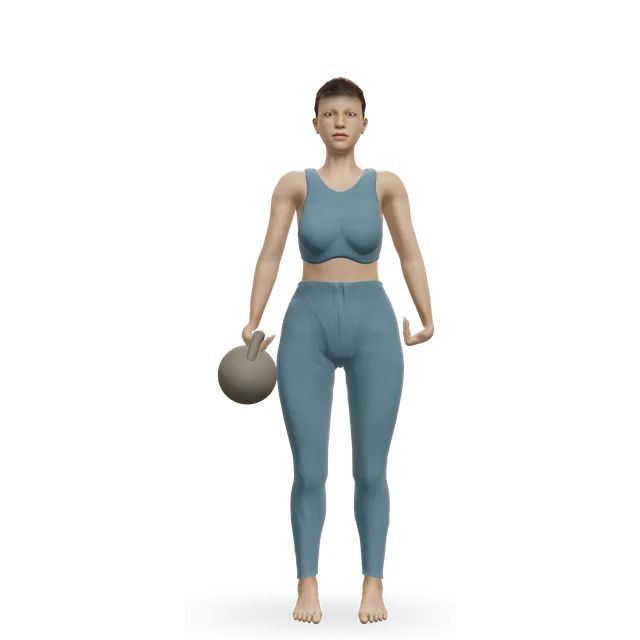
Carrying a weight in one hand (a suitcase carry) trains the opposite side of your trunk to stop you leaning, and side planks train the same muscles. If you can't stay level on a carry, the weight is too heavy (editorial).
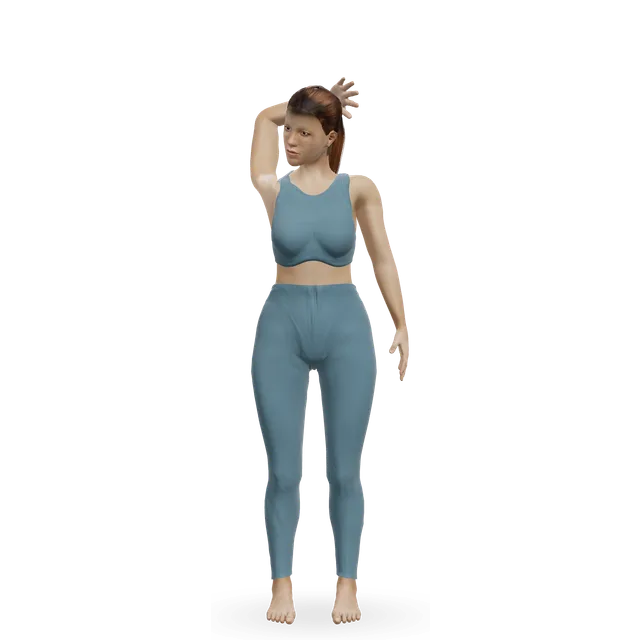
Gentle stretches and turns can ease stiffness: the upper trap release, 2 slow holds of 30 seconds per side, and the levator scapulae stretch, held 20 to 30 seconds, 2 to 4 times each side (the move pages' doses). They're for comfort, not to change shoulder height.
Active, varied play and PE are good for children, with an average of at least 60 minutes of activity a day. There's no need to correct a child's shoulder height; if you notice signs of scoliosis, see a GP.
Source 22
The suitcase carry page's caution: if you can't stay level, the weight is too heavy. The distances are our editorial starting point.
See the movement on the 3D figure: Suitcase carry
Band rows: 3 sets of 10 to 15, stopping 2 to 3 reps short of failure, with 60 to 90 seconds' rest (the move page's dose). Single-arm rows, 3 sets of 8 to 12 each arm; pull-aparts and face pulls, 2 to 3 sets of 12 to 15; Y-T-W raises, 5 of each letter; push-up plus, 2 to 3 sets of 10; wall angels, 8 slow slides (editorial starting points). Train both sides the same.
 3D demoBand rowBeginner · A band + An anchor point
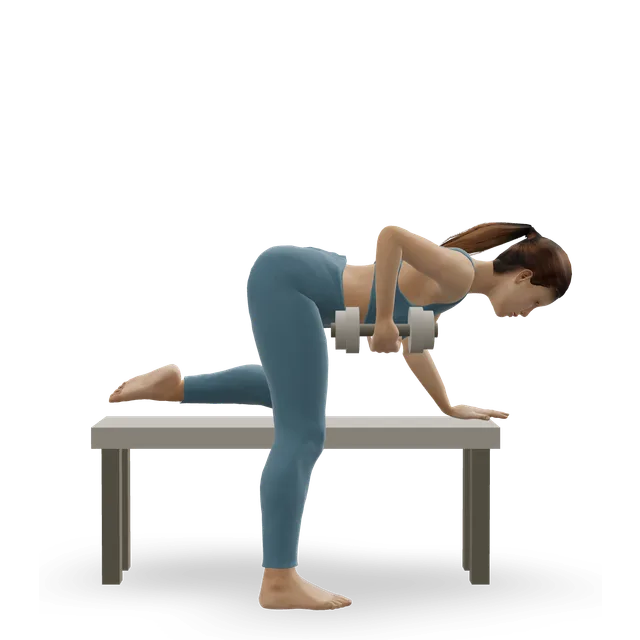 3D demoSupported single-arm dumbbell rowIntermediate · A dumbbell + A bench or box
 3D demoProne Y-T-W raisesBeginner · No equipment
 3D demoBand pull-apartIntermediate · A band
 3D demoFace pullIntermediate · A band
 3D demoScapular push-up (push-up plus)Beginner · No equipment
 3D demoWall angelBeginner · A wall
Carries, 2 to 3 walks of 20 to 30 metres each side; knee side planks, 3 holds of 10 to 20 seconds each side, then side planks, 3 holds of 15 to 30 seconds (editorial starting points).
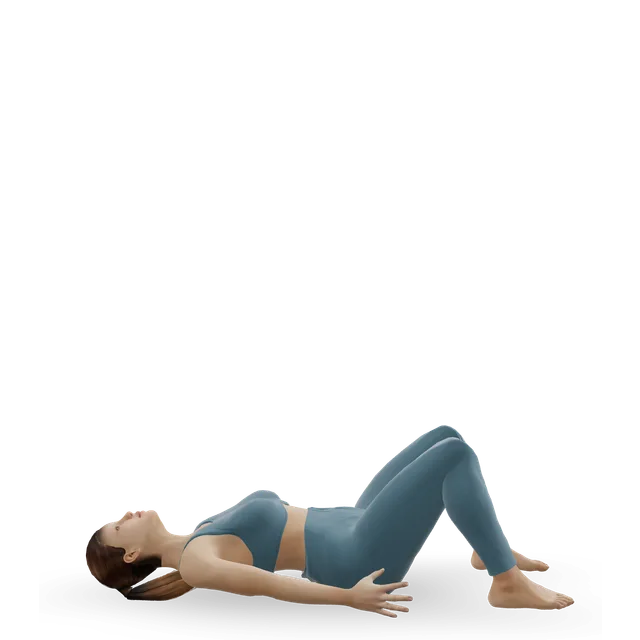
For stiffness, not to change shoulder height. Upper trap release, 2 slow holds of 30 seconds per side; levator scapulae stretch, 20 to 30 seconds, 2 to 4 times each side; thoracic rotation, 6 rotations per side; open book, 8 to 10 slow openings each side (the move pages' doses).
Two or three sessions a week of the upper back or shoulder routine, with a core workout for the trunk. The stretches are for comfort on any day.
A 12-minute routine for a stiff upper back and rounded shoulders: chin tucks, wall angels, Y-T-W raises and open books.
12 minBeginner8 movesA foam roller, A wallA 25-minute band routine for healthy shoulders: move the shoulder and upper back through their range, then strengthen the rotator cuff and shoulder blades.
25 minBeginner12 movesA wall, A bandDeep neck holds and shoulder-blade strength in under 20 minutes: one of the best-supported kinds of exercise for a stiff, sore neck.
18 minBeginner11 movesA band, An anchor pointEight gentle neck and shoulder stretches for desk stiffness, done standing or seated in ten minutes.
10 minBeginner8 movesA wallA 15-minute beginner core workout on the floor: dead bugs, bird dogs, knee planks, side planks and curl-ups.
15 minBeginner6 movesNo equipmentStrength and balance in one session: squats, Romanian deadlifts, push-ups, rows, step-ups, back extensions, carries and single-leg balance.
45 minBeginner14 movesA wall, A dumbbellMost healthy teenagers' shoulders aren't level, and about 1 in 100 school children has scoliosis. It's uneven shoulders together with other signs that are the reason to see a GP.
We found no study showing this, and reviews find no agreed link between posture and back pain.
Source 9
Handedness and sport affect how the shoulder blades sit, but not consistently enough to make a rule.
They don't. We also found no study showing that carrying a bag on one shoulder or sleeping on one side causes a lasting difference in shoulder height.
No trial in adults shows this. One school study in children is encouraging but weak: two schools, not randomly assigned, with no long-term follow-up.
Source 10
No study has tested this. Train both sides the same.
Yes. In healthy teenagers who thought their shoulders were level, only about 1 in 5 actually were, with an average difference of 7.5 mm. Small differences are normal in adults too.
Usually not. In a child or teenager it can be a sign, especially with a shoulder blade or hip that sticks out, ribs that stick out when they bend forward, or clothes that hang unevenly; then see a GP.
Usually normal variation, which hand you use or the sport you play. Studies don't agree well enough to say the dominant shoulder is always the lower one.
We found no study showing that a small difference in shoulder height causes neck or back pain. If your neck hurts, our neck pain guide covers what helps and when to get it checked.
Exercise builds strength, movement and comfort, but no trial in adults has shown that it changes resting shoulder height. One school study in children was encouraging, but it was too weak to be sure.
Heavy bags don't cause scoliosis. We found no study showing that bags or sleeping position cause a lasting difference in shoulder height.
A shoulder that newly droops, especially with trouble lifting the arm out to the side, can come from an injury to the nerve of the trapezius muscle, often after surgery in the neck. See a GP for an assessment.
Shoulder blades often sit or move a little unevenly in healthy people, especially athletes. A shoulder blade that newly sticks out with weakness can be a nerve problem, and in a growing child it can be a sign of scoliosis: see a GP.
Yes. A tilted pelvis tilts the spine and shoulders above it, and a curve that disappears when the pelvis is levelled isn't true scoliosis. Our lateral pelvic tilt guide explains leg length differences.
For a child or teenager with other signs of scoliosis, see a GP. Adults should see a GP for a shoulder that starts to droop or stick out, a curve that seems to be getting worse, or shoulder pain that hasn't improved after 2 weeks.
Exercise education, not a diagnosis or treatment plan, and clinical review of these guides is pending. Get a curve or hunch that is new or getting worse checked, above all in a growing child or after a fall, and get urgent help for numbness or weakness in the legs or a change in bladder or bowel control. Health disclaimer.