Your score is a count
Your score is the beats in the full minute after stepping, counted from within 5 seconds. Lower counts rank higher.
Source 1
Fitness test
Step up and down on a sturdy 30 cm (12 inch) step to a beat of 96 a minute for 3 minutes, sit straight down, and count your pulse for one full minute, starting within 5 seconds. Enter that count with your age and sex to see where you sit in the YMCA's norms, where a lower count ranks higher. The test doesn't give a VO2 max, because it wasn't built to; for that, use the 1-mile walk in our VO2 max calculator. It's harder than it looks, so answer the PAR-Q+ questions first, and if you're 60 or over, unsteady on your feet or have knee or back problems, the 2-minute step test or the 6-minute walk will suit you better.
Choose your sex and enter your age and the beats you counted in the full minute after stepping. A test you didn't finish in time with the beat gets no rating, and a beta blocker or atrial fibrillation adds a caution.
100beats in the minute after
At the 50th percentile for men aged 26 to 35 in the YMCA's norms: the YMCA's "Average", around the middle.
| Rank | YMCA label | Beats |
|---|---|---|
| 100 | Excellent | 51 |
| 95 | Excellent | 70 |
| 90 | Excellent | 76 |
| 85 | Good | 79 |
| 80 | Good | 83 |
| 75 | Good | 85 |
| 70 | Above average | 88 |
| 65 | Above average | 91 |
| 60 | Above average | 94 |
| 55 | Average | 96 |
| 50your count reaches this | Average | 100 |
| 45 | Average | 102 |
| 40 | Below average | 104 |
| 35 | Below average | 108 |
| 30 | Below average | 110 |
| 25 | Poor | 114 |
| 20 | Poor | 118 |
| 15 | Poor | 121 |
| 10 | Very poor | 126 |
| 5 | Very poor | 134 |
| 0 | Very poor | 161 |
These norms are the YMCA's, reprinted with permission by the American Council on Exercise. Who was tested isn't documented, and we found no study of how much the count varies from day to day, so compare tests done the same way at the same time of day.
No VO2 max: the test wasn't designed to estimate one. For an estimate, try the 1-mile walk in our VO2 max calculator.
Walk gently for 3 to 5 minutes afterwards. Stop and call 999 for chest pain that doesn't go away, palpitations with chest pain, breathlessness or fainting, or if you faint while exercising.
You need a sturdy 30 cm (12 inch) step or box, a metronome app set to 96 beats a minute, a timer and a chair. These are the YMCA's steps as the American Council on Exercise (ACE) reprints them. Skipping caffeine, a big meal and hard exercise beforehand is our addition (editorial).
Loading the 3D figure…
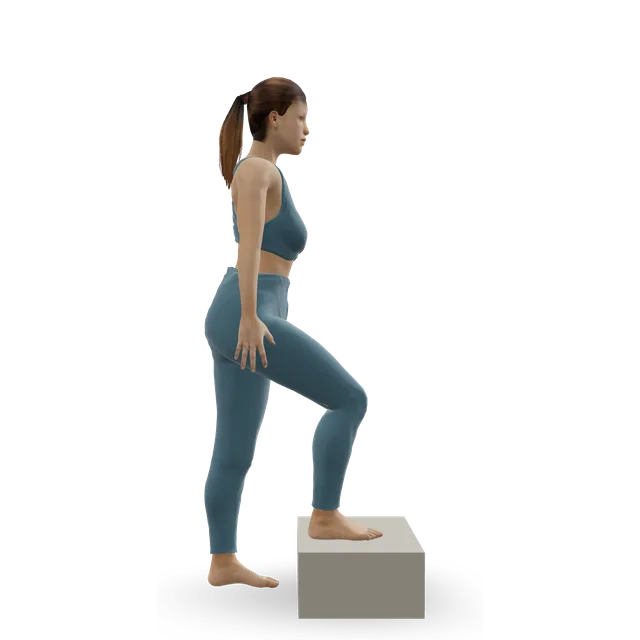
The movement on the figure: Step-up
Your score is the beats in the full minute after stepping, counted from within 5 seconds. Lower counts rank higher.
Source 1
Percentile ranks from 100 to 0 for six age groups, from 18 to 25 up to 66 and over, reprinted with permission. Who was tested isn't documented.
Source 1
The test wasn't designed to estimate VO2 max, the most oxygen your body can use, and we found no equation for it that we'd trust.
By our arithmetic from the stepping equation of the American College of Sports Medicine (ACSM), which we could read only in a study's abstract, it asks for about 7.4 METs. In one study, 27% of 189 people couldn't finish it, nearly all of them over 50.
ACE calls the test suitable for low-risk, healthy, non-athletic adults aged 20 to 59. From 60, the 2-minute step test, marching on the spot, may suit you better.
The YMCA's post-exercise heart rate norms: the beats in the minute after the test at each percentile rank, printed from the scorer's own table. A count equal to a cell is at that rank; otherwise it reaches the lower of the two ranks either side.
Each row gives the rank and the YMCA's label, then the count for ages 18 to 25, 26 to 35, 36 to 45, 46 to 55, 56 to 65, 66 and over, in that order.
Source 1
The same rows for women.
Source 1
The YMCA Fitness Testing and Assessment Manual (4th edition, 2000), reprinted with permission by ACE. We checked every cell against an image of the page. The YMCA manual itself couldn't be opened, so who was tested, how many and where isn't documented.
Source 1
The YMCA's own words: Excellent (ranks 100 to 90), Good (85 to 75), Above average (70 to 60), Average (55 to 45), Below average (40 to 30), Poor (25 to 15) and Very poor (10 to 0). The scorer adds plain words: rank 75 or above is a lower recovery heart rate than most, 20 or below a higher one, and the rest around the middle (editorial).
Source 1
Harvard Health prints a three-band chart credited to the YMCA's standards, but it tells readers to rest in a chair for a minute before counting, which lowers the count, and its cut-offs don't match the full table: for men aged 26 to 35 its best band is 86 or lower, where the YMCA's rank 75 is 85. We use the full table reprinted with permission (our comparison).
As the scorer works them out:
Source 1
We found no study of how much the 1-minute count varies from day to day. For step tests in general, only two of 11 studies reported retest reliability, and it was good. Compare tests done the same way at the same time of day, because sleep, caffeine, heat and nerves all change your heart rate (editorial).
Source 3
A model including the YMCA count predicted peak oxygen uptake with a correlation of 0.83, but only in people who finished the test. Korean models explained 56 to 61% of the differences between people, with errors of about 5 mL/kg/min, and across 11 studies, step tests correlated with measured VO2 max anywhere from 0.47 to 0.95.
One research group that tested a Korean equation for it writes that the YMCA test "is only intended to assess cardiorespiratory fitness, and not to estimate VO2max". Its equation, as printed, can't reproduce the paper's own average estimate at any likely count (our arithmetic), so we don't use it.
Source 2
With the step height and pace fixed, your body weight sets most of the work. People who finished were more likely to be younger, healthier and leaner, and ACE warns that shorter people may struggle with the step height.
Studies of step tests leave out people taking beta blockers, and the Chester step test's authors say VO2 max can't be predicted with them because the medicine blunts the heart rate's rise. A rating means little on a beta blocker or with atrial fibrillation.
ACSM's stepping equation, which predicted measured oxygen use well in 55 young adults, gives about 25.9 mL/kg/min for this test, or about 7.4 METs (our arithmetic; we could read the study only as an abstract). That's above the median measured VO2 max of US women in their 50s (23.4) in the registry our VO2 max calculator uses, which fits with 27% of 189 people not finishing, nearly all of them over 50.
Each test sets its own step, pace and pulse count, so their charts don't mix. None is scored here.
A 41 cm (16.25 inch) step at 24 steps a minute for men and 22 for women, for 3 minutes, then a 15-second pulse count from 5 to 20 seconds after, multiplied by 4. Its VO2 max equations, as one study reprints them, are 111.33 - 0.42 × heart rate for men and 65.81 - 0.1847 × heart rate for women. In 40 female students in India, agreement with measured VO2 max was poor, and the original papers couldn't be opened.
A UK test used in occupational health: 2-minute stages at 15 to 35 steps a minute on a 15 to 30 cm step, stopping at 80% of an age-predicted maximum heart rate or an effort of 14 on a 6 to 20 scale, with VO2 max read from the heart rate line. It read about 2 to 3 mL/kg/min low on average in 13 active students, with wide limits, and 1.4 low in 22 firefighters. It assumes a maximum heart rate of 220 minus your age, a formula our heart rate zones calculator doesn't use.
Up to 5 minutes on a 50 cm (men) or 45 cm (women) step at 30 steps a minute, with three pulse counts in recovery and a fitness index rather than a VO2 max. On the men's step it's close to a maximal effort for most adults (our arithmetic).
Source 15
US Customs and Border Protection applicants step to a beat of 120 a minute for 5 minutes, and Border Patrol uses a 14-inch step. They're pass-or-fail job tests without a heart rate score.
For children aged 6 to 12 there are Polish reference ranges from 14,501 children for a 3-minute step test scored with a heart rate monitor. They don't compare with the adult table.
Source 18
Regular aerobic exercise lowers your heart rate at the same effort. Step-ups build the stepping itself, and walking, cycling, rowing and stairs build the fitness behind it.
 3D demoStep-upBeginner · A step
 3D demoLow step-upBeginner · A step
 3D demoStanding marchBeginner · No equipment
 3D demoStair climbingIntermediate · A step
 3D demoTreadmill walkingBeginner · Cardio machine
 3D demoStationary cyclingBeginner · Cardio machine
 3D demoIndoor rowing (rowing machine)Beginner · Cardio machine
 3D demoSit to stand from a chairBeginner · A bench or box
The easy and low-impact sessions build fitness from a low start; the step-up workout builds the legs for the test.
A steady 30 to 45 minute cardio session at talk-but-not-sing pace: walk, cycle, row or cross-train, counting toward weekly activity guidelines.
40 minBeginner3 movesCardio machine, A wallA 25-minute standing cardio circuit with no jumping: marching, step jacks, sit-to-stands, punches, step-ups and wall push-ups, with a seated option for most moves.
25 minBeginner9 movesA bench or box, A stepA 40-minute walk alternating 3 minutes fast and 3 minutes easy, five times over: the interval walking tested in Japanese trials, built up from three rounds.
40 minBeginner3 movesCardio machine, A wallA 30-minute step-up workout at home or in the gym: step-ups, split squats, step-downs and calf raises on one step, with the height set to your level.
30 minBeginner9 movesA wall, A stepEach builds regular aerobic exercise over weeks; test again after 6 to 8 weeks the same way.
A free 8-week walking plan for beginners: build to 150 minutes of brisk walking a week, with intervals, hills and two short strength sessions.
6 training days40 minBeginner3 days a weekA 9-week beginner plan with the same walk-to-run shape as Couch to 5K: three run-walk sessions a week, from 1-minute jogs to 30 minutes of running.
3 training days35 minBeginner2 days a weekYour first four weeks: two, then three short strength sessions a week at home plus walks, building gently to a full routine.
2 training days20 minBeginnerChoose the 2-minute step test, the 6-minute walk or the chair stand test if any of these apply.
The PAR-Q+ asks you to check with your GP or a qualified exercise professional first, and suggests people over 45 who aren't used to vigorous exercise talk to an exercise professional. This test asks a lot: in one study, 27% of 189 people couldn't finish it.
Ask your heart team before any test that pushes your heart rate up; our heart disease and atrial fibrillation guides cover exercise.
Heart rate scores don't hold: studies leave such people out. The 6-minute walk, scored by distance, suits you better.
Blood Pressure UK says to speak to your doctor or nurse before new activity at 180/100 or higher, and not to start any at 200/110 or higher. Our line for hard tests is stricter: wait until readings of 160/100 or higher are treated (editorial).
Source 20
ACE lists balance concerns, knee or lower back problems, being extremely deconditioned and being short as reasons the test may not suit you, and in one study nearly everyone who couldn't finish was over 50. Try the 2-minute step test, the 6-minute walk or the chair stand test.
Talk to your midwife or doctor first. The NHS says it's not recommended to start a new vigorous activity in pregnancy.
The adult table doesn't apply. Children's step test ranges exist only for ages 6 to 12, from a different test.
Source 18
Call 999 if:
Stop, sit or lie down until the dizziness passes, then get up slowly, as the NHS advises. A 3 to 5 minute cool-down after the test helps prevent dizziness afterwards. See a GP if dizziness keeps coming back or comes with changes to your pulse, fainting or collapsing.
A review found strong evidence on safety only for a 2 km walk test in adults, so take the warning signs seriously in any home test.
Source 27
The YMCA test is "only intended to assess cardiorespiratory fitness, and not to estimate VO2max", and step-test estimates correlate with measured VO2 max anywhere from 0.47 to 0.95.
Each test sets its own step height, pace and counting window, and a chart that counts after a minute's rest doesn't match the YMCA's table.
Beta blockers, atrial fibrillation, body size and leg length all change it.
In one study, 27% of 189 people couldn't finish it, nearly all over 50. By our arithmetic from ACSM's stepping equation, which we could read only as an abstract, it asks for about 7.4 METs, above the median measured maximum of US women in their 50s.
The YMCA score is the full first minute, because your heart rate falls during it, so a 15-second count times 4 would read higher (our reasoning). The Queens College test counts for 15 seconds with its own step, pace and equation.
Set a metronome to 96 beats a minute and step up and down on a 30 cm (12 inch) step for 3 minutes, one foot on each beat: up, up, down, down. Then sit straight down and, within 5 seconds, count your pulse for one full minute. That count is your score.
Lower is better, and there's no health target. In the YMCA's norms, the middle (rank 50) count is 97 for men and 108 for women aged 18 to 25, and 106 and 120 at 66 and over. Enter your count to see your rank for your age and sex.
Your heart rate in the minute after a set amount of stepping: the fitter your heart and lungs, usually the lower it is. Medicines, caffeine, heat, nerves and late counting all change it, so compare tests done the same way at the same time of day.
Not reliably. Researchers who used it say the YMCA test is meant to assess fitness, not to estimate VO2 max, and step-test estimates in general match measured VO2 max anywhere from poorly to well. For a number, use the 1-mile walk in our VO2 max calculator.
A sturdy 30 cm (12 inch) step or box that can't slide, and a metronome at 96 beats a minute; free metronome apps work. One foot moves on each beat, so you make 24 full steps up a minute, and either foot can lead.
Not for this test. The norms use a full minute's count started within 5 seconds, because your heart rate falls during that minute, so a 15-second count times 4 would read higher. The Queens College test uses a 15-second count, but with its own step, pace and equation.
For most healthy adults, yes, but it's harder than it looks: in one study, 27% of people couldn't finish it, nearly all of them over 50. Answer the PAR-Q+ questions first, and stop for chest pain, dizziness or breathlessness you can't talk through.
If your doctor is happy for you to exercise, you can, but the score won't mean the same: beta blockers keep your heart rate low, and studies of step tests leave out people taking them. The 6-minute walk, scored by distance, suits you better.
The American Council on Exercise lists balance problems, knee or lower back problems, being very deconditioned and being short, because the step is a fixed 30 cm. Check with a doctor first if you have a heart condition, and if you're pregnant, don't start new vigorous exercise. The 2-minute step test and the 6-minute walk are the gentler options.
The Chester step test (a UK test used in occupational health), the Queens College test and the Harvard step test each use their own step height, pace and pulse count, so their charts don't mix. The 2-minute step test, marching on the spot, is the gentle option for older adults.
Fitness tests compared with published norms for adults (and for children on the beep test, the vertical jump test and the plank test), not a diagnosis, and clinical review of these pages is pending. Check with a GP before a hard test if you have a heart condition, high blood pressure, chest pain, dizziness or breathlessness when active, and have someone with you for the balance, walking, stepping and floor tests if you've fallen or feel unsteady. Health disclaimer.





