Stretching & mobility
Ankle mobility routine: the knee-to-wall test, calf stretches and full-range calf raises
Bending the ankle up, with your knee travelling over your toes, is what deep squats, lunges, stairs and running ask of it. In trials, calf stretching added a few degrees over several weeks, and slow, full-range calf raises improved it about as much; this routine does both. Measure your knee-to-wall distance first, so you can see the change. Do the stretches most days and the calf raises 2 or 3 times a week.
Test
- Knee-to-wall ankle rockTest: 1 measured reach each sideBeginner · 3D demoMove the foot back until your knee only just touches the wall with the heel down; measure from your big toe to the wall and write it down

Move the ankle
- Ankle CARs (controlled articular rotations)5 slow circles each way, each ankleBeginner · Calves, Shins · 3D demoMove only the foot, as big and slow as you canEasier: Ankle circlesHarder: Toes-tucked kneeling (toe squat)
- Knee-to-wall ankle rock10 slow rocks each sideBeginner · 3D demoHeel down, knee over the middle toes; stop at a pinch at the front of the ankle

Stretch both calf muscles
- Wall calf stretch (gastrocnemius)2 holds of 30 s each sideBeginner · Calves · 3D demoBack knee straight, heel downEasier: Seated calf stretch with a towelHarder: Heel-on-step calf and hamstring stretch
- Soleus wall stretch2 holds of 30 s each sideBeginner · Calves · 3D demoBack knee bent, heel downEasier: Seated calf stretch with a towelHarder: Toes-tucked kneeling (toe squat)


Strength through the full range
Rest 30 to 60 s between sets
- Slow calf raise2 sets of 12 to 15Beginner · Calves · 3D demo3 seconds up and 3 seconds down, through your whole range; hold a wallEasier: Seated bent-knee calf raise (soleus raise)Harder: Standing dumbbell calf raise
- Single-leg calf raise from a step2 sets of 8 to 12 each leg (optional)Intermediate · Calves · 3D demoOnce two-leg raises are easy; lower only into a comfortable range. With Achilles pain, stay on the floorEasier: Slow calf raiseHarder: Single-leg pogo hops
- Tibialis raise2 sets of 15Beginner · Shins · 3D demoBack against a wall; lift the fronts of both feetHarder: Single-leg tibialis raise



Use it
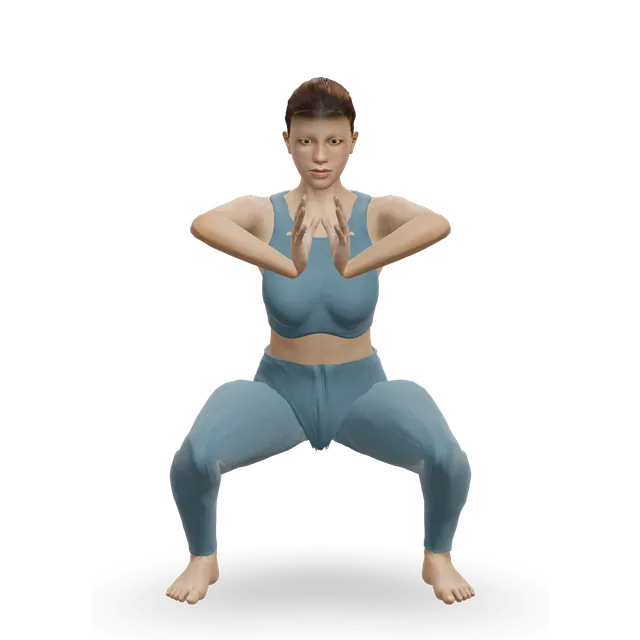
- Deep squat hold30 to 60 sIntermediate · Quads, Glutes, Adductors · 3D demoHold a door frame, heels down if you can; a folded mat under them if they liftEasier: Goddess pose (Utkata Konasana)Harder: Cossack squat
Tips
- Do the stretches most days and the calf raises 2 or 3 times a week. Once you're happy with your range, 2 or 3 days a week keeps it, as our flexibility guide says.
- Retest the knee-to-wall distance every 2 to 4 weeks, at the same time of day after the same warm-up. A change of about 2 cm is needed to be sure it's more than measuring error (our suggestion, from the studies of the test).
- If the ankle drill gives you a pinch at the front of the ankle rather than a stretch in the calf, don't force it: keep your heels raised and see our anterior ankle impingement guide.
- After a sprain, start once you can walk without a limp and your clinician agrees, and follow the stages in our ankle sprain guide (our suggestion, from our strengthen your ankles guide's after-sprain advice).
- After a broken ankle or ankle surgery, follow your team's advice on when to start.
- A step-based heel drop may be unsuitable for some Achilles problems, as our calf raise move page says: do calf raises on the floor and see our Achilles tendinopathy guide.
- With numb feet from diabetes or another cause, do the standing moves in well-fitting shoes rather than barefoot, and check your feet afterwards (our suggestion, following our foot and ankle strengthening routine).
- Some discomfort during exercise is fine. Aim for pain you would call mild to moderate, no more than about 5 out of 10, that settles within an hour, with no more swelling or stiffness the next morning. If it's worse the next day, do a little less (a smaller range, fewer reps, a lighter band), not nothing.
- Same day: a sudden snap or pop at the back of the heel or calf, or a feeling of being kicked there, then walking flat-footed and being unable to push off, stand on tiptoe or climb stairs. It could be an Achilles tendon rupture or a broken heel bone. Go to A&E or a minor injuries unit, or contact NHS 111.
The doses are suggested starting points, not a prescription. Choose a range you can control and stop for sharp or increasing pain, numbness or tingling. Get individual advice after an injury or surgery, or if you are pregnant or managing a health condition.
Guides that recommend it
Find more moves like these
More stretching & mobility




10-minute morning stretch
A gentle, no-equipment stretch routine to wake up the spine, hips and shoulders in ten minutes.
10 minBeginner10 movesNo equipment


Full-body stretch routine
A 15-minute head-to-toe stretch for the neck, shoulders, back, hips, hamstrings and calves.
15 minBeginner11 movesA wall


Lower back stretch routine
Seven gentle stretches and mobility moves for a stiff lower back, done lying and kneeling.
12 minBeginner7 movesA wallQuestions people ask
How long does the ankle mobility routine: the knee-to-wall test, calf stretches and full-range calf raises take?
About 12 minutes, including any warm-up and cool-down listed. Shorten it by doing fewer rounds; lengthen it by adding one.
What equipment do I need?
You need: A wall, A step. Each move links to its guide, where you can find an alternative if you are missing something.
Is it suitable for beginners?
It is written for beginners. 6 of its 8 moves have an easier option listed beside them if you need one.
How do I make it easier or harder?
Use the easier or harder option listed under each move, change the number of rounds, or adjust the rest. Progress one change at a time.