Pain guide · Leg pain

Thigh pain: a strain or dead leg, the hip and back, a burning nerve, a clot and how to build back

Thigh pain usually comes from a muscle: a pulled quad at the front or a pulled hamstring at the back, or a dead leg after a knock. But the thigh is also where pain from the hip joint, the lower back, a squeezed skin nerve on the outer thigh and narrowed arteries is often felt, and a blood clot can cause throbbing pain and swelling. Most new thigh problems begin to settle within 6 weeks.

This guide starts with the signs that need help today, from a 999 call or accident and emergency (A&E) to the National Health Service's 111 line (NHS 111) or a general practitioner (GP): the NHS's signs of a clot, severe pain after a fall, and new thigh pain while taking a bisphosphonate bone medicine. It then maps the causes by where it hurts (the front, back, inner or outer thigh), explains why a dead leg needs gentle knee bending rather than massage, and gives a three-stage plan from the first days to running, sprinting and kicking.

When to get help first

Exercise is for pain that has been checked or is clearly mild and settling.

Get urgent medical help if

  • Call 999: calf or leg pain or swelling with breathlessness or chest pain. It could be a clot that has reached the lungs. Do not drive yourself to A&E.
  • Call 999 or go to A&E after an injury if the leg is twisted or bent, a bone is sticking out, there's a bad cut or wound, or there are signs of shock: cold, sweaty skin, a fast or weak pulse, fast or shallow breathing, or blue, grey, pale or blotchy skin or lips. While you wait, don't move the leg or put weight on it, and don't eat or drink in case you need surgery.
  • Call 999 or go to A&E: severe hip pain after a fall or injury, or you cannot stand, walk or put weight on the leg. In an older adult this can be a broken hip; the leg may be at an odd angle or look shorter. Don't drive yourself.
  • Tingling or loss of feeling in the hip or leg after an injury.
  • Call 999 or go to A&E: sudden, severe pain in a thigh muscle, which may be worse when you stretch it (for example bending the knee), with swelling, numbness, weakness or pins and needles, or tightness or difficulty moving the leg. This can be acute compartment syndrome, which needs surgery as soon as possible. In the thigh it usually follows a heavy knock, a crush or a broken bone. Do not drive yourself to A&E.
  • Call 999 or go to A&E: leg pain with numbness around the genitals or bottom, new trouble starting or controlling peeing, not knowing when you need to poo or losing control of it, sciatica in both legs, or weakness or numbness in both legs that is severe or getting worse. These can be signs of cauda equina syndrome, which needs treating in hospital as soon as possible.
  • Call 999 or go to A&E: a leg that is suddenly cold, pale, numb, weak or very painful. A sudden loss of blood supply to a leg is a vascular emergency.
  • Same day: a pop just above the kneecap, then you can't straighten your knee or lift the straight leg, or there's a dent above the kneecap. This can be a quadriceps tendon tear, which almost always needs surgery and does better if it's repaired soon. Our torn kneecap tendons guide covers that injury.
  • Same day: a pop near the sitting bone, a large bruise high on the back of the thigh, or you cannot put weight on the leg. The tendon may have pulled away from the bone, which needs assessing before you start these exercises.
  • Same day (urgent GP appointment or NHS 111): throbbing pain in one leg (rarely both), usually the calf or thigh; swelling in one leg (rarely both); red, blue or darkened skin around the painful area, which may be harder to see on brown or black skin; or swollen veins. This can be a deep vein thrombosis (DVT). It is more likely after surgery, a hospital stay, 3 or more days in bed, a journey of over 4 hours, pregnancy or a recent birth, cancer, a previous clot, or oestrogen-containing contraception or HRT.
  • Same day, and stop running now: groin or front-of-hip pain in a runner, sometimes felt in the thigh or knee, that builds with running, hurts with every step or at night, or hurts when the hip is turned to the end of its range. Keep weight off the leg, using crutches if you have them, and get an urgent GP appointment or help from NHS 111 the same day: a stress fracture of the hip (femoral neck) needs urgent imaging.
  • Call a doctor or NHS 111 straight away: new pain, weakness or discomfort in your thigh, hip or groin while you're taking a bisphosphonate bone medicine, such as alendronic acid. The NHS says this happens rarely but may be an early sign of a possible broken thigh bone, and the UK medicines regulator asks everyone taking these medicines to report thigh, hip or groin pain.
  • Phone NHS 111: a new, significant injury to the thigh in the last 7 days, such as a fall from a height or a direct blow, or you can't move your leg at all.
  • Contact your GP practice, or phone NHS 111 if it's closed: your thigh is hot, swollen or tender, especially if you can't remember an injury, or you can't put any weight through your leg.
  • Same day (urgent GP appointment or NHS 111): a child or teenager with sudden pain in the hip, thigh or knee, or who is limping or can't put any weight on 1 leg. Hip problems in children can sometimes be felt in the thigh or knee.
  • Same day: leg weakness that is getting worse; new leg pain with a history of cancer, HIV, TB or inflammatory arthritis; or leg pain with a fever, feeling unwell, loss of appetite, unexplained weight loss or night sweats.
  • Same day (GP or NHS 111): you are over 50 and have new pain and stiffness in both shoulders (often the hips too), especially with morning stiffness lasting more than 45 minutes. This can be polymyalgia rheumatica. With a new headache, jaw pain when chewing or problems with your vision, contact a GP immediately. If you suddenly can't see from 1 or both eyes, call 999 or go to A&E.

See a doctor or physiotherapist if

  • A deep ache in the thigh bone that builds with every run and later hurts with walking or at night: stop running and get it checked. It can be a stress fracture of the thigh bone.
  • A hard, painful lump in the thigh that stays or grows weeks after a knock: bone can form in a bruised muscle (myositis ossificans).
  • Front-of-thigh pain with tingling or numbness, or with back pain: it may come from a nerve rather than the muscle.
  • Weakness, a knee that gives way, or trouble climbing stairs or getting up from a chair; numbness that spreads to the front or inside of the thigh, below the knee or into the foot; back pain with the thigh symptoms; or symptoms in both thighs. These point to a nerve in the back or another cause, so see a GP.
  • Pain that comes on when you walk a set distance and goes after a few minutes' rest, especially if you smoke or have diabetes. Exercise treats it well, but it needs a diagnosis first.
  • Pain that is not improving after a few weeks, is getting worse, or is stopping your normal activities. NHS inform expects most new thigh problems to begin to settle within 6 weeks.
  • Bone pain that is constant or worse at night, especially with a lump, unexplained weight loss, fever or tiredness, or a past history of cancer.
  • A stress fracture from ordinary activity, more than one stress fracture, periods that have stopped or become irregular, or worries that you're eating too little for your training: see a GP about bone health and energy intake.
  • A second strain in the same place: ask a physiotherapist to review your rehab.

Where does it hurt?

Location narrows the likely causes; it does not diagnose.

The front of the thigh, a sudden sharp pull while kicking, sprinting or jumping, sometimes with a pop

A quad (quadriceps) strain, tender in one spot, sometimes with bruising.

Read: Quad strain →
The front or outer thigh after a knock from a knee, a helmet or a fall: painful, stiff, swollen, and hard to bend the knee

A dead leg, a bruise deep in the muscle (a contusion). Our quad strain guide covers it.

Read: Quad strain →
A hard, painful lump in the thigh that stays or grows weeks after a knock

Bone can form in a bruised muscle (myositis ossificans): see a GP.

Read: Quad strain →
After a heavy knock: severe pain far worse than expected, a tight, swollen thigh, pain when the knee is bent, or tingling

Possible acute compartment syndrome of the thigh: call 999 or go to A&E.

Just above the kneecap, a pop, then you can't straighten the knee or lift the straight leg

A possible quadriceps tendon tear: get it checked the same day.

Read: Kneecap tendon rupture →
The back of the thigh, a sudden sharp pain while sprinting or stretching, then bruising that can spread to the calf

A hamstring strain.

Read: Hamstring strain →
A pop near the sitting bone with a large bruise high on the back of the thigh, and difficulty walking

The hamstring tendon may have pulled off the bone, which can be time-sensitive: get it checked the same day.

Read: Hamstring strain →
A deep ache at the sitting bone that builds over weeks, worse sitting and running uphill

High hamstring tendinopathy.

Read: High hamstring tendinopathy →
The back of the thigh with tingling, numbness or pain spreading below the knee, often with back pain

Sciatica, a nerve irritated in the lower back.

Read: Sciatica →
The inner thigh close to the groin, worse squeezing the knees together, kicking or changing direction

Usually adductor-related groin pain (a groin strain).

Read: Groin strain →
The front of the hip and top of the thigh when lifting the knee, kicking or climbing stairs

The hip flexors.

Read: Hip flexor pain →
A deep ache in the groin and front of the thigh, stiff after rest, worse walking, from mid-life

Often the hip joint, which is commonly felt in the thigh.

Read: Hip arthritis →
Burning, tingling or a numb patch on the outer thigh you could draw round, with no weakness

Meralgia paraesthetica, a squeezed skin nerve: tight belts, leggings or a heavy tool belt and weight gain are common causes.

Read: Meralgia paresthetica →
The outer thigh just below the bony point of the hip, sore to lie on

Usually the outer hip tendons (often called hip bursitis), whose pain can spread down the side of the thigh.

Read: Outer hip pain →
The outer thigh down to the outer knee, sharp at the knee during runs

Iliotibial band syndrome.

Read: IT band syndrome →
The front or inner thigh with weakness, a knee that gives way, or numbness spreading to the front or inside of the thigh

A nerve from the back rather than the skin nerve: see a GP.

Read: Sciatica →
A deep ache in the thigh bone in a runner that builds with every run, then hurts walking or at night

A possible stress fracture of the thigh bone: stop running and get it checked.

Read: Stress fracture →
Groin or front-of-hip pain in a runner, sometimes felt in the thigh, that hurts with every step

A possible stress fracture of the hip: stop running and get help the same day.

Read: Stress fracture →
A dull ache in the thigh or groin, sometimes on both sides, in someone taking a bisphosphonate such as alendronic acid

Rarely, an early sign of a fracture of the thigh bone: call a doctor or NHS 111 straight away.

An ache in the thigh or buttock after walking a set distance that goes after a few minutes' rest

Possibly narrowed arteries higher up the leg, or narrowing in the lower spine if sitting or bending forward eases it.

Read: Calf pain when walking →
One leg throbbing and swollen, with red, blue or darkened skin or swollen veins

A possible blood clot (DVT): get help the same day.

A child aged about 10 to 16 with groin, thigh or knee pain and a limp

Possibly a slipped growth plate at the hip: get it seen the same day.

Read: SUFE (slipped hip growth plate) →
A child aged about 4 to 10 with a limp, or thigh or knee pain, coming and going over weeks

Possibly Perthes disease: an urgent GP appointment or NHS 111.

Read: Perthes disease →
Over 50, both hips and thighs (and the shoulders) stiff for more than 45 minutes in the morning

Possibly polymyalgia rheumatica: see a GP.

A hot, swollen, tender thigh without an injury

Contact your GP practice the same day.

Bone pain that is worse at night, or a lump

Rarely a bone tumour: see a GP.

Understand it

In sport, the thigh musclesEmerging evidence

In 2,299 professional footballers followed for several seasons, muscle injuries were 31% of all injuries that stopped them playing, and the hamstrings (37%), the inner thigh muscles (23%) and the quadriceps (19%) were three of the four biggest groups; 16% were reinjuries, which kept players out longer. In another elite cohort, thigh muscle injuries were 25% of all injuries: 88% were strains and 12% bruises from a direct blow, and players came back from the bruises in under half the time.

Most people with thigh pain aren't professional footballers, and these numbers come from elite men. NHS inform says thigh problems come from overstretching or twisting, a fall, a direct blow, or no clear reason, and usually begin to settle within 6 weeks.

Sources 1, 2, 3

A sudden pull: a quad or hamstring strainStrong evidence

A strain often comes with a popping or snapping feeling and sudden pain, then tenderness and bruising, which can spread down to the calf and ankle over 1 to 2 days, the American Academy of Orthopaedic Surgeons (AAOS) says. At the back of the thigh, the NHS describes a sharp pain, sometimes a snap or pop, then tenderness, swelling and bruising, and difficulty standing or walking.

The AAOS warns that a hamstring pulled off the sitting bone can look like a strain, with similar bruising, but can be time-sensitive and may need surgery, so pain close to the sitting bone after a pop needs checking. Our quad strain and hamstring strain guides cover both in full.

Sources 4, 5

A knock: a dead leg, and bone in the muscleEmerging evidence

A dead leg is a bruise deep in the thigh muscle (a contusion) from a knock. In 117 thigh bruises in military cadets, people were out of activity for a mean of 13 days when the knee could still bend past 90 degrees, 19 days for moderate and 21 days for severe bruises. Bone formed in the muscle (myositis ossificans) in 9%, more often with knee bend under 120 degrees, a bruise from football, a previous thigh injury, a delay of more than 3 days before treatment, or a swollen knee. In one small series of 47 midshipmen, with no comparison group, the knee was held bent to 120 degrees for the first 24 hours, and they returned to full activity in a mean of 3.5 days.

The AAOS says the two main complications of a deep bruise are bone forming in the muscle and compartment syndrome, a build-up of pressure inside the muscle that the NHS says needs surgery as soon as possible. In 8 people who developed it after a bruise or tear at the front of the thigh, the pressure in the muscle was 41 to 80 millimetres of mercury, and all had normal function about 4 weeks after an operation to release it.

Sources 6, 7, 8, 2, 9, 10, 11

Pain from somewhere else: the hip joint, the back and a skin nerveEmerging evidence

The hip joint is often felt in the thigh. In 51 people with a painful hip joint, mapped before a hip injection, 57% felt it in the thigh, 55% in the groin and 71% in the buttock. The NHS lists hip osteoarthritis (over 45, pain worse walking, stiffness after moving) and bursitis, whose pain may spread to the thigh, among the causes of hip pain.

NHS inform says problems felt in the thigh can come from the back, even when the back doesn't hurt, described as pins and needles, or sharp, hot or burning pain. A burning, tingling or numb patch on the outer thigh is usually meralgia paraesthetica, a squeezed skin nerve; the AAOS says tight clothing and weight gain are two of the commonest causes, along with a heavy tool belt.

Sources 12, 13, 3, 14

A deep ache in the thigh boneEmerging evidence

In 914 college athletes followed for 2 years, 7 of 34 stress fractures (20.6%) were in the shaft of the thigh bone, more than the authors expected. A small series of 7 top athletes says these fractures have few clear signs, so diagnosis is often delayed. Stress injuries of the neck of the thigh bone, near the hip, had the longest return to sport after the navicular in the foot (107 days) and among the highest complication rates in pooled studies, which is why a runner's groin or thigh pain with every step needs checking the same day.

Separately, bisphosphonates, the bone medicines taken for osteoporosis, can rarely cause an unusual fracture of the thigh bone after little or no injury, mainly after long-term use. The UK medicines regulator (MHRA) says some people have a dull ache in the thigh or groin for weeks to months before, that it often affects both sides, and that people taking these medicines should report thigh, hip or groin pain; the NHS alendronic acid page says call a doctor or NHS 111 straight away.

Sources 15, 16, 17, 18, 19

Clots, arteries, children and other causesStrong evidence

The NHS's signs of a blood clot in a deep vein (a deep vein thrombosis, DVT) are throbbing pain in one leg, usually in the calf or thigh, swelling, red, blue or darkened skin around the painful area, and swollen veins. An ache in the leg on walking that goes after a few minutes' rest can be narrowed arteries; NHS Scotland's pathway says it is felt in the thigh and buttock when the narrowing is higher up.

In children, the NHS says hip problems can be felt in the thigh or knee, so sudden thigh pain or a limp needs an urgent GP appointment or NHS 111; aching in both legs in the evening that has gone by morning is usually growing pains. Polymyalgia rheumatica causes pain and stiffness around the shoulders, neck and hips, with morning stiffness lasting more than 45 minutes, mostly over 65. Bone pain that is worse at night, or a lump, needs a GP: rarely, it is a bone tumour.

Sources 20, 21, 22, 23, 24, 25, 26

When a scan or test helpsStrong evidence

Strains are usually diagnosed by examination, with a magnetic resonance imaging (MRI) scan if the muscles and tendons need a closer look. A hard lump weeks after a knock can be X-rayed for bone forming in the muscle: in the midshipmen series, X-rays at 3 and 6 months found it in 1 of the first 23.

For a suspected stress fracture, an early X-ray may look normal, and an MRI shows the bone swelling; a clinical test helped early diagnosis in the college athletes. The MHRA asks doctors to check anyone taking a bisphosphonate who has thigh, hip or groin pain for an incomplete fracture, and to check the other thigh bone too. Meralgia paraesthetica is diagnosed by pressing on the nerve to bring on the burning, sometimes with a numbing injection to confirm it. A swollen, throbbing leg needs an ultrasound scan within 24 hours if a doctor thinks it's a clot, and narrowed arteries are checked by comparing blood pressure at the arm and ankle.

Sources 4, 8, 27, 15, 18, 14, 20, 21

How it usually goesEmerging evidence

NHS inform expects most new thigh problems to begin to settle within 6 weeks. The NHS says mild hamstring injuries usually get better in a few days and severe ones can take weeks or months, and the AAOS says getting strength and flexibility back takes 10 days to 3 weeks for a mild thigh strain and up to 6 months for a severe one. Most sprains and strains feel better after 2 weeks. In elite football, 16% of muscle injuries were reinjuries.

In the 7 athletes with a stress fracture of the thigh bone, all were back to full activity 12 to 18 weeks after starting a four-phase plan, with no recurrence over 4 to 8 years. The burning of meralgia paraesthetica can take time to stop, and some numbness can stay, the AAOS says. Of people with narrowed leg arteries, 75% stay the same or improve. No one can promise a date.

Sources 3, 5, 4, 28, 1, 16, 14, 22

What helps, and how strong the evidence is

Keep moving from the first daysStrong evidence

In the first 24 to 48 hours, NHS inform says reduce your activities but move as much as your symptoms allow, move the leg gently for 10 to 20 seconds every hour, and avoid long periods on your feet; on stairs, lead with the good leg going up and the sore leg coming down. After 48 hours, use the leg more and stay at or return to work.

After a strain, the NHS advises protection, rest, ice, compression and raising the leg for the first 2 to 3 days, and avoiding heat, massage and alcohol for the first few days to help prevent swelling; once you can move the leg without pain stopping you, keep it moving. NHS inform's soft tissue advice adds that too much rest can slow recovery, that you don't need to be pain-free, and that anti-inflammatory tablets may have limited value and may slow healing if taken too early.

Sources 3, 28, 5, 29

Start loading early, and lengthen the muscleEmerging evidence

In a trial of 50 recreational athletes with a severe thigh or calf strain, starting rehabilitation early rather than delaying it got people back to sport sooner, and their strength recovered just as well. In 75 elite footballers with hamstring strains, a programme built on lengthening exercises returned players to full training in a mean of 28 days against 51 with conventional exercises; strains from stretching took longer than strains from sprinting.

How much pain is fine? In 43 men with hamstring strains, rehab that allowed pain up to a tolerable threshold got them back as fast as pain-free rehab (a median of 17 and 15 days) and rebuilt 15% more strength. These trials are mostly in athletes and in hamstrings; no trial was found for quad strains, so this guide borrows from them.

Sources 30, 31, 32

A dead leg: bend the knee gently, and don't massage itEmerging evidence

The AAOS says rest, ice, compression and raising the leg in the first 24 to 48 hours, keep the bruised muscle in a gentle stretch, and do not massage the injured area. A thigh bruise can be held with the knee bent for the first 24 hours to limit the bleeding, gentle stretching starts the day after, and vigorous stretching may make bone formation in the muscle worse.

The military series point the same way. The West Point programme rested the leg with the knee bent and started knee bending early, and in the small, uncontrolled midshipmen series, holding the knee bent to 120 degrees for 24 hours was followed by a quick return. These aren't trials, so the evidence is emerging.

Sources 6, 7, 8

NHS inform's thigh exercisesStrong evidence

NHS inform's thigh exercises are a hamstring stretch lying on your back, held for up to 10 seconds; a seated knee bend held for 2 seconds; and standing quad and hamstring stretches building to holds of 20 to 30 seconds. Its pacing starts with 2 to 3 repetitions at a time, practised often, adding 1 or 2 every few days, then sets of 8, up to 2 sets of 15, with stretches held 20 to 30 seconds, 2 to 3 times a day, keeping pain within 0 to 5 out of 10.

Source 33

When surgery or a procedure is neededEmerging evidence

A hamstring tendon pulled off the sitting bone may need surgery to reattach it, and the NHS says the most serious hamstring injuries, with a complete tear, may need an operation and months of recovery. A large bruise that doesn't go away within several days may be drained, the AAOS says, and compartment syndrome needs an urgent operation. For meralgia paraesthetica, a steroid injection is an option in more severe cases, and surgery is rarely needed.

Sources 4, 5, 6, 9, 14

A stress fracture of the thigh bone: a staged returnEmerging evidence

In 7 top athletes with a stress fracture of the shaft of the thigh bone, a plan of four phases of 3 weeks each, moving on only after tests at the end of each phase, returned all of them to full activity in 12 to 18 weeks. It's one small series, so your clinician's plan comes first. An NHS sports medicine leaflet starts running only after 30 minutes of fast walking is pain-free, then builds a walk-jog programme over 6 weeks.

Sources 16, 15, 34

How much pain is OK while you exercise?

A tolerable ache for strains, stopping just before pain in lengthening work; gentle knee bending after a dead leg; no pain at all in the boneEmerging evidence

Strains: discomfort up to a tolerable level, about 3 to 4 out of 10, is fine if it settles within the day, as our quad and hamstring strain guides say, from a hamstring trial where rehab to a pain threshold was as quick as pain-free rehab and rebuilt more strength. In lengthening work, such as the hamstring drill on your back or the reverse Nordic, stop just before pain. Sharp pain, or a limp afterwards, means drop back for a session or two. NHS inform's thigh exercises allow up to 5 out of 10, with pain no worse the morning after.

A dead leg: in the first days, bend the knee gently and within comfort, and avoid massage, heat and forceful stretching, as the AAOS and the NHS advise.

The hip joint: our hip pain guide's 5 out of 10, settling within an hour or so and no worse that night or the next morning. A burning outer thigh: up to 5 out of 10, and the numb patch shouldn't spread, as our meralgia guide says.

A possible stress fracture of the thigh bone: no pain at all in the bone during, after or the next day; as Health New Zealand puts it for stress fractures, as long as you can feel pain, the bone is still fragile. A swollen, throbbing leg, breathlessness, a pop with a gap above the kneecap, or new thigh pain while taking a bisphosphonate are never pain-rule questions. In trials of long-lasting muscle and joint pain, exercise that allowed some pain did no worse than pain-free exercise.

Sources 33, 32, 31, 6, 28, 35, 36

The exercise plan: 3 stages

Start at the first stage. Each move opens a full guide with a 3D demo.

Stage 1

Settle: early, gentle loading

About the first week: move the leg gently for 10 to 20 seconds every hour and avoid long periods on your feet (NHS inform); after a strain or a bruise, no heat, massage or alcohol for the first few days (the NHS); after a dead leg, bend the knee gently. A swollen, throbbing leg, a pop with a gap above the kneecap, new thigh pain while taking a bisphosphonate, a burning patch (our meralgia guide) or a deep groin ache from the hip joint (our hip arthritis guide) go to the warning signs or their own guides first.

Quad set (static quads) demonstrated on the 3D figure3D demoQuad set (static quads)Beginner · No equipment

Hold 5 s, 10 times, 2 to 3 times a day · As in our quad strain guide; for the front of the thigh and after a dead leg

Harder: Straight-leg raise

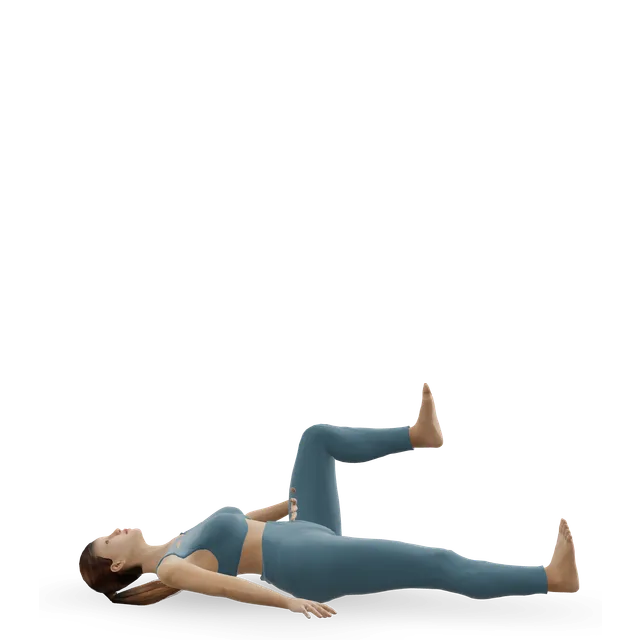
Supine heel slide demonstrated on the 3D figure3D demoSupine heel slideBeginner · No equipment

10 slow reps, once or twice a day · The move page's dose, which it labels an editorial starting point. After a dead leg, aim to bring the heel closer to your bottom over the week, as our quad strain guide says

Harder: Hip windshield wipers

90/90 hamstring stretch (active knee extension) demonstrated on the 3D figure3D demo90/90 hamstring stretch (active knee extension)Beginner · No equipment

3 sets of 12 slow straightenings each leg, stopping just before pain, twice a day · The move page's dose, from the hamstring lengthening trial, as in our hamstring strain guide; for the back of the thigh

Easier: Supine hamstring stretch with a strap · Harder: Contract-relax hamstring stretch (PNF)

Glute bridge demonstrated on the 3D figure3D demoGlute bridgeBeginner · No equipment

2 sets of 10, or 5 holds of 20 to 30 s · As in our quad and hamstring strain guides

Easier: Pelvic tilt into bridge · Harder: Single-leg glute bridge

Treadmill walking demonstrated on the 3D figure3D demoTreadmill walkingBeginner · Cardio machine

Short walks as able · As in our quad and hamstring strain guides; walking outdoors counts

Harder: Treadmill jogging

Stationary cycling demonstrated on the 3D figure3D demoStationary cyclingBeginner · Cardio machine

10 to 15 min, easy, once pedalling is comfortable · As in our quad strain guide

Easier: Recumbent exercise bike · Harder: Air bike intervals

Move on when: Brisk walking is pain-free, the knee bends nearly fully, and for the back of the thigh the slow straightening drill reaches nearly full (our hamstring strain guide's check).

Follow along: a timer, a cue and the next move, one step at a time.
Stage 2

Build: strength through range

About weeks 1 to 3: load the injured muscle through more of its range within the pain rule; starting early got athletes back to sport sooner in a trial.

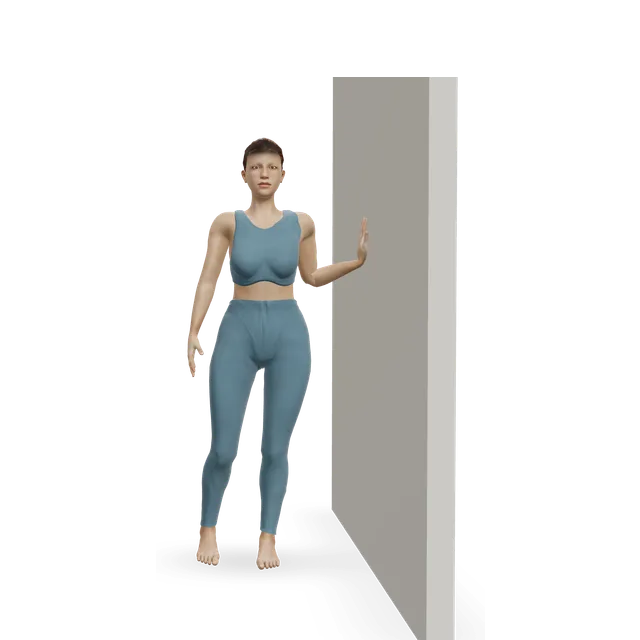
Wall sit demonstrated on the 3D figure3D demoWall sitBeginner · A wall

4 holds of 30 to 45 s · As in our quad strain guide; breathe normally through the hold, as the move page says

Easier: Straight-leg raise · Harder: Spanish squat (band squat hold)

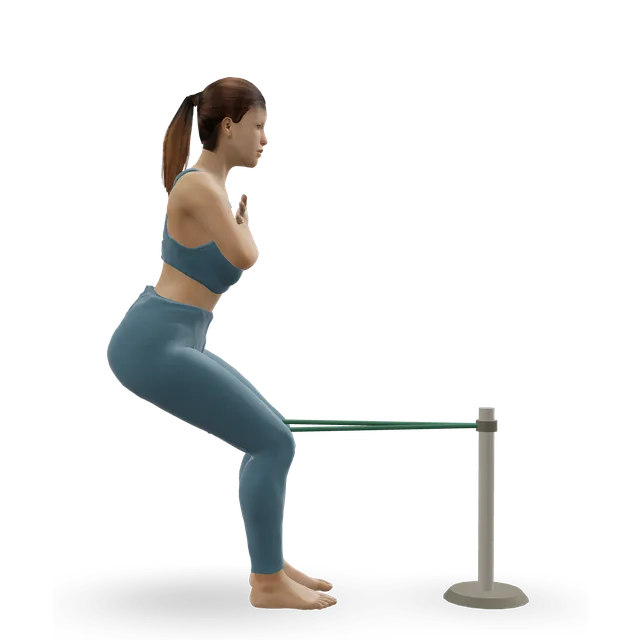
Spanish squat (band squat hold) demonstrated on the 3D figure3D demoSpanish squat (band squat hold)Intermediate · A band + An anchor point

4 to 5 holds of 30 to 45 s, once a day · The move page's dose (modelled on a tendon trial), as in our quad strain guide; check the anchor every time

Easier: Straight-leg raise · Harder: Pistol squat

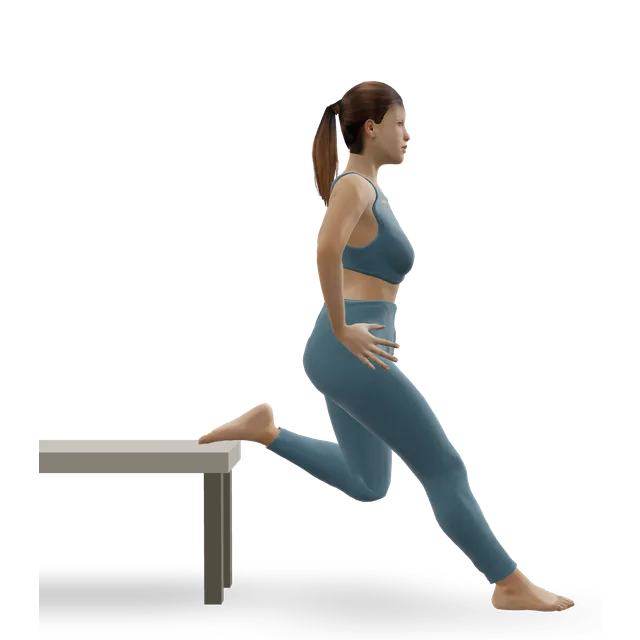
Step-up demonstrated on the 3D figure3D demoStep-upBeginner · A step

3 sets of 8 to 10 each leg · As in our quad strain guide

Easier: Low step-up · Harder: Dumbbell step-up

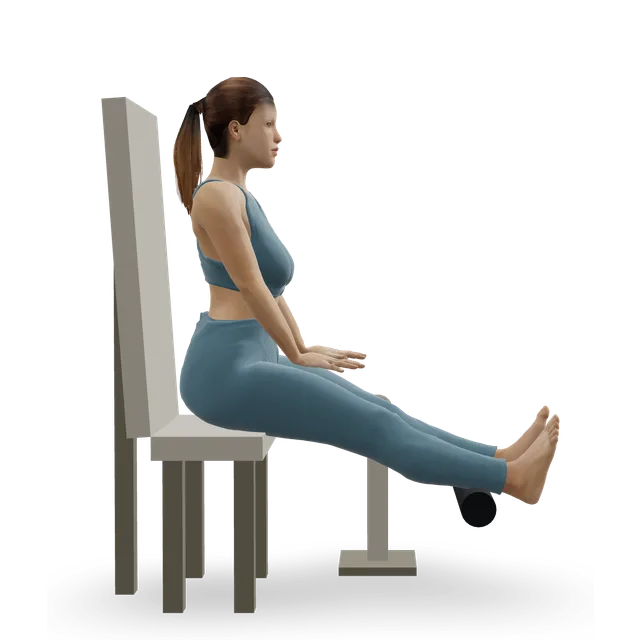
Seated knee extension (chair) demonstrated on the 3D figure3D demoSeated knee extension (chair)Beginner · A bench or box + Something with weight

3 sets of 10 to 15 each leg, 2 to 3 days a week · The move page's dose, which it labels an editorial starting point; a home version of the quad strain guide's leg extension

Easier: Quad set (static quads) · Harder: Leg extension

Single-leg Romanian deadlift demonstrated on the 3D figure3D demoSingle-leg Romanian deadliftAdvanced · A dumbbell

3 sets of 6 each leg, bodyweight, every other day, stopping just before pain · For the back of the thigh, as in our hamstring strain guide; fingertips on a wall at first, as the move page says

Easier: Dumbbell Romanian deadlift

Move on when: These are pain-free at a moderate speed (our hamstring strain guide's check), and stairs and sitting down to a chair feel normal (our suggestion).

Follow along: a timer, a cue and the next move, one step at a time.
Stage 3

Lengthen, then run, sprint and kick

From about weeks 3 to 6: lengthening strength, then speed, built over several sessions rather than within one, while running, sprinting, kicking and contact come back by the written steps below.

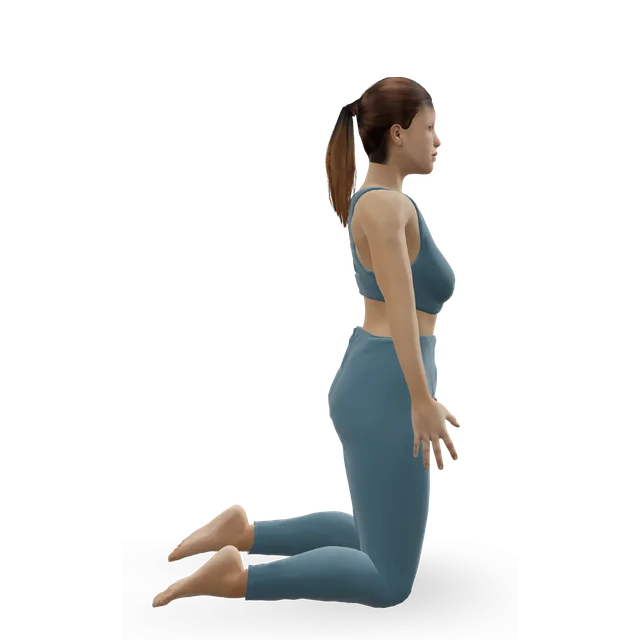
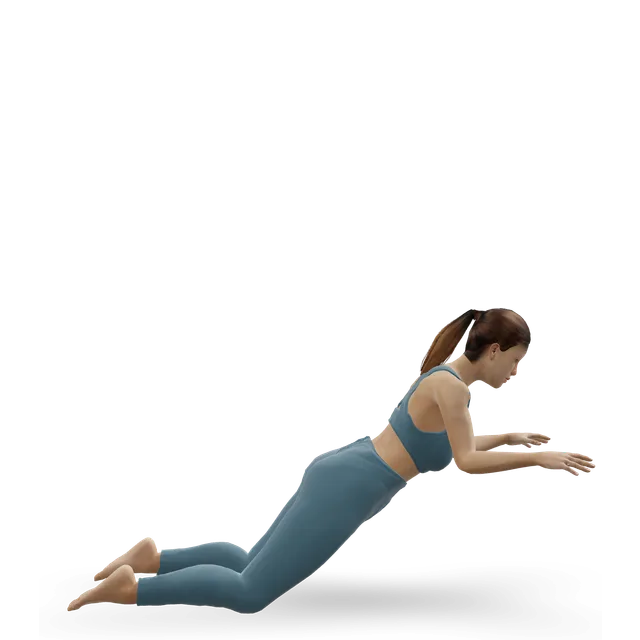
Reverse Nordic demonstrated on the 3D figure3D demoReverse NordicAdvanced · No equipment

2 to 3 sets of 5 to 8, leaning back only a short way at first, stopping just before pain · For the front of the thigh, as in our quad strain guide; leave it out if kneeling hurts, as the move page says

Easier: Straight-leg raise · Harder: Weighted sissy squat

Nordic curl demonstrated on the 3D figure3D demoNordic curlAdvanced · An anchor point

2 to 3 sets of 4 to 6 · For the back of the thigh, as in our hamstring strain guide; expect some soreness at first, as the move page says

Easier: Slider hamstring curl · Harder: Full Nordic curl

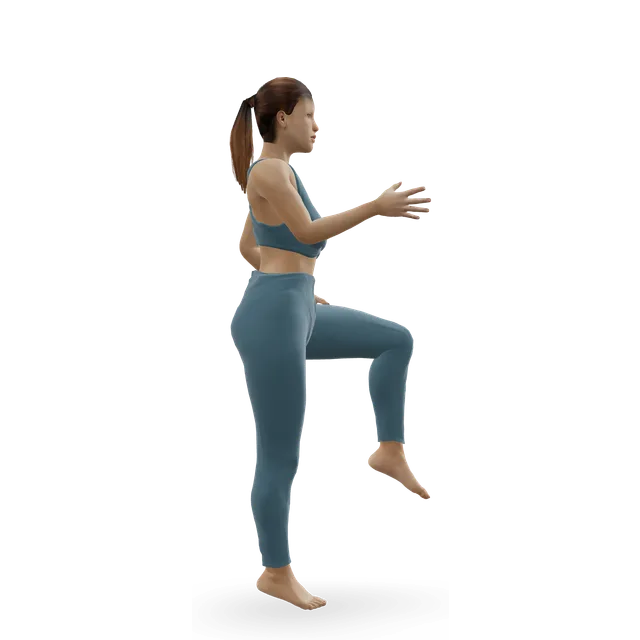
Skipping demonstrated on the 3D figure3D demoSkippingBeginner · No equipment

3 sets of 20 m · As in our quad and hamstring strain guides; not with a suspected stress fracture, as the move page says

Easier: Ankle bounces (mini pogo) · Harder: Alternate-leg bounding

Sprint intervals demonstrated on the 3D figure3D demoSprint intervalsAdvanced · No equipment

Short efforts at 60 to 70% effort, building to full speed over several sessions · As in our quad and hamstring strain guides; warm up thoroughly first, as the move page says

Easier: Treadmill jogging

Move on when: Our suggestion: full-effort sprints, kicking and your sport are pain-free, and the leg is no worse the next day. Keep the Nordic curls in your weekly routine to help prevent the next hamstring strain, as our hamstring strain guide advises.

Follow along: a timer, a cue and the next move, one step at a time.

What to change for now

What to change for now (written steps)

Our 3D figure can't show these changes. They come from NHS inform, the NHS and the AAOS; where a step is our suggestion, it says so.

  • 1. The first 2 days: reduce your activities but keep moving as your symptoms allow, move the leg gently for 10 to 20 seconds every hour, and avoid long periods on your feet. On stairs, lead with the good leg going up and the sore leg coming down, and use a handrail (NHS inform).
  • 2. After a strain: protection, rest, ice for up to 20 minutes every 2 to 3 hours, a snug but not tight bandage taken off before sleep, and the leg raised, for 2 to 3 days (the NHS). No heat, massage or alcohol for the first few days.
  • 3. After a dead leg: bend the knee gently, don't massage the bruise, and don't force a stretch (the AAOS).
  • 4. A burning outer thigh: loosen tight clothing and belts, swap a tool belt for a toolbox, and lose weight if that is a factor (the AAOS).
  • 5. A deep hip joint ache: keep moving without overdoing it, avoid low chairs and carrying heavy things, and wear shock-absorbing shoes (the NHS).
  • 6. Work: you don't need to be symptom-free to go back; staying at or returning to work helps recovery (NHS inform).

Sources 3, 28, 5, 6, 14, 13

Running, sprinting, kicking and contact come back (written steps)

No trial has tested how to bring these back after thigh pain as a whole. These steps are our suggestion unless a source is named.

  • 1. Walking and stairs: normal stairs once the knee bends and straightens comfortably.
  • 2. Running: easy runs, building time, once brisk walking and the stage 2 moves are comfortable (our strain guides).
  • 3. Sprinting: build from 60 to 70% effort to full speed over several sessions; full-effort sprints should be pain-free before matches (our hamstring strain guide).
  • 4. Kicking: last, from short passes to long ones and then shooting, over several sessions (our quad strain guide).
  • 5. Contact sport after a dead leg: back to contact once full strength, movement and endurance return; a doctor may suggest a protective pad over the bruised area (the AAOS).
  • 6. After a stress fracture of the thigh bone: your clinician's plan comes first. One small series used four phases of 3 weeks each; then the NHS sports medicine leaflet's walk-jog weeks, after 30 minutes of pain-free fast walking.
  • 7. Keep the lengthening work going: in elite football, 16% of muscle injuries were reinjuries.
  • 8. If it isn't improving: NHS inform suggests talking to a professional if a new thigh problem hasn't improved within 6 weeks, and our quad strain guide suggests a GP or physiotherapist if a strain isn't feeling better after 2 weeks of looking after it yourself.

Sources 3, 6, 16, 34, 1

Positions to swap, and why

Habit or positionWhy it mattersInstead
Massaging a fresh dead leg or strainThe AAOS says don't massage the injured area, and the NHS says avoid massage for the first few days to help prevent swelling.Ice, gentle knee bending within comfort, and a snug bandage.Try: Supine heel slide
Heat, hot baths or alcohol in the first few daysThe NHS says avoid them for the first 2 to 3 days to help prevent swelling.Ice for up to 20 minutes every 2 to 3 hours, wrapped in a towel.
Forcing a hard quad stretch after a knockThe AAOS says vigorous stretching may make bone formation in a bruised muscle worse.Gentle knee bending, aiming a little further over the week.Try: Supine heel slide
Pushing a hamstring stretch through pain after a strainLengthening work stops just before pain, as in the hamstring trial that shortened recovery.The slow straightening drill on your back, stopping just before pain.Try: 90/90 hamstring stretch (active knee extension)
Sprinting or kicking hard too soonHamstrings tear at top speed, the move page says, and reinjuries keep players out longer.Skipping, then sprints at 60 to 70% effort, building over several sessions.Try: Skipping
Complete rest until it stops hurtingStarting rehab early got athletes back to sport sooner in a trial, and NHS inform says use the leg more after 48 hours.The stage 1 moves from the first days, within the pain rule.Try: Quad set (static quads)
Running on through a deep ache in the thigh boneIt can be a stress fracture of the thigh bone.Stop running and get it checked; cycle only if the bone is pain-free.Try: Stationary cycling
Tight belts, low waistbands, heavy tool belts or tight leggings with a burning outer thighThe AAOS says restrictive clothing and tool belts press on the nerve.Looser clothing, and a toolbox instead of a tool belt.
The reverse Nordic with a sore kneeThe move page says leave it out if kneeling hurts.Spanish squat holds for the front of the thigh.Try: Spanish squat (band squat hold)

Routines to follow

More moves for this area

Questions people ask

What causes thigh pain?

In active people it's usually a pulled muscle (a quad strain at the front, a hamstring strain at the back) or a dead leg from a knock. The thigh is also where pain from the hip joint, the lower back, a squeezed skin nerve (meralgia paraesthetica) and narrowed arteries is often felt, and a blood clot can cause throbbing pain and swelling. Where it hurts and how it started point to the cause.

Why does my thigh hurt when I walk?

A strain or a dead leg hurts with walking at first, and NHS inform suggests leading with the good leg upstairs and the sore leg downstairs while it settles. A deep ache in the groin and front of the thigh, stiff after rest, from mid-life, points to the hip joint, and an ache in the thigh or buttock after a set distance that goes with rest can be narrowed arteries, which needs a GP.

What causes pain at the front of the thigh?

A sharp pull while kicking or sprinting is usually a quad strain, and a knock that leaves the thigh stiff is a dead leg. The hip joint and the hip flexors can be felt there too, and pins and needles or burning can come from the back, even without back pain.

Why does my outer thigh burn or feel numb?

A burning, tingling or numb patch on the outer thigh with no weakness is usually meralgia paraesthetica, a squeezed skin nerve; tight clothing, a heavy tool belt and weight gain are common causes. Weakness, a knee that gives way or numbness spreading elsewhere point to the back instead, and need a GP.

Could my thigh pain be a blood clot?

The NHS's signs of a clot are throbbing pain in one leg, usually the calf or thigh, swelling in one leg, red, blue or darkened skin around the painful area, and swollen veins: ask for an urgent GP appointment or get help from NHS 111. With breathlessness or chest pain, call 999 or go to A&E. A clot is more likely after surgery or a hospital stay, on a long journey, in pregnancy and the weeks after a birth, and with some medicines.

What is a dead leg and how should I treat it?

A dead leg is a bruise deep in the thigh muscle from a knock. The AAOS says rest it, ice it, keep the knee gently bent, and don't massage it; in one small series without a comparison group, holding the knee bent for the first 24 hours was followed by a quick return to sport. Severe pain, a tight, swollen thigh or tingling after a heavy knock needs A&E.

Why is there a hard lump in my thigh after a knock?

Bone can form in a badly bruised muscle (myositis ossificans). In 117 thigh bruises in military cadets it happened in 9%, more often after a delay in treatment or with a knee that couldn't bend far. See a GP if a hard lump stays or grows weeks after a knock, and avoid forceful stretching, which may make it worse.

Why does the back of my thigh hurt when I sit?

A deep ache at the sitting bone, worse sitting and running uphill, is often high hamstring tendinopathy, which has its own guide. Pain spreading below the knee with tingling or numbness points to sciatica, and a sudden sharp pain while sprinting is a hamstring strain.

What does a deep ache in the thigh bone mean?

In a runner, an ache that builds with every run and later hurts when walking or at night can be a stress fracture of the thigh bone: stop running and get it checked. If you take a bisphosphonate bone medicine such as alendronic acid, call a doctor or NHS 111 straight away about new thigh, hip or groin pain, which can rarely be an early sign of a broken thigh bone. Bone pain that is worse at night, or a lump, needs a GP.

How long does a thigh strain take to heal?

NHS inform expects most new thigh problems to begin to settle within 6 weeks, and the AAOS says 10 days to 3 weeks for a mild strain and up to 6 months for a severe one. Starting gentle rehab early rather than waiting got athletes back to sport sooner in a trial. No one can promise a date.

Why does my child's thigh hurt?

In a child or teenager, sudden thigh or knee pain, or a limp, can come from the hip, and the NHS asks for an urgent GP appointment or NHS 111 the same day. Aching in both legs in the evening that has gone by morning is usually growing pains.

Is thigh pain in pregnancy normal?

Pain at the pubic bone, groin or back of the pelvis can be pelvic girdle pain, which is treatable and has its own guide, and pregnancy makes a burning outer thigh from meralgia paraesthetica more likely. A swollen, throbbing leg needs an urgent GP appointment or NHS 111, because pregnancy and the weeks after a birth raise the chance of a clot. Tell your midwife about any new pain.

Related exercise guides

Other pain guides

Sources

  1. Ekstrand 2011 · Muscle injuries in 2,299 professional footballers (cohort, Am J Sports Med)
  2. Ueblacker 2015 · Thigh strains against thigh bruises: 2,287 injuries in elite football (cohort, Br J Sports Med)
  3. NHS inform · Thigh problems
  4. American Academy of Orthopaedic Surgeons (OrthoInfo) · Muscle strains in the thigh
  5. NHS · Hamstring injury
  6. American Academy of Orthopaedic Surgeons (OrthoInfo) · Muscle contusion (bruise)
  7. Ryan 1991 · 117 thigh bruises (quadriceps contusions) in military cadets (case series, Am J Sports Med)
  8. Aronen 2006 · Holding the knee bent after a thigh bruise in 47 midshipmen (case series without a control group, Clin J Sport Med)
  9. Rööser 1991 · Acute compartment syndrome after a bruise or tear at the front of the thigh in 8 people (case series, J Orthop Trauma)
  10. American Academy of Orthopaedic Surgeons (OrthoInfo) · Compartment syndrome
  11. NHS · Compartment syndrome
  12. Lesher 2008 · Where hip joint pain is felt in 51 people (descriptive study, Pain Med)
  13. NHS · Hip pain in adults
  14. American Academy of Orthopaedic Surgeons (OrthoInfo) · Burning thigh pain (meralgia paresthetica)
  15. Johnson 1994 · Stress fractures of the thigh bone in 914 college athletes (cohort, Am J Sports Med)
  16. Ivkovic 2006 · A four-phase plan for thigh bone stress fractures in 7 athletes (case series, Br J Sports Med)
  17. Hoenig 2023 · Return to sport after bone stress injuries: 76 studies, 2,974 injuries (systematic review and meta-analysis, Br J Sports Med)
  18. Medicines and Healthcare products Regulatory Agency (MHRA) · Bisphosphonates: atypical femoral fractures (Drug Safety Update, June 2011)
  19. NHS · Side effects of alendronic acid
  20. NHS · DVT (deep vein thrombosis)
  21. NHS · Peripheral arterial disease (PAD)
  22. NHS Scotland (Right Decisions) · Intermittent claudication pathway (past its review date: reviewed September 2024, review due September 2026)
  23. NHS · Hip pain in children (irritable hip)
  24. NHS · Growing pains
  25. NHS · Polymyalgia rheumatica (past its review date: reviewed April 2023, review due April 2026)
  26. NHS · Symptoms of bone cancer
  27. American Academy of Orthopaedic Surgeons (OrthoInfo) · Stress fractures
  28. NHS · Sprains and strains
  29. NHS inform · Soft tissue injury advice
  30. Bayer 2018 · Early against delayed rehab after severe thigh or calf strains in 50 recreational athletes (RCT, Scand J Med Sci Sports)
  31. Askling 2013 · Lengthening exercises against conventional exercises after hamstring strains in 75 elite footballers (RCT, Br J Sports Med)
  32. Hickey 2020 · Pain-free against pain-threshold rehab after hamstring strains in 43 men (RCT, J Orthop Sports Phys Ther)
  33. NHS inform · Exercises for thigh problems
  34. Oxford University Hospitals NHS Foundation Trust (OxSport) · Return to running programme (patient leaflet, September 2024)
  35. Health New Zealand · Stress fractures of the foot and shin bone
  36. Smith 2017 · Should exercise be painful? 7 trials of long-lasting muscle and joint pain (systematic review and meta-analysis, Br J Sports Med)
  37. NHS · Sciatica
  38. NHS · Broken leg

Exercise education, not a diagnosis or treatment plan. It is written from the guidelines and studies listed above; review by a clinician is pending. If your pain follows an injury, is severe, is getting worse, or comes with any warning sign listed on this page, get it assessed. Health disclaimer.