Training guide

How to do incline push-ups: the right height, the chest and arms, a ladder to the floor, your wrists and shoulders, and how many

An incline push-up is a push-up with your hands raised on a worktop, table, bench or step, so less of your weight goes through your arms: in one study about 55% of body weight with the hands on a 30 cm box and 41% on a 61 cm box, against 64% on the floor. The higher the surface, the easier it is, which makes it the main step between wall push-ups and the floor.

Those figures come from one small study whose tables don't fully agree, and nobody has measured a worktop, a table or a wall, so treat them as a guide to the order rather than exact loads. The chest keeps working more than you might expect: in one study it worked about as hard with the hands moderately raised as on the floor.

This guide shows it step by step on the 3D figure and covers how high to go, what it works, the ladder down to a full push-up, incline against knee push-ups, how many to do, and what to do if your wrists or shoulders hurt.

The short version

Hands up, feet back, body straight

Put your hands on a worktop, table, sturdy bench, the bottom stair or a locked bar, just outside shoulder width. Walk your feet back until your body makes one straight line, lower your chest to the edge with your elbows angled back about 45 degrees, and push back up. This is our move pages' cue and the National Academy of Sports Medicine's (NASM's).

Source 1

The higher your hands, the easier it is

In one study of 23 adults, the hands carried about 64% of body weight on the floor, 55% with the hands on a 30 cm box, 49% on the knees and 41% on a 61 cm box. That study's tables don't fully agree, and nobody has measured a worktop, a table or a wall: by the trend they are lighter still.

Sources 2, 3

It still works your chest

Overall muscle activity is lower than on the floor, but the chest drops least. In one study of 19 trained men, the chest worked about as hard with the hands moderately raised as in a floor push-up; with the hands on a 65 cm bar in 29 trained men, it fell a little while the triceps, front shoulder and abs fell more.

Sources 4, 5, 6

A ladder down to the floor

Train at the hardest height you can do for 8 clean reps, and move one step lower when all 3 sets reach 15, as our push-up guide advises. No trial has tested incline push-ups on their own, but a ladder from the wall to the floor, with slow daily reps, raised push-up scores in inactive adults within 4 weeks.

Source 7

How many

3 sets of 8 to 15, 2 or 3 times a week, stopping 1 to 3 reps short of failure, with 60 to 90 seconds' rest: our push-up guide's starting point, matching NASM's 3 sets of 8 to 15.

Source 1

Wrists and shoulders

Raising your hands takes weight off your wrists; fists, push-up handles or dumbbells keep the wrist straight, though handles shift a little load to the shoulder. NHS physiotherapy programmes for painful shoulders use this same ladder, from the wall to a worktop to the floor.

Sources 8, 9, 10

What an incline push-up is, and what it works

The lift

A push-up with your hands on something raised and your feet on the floor, so your body slopes up towards your head. It's the easier side of the push-up ladder. The decline push-up, with your feet raised, is the harder side, as our decline push-up guide explains.

Incline or decline? The names get mixed up

Some people call a push-up with the feet raised an "incline" push-up. On this site, incline means your hands are raised, which is easier, and decline means your feet are raised, which is harder.

Muscles and joints

Your chest (pectoralis major), the front of your shoulders (anterior deltoid) and your triceps do the pressing. The serratus anterior, along your ribs, holds your shoulder blades in place, and your trunk holds the plank. NASM lists the chest and triceps as the main movers. The joints are the shoulder, elbow and wrist, with the wrist bent back.

Source 1

Before you start

You need a wall push-up you can do for about 12 controlled reps, wrists that tolerate leaning on your hands, and a surface that can't slide or tip, as our move pages say.

How people differ

The same box gives a taller person a gentler slope, because their feet sit further from their hands, so pick your step by your reps, not by the height. In the force study, the share of weight on the hands didn't differ between women and men. Heavier people press more weight at every step, because the shares are percentages of body weight.

Source 3

How to do an incline push-up, step by step

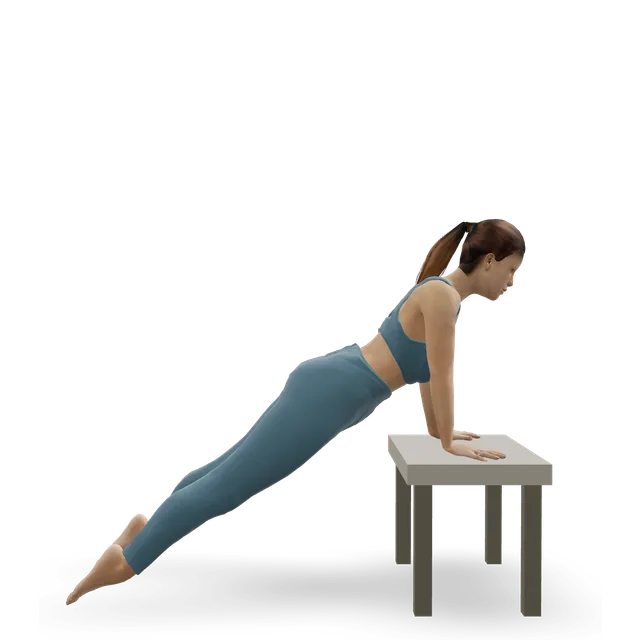
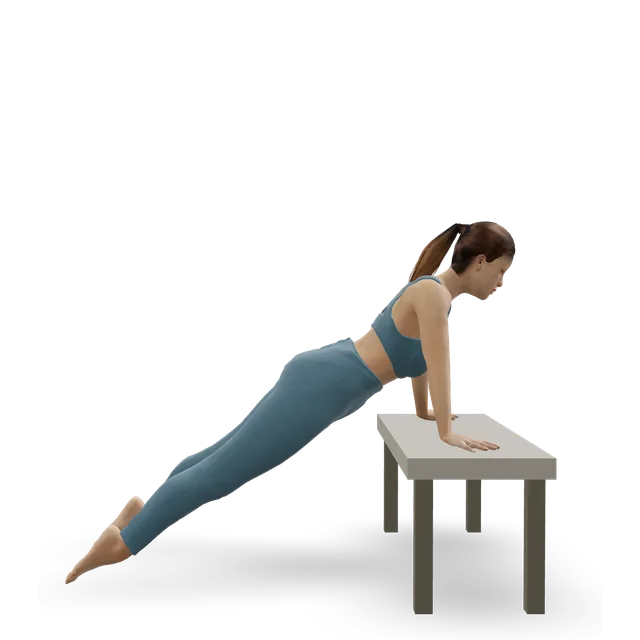
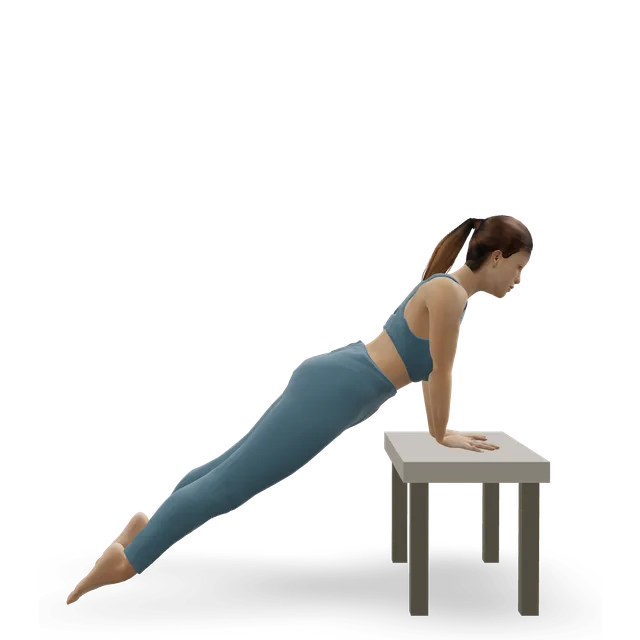
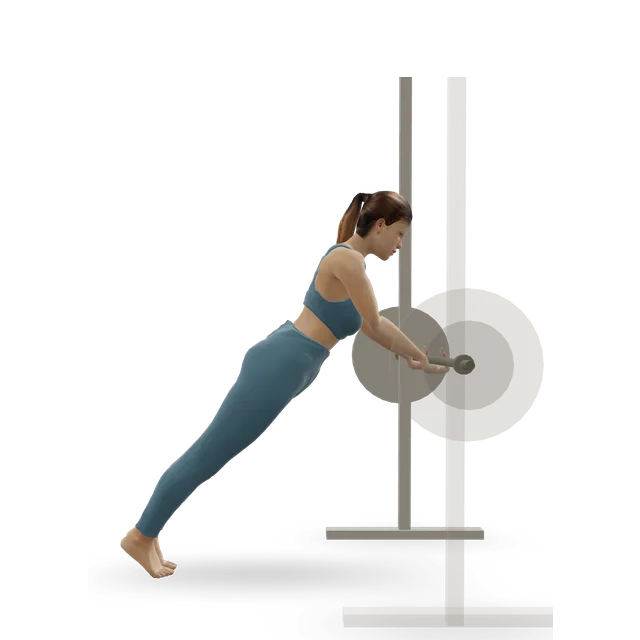
From our incline push-up move pages, NASM's incline push-up page and our push-up guide. The 45-degree elbow is a coaching cue that no study has tested. On a gym's Smith machine, the medium-grip incline push-up below shows the same move on a bar.

  1. Choose a surface that can't slide or tip: a kitchen worktop, a table pushed against a wall, a sturdy bench, the bottom stair or a locked Smith machine bar. The higher it is, the easier the push-up.
  2. Put your hands on the edge just outside shoulder width, fingers pointing forward or slightly out.
  3. Walk your feet back until your arms are straight and your body makes one line from head to heels, feet together or hip-width apart.
  4. Breathe in and bend your elbows to lower your chest towards the edge, elbows angled back about 45 degrees, not flared straight out to the sides.
  5. Go down until your chest nearly touches, or as low as you can control.
  6. Breathe out and push the surface away until your arms are straight, without snapping your elbows. A small extra push at the top spreads your shoulder blades (the push-up plus).
  7. To finish, walk your feet back in and stand up.

Loading the 3D figure…

Gets into position, then repeats the movement. Technical checks passed; qualified exercise review is pending.

The movement on the figure: Incline push-up

How high should your hands be?

The load on your hands, by heightEmerging evidence

In 23 young adults on a force plate, peak force through the hands was about 64% of body weight in a floor push-up, 55% with the hands on a 30 cm box, 49% from the knees and 41% with the hands on a 61 cm box. Those figures come from one conference paper whose tables disagree: in its table of forces, the 61 cm push-up comes out slightly above the knee push-up, the reverse of its percentages. So treat them as a guide to the order, not exact numbers. The journal version agrees that hands-raised and knee push-ups loaded the hands least.

Sources 2, 3

Floor and knee push-ups: four studies agreeStrong evidence

A floor push-up puts about two-thirds to three-quarters of your body weight through your hands, and a knee push-up about half: 66% and 53% in 8 men, about 70 to 76% on the toes and 53 to 58% on the knees in 22 trained adults, and less at the top of the push-up than at the bottom in 28 strength-trained men.

Sources 2, 11, 12, 13

Above 61 cm, nobody has measured it

We found no force study of a worktop (often about 90 cm), a table (about 75 cm), a wall or a bar. By the trend, higher is lighter, but the loads at those heights are our reading, not measurements, and the furniture heights are typical figures, not standards.

Source 2

How many incline push-ups equal one push-up?

Our arithmetic from that one study: a rep with your hands on a 30 cm box loads your hands about 86% as much as a floor rep, and on a 61 cm box about 64%. They don't convert one for one. For building strength and muscle, what matters is how hard the set is: muscle grows with light or heavy loads when sets are taken close to failure.

Sources 2, 14

Pick the height by your reps

The hardest surface you can do for 8 clean reps, with your chest nearly touching, is your step (our push-up guide's ladder rule). Easiest first, a typical order is a wall, a kitchen worktop, a table, a sturdy bench or a chair pushed against a wall, the bottom stair, then the floor.

What it works: chest, arms and shoulders

Less activity overall, in a pooled comparisonEmerging evidence

A review of 30 studies of shoulder muscle activity found that hands-raised push-ups drew less activity in every muscle it covered than standard push-ups. That result rests on 3 small studies of young men pooled against 17 others, not on the same people tested both ways.

Source 4

The chest drops leastEmerging evidence

In one study of 19 trained men, with the hands moderately raised on stacked steps, the chest worked about as hard as in a floor push-up (41% against 39% of its maximum), while the serratus anterior and upper trapezius worked less. The study didn't give the hand height. In 29 trained men, with the hands on a bar at 65 cm against boxes at 10 cm, the triceps, front shoulder and abs worked clearly less, and the upper chest a little less.

Sources 5, 6

More weight on your hands, more workEmerging evidence

In 21 people, muscle activity rose with the weight on the hands across press-up variations on a stable base: the lighter the step, the less each muscle has to do.

Source 15

Upper or lower chest?Emerging evidence

Nobody has measured the lower chest in an incline push-up. The press it resembles, a decline bench press, worked the lower chest about as much as a flat press in 14 trained men, and the upper chest worked only a little less with the hands on a 65 cm bar than on low boxes. Every push-up works the whole chest.

Sources 16, 6

Activity isn't growthStrong evidence

Muscle activity (EMG, electromyography) over a few reps shows effort, not what a muscle will build. What builds muscle is sets taken close to failure: in 18 young men, easier push-up versions, including knees bent with the hands raised, built as much chest muscle as light bench pressing over 8 weeks.

Sources 17, 18

The ladder: worktop to floor

Train at the hardest step you can do for 8 clean reps, and move up a step when all 3 sets reach 15 (our ladder rule, as in our push-up progression): here that means a lower surface, from the wall to a worktop or table, a sturdy bench, a chair against a wall or the bottom stair, then the floor. 3 sets of 8 to 15 at each step, as our push-up progression uses. A locked Smith machine bar can be lowered a notch at a time, the smallest steps there are (our suggestion).

Incline or knee push-ups?

It depends on the heightEmerging evidence

At about knee height (30 cm), an incline put a little more weight on the hands than kneeling (55% against 49%), and at 61 cm a little less (41%). Whether a low incline or a knee push-up is easier depends on the height of the bench, so pick whichever you can do for 8 clean reps (our suggestion).

Source 2

Why we lean towards the incline

An incline keeps your hips in the same plank as a floor push-up, and you can lower it a little at a time. Kneeling suits you when there's no stable surface, but it needs padding and can be uncomfortable on sore knees. No study has compared the two as routes to the floor, so this is our view.

Does it lead to a full push-up?

A ladder from the wall worked in inactive adultsEmerging evidence

In 22 inactive adults aged 32 to 69, one daily set of 10 slow reps (5 seconds down) for 4 weeks, moving from the wall to a table, the knees and the floor once 10 reps were easy two sessions running, raised push-up test scores from about 12 to 17 reps; 3 people reached the floor. In a follow-up of 10 adults, scores kept rising to 8 weeks, and the authors raised their move-up rule because some steps were too big a jump. Neither study had a separate control group.

Sources 7, 19

Easier push-ups taken close to failure build muscleEmerging evidence

In 18 young men, push-ups set to the same load as a light bench press (40% of their best), using knees-bent and hands-raised positions, built as much chest and strength as that bench pressing over 8 weeks. In 23 moderately trained men, 4 weeks of progressively harder push-ups raised bench strength as bench pressing did, and band-resisted push-ups matched the bench press in a third small trial. All small and short.

Sources 18, 20, 21

The reps have to keep getting harderEmerging evidence

In 30 active men with a year of training, a fixed 3 sets of 10 floor push-ups twice a week for 8 weeks didn't raise strength or push-up counts.

Source 22

What hasn't been tested

We found no trial of incline push-ups on their own, and none comparing incline and knee push-ups as a route to the floor. Nobody has timed the climb either: our push-up guide's estimate is about 1 to 3 months from the wall, at 2 or 3 sessions a week.

How many, and how often

Sets, reps and rest

3 sets of 8 to 15, 2 or 3 times a week, stopping 1 to 3 reps short of failure, with 60 to 90 seconds' rest (our push-up guide and push-up progression; NASM gives 3 sets of 8 to 15). In your first two weeks, keep 3 or 4 reps to spare, as our plans advise: most people misjudge the reps they have left by about one.

Sources 1, 23

When to move down a step

When all 3 sets reach 15 (our push-up guide's rule; NASM moves people on at 12 to 15 with perfect form). If the next surface is too big a jump, add a slow 3-second lowering first, as our push-up challenge does, or lower a Smith machine bar a notch at a time.

Sources 1, 19

Every day?

Easy daily sets, well short of failure, are fine if your wrists, elbows and shoulders feel normal, but hard sets still need recovery between them (our push-up guide's suggestion).

How it fits your week

About 10 or more hard sets a week for a muscle builds more than fewer, with smaller returns as you add more, and strength improved with 2 or more sessions a week. Three sets of incline push-ups 2 or 3 times a week makes 6 to 9 hard chest sets.

Sources 24, 25

Grips and versions

Wide hands work the serratus anterior more and the triceps and elbows less; close hands with your elbows by your ribs work the triceps and elbows more (our push-up guide), at 2 to 3 sets of 6 to 12 in our arm challenge workout. The reverse grip on a locked bar is less secure. The scapular push-up, 2 sets of 10 at a bench in our push-up progression, trains the push-up plus on its own. There's no 3D demo of an incline push-up on handles or on one leg.

Common mistakes

A surface that slides or tips

Check the bench or table can't move, and push a chair against a wall, as our move page says.

Hips sagging or piking

Keep one line from head to heels and squeeze your glutes. If you can't, go up a step.

Source 1

Elbows flared straight out

Angle them back about 45 degrees. NASM warns that flared elbows add shoulder stress, and in 16 people, arms held out wide put the shoulder blade in a position linked with impingement.

Sources 1, 26

Stopping short because the edge is high

Lower until your chest nearly touches. NASM lists a short range as a common fault, and full range built more strength than partial range across 16 studies.

Sources 1, 27

Hands too far forward

At the top, your hands sit under your shoulders, not out in front (our suggestion). NASM warns that leaning too far forward shifts the work to your shoulders and triceps.

Source 1

Leading with your chin, or holding your breath

Let your chest reach the edge first, and breathe out as you push (our push-up guide).

Wrists, elbows and shoulders

Bent-back wristsEmerging evidence

A push-up bends your wrist back under your body weight. In 8 donated wrists tested in a lab, the bent-back position raised pressure in part of the wrist joint compared with a straight-wrist knuckle push-up, and in 14 volunteers the force moved towards the back of the wrist when it was bent right back. Raising your hands takes weight off, but nobody has measured the wrist in an incline push-up, and it still bends back about as far.

Sources 8, 28

What to do about sore wrists

Keep the wrist straight with fists, push-up handles or dumbbells, or put your hands on a bench to take some weight off. Choose a forearm plank over a high plank. Our wrist pain from push-ups guide has a staged plan.

In 14 men, handles that kept the wrist straight put a little more load through the shoulder and less through the elbow.

Some discomfort during these exercises is fine and doesn't mean you are doing damage. Keep it to about 5 out of 10 or less. It should settle within half an hour or so, and your hand should be no worse the next morning. If it is, do fewer, smaller or lighter next time, not nothing. That's our wrist pain guides' rule.

Source 9

Your shouldersEmerging evidence

Flaring the arms out wide (about 65 degrees from the body) put the shoulder blade in a position linked with impingement in 16 people; about 45 degrees is a coaching cue that no study has tested. NHS physiotherapy programmes for painful and weak shoulders use the wall, then a worktop or table, then the knees, then the floor, and one shoulder class puts the hands a little wider than shoulder width, slightly turned out, with the elbows tucked in.

Sources 26, 10, 29

The shoulder rule

Keep shoulder pain to about 5 out of 10 or less during the exercise, back to its usual level by your next session, as our shoulder guides advise. A sharp pinch means lower, lighter or stop.

Our shoulder pain when doing push-ups guide maps the causes by where it hurts and has a plan back to the floor.

Sore elbows

Use a base wider than usual rather than hands together, and point your fingers forward (our push-up guide). Our elbow pain when doing push-ups guide maps the causes by where it hurts and has a plan back to the floor.

Warm-up and support work

Warm up with the wrist and forearm flow for 60 seconds and shoulder CARs (controlled articular rotations), 3 slow circles each way with each arm, then a set of scapular push-ups at the wall (our push-up challenge workout). Band rows, 3 sets of 10 to 15 stopping 2 to 3 reps short, balance the pushing (the band row move page), and forearm planks, 2 holds of 20 to 30 seconds, train the trunk (our push-up challenge workout). Band external rotations and quadruped wrist rocks are for sore shoulders and wrists, as our push-up pain guides use them.

Workouts

The push-up progression and push-up challenge follow the same ladder, with incline push-ups at 3 sets of 8 to 15. The arm challenge uses incline and close-grip incline push-ups, the strength and balance workout uses them for older adults, and the pregnancy strength workout uses them with no lying on your back.

Plans

Who should modify, and warning signs

Stop and get medical help

If you get chest pain or pressure, feel faint or dizzy, are unusually breathless, or your heart races or beats irregularly during exercise, as our plans advise. The American Heart Association says these need immediate medical evaluation.

Source 30

Call 999 (911 in the US)

For chest pain that comes on suddenly and doesn't go away, feels tight or like squeezing, spreads to your arms, neck, jaw, stomach or back, or comes with sweating, feeling sick, light-headedness or breathlessness; arm pain that comes on suddenly with pressure, heaviness or squeezing across your chest; severe difficulty breathing, or a chest that feels tight or heavy; someone who faints while exercising; palpitations that don't go away, or come with chest pain, shortness of breath or feeling faint; or a headache that starts suddenly and is extremely painful, especially while lifting or straining. The NHS says a bleed on the brain may be more likely when lifting something heavy. Don't drive yourself to A&E.

Sources 31, 32, 33, 34, 35, 36, 37, 38

A headache with effort

Ask for an urgent GP appointment or get help from NHS 111 for a headache that's triggered or made worse by coughing, sneezing, bending down or exercising.

Source 37

Contact NHS 111 for a wrist injury

For severe wrist pain; feeling faint, dizzy or sick from the pain; a snap, grinding or popping noise at the time of the injury; being unable to move your wrist or hold things; a wrist that has changed shape or colour; a very painful, hot or red lump; or lost feeling in your hand. In the US, use urgent care.

Source 39

See a GP about your wrist

If wrist pain is no better after 2 weeks of home treatment, or comes with tingling, diabetes, or a hot, swollen, stiff wrist.

Source 39

Your shoulder

Ask for an urgent GP appointment or get help from NHS 111 for sudden or very bad shoulder pain, an arm you can't move, a shoulder that has changed shape or is badly swollen, pins and needles that don't go away, no feeling in your arm or shoulder, an arm or shoulder that's hot or cold to touch, pain after an injury or a fall, severe pain in both shoulders, or feeling feverish or unwell. Go to A&E if, after an injury, you can't move your arm or your shoulder looks out of place or has changed shape. See a GP if shoulder pain is getting worse or hasn't improved after 2 weeks.

Sources 40, 41

Very sore, swollen or weak arms after a big session

After a big or unusual session, such as hundreds of push-ups, muscle pain, swelling or weakness far worse than the session explains, with or without dark pee (red, brown, tea or cola coloured), needs help the same day: call NHS 111, or go to A&E if you feel very unwell. It can be rhabdomyolysis, a breakdown of muscle that can harm the kidneys, as our rhabdomyolysis guide explains.

Heart failure

The British Heart Foundation advises avoiding exercises that use your whole body as the weight, such as press-ups and planks. An incline push-up still puts much of your weight through your arms, so stay at the wall unless your heart team agrees (our suggestion).

Source 42

Pregnancy

Wall push-ups appear in our pregnancy routines. Ask your midwife about floor push-ups as your bump grows (our suggestion). The NHS advises against starting new vigorous activity in pregnancy.

Source 43

After heart, lung or breast surgery

After heart surgery through the breastbone, or a heart or lung transplant, follow your surgeon's advice before pushing, pulling or lifting with your arms.

After breast cancer surgery or reconstruction, follow your surgical team's advice on when you can lift your arm above shoulder height, or push, pull or lift with it.

Before you start

Speak to your GP first if you haven't exercised for some time or have medical conditions or concerns, as the NHS advises. Get advice before hard or straining work if your blood pressure is uncontrolled (140/90 or higher at a clinic, or 135/85 at home), or you have heart disease or chest pain when you're active, a pacemaker or defibrillator, diabetic eye disease, glaucoma, a hernia, recent eye or tummy surgery, or you're pregnant, as our breathing guide lists.

With controlled high blood pressure, the American Heart Association considers low- to moderate-intensity strength training with proper breathing safe. Breathe out as you lift, as our breathing guide advises.

With a pacemaker or defibrillator, the American Heart Association asks you to check with your doctor before upper-body strength training, because repeated arm movements can damage or dislodge the leads.

Sources 44, 45, 30

Sore, or hurt?

Muscle soreness for a day or two after a new or harder session is common and fades. Sharp pain, or pain that builds during a set or lingers into the next day, isn't: swap to an easier version, and see a clinician if it persists, as our plans advise. The NHS says to stop exercising straight away if you feel any pain or become unwell, and to get help from 111 if symptoms worry you or don't go away.

Source 46

Myths

"Incline push-ups are cheating"Emerging evidence

They're a lighter push-up, not a fake one: about 41 to 55% of body weight on the hands at 61 and 30 cm, against 64% on the floor. Easier push-up versions taken close to failure, hands-raised ones among them, built as much chest muscle as light bench pressing over 8 weeks, and a ladder from the wall raised push-up scores in inactive adults. Use them to build reps, then move down a step.

Sources 2, 18, 7

"Incline push-ups work the lower chest"Emerging evidence

Nobody has measured it. The press an incline push-up resembles, the decline bench press, worked the lower chest about as much as a flat press, and the upper chest worked only a little less with the hands on a 65 cm bar. Every push-up works the whole chest.

Sources 16, 6

"Incline push-ups are harder than regular push-ups"Emerging evidence

With your hands raised, they're easier; with your feet raised, a decline push-up, they're harder. The names get mixed up, so check which one a page means.

Source 2

"Knee push-ups are always easier than incline push-ups"Emerging evidence

It depends on the height: with the hands at about knee height the incline loaded them a little more than kneeling, and at 61 cm a little less.

Source 2

"You need a gym to build your chest"Emerging evidence

Push-ups and their easier versions built strength like the bench press in small trials. In the American College of Sports Medicine's 2026 overview of 137 reviews, circuit, elastic band and home-based training all improved strength, and free weights and machines did equally well; body-weight training on its own wasn't studied separately.

Sources 20, 18, 21, 24

Questions people ask

Are incline push-ups easier than regular push-ups?

Yes, with your hands raised. In one study of 23 adults, the hands carried about 64% of body weight in a floor push-up, 55% with the hands on a 30 cm box and 41% on a 61 cm box. The higher the surface, the easier it gets.

How high should my hands be for incline push-ups?

High enough that you can do 8 clean reps with your chest nearly touching the edge. Start at a worktop or table if the floor is out of reach, then work down to a bench, the bottom stair and the floor.

What muscles do incline push-ups work?

Your chest, the front of your shoulders and your triceps, with your trunk holding the plank. Raising your hands lowers the work overall, most of all for the triceps, shoulders and abs, but in one study the chest worked about as hard with the hands moderately raised as on the floor.

Do incline push-ups work the upper or lower chest?

Neither specifically. Nobody has measured the lower chest in an incline push-up, and the upper chest worked only a little less with the hands on a hip-high bar. Every push-up works the whole chest.

Incline push-ups or knee push-ups: which is easier?

It depends on the height. At about knee height an incline put a little more weight on the hands than kneeling (55% against 49%), and at about 61 cm a little less (41%). Pick whichever you can do for 8 clean reps.

Will incline push-ups help me do a full push-up?

That's what they're for, though no trial has tested them on their own. In inactive adults, a ladder from the wall to the floor raised push-up scores within 4 weeks, and the reps have to keep getting harder. Move down a step when all 3 sets reach 15.

How many incline push-ups should I do?

3 sets of 8 to 15, 2 or 3 times a week, stopping 1 to 3 reps short of failure, with 60 to 90 seconds' rest. That's our push-up guide's starting point, and NASM suggests the same 3 sets of 8 to 15.

How many incline push-ups equal one push-up?

They don't convert exactly. By our arithmetic from one study, a rep with your hands on a 61 cm box loads your hands about two-thirds as much as a floor rep, and on a 30 cm box about 86%. What matters more is how hard the set is.

Can I do incline push-ups every day?

Easy daily sets, well short of failure, are fine if your wrists, elbows and shoulders feel normal. Hard sets need recovery between them, so keep those to 2 or 3 times a week.

Why do my wrists hurt doing incline push-ups?

A push-up bends your wrist back under your weight, which raised joint pressure in a lab study. Raising your hands takes weight off, and fists, handles or dumbbells keep the wrist straight. Our wrist pain from push-ups guide has a staged plan.

Are incline push-ups good for older adults?

Yes, as the step after wall push-ups: NHS shoulder programmes use a worktop or table in the same way. Use a surface that can't slide, keep your body in one line, and move on only when 3 sets of 15 feel steady.

Is an incline push-up the same as a decline push-up?

No. Incline means your hands are raised, which is easier; decline means your feet are raised, which is harder. Our decline push-up guide covers the feet-raised version.

Sources

  1. National Academy of Sports Medicine · Incline push-up (exercise library)
  2. Wurm 2010 · Forces through the hands in six push-up variations in 23 adults, as a share of body weight (lab study, ISBS conference proceedings)
  3. Ebben 2011 · Forces through the hands in push-up variations in 23 adults (lab study, J Strength Cond Res)
  4. Kowalski 2022 · Shoulder muscle activity in push-up variations: 30 studies (scoping review, Shoulder Elbow)
  5. Lin 2026 · Upper-body muscle activity in push-ups at five body angles, stable and suspended, in 19 trained men (EMG study, BMC Sports Sci Med Rehabil)
  6. Calatayud 2014 · Muscle activity in push-ups with the hands at 10 cm and 65 cm, stable and suspended, in 29 trained men (EMG study, Motricidade)
  7. Kirk 2025 · A daily 5-minute home programme, starting push-ups at the wall, for 4 weeks in 22 inactive adults (single-group study with a control period, Eur J Appl Physiol)
  8. Daly 2018 · Push-up wrist position and joint pressure in 8 donated wrists (lab study, J Hand Surg Am)
  9. Polovinets 2026 · Straight-wrist and bent-back-wrist push-ups: loads at the elbow and shoulder in 14 men (lab study, Handchir Mikrochir Plast Chir)
  10. NHS Ayrshire & Arran · Exercises for painful and weak shoulders, levels 1 to 3 (physiotherapy exercise booklet)
  11. Gouvali 2005 · Forces and muscle activity in push-up variations in 8 men (lab study, J Strength Cond Res)
  12. San Juan 2015 · Forces on the hands and muscle activity in the push-up plus on the toes and knees in 22 adults (lab study, BMC Musculoskelet Disord)
  13. Suprak 2011 · Share of body weight on the hands in push-up positions in 28 trained men (lab study, J Strength Cond Res)
  14. Schoenfeld 2017 · Low- against high-load resistance training for strength and muscle growth (systematic review and meta-analysis, J Strength Cond Res)
  15. Herrington 2015 · Shoulder muscle activity in press-up variations and progressions in 21 people (EMG study, J Electromyogr Kinesiol)
  16. Lauver 2016 · Bench angle and upper-body muscle activity in 14 trained men (muscle activity study, Eur J Sport Sci)
  17. Vigotsky 2022 · Muscle activity measured in one session is not a validated predictor of muscle growth (review, Sports Med)
  18. Kikuchi 2017 · Low-load bench press and push-ups built similar muscle and strength in 18 men (randomised trial, J Exerc Sci Fit)
  19. Kirk 2026 · An 8-week minimal-dose home programme in 10 inactive adults (single-group study, Eur J Appl Physiol)
  20. Kotarsky 2018 · Progressive push-up training against bench pressing for 4 weeks in 23 men (randomised trial, J Strength Cond Res)
  21. Calatayud 2015 · Band push-ups against the bench press at matched muscle activity (randomised trial, J Strength Cond Res)
  22. Chulvi-Medrano 2012 · Eight weeks of push-ups on stable and unstable surfaces in 30 men (randomised trial, Int J Sports Phys Ther)
  23. Halperin 2022 · How accurately people predict the reps they have left: 12 studies (scoping review and meta-analysis, Sports Med)
  24. Currier 2026 · Resistance training prescription for muscle function, size and performance in healthy adults: an overview of 137 reviews (ACSM position stand, Med Sci Sports Exerc)
  25. Pelland 2026 · Weekly sets, training frequency, muscle growth and strength: 67 studies (meta-regressions, Sports Med)
  26. Suprak 2013 · Shoulder blade movement and arm position in the push-up in 16 people (lab study, J Athl Train)
  27. Pallarés 2021 · Full against partial range of motion in strength training: 16 studies (systematic review and meta-analysis, Scand J Med Sci Sports)
  28. Polovinets 2018 · Force through the wrist in push-ups on a bent-back and a straight wrist in 14 volunteers (lab study, J Hand Ther)
  29. St George's Healthcare NHS Trust · Cuff class exercise booklet (shoulder unit physiotherapy booklet)
  30. Paluch 2024 · Resistance training with and without heart disease: 2023 update (American Heart Association scientific statement, Circulation)
  31. NHS · Chest pain (past its review date: reviewed August 2023, review due August 2026)
  32. NHS · Heart attack
  33. NHS · Elbow and arm pain
  34. NHS · Shortness of breath
  35. NHS · Fainting
  36. NHS · Heart palpitations
  37. NHS · Headaches
  38. NHS · Subarachnoid haemorrhage
  39. NHS · Wrist pain
  40. NHS · Shoulder pain (past its review date: reviewed May 2023, review due May 2026)
  41. NHS · Dislocated shoulder
  42. British Heart Foundation · Exercise for heart failure: tips for exercising safely
  43. NHS · Exercise in pregnancy
  44. NHS · Physical activity guidelines for adults aged 19 to 64
  45. NHS · High blood pressure
  46. NHS · How to warm up before exercising

Exercise education, not a personal prescription, and clinical review of these guides is pending. Check with a GP before starting hard training if you have a heart condition, chest pain, dizziness or breathlessness when active, and stop for sharp or increasing pain. Health disclaimer.