Move, and stay upright
Gas moves through the gut faster when you're upright and moving, and a 10 to 15 minute walk after meals eased fullness and bloating in a trial. The NHS says exercise "can also help when you're feeling bloated".
Pilates guide
Pilates can help bloating in ordinary ways: moving and staying upright help trapped gas move on, being active eases irritable bowel syndrome (IBS) a little, and a calm, breathing-led class can help the stress side of IBS. No Pilates move has been shown to massage or "detox" the gut, and core work won't flatten a bloated tummy for good. On a bloated day, the curls, roll-ups and face-down moves are the ones to skip.
One small trial found Pilates added to diet advice eased IBS with constipation, but it had real weaknesses. Pilates sits beside your GP's care and the diet changes and treatments that have more evidence, never in place of them.
This guide covers what bloating and a visibly swollen tummy are, what the trials show, breathing for a swollen tummy, constipation and straining, which moves to do and skip, a 20-minute class for bloated days, and the warning signs that need a GP before you call it IBS.
Gas moves through the gut faster when you're upright and moving, and a 10 to 15 minute walk after meals eased fullness and bloating in a trial. The NHS says exercise "can also help when you're feeling bloated".
In many people the diaphragm pushes down while the tummy wall lets go, with little extra gas inside. Retraining that reflex with biofeedback, which shows people their breathing muscles at work, cut the swelling by more than half in two trials.
The retraining that worked taught "chest up" and "abdomen in", and pushing the belly out after a meal made bloating feel worse in a lab study. Pilates lateral breathing is similar, but hasn't been tested for bloating (our suggestion).
In 60 women with IBS and constipation, twice-weekly Pilates added to diet advice eased symptoms more than diet advice alone. But the people measuring the results knew who did Pilates, and the groups started unequal, so treat it as promising, not proven.
Source 10
Roll-ups kept pressure inside the tummy highest for longest in a lab study. On a swollen day, choose standing, all-fours and side-lying moves (our suggestion).
Source 11
The warning signs below say when bloating needs a GP or urgent help, word for word from the NHS lines our digestion and belly fat guides use.
Bloating is "an uncomfortable feeling of fullness"; a visible widening of the waist is called distension, Guts UK explains. The NHS says "The most common reason for bloating is having a lot of gas in your gut", and lists constipation, food intolerance, coeliac disease, IBS and periods among the causes.
In a survey of 51,425 people in 26 countries, nearly 18% had bloating at least once a week, women about twice as often as men. Most people with IBS have bloating.
Normally, when the gut fills, the diaphragm relaxes and the tummy wall tightens a little. In people with visible swelling the opposite happens: the diaphragm pushes down and the tummy wall relaxes, so the belly bulges. Doctors call this abdomino-phrenic dyssynergia. In scans, the total volume inside the tummy barely changed; the contents were pushed down and forward. So a swollen tummy is mostly a reflex, not a lot of extra gas, and not just weak muscles.
The NHS's main IBS symptoms are stomach pain or cramps that usually ease after a poo, bloating, diarrhoea and constipation. Triggers include alcohol, caffeine, spicy or fatty food, stress and anxiety. The National Institute for Health and Care Excellence (NICE) suggests thinking of IBS when tummy pain, bloating or a change in bowel habit has lasted 6 months or more; a GP rules out other causes first.
The NHS lists "not moving enough and spending long periods sitting or lying down" among the causes, and says "A daily walk or run can help you poo more regularly".
Source 18
In 8 healthy people, much less gas fed into the gut stayed there when they were upright than when they lay on their backs (13 mL against 146 mL after an hour). Most mat Pilates is done lying down, which is why our bloated-day class spends most of its time standing, on all fours or on your side.
Source 1
Diet changes, medicines and talking therapies designed for IBS have more evidence than exercise; our exercise for IBS and yoga for IBS guides cover them. Pilates goes alongside them.
NICE asks GPs to give people with IBS information about physical activity, to encourage them "to create relaxation time", and to give brief advice to people who aren't very active. UK gut specialists say people with IBS "should be encouraged to increase physical activity, where feasible". The NHS says to "get plenty of exercise" for IBS, and to "exercise regularly to improve your digestion and help prevent bloating". None of them names Pilates.
In Cochrane's review of 11 trials (622 people), activity improved IBS symptoms against usual care, but not quality of life or tummy pain, at very low certainty. In the largest trial, 102 people helped to be more active by a physiotherapist improved by 51 points on a 500-point symptom scale, against 5 points without help, and about 5 years later the 39 people followed up still had milder symptoms than at the start. A 2026 review of 10 studies (437 people) found symptoms eased by about 61 points, at low certainty.
In Egypt, 60 women with constipation-type IBS had diet advice; half also did 16 supervised Pilates sessions (twice a week for 8 weeks, 45 to 50 minutes, on a mat and a Swiss ball). Symptom scores fell from 313 to 104 with Pilates and from 284 to 175 without it, and bowel movements rose from about 2.5 to 4.9 a week, against 2.4 to 3.8. But the people measuring the results knew who did Pilates, the Pilates group started more swollen, the comparison group had no extra sessions of any kind, and it lasted only 8 weeks. A 2026 analysis that ranked Pilates second of six exercise types rests on this one trial.
Across 11 yoga trials (535 people), yoga made no clear difference to IBS symptoms compared with control groups. Our yoga for IBS guide covers it.
Source 27
In 8 people with bloating, light pedalling cut the gas their guts held on to from 45% to 24% and eased their symptoms, and in 8 healthy people it reduced swelling of the tummy. In a trial of 94 adults with bloating, a 10 to 15 minute walk after each meal for 4 weeks eased fullness and bloating after meals more than a medicine did. The 2025 European consensus says activity "seems to have a positive impact", at very low certainty.
In two placebo-controlled trials from one research group, people with visible swelling learned to control their diaphragm and tummy wall with biofeedback over 3 sessions: swelling fell by 56% (against 13% with a placebo; 48 people) and by 66% (42 people, with home practice 3 times a day). American gut specialists list diaphragmatic breathing as a treatment for the reflex. This needs a trained clinician; it isn't a Pilates class.
The retraining taught people first to relax the diaphragm with the "chest up" and the "abdomen in". In 16 healthy women after a big meal, holding the diaphragm down with the belly pushed out caused more swelling and a stronger feeling of bloating. Common home advice to breathe with the belly pushed out hasn't been shown to treat swelling, and a version without equipment is "still under development". In a trial with no untreated group, written breathing instructions practised 3 times a day were followed by less bloating; slow deep breathing alone didn't change IBS symptoms in 14 people.
In 20 healthy women, most beginner mat and reformer moves raised pressure inside the tummy no more than standing up from a chair; only roll-ups kept it high for longest. That supports saving roll-ups for good days, not avoiding them for ever.
Source 11
In 9 small trials (680 people), mostly of walking and qigong, more people improved with exercise, but the trials were at high risk of bias. In studies following 119,426 people, those meeting activity guidelines were less often constipated. In one IBS trial, exercise helped constipation most.
If you strain and can't empty fully, the pelvic floor may not be relaxing. Specialist biofeedback helped 80% against 22% with laxatives at 6 months in one trial, though the trials overall are low quality. American gut specialists suggest tests when bloating comes with this kind of constipation.
Our suggestion, untested: it borrows the "chest up, abdomen in" pattern taught in the biofeedback trials, which used specialist equipment (Melchior 2025; Barba 2017 and 2024). No study has tested Pilates breathing for bloating. The 5 minutes follows the home practice in the European consensus.
See the movement on the 3D figure: Lateral breathing (Pilates breathing)
"A daily walk or run can help you poo more regularly", the NHS says. Pilates can be part of being active, but walking has more evidence.
Pilates teaches you to draw the pelvic floor in. If you strain on the toilet, practise letting it go as well: the pelvic floor relaxation move, 5 to 10 slow breaths, 1 to 3 times a day (the move's page). See a GP if straining goes on; specialist biofeedback helps.
Our pelvic floor relaxation move says to "see a GP or pelvic health physiotherapist about pelvic pain, pain with sex, or trouble emptying your bladder or bowel."
On bloated days and after meals: a standing march for 2 to 3 minutes (our editorial starting point), and a 10 to 15 minute walk after each meal, the dose in a trial of 94 adults with bloating.
Lateral breathing, 5 to 8 breaths at the start of every session (the move's page), then about 5 minutes on a bloated day (our suggestion). Slow breathing for the stress side of IBS, at least 5 minutes, done regularly as part of your daily routine (the move's page), with your ribs widening rather than your belly pushing out. Pelvic floor relaxation, 5 to 10 slow breaths, 1 to 3 times a day (the move's page).
From the moves' pages: cat-cow, 8 waves, slower than feels natural; thoracic rotation, 6 rotations per side, moving with the breath; mermaid, 3 each direction, each side; side kick, 8 to 10 each side. Bird dog, 6 each side, and clamshell, 10 each side (our editorial starting point).
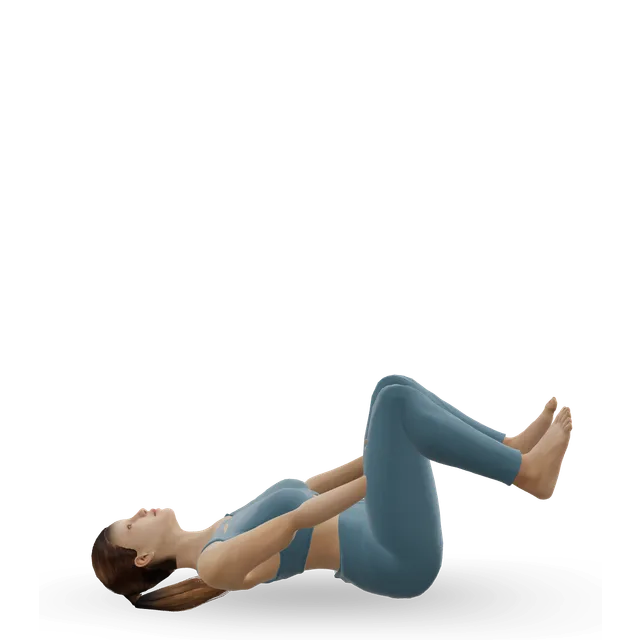
Knee fold, 2 sets of 5 to 10 each side, every other day; single knee-to-chest, hold 20 to 30 seconds, 2 to 4 times each side (the moves' pages). Pelvic tilts then bridges, 8 of each, and the lying twist, 3 to 5 slow breaths each side (our editorial starting point). No study has tested any pose for gas.
The hundred, 50 beats to start, building to 100, head down; single-leg stretch, 6 to 10 each side, head down (the moves' pages); dead bug heel taps, 2 sets of 6 each side (our editorial starting point). The Pilates trial used the hundred, the single-leg stretch and curl-ups on a ball twice a week.
These are comfort changes, not bans: women in the Pilates trial did the swan, the hundred and ball curl-ups on ordinary days.
The swan, swimming, the single and double leg kick: skip them, or put a pillow under your tummy, as our Pilates for endometriosis guide suggests (our suggestion).
The roll-up, chest lift, criss-cross, teaser and neck pull press on a swollen tummy, and roll-ups kept tummy pressure highest for longest in a lab study. Keep them for good days, or use the head-down hundred and dead bug heel taps (our suggestion).
Source 11
Rolling like a ball, the roll-over and the jack knife: skip them after a meal or if you get heartburn (our suggestion). Our exercise for acid reflux guide suggests waiting about 2 hours after a main meal before head-down poses.
Avoid it: it made bloating feel worse in a lab study, and belly breathing at home hasn't been shown to treat swelling.
Breath of fire and kapalabhati: leave them out, as our yoga for IBS guide advises, because they cause more side effects than slow breathing.
Follow your team's advice and our exercise with a stoma guide before you return to curls.
Use our 20-minute Pilates class on bloated days, followed by a short walk, and the beginner Pilates class or the pelvic floor class on good days. The yoga, walking and breathing routines suit days when you'd rather not get on the floor.
A 20-minute Pilates class for a bloated day: upright movement first, rib breathing, then all-fours, side-lying and knees-bent moves, with no curls or face-down work.
20 minBeginner15 movesNo equipmentTwenty-five minutes of movement, upright poses, knee hugs and slow belly breathing for bloating and IBS, with no face-down poses.
25 minBeginner14 movesA step, Firm cushionA daily morning routine for constipation: a brisk walk, slow breathing, knee hugs and relaxing your pelvic floor, then tummy massage and unhurried toilet time.
25 minBeginner7 movesCardio machineA 10-minute routine for straight after a meal: an easy walk, a few simple standing moves from blood sugar trials, then a short walk to finish.
10 minBeginner6 movesCardio machine, A bench or boxA 6-minute breathing routine: slow breathing, crocodile breathing, alternate nostril breathing, box breathing and 4-7-8 breathing.
6 minBeginner5 movesNo equipmentA 20-minute Pilates workout for your pelvic floor, built on UK pelvic health physiotherapists' booklet: squeeze as you breathe out, move, then fully release.
20 minBeginner18 movesA wall, A bench or boxA 20-minute mat Pilates workout for complete beginners. It covers breathing, spine position and the foundation moves, each with an easier option.
20 minBeginner13 movesNo equipmentDaily walking is the activity with the most evidence for IBS and constipation.
These are the same warning signs as our digestion, IBS and belly fat guides, word for word. This is general information, not a diagnosis. In the US, call 911 where this page says 999.
The NHS says call 999 or go to accident and emergency (A&E) if you have severe tummy pain with vomiting or a swollen tummy, or bleeding from your bottom that won't stop, or a lot of blood or large clots when you poo.
It also says call 999 or go to A&E now if you have a stomach ache and:
Source 38
If you have bloating with a swollen stomach and a stomach ache that is severe and came on very suddenly, you're vomiting blood or your vomit looks like ground coffee, or you have severe difficulty breathing. Don't drive yourself to A&E. During exercise, stop and get help for chest pain or pressure, unusual breathlessness, dizziness or fainting, as our plans advise.
Source 4
If you have bloating with being sick, diarrhoea or constipation, or with a stomach ache; a high temperature, or you feel hot, cold or shivery; a swelling or lump in your tummy; a burning feeling in your chest caused by stomach acid travelling up towards your throat (acid reflux); or you can't pee, poo or fart. In the US, contact your doctor or urgent care.
Source 4
If you feel bloated regularly, or have bloating with weight loss you can't explain or blood in your poo: the NHS says bloating that doesn't go away can sometimes be a sign of something more serious, such as ovarian cancer, whose symptoms include a swollen tummy or feeling bloated roughly 12 or more times a month.
The NHS says these could be signs of something more serious:
Call 999 if:
Source 40
Call 999 or go to A&E (accident and emergency) straight away for severe difficulty breathing (gasping, choking or not able to get words out), a chest that feels tight or heavy, pain that spreads to your arms, back, neck and jaw, lips or skin turning very pale, blue or grey, or sudden confusion. If you're more short of breath than usual, or your heart is racing, fluttering or skipping beats, contact NHS 111.
IBS and anxiety or low mood can feed into each other, and our anxiety and depression guides can help. If you are thinking about suicide or can't keep yourself safe, call 999 or go to A&E. For urgent help, call Samaritans free on 116 123, any time, or in England call 111 and select the mental health option. In the US, call or text 988.
You feel any pain or become unwell, as the NHS advises for its Pilates videos, and especially for chest pain or pressure, unusual breathlessness, dizziness or fainting. If you have a health problem, an injury or any symptoms, get advice from a healthcare professional, such as a GP, before you start.
The NHS advises getting advice from a healthcare professional first if you have a health problem, an injury or symptoms, or have recently had a heart attack or an operation.
No study has tested a twist, or any single Pilates move, on how the gut works. What helps gas move on is ordinary: being upright and moving.
A swollen tummy is mostly a reflex, with little extra gas inside, and the treatment that reduced it retrained the reflex with biofeedback, not sit-ups.
In people with visible swelling the tummy wall relaxes as part of a reflex; it hasn't been shown to be weakness.
Source 15
The retraining that worked taught the opposite after meals ("chest up", "abdomen in"), and pushing the belly out made bloating feel worse in a lab study.
Gas moves through faster when you're upright, light exercise helped people with bloating clear it, and a short walk after meals helped fullness and bloating.
Being active helps IBS symptoms a little, at very low certainty, and there's one small Pilates trial with real weaknesses. Diet changes, medicines and talking therapies stay part of care.
It may, mostly in ordinary ways: moving and staying upright help trapped gas move on, and being active eases bloating and IBS a little. In one small trial, twice-weekly Pilates added to diet advice eased IBS with constipation more than diet advice alone, though the trial had real weaknesses. No move "detoxes" the gut.
It can be part of being active, which NICE and the NHS recommend for IBS. The only Pilates trial was small, in women with constipation-type IBS, and not blinded, so treat it as promising rather than proven. Walking has more evidence, and diet changes and other treatments matter too.
Start upright and moving, with marching or a walk, then do gentle moves on all fours, on your side and sitting up, such as cat-cow, the mermaid and side kicks. Light activity helped people with bloating clear gas in a lab study. No single move has been shown to work on its own.
On a swollen, sore day, skip face-down moves like the swan and swimming, and long curls and roll-ups, which press on the tummy. This is about comfort, not harm: women in the Pilates trial did these moves on ordinary days.
We found no study that shows it does. Lying on your back for a long session slows gas compared with being upright, and a full stomach, hard bracing or holding your breath can make a class uncomfortable. Try a lighter meal beforehand, more upright moves, and a short walk afterwards.
Exercise helps constipation a little, mostly walking, in small trials, and the NHS says a daily walk or run can help you poo more regularly. In the Pilates trial, bowel movements rose from about 2.5 to 4.9 a week. If you strain or can't empty fully, the pelvic floor may need to learn to relax, and our pelvic floor relaxation move says to "see a GP or pelvic health physiotherapist about pelvic pain, pain with sex, or trouble emptying your bladder or bowel."
Our suggestion is to breathe so your ribs widen to the sides while your lower tummy stays gently drawn in, rather than pushing your belly out. That is close to the pattern taught in the biofeedback trials that reduced visible swelling, but no study has tested Pilates breathing for bloating.
You don't have to, but a big meal right before a lying-down class is uncomfortable. If you get heartburn, wait about 2 hours after a main meal before head-down moves. A gentle walk straight after a meal is fine.
Not for good. Swelling that comes and goes is mostly a reflex and gas, not fat or weak muscles. Pilates can help you move, breathe and feel more comfortable; for belly fat, see our belly fat guide.
Yes, if it feels comfortable; no study has tested it. The same rules apply: on a bloated day, choose upright and side-lying work over long curls and face-down moves, and know where the toilets are.
Neither has been compared directly. Across 11 yoga trials, yoga made no clear difference to IBS symptoms compared with control groups, and Pilates has one small trial. Choose the one you'll keep doing.
The trial used 2 supervised sessions a week of 45 to 50 minutes for 8 weeks, alongside diet advice. Add a daily walk, especially a 10 to 15 minute walk after meals on bloated days, and use the 20-minute class on a swollen day.
Exercise education, not a personal prescription, and clinical review of these guides is pending. If you are pregnant, have a health condition or have had recent surgery, check with a doctor, midwife or physiotherapist before starting, and stop for sharp or increasing pain. Health disclaimer.