Pilates for lymphatic drainage: how lymph really moves, what Pilates can and can't do, the detox claims, and swelling to get checked
Pilates helps lymph move, because any movement does: your lymphatic system has no heart to pump it, so it relies on its own vessels, the squeeze of working muscles and your breathing. But no study has measured lymph flow during Pilates, no trial has tested a "lymphatic drainage" Pilates routine, and nothing shows one moves lymph better than a walk. A healthy lymphatic system doesn't need draining, "opening" or detoxing.
If you have lymphoedema (long-term swelling), or you're at risk of it after cancer treatment, our Pilates for lymphoedema guide is the one for you.
This guide explains what lymph is and how it really moves, what breathing, walking and raising your legs do, what the branded drainage routines claim, why bloating and puffy ankles usually aren't lymph, and the swelling that needs a doctor. It points you to moving classes with 3D demos.
"Unlike blood circulation, the lymphatic system has no central pump, such as the heart", the NHS says; it uses the massaging effect of the muscles around it. Cancer Research UK says "any type of movement and exercise helps lymph move through the lymphatic system".
No study shows Pilates does it better than walking
Nobody has measured lymph flow during Pilates, and no trial has tested a "lymphatic Pilates" or "lymphatic drainage workout". In 20 healthy adults, 15 minutes of slow walking widened the main lymph duct on ultrasound.
About 4 litres of lymph a day returns to your blood whether or not you do a routine, and no study has tested exercise for "detox", debloating or water retention.
A bloated tummy is mostly gut gas; our Pilates for bloating guide covers it. Puffy ankles usually come from standing or sitting still, salty food, medicines, pregnancy or varicose veins, and ease with raising your legs and gentle walking. Lipoedema is fat, not fluid.
UK lymphoedema bodies recommend Pilates with lymphoedema, alongside compression and your lymphoedema team. Our Pilates for lymphoedema guide covers how to build up.
Lymphoedema is "a long-term (chronic) condition that causes swelling in the body's tissues", the NHS says. UK lymphoedema bodies recommend Pilates with it, but compression, skin care and your lymphoedema team come first, and arm or leg strength is built up slowly. Our Pilates for lymphoedema guide covers all of that, with a class. Don't swap any of it for a drainage routine.
About 8 litres of fluid a day leaks out of the tiny blood vessels into your tissues and becomes lymph. It passes through some of your 500 to 600 lymph nodes, and about 4 litres a day returns to the blood. The lymphatic system "helps fight infection and remove excess fluid", the NHS says.
The nodes filter what lymph carries as part of normal function. Swollen glands are "usually a sign the body is fighting an infection", the NHS says; they aren't blocked drains.
The vessels pump, and valves keep it going one wayStrong evidence
Lymph vessels are divided by one-way valves into short segments that contract on their own, "analogous to that occurring in the chambers of the heart", a 2018 review says. Muscles, breathing and pulsing arteries squeeze them too, but "The relative importance of extrinsic pumping is not known with any accuracy". The British Lymphology Society says "Without movement, lymphatic vessels collapse."
In 8 men, 100 thigh muscle contractions sped the clearance of a tracer from the muscle three- to sixfold. During steady exercise, lymph flow rises to about 2 to 3 times its resting level. In healthy men, leg lymph flow rose 83% during two hours of cycling. These are small physiology studies.
Walking widened the main lymph ductEmerging evidence
In 20 healthy adults, 15 minutes of slow treadmill walking widened the end of the main lymph duct from about 2.7 to 3.4 mm on ultrasound. That's a measure of width, not of how much lymph flowed.
Standing up, and raising your legsEmerging evidence
In 16 healthy young adults, the lymph vessels in the legs pumped more often within 3 minutes of standing up, not less. For everyday swollen ankles, the NHS suggests raising your legs on a chair or pillows.
We found no study of Pilates or yoga inversions and lymph flow. In one ultrasound study, tilting head-down widened the main lymph duct a little, but nobody measured whether more lymph flowed.
Deep breathing changes the pressure in your tummy and chest, which Cancer Research UK says "encourages lymph to flow back into the blood system". The British Lymphology Society says "Deep breathing exercises may be as important as limb exercises".
What's been measured: small and mixedEmerging evidence
In one small study of 20 healthy adults, deep tummy breathing at rest didn't significantly change the width of the main lymph duct (2.6 mm breathing in, 2.4 mm breathing out), while 15 minutes of walking did widen it. In another, the duct was 1.8 mm on a full breath in and 1.6 mm on a full breath out. Both measured width, not flow.
Tested only as part of self-care routinesEmerging evidence
In 38 women with arm lymphoedema, 10 minutes of gentle arm exercise with deep breathing reduced arm volume by 5.8% straight away, with no comparison group. In 126 people with leg lymphoedema in Ethiopia, adding self-massage, deep breathing and thigh exercises to hygiene care cut sudden painful flare-ups (acute attacks) from 38% to 12% over 24 weeks, without changing leg size.
Our suggestion, from Cancer Research UK's and the British Lymphology Society's advice on deep breathing and the slow breathing move's page. No study has shown this moves more lymph than walking.
Lie on your back with your knees bent, or sit tall, with one hand on your tummy and one on your lower ribs.
Breathe in slowly through your nose for a count of about 4, letting your tummy and the sides of your ribs widen.
Breathe out slowly through your mouth for a count of about 6, letting them settle.
Repeat for 5 breaths. If you feel light-headed, make the breaths smaller.
Follow it with ankle circles and calf raises, so your muscles do their share.
No study has measured lymph flow during Pilates, in anyone.
No study of Pilates and lymph flowStrong evidence
Our searches of PubMed, Europe PMC and ClinicalTrials.gov (October 2026) found no study measuring lymph flow, swelling or drainage with Pilates in people without lymphoedema, and no trial of any named "lymphatic Pilates", "lymphatic yoga" or "lymphatic drainage workout". Nothing supports the claims made for these routines.
The nearest tested routine is for heart failureMixed evidence
An 8-minute routine of "muscle-tightening deep breathing, muscle-tightening pumping, and large muscle exercises" reduced self-reported fluid symptoms and sudden weight gains in 66 people with heart failure over 4 weeks, and fluid in the chest in 80 people in a 2026 trial whose authors include the routine's developer. These were people with fluid problems, not healthy people, it wasn't Pilates, and nobody measured lymph flow.
Pilates with lymphoedema: safe, but swelling is uncertainMixed evidence
The British Lymphology Society found "no evidence of harm from several forms of exercise, including aerobics, resistance, yoga, qigong and pilates". But a 2026 overview calls the Pilates evidence on swelling very uncertain, and in 69 women after breast surgery, 16 weeks of mat Pilates didn't change arm volume. Across 36 studies, exercise in general didn't worsen lymphoedema. Our Pilates for lymphoedema guide has the detail.
Specialist massage adds little for lymphoedemaStrong evidence
In a 194-person trial, manual lymphatic drainage (MLD) "did not provide clinically important additional benefit" when added to compression, skin care and exercise, and the International Society of Lymphology says it has "limited additive value". Our lymphatic drainage massage guide covers it.
"Tap your lymphatic stations to open them first"Mixed evidence
Untested, and harmless. It borrows from the simple self-massage that lymphoedema services teach to people with lymphoedema; a healthy lymphatic system doesn't need opening.
"It gets rid of water retention and cellulite"Mixed evidence
No study of Pilates tested either. Puffy ankles have everyday causes and ease with raising your legs and walking; our guide to losing thigh fat covers cellulite.
The NHS lists standing or sitting in the same position for too long, salty food, being overweight, pregnancy, some medicines, varicose veins and thyroid problems. It suggests raising your legs, gentle exercise such as walking, and comfortable shoes.
Usually gas in the gut, not fluid or lymph. Our Pilates for bloating guide explains what helps and when to see a GP.
Lipoedema
A build-up of fat, usually equal on both sides, that doesn't usually affect the feet. Early on it isn't a lymph problem at all, so there's nothing to drain. Our Pilates for lipoedema guide covers it.
Long-term swelling, often in one arm or leg, that can follow cancer treatment, infection or injury. It needs a GP and a lymphoedema service, not a drainage routine.
Slow breathing: 5 slow breaths at the start and end (our Pilates for lymphoedema class; adapted from the move page's dose). Lateral breathing: "5 to 8 breaths at the start of every session." (the move page's dose). Crocodile breathing, optional: 5 minutes of easy nose breathing, lying face down (adapted from the move page's dose).
Ankle circles: 10 pumps, then 5 circles each way, legs up the wall or on a cushion (our Pilates for lymphoedema class; adapted from the move page's dose). Slow calf raises: 10, a hand on the wall (the class). Seated calf raises: 10 to 15 at your desk (our editorial starting point).
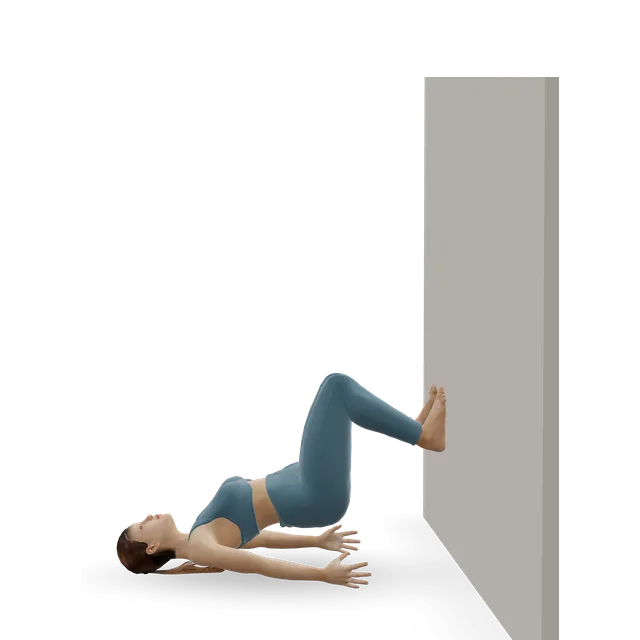
Knee folds: 6 each side, slow and rhythmic (our Pilates for lymphoedema class; adapted from the move page's dose). Heel slides: 8 each side (the class; adapted from the move page's dose). Single-leg circles: "5 circles each direction, each leg (the classical sequence uses 5)." (the move page's dose). Wall bridge: 8, feet on the wall (the class; adapted from the move page's dose).
Shoulder rolls: 5 to 10 each way (our Pilates for lymphoedema class; adapted from the move page's dose). Breath reach: "5 breaths, exhale longer than inhale" (the move page's dose). Band row: 1 set of 8 to 10 with a light band (the class; adapted from the move page's dose).
Clamshells: 10 each side (our Pilates for lymphoedema class). Side kicks: 8 each side, moving rather than held (the class; adapted from the move page's dose).
A walk: 10 minutes at a pace where you can talk (our editorial starting point). Legs up the wall: 2 to 3 minutes, or legs on cushions (our PoTS starter session's dose); with heart failure, or kidney or liver disease that causes fluid build-up, its page says to ask your doctor first.
The roll-over, jack knife and shoulder stands put weight over your neck, and no study shows they move more lymph. Their pages say to leave them out with a neck problem, and with hypermobility or EDS (Ehlers-Danlos syndromes) "unless a physiotherapist who knows your neck has cleared it". Legs up the wall uses gravity without the neck load.
Muscles pump lymph by squeezing and letting go, so moving versions suit better than long planks or a hundred held still (our reading of the physiology).
There's no "lymphatic drainage" Pilates class, because no sequence of moves has been shown to drain lymph. Our Pilates for lymphoedema class keeps you moving throughout, with breathing first and your legs up the wall: built for lymphoedema, and fine without it. The calf pump routine suits heavy legs, and a walk counts too. The daily lymphoedema routine is for people with lymphoedema.
These are the warning signs from our Pilates for lymphoedema guide, word for word. This is general information, not a diagnosis. A&E means accident and emergency; in the US, call 911 for 999, and use your doctor's urgent line or urgent care for NHS 111.
Call 999 (911 in the US) or go to A&E
If you have cellulitis with any of these, which can be signs of sepsis:
A very high temperature, or feeling hot, cold or shivery.
A fast heartbeat or fast breathing.
Purple patches on the skin (these may be harder to see on brown or black skin).
Call 999 or go to A&E if breathing suddenly becomes difficult, if pain in your chest or upper back comes on suddenly with breathlessness or a very fast heartbeat, or if someone passes out. Do not drive yourself. It can be a blood clot that has reached the lungs.
The skin of the swollen or at-risk area is painful, hot and swollen, perhaps red (harder to see on brown or black skin), or you feel unwell with flu-like symptoms: this can be cellulitis, and early antibiotics help.
Throbbing pain and swelling in one limb with red, blue or darkened skin or swollen veins, which can be a DVT (it can happen in an arm too).
Antibiotics for cellulitis aren't helping after 48 hours.
Same day (urgent GP appointment or NHS 111): throbbing pain in one leg (rarely both), usually the calf or thigh; swelling in one leg (rarely both); red, blue or darkened skin around the painful area, which may be harder to see on brown or black skin; or swollen veins. This can be a deep vein thrombosis (DVT). It is more likely after surgery, a hospital stay, 3 or more days in bed, a journey of over 4 hours, pregnancy or a recent birth, cancer, a previous clot, or contraception or hormone replacement therapy (HRT) that contains oestrogen.
New swelling with no signs of a clot or infection: see your GP or cancer team, who may refer you to a lymphoedema service.
New swelling in an arm or leg, especially after cancer treatment: early swelling can come and go, and after breast cancer treatment Breast Cancer Now says to get advice as soon as you notice it. A GP can refer you to a specialist lymphoedema service. New swelling after cancer treatment needs checking for other causes first.
Signs of a skin infection, such as redness or heat, as soon as possible.
Swollen legs, ankles or feet that haven't improved after a few days, or symptoms of lipoedema.
Swollen lymph nodes aren't something to stretch or drain away. See a GP if they're getting bigger or haven't gone down within 1 week, feel hard or don't move, come with night sweats or a very high temperature, or are just above or below your collarbone.
Signs of infection (cellulitis) or a blood clot in a swollen limb need urgent medical attention. If the swollen or at-risk area changes during or after exercise, stop and contact your lymphoedema specialist.
Macmillan says you should not exercise if you have a skin infection (cellulitis), and the NHS says not to wear compression stockings until you're better. Our exercise for lymphoedema guide covers what to do.
Call 999 or go to A&E (accident and emergency) straight away for severe difficulty breathing (gasping, choking or not able to get words out), a chest that feels tight or heavy, pain that spreads to your arms, back, neck and jaw, lips or skin turning very pale, blue or grey, or sudden confusion. If you're more short of breath than usual, or your heart is racing, fluttering or skipping beats, contact NHS 111.
You feel any pain or become unwell, as the NHS advises for its Pilates videos, and especially for chest pain or pressure, unusual breathlessness, dizziness or fainting. If you have a health problem, an injury or any symptoms, get advice from a healthcare professional, such as a GP, before you start.
Before you start
The NHS advises getting advice from a healthcare professional first if you have a health problem, an injury or symptoms, or have recently had a heart attack or an operation.
Myths
"Pilates drains your lymph"Mixed evidence
Any movement helps lymph move, Pilates included, but no study has measured lymph flow in Pilates or shown it does more than walking.
UK lymphoedema bodies recommend deep breathing, but in one small study of healthy adults, deep breathing at rest didn't change the main lymph duct's width significantly while walking did, and nobody knows how much each part contributes.
"You need a reformer for a real lymphatic workout"Mixed evidence
No study of reformer or mat for lymph exists. The International Society of Lymphology says muscle-pumping activity in daily life, such as walking and stairs, is useful for anyone.
Pilates helps lymph move, as any movement does: working muscles squeeze the lymph vessels and deep breathing changes the pressure in your chest. But no study has measured lymph flow during Pilates, or shown it works better than a brisk walk.
Does lymphatic drainage Pilates work?
There's no published study of any named lymphatic drainage Pilates routine. The moves are ordinary Pilates moves, so they're fine to do, but the claims about detox, fast debloating and less water retention aren't backed by evidence.
Does Pilates detox your body?
No study has tested any exercise for detox, and a healthy lymphatic system doesn't need one: your lymph nodes filter lymph all the time as part of normal function.
Can Pilates reduce bloating or water retention?
A bloated tummy is usually gut gas; our Pilates for bloating guide covers what helps. Puffy ankles usually ease with raising your legs and gentle walking, the NHS says. Neither is a lymph problem in most people.
What's the best exercise for the lymphatic system?
Whatever gets your muscles working regularly: walking, cycling, swimming and Pilates all count. Working a muscle sped lymph clearance three- to sixfold in one study, and steady exercise raises lymph flow about 2 to 3 times.
Do breathing exercises help lymph flow?
UK lymphoedema bodies recommend deep breathing, because it changes the pressure in your chest and tummy. The measurements are small: in one study of healthy adults, deep breathing at rest didn't change the main lymph duct's width significantly, but a 15-minute walk did. Breathe deeply and keep moving.
Is reformer Pilates good for lymphatic drainage?
No study has tested it. The reformer's leg work is the same muscle-pump work as mat Pilates or walking, so choose whichever you'll do regularly.
Does hot Pilates help lymphatic drainage?
No. Heat can make swelling worse: the NHS says heat from saunas, steam rooms and sun beds may increase lymphoedema swelling. Sweating isn't draining lymph.
Is yoga or Pilates better for lymphatic drainage?
Neither has been shown to move lymph better than the other, or than walking. Both get your muscles working and include deep breathing; our yoga for lymphatic drainage guide covers the yoga side.
I have lymphoedema. Is this page for me?
Our Pilates for lymphoedema guide is the one to read: UK lymphoedema bodies recommend Pilates with lymphoedema, built up slowly, with your garment and your lymphoedema team. Don't swap compression or specialist care for a drainage routine.
When should swelling be checked by a doctor?
See a GP for new swelling in an arm or leg, especially after cancer treatment, swelling that hasn't improved after a few days, or swollen glands that last more than a week. Get urgent help for a swollen, red, hot or painful leg, or swelling with breathlessness or chest pain.
Exercise education, not a personal prescription, and clinical review of these guides is pending. If you are pregnant, have a health condition or have had recent surgery, check with a doctor, midwife or physiotherapist before starting, and stop for sharp or increasing pain. Health disclaimer.