Cardio & conditioning
Battle rope workout for beginners: 30-second waves, building to 10 rounds
Battle rope waves are hard interval work for your shoulders, arms, grip and trunk: in lab studies, heart rate averaged about 80% of its maximum. This session starts with 4 rounds of 30-second waves and a minute's rest, the move page's starting point, and adds rounds over the weeks towards the 10 rounds a 6-week study used three times a week. Work hard enough that you can say only a few words, and end a round early if the waves stop reaching the anchor. Do it once or twice a week as one of your hard sessions. No trial has tested this session as a whole, so it's our starting point.
Warm-up (about 5 minutes)
- Standing march2 minBeginner · Hip flexors, Abs, Glutes · 3D demoEasy, building to brisk, arms swingingEasier: Seated marchHarder: Standing band hip flexion
- Shoulder CARs (controlled articular rotations)3 slow circles each way, each armBeginner · Shoulders, Back · 3D demoWork round any pinch rather than through itEasier: Arm circlesHarder: Sleeper stretch
- Beginner · Forearms · 3D demoSlow circles and palm turnsEasier: Wrist circlesHarder: Wrist flexor stretch
- Bodyweight squat10 repsBeginner · Quads, Glutes, Hamstrings · 3D demoDown to a quarter squat: your rope stanceEasier: Sit squat (partial squat)Harder: Dumbbell goblet squat
- Battle rope alternating waves2 easy bouts of 10 s, 30 s betweenBeginner · Shoulders, Chest, Forearms · 3D demoPractice: feet shoulder-width apart, a quarter squat, chest up, and waves that reach the anchorEasier: Arm-crank intervals (arm bike)Harder: Bear crawl




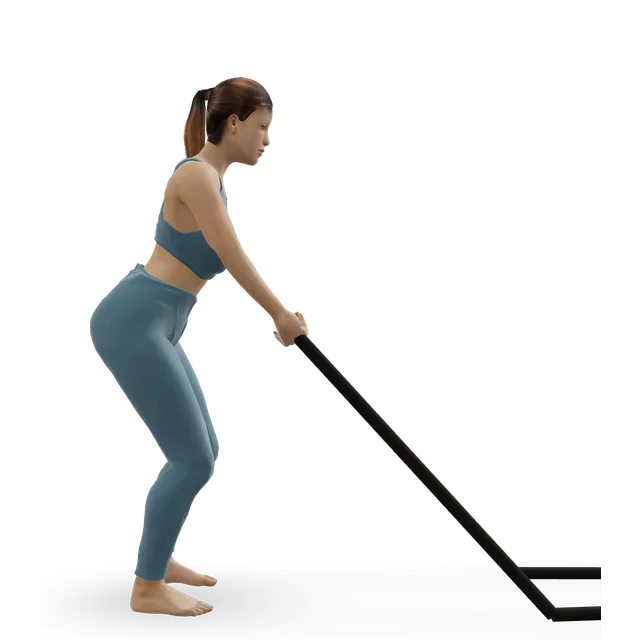
Intervals (6 to 15 minutes)
4 rounds
- Battle rope alternating waves30 s on, 60 s offBeginner · Shoulders, Chest, Forearms · 3D demoAlternating waves, hard: a few words at most. Weeks 1 and 2: 4 rounds; then add 1 or 2 rounds a week, up to 10. End a round early if the waves stop reaching the anchor. Easier: 15 s on, 45 s off. Once 10 rounds feel steady, try double waves for some rounds, or a heavier ropeEasier: Arm-crank intervals (arm bike)Harder: Bear crawl
Trunk (about 3 minutes)
Rest 30 s between sets
- Dead bug2 sets of 6 to 8 each sideBeginner · Abs, Hip flexors · 3D demoLower back stays gently on the floor; breathe out as you reachEasier: Dead bug heel tapsHarder: Forearm plank
- Side plank2 sets of 20 to 30 s each sideIntermediate · Abs, Hip abductors, Shoulders · 3D demoFrom your knees to startEasier: Knee side plankHarder: Side plank with leg lift


Cool-down (about 2 minutes)
- Cross-body shoulder stretch30 s each sideBeginner · Shoulders, Back · 3D demoGentleHarder: Sleeper stretch
- Beginner · Chest, Shoulders · 3D demoElbow at or below shoulder heightEasier: Elbows backHarder: Fish pose (Matsyasana)


Tips
- Go by your breathing, not your heart rate: hard means you can say only a few words. Heart rate drifted up across the session in a lab study, so start firm rather than flat out and keep your last round as good as your first.
- Once or twice a week as one of your hard sessions, up to three, with an easier day between. The training studies used 2 or 3 sessions a week.
- Set-up: loop the rope round a sturdy anchor at its middle so both ends match, check the anchor can't move, and stand where the rope is almost straight with a little slack on the floor.
- A seated version works: sit tall on a sturdy bench, a chair or your wheelchair with the brakes on. Seated waves reached about 72% of aerobic capacity in one study.
- No rope? Use the same timings with standing punches, or with an air bike, as our cardio intervals workout does.
- Shoulder pain: keep the waves below shoulder height and leave out slams. Pain up to about 5 out of 10 that settles by your next session is acceptable, as our shoulder pain guide says.
- Check with your GP first if you're inactive and have heart, metabolic or kidney disease, or get chest discomfort, unusual breathlessness, dizziness or fainting when active. Keep to moderate effort while your blood pressure isn't controlled, and don't start this new in pregnancy.
- Stop for chest pain or pressure, dizziness, unusual breathlessness or a racing or irregular heartbeat, and get medical help. Arms far sorer, more swollen or weaker than the session explains, with or without dark pee, need a same-day check (NHS 111) after a first hard session.
The doses are suggested starting points, not a prescription. Choose a range you can control and stop for sharp or increasing pain, numbness or tingling. Get individual advice after an injury or surgery, or if you are pregnant or managing a health condition.
Guides that recommend it
Find more moves like these
More cardio & conditioning


HIIT workout at home
A 20-minute no-equipment HIIT workout: jumping jacks, jump squats, mountain climbers, burpees, skips and bear crawls.
20 minIntermediate10 movesNo equipment


Plyometric workout
An advanced jump training session: pogo hops, box jumps, split squat jumps, broad jumps and depth jumps.
30 minAdvanced8 movesA bench or box, A step


Easy cardio workout
A steady 30 to 45 minute cardio session at talk-but-not-sing pace: walk, cycle, row or cross-train, counting toward weekly activity guidelines.
40 minBeginner3 movesCardio machine, A wallQuestions people ask
How long does the battle rope workout for beginners: 30-second waves, building to 10 rounds take?
About 25 minutes, including any warm-up and cool-down listed. Shorten it by doing fewer rounds; lengthen it by adding one.
What equipment do I need?
You need: Other / check instructions, An anchor point, A wall. Each move links to its guide, where you can find an alternative if you are missing something.
Is it suitable for beginners?
It is written for beginners. 8 of its 9 moves have an easier option listed beside them if you need one.
How do I make it easier or harder?
Use the easier or harder option listed under each move, change the number of rounds, or adjust the rest. Progress one change at a time.