Training guide

How to do a dumbbell bench press: set-up, getting the dumbbells up and down safely, flat, incline and neutral grip, dumbbells against a barbell, and how heavy

A dumbbell bench press, or dumbbell press, is a bench press with a dumbbell in each hand: each arm steadies its own weight, and you can choose your grip. You'll lift about a sixth less than with a barbell at first, with similar chest work, and the gap closes with practice.

The risky moments are getting the dumbbells into place and putting them down, not the press itself. Nobody has compared chest growth with dumbbells and a barbell, and the safest ways in and out come from coaching practice rather than trials, so this guide says which is which.

It shows the whole lift step by step on the 3D figure, from your thighs to the bench and back, and covers spotting, flat, incline and neutral-grip versions, dumbbells against a barbell, how heavy to go and your shoulders, with a dumbbell chest workout to follow.

The short version

The move

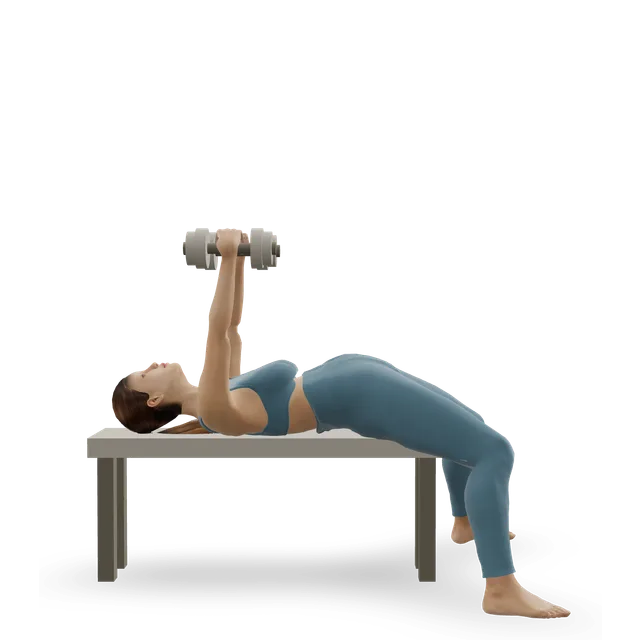
Sit on the end of a flat bench with the dumbbells on your thighs, lie back bringing them to your chest, press them up over your chest, lower them under control to the sides of your chest, and press again. At the end, bring them back to your chest and thighs and sit up. This follows the National Strength and Conditioning Association's (NSCA's) technique column and our move pages.

Source 1

The risky moments are getting in and out

Use your knees to help each dumbbell into place. If a rep fails, lower the weights to your chest and tip them out to the sides, never over your face, as our move page says. In emergency department data, weights dropping on the person were the commonest cause of weight-training injuries (65.5%) and of dumbbell injuries (78.4%). A spotter holds your wrists, not your elbows.

Sources 2, 3, 4, 5

You lift less, at first

Two dumbbells came to about 17% less than a barbell in 12 trained men. After 10 weeks of training only with dumbbells, the gap all but closed, from 81% to 99% of the barbell. There are no validated dumbbell strength standards, so find your weight by reps.

Sources 6, 7

Dumbbells or a barbell? Both work

Chest activity is similar or a little higher with dumbbells and the triceps work less, and dumbbell training carried over to the barbell. No study has compared chest growth between them, so "dumbbells build more chest" is unproven.

Sources 6, 8, 7

Flat, incline or neutral grip

Flat for most. An incline of about 30 to 45 degrees shifts work towards the upper chest and front shoulder, as our incline bench press guide explains. Palms facing, or a floor press, if your shoulders complain: a sensible clinical swap that no study has tested.

Sources 9, 10, 11

How many

3 or 4 sets of 6 to 12, stopping about 2 reps short, with 90 seconds to 2 minutes' rest, once or twice a week (our bench press guide's starting point). Reach the top of the range on every set before the next dumbbell, because each step is 1 to 2 kg a hand. Never go to failure on your own.

Sources 12, 13

What it is, and what it works

The lift

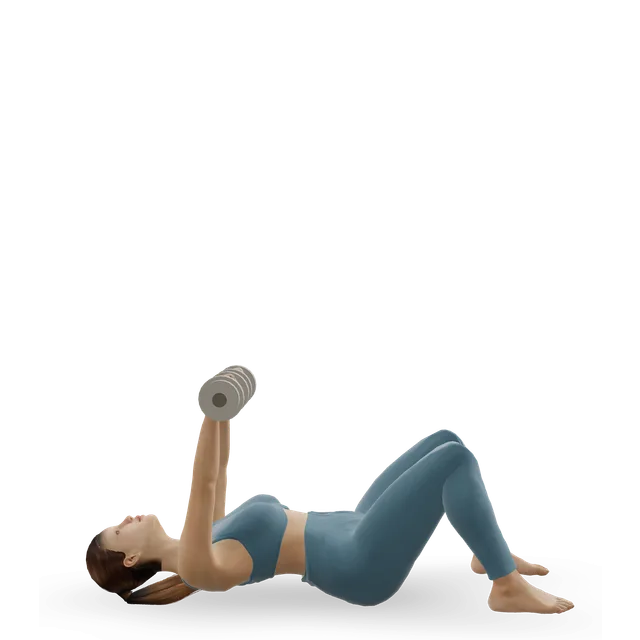
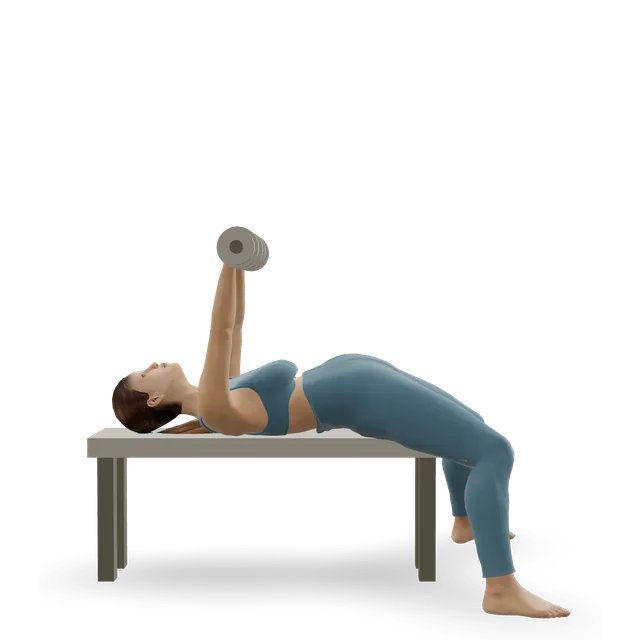
Lying on a flat bench with a dumbbell in each hand, you lower the weights to the sides of your chest and press them back up over it. Each arm steadies its own weight on its own path, and you can turn your palms towards your feet, angle them, or have them face each other.

Muscles and joints

Your chest, the front of your shoulders and your triceps, as in a barbell bench press. With dumbbells the biceps work more and the triceps less, and chest activity is similar or a little higher in muscle activity (EMG, electromyography) studies. The wrist stays straight under each dumbbell.

Sources 6, 14, 8

Before you start

Controlled push-ups or a machine chest press (our bench press guide's ladder), a bench that doesn't wobble, and dumbbells light enough to get into place. "Dumbbell chest press" often means the same lift; without a bench, the floor press is the version to use.

How people differ

Dumbbells come in fixed steps, often 1 to 2 kg a hand and bigger at the heavy end, so smaller and newer lifters may find the jump between pairs large (our incline bench press guide). How used you are to dumbbells matters most for how they compare with a barbell. Older adults gain with dumbbells too: in 65 healthy adults aged about 66, 6 weeks of training raised arm muscle and pressing strength.

Sources 7, 15

How to do a dumbbell bench press, step by step

From the NSCA's dumbbell bench press technique column, our dumbbell press move page, our bench press guide and the American Council on Exercise's (ACE's) wrist cue. The knee kick-up and the tip-out are coaching practice, not tested in studies.

  1. Choose dumbbells you think you could press 10 to 12 times.
  2. Sit on the end of a flat bench with the dumbbells standing on your thighs, near your knees.
  3. Lie back, using a knee to help bring each dumbbell up to your chest, one at a time.
  4. Plant your feet, set your shoulder blades back and down, and hold the dumbbells beside your chest with your wrists straight over your elbows.
  5. Breathe out and press up over your chest until your arms are straight, without banging the dumbbells together.
  6. Breathe in and lower them under control to the sides of your chest, elbows about 45 to 75 degrees from your sides, without bouncing.
  7. After the last rep, bring them to your chest, then onto your thighs, and sit up; or lower them to the floor beside you from your chest, never from straight arms.
  8. If a rep fails, lower the weights to your chest and tip them out to the sides, away from your face.

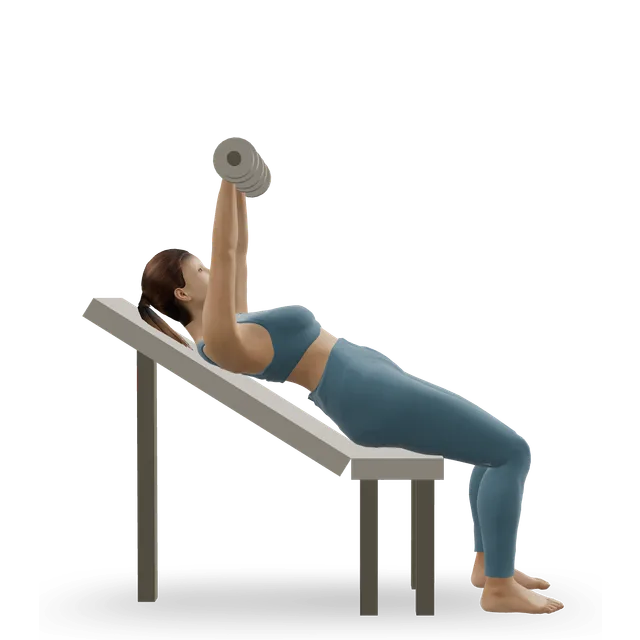
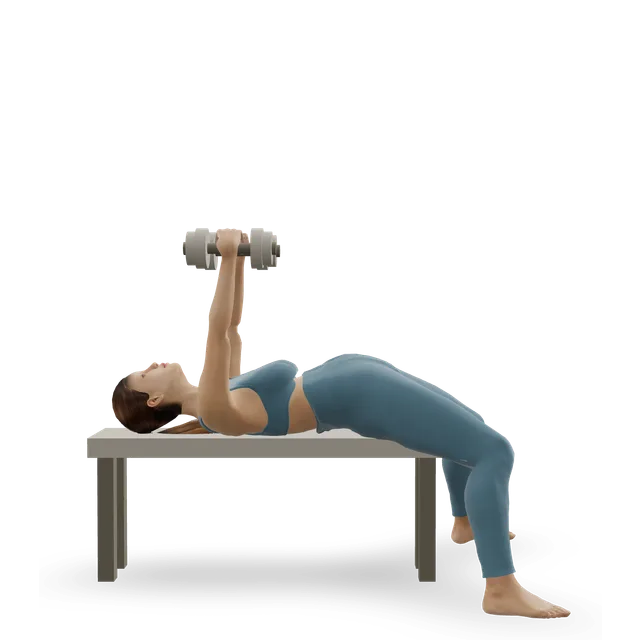
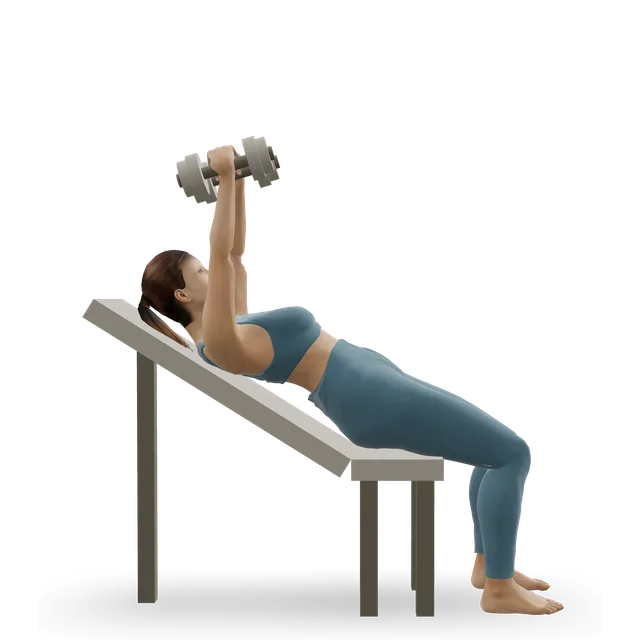
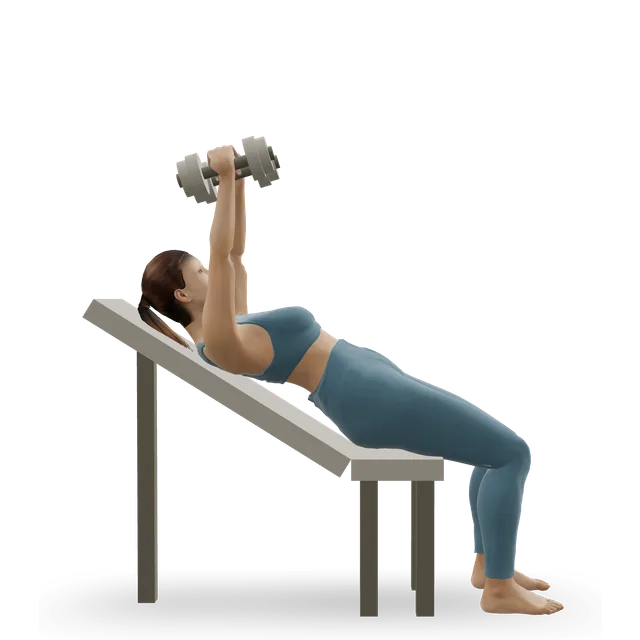
Loading the 3D figure…

Gets into position, then repeats the movement. Technical checks passed; qualified exercise review is pending.

The movement on the figure: Dumbbell bench press

Getting the dumbbells into place, and down safely

Thighs to chest, and back to thighsStrong evidence

The NSCA's technique column starts seated on the lower end of the bench with the dumbbells resting on the top of your thighs, and finishes by sitting up slowly and returning the dumbbells to your thighs before standing up.

Source 1

The knee kick-up and the bail-out

Our dumbbell press move pages add the knee kick-up: start with the dumbbells on your knees and kick them back one at a time as you lie down. And the bail-out: when a rep fails, lower the weights to your chest, tip them out to the sides and let them go; never fight a falling dumbbell over your face. We found no professional body's source for the kick itself: it's coaching practice. Don't drop dumbbells from straight arms, as our floor press guide says.

Spot at the wrists, not the elbows

ACE puts the spotter in a split or half-kneeling stance with their hands as close to your wrists as possible, and a strength-training textbook says spotting at the elbows is wrong because it lets the dumbbell move forwards or backwards. This is expert advice: we couldn't open an NSCA source on it.

Sources 4, 5

Dropped weights are the commonest injuryStrong evidence

In US emergency departments from 1990 to 2007, weights dropping on the person were the commonest cause of weight-training injuries (65.5%). Of 2,873 fitness-facility injuries in Victoria, Australia, dumbbells were named in 111, and 78.4% of those were weights falling or dropping on the person. In 15,348 more recent US cases, dropped equipment caused 12% of men's visits and 19% of women's. These are counts without exposure data: they can't show that dumbbells are riskier than a barbell.

Sources 2, 3, 16

No bar can pin your neckEmerging evidence

Reported deaths from pressing involved a barbell on the neck. We found no study of dumbbells for this risk. A dumbbell can't pin you to the bench, but it can land on your face or chest if you fight a failed rep (our reading).

Source 17

Dumbbells or a barbell?

Dumbbells lift less, with similar chest activityEmerging evidence

In 12 trained men, people lifted 14% less with dumbbells than on a Smith machine and 17% less than with a barbell, with similar chest activity; the barbell was about 3% heavier than the Smith machine. In 11 men from the same lab, probably partly the same people, the dumbbells came to about 84% of the barbell.

Sources 6, 18

The gap closes with practiceEmerging evidence

After 10 weeks of chest pressing only with dumbbells, 11 trained men's dumbbell 6-rep best rose from 60.8 to 82.7 kg and their barbell best, which they hadn't trained, from 75.3 to 83.7 kg, so the dumbbells went from 81% to 99% of the barbell.

Source 7

Muscle activity: similar, with less tricepsMixed evidence

At each lift's own maximum, chest and front-shoulder activity didn't differ in 12 trained men, while the biceps worked more with dumbbells and the triceps less. In 12 men and women, chest activity didn't differ across the barbell press, dumbbell press and dumbbell fly. In 19 trained men doing 4 sets of 10, the dumbbell press drew more chest activity and less triceps. Activity over a few reps shows effort, not growth.

Sources 6, 14, 8, 19

Strength carries over; growth hasn't been comparedEmerging evidence

In trained men pressing twice a week for 10 weeks, each group got best at the press it trained, but dumbbell training still raised the barbell bench by 11.6%. No study has compared chest growth after dumbbell and barbell pressing, so whether either builds more chest is unknown.

Sources 20, 7

Free weights or machines: both build strength and muscleEmerging evidence

In 36 novice men, 10 weeks of free weights, including the dumbbell bench press, or machines gave similar gains in size and strength. In 65 older adults, 6 weeks of dumbbell training raised arm muscle and strength. Across 13 studies of 1,016 adults, free weights and machines gave similar strength and growth.

Sources 21, 15, 22

Depth and stabilityEmerging evidence

We found no study measuring whether two dumbbells go deeper than a barbell. Pressing one dumbbell rather than two gave about 7 degrees more shoulder range in 22 adults, and the authors couldn't say whether that matters. Wobbly loads lower the weight you can lift, as in a seated press in 30 trained people. Full range built more strength than partial range across 16 studies.

Sources 23, 24, 25

Reps at the same total weightEmerging evidence

In 40 college football players, the same total weight as two dumbbells allowed about 9% fewer reps than as a barbell (12.5 against 13.8).

Source 26

Flat, incline or neutral grip?

The incline dumbbell pressEmerging evidence

Barbell studies put the upper chest's biggest share at about 30 degrees of incline, with the front of the shoulder taking over above 45; in the largest, the upper chest's peak at 30 degrees wasn't significantly above flat. The only dumbbell incline study, of 24 women with 4.5 kg dumbbells, found more upper-chest activity at 45 degrees than flat, though its abstract contradicts its results. ACE's incline page uses 45 to 60 degrees, steeper than these studies suggest; we keep our incline bench press guide's 30 to 45 degrees.

Sources 9, 27, 28, 29, 30

Neutral grip (palms facing)

Clinicians and a strength textbook suggest palms-facing dumbbells for sore shoulders and elbows, as our bench press guide does ("switch to neutral-grip dumbbells or a floor press"). We found no study of a neutral-grip dumbbell press, so this is expert opinion. ACE calls the floor press a great alternative to the dumbbell bench press for people with shoulder problems.

Sources 10, 5, 31, 11

Grip, forearms and elbowsEmerging evidence

In 12 men, a palms-up barbell grip raised upper-chest and biceps activity, and on a seated chest press machine a neutral grip drew slightly more upper-chest activity than a wide bench press in 20 adults. In a computer model of the barbell bench press, grip width and shoulder-blade position mattered more to shoulder load than elbow angle. ACE lets you keep the elbows close (more triceps) or flared (more chest); our bench press guide's 45 to 75 degrees, with forearms upright, sits between.

Sources 32, 33, 34, 4

Decline and squeeze presses

A decline adds little over flat and puts your head down, which some people should avoid (its move page lists who). A squeeze press, dumbbells pressed together, works the triceps more. Neither is needed as a main press (our view).

The versions

The dumbbell bench press at 3 or 4 sets of 6 to 12, stopping about 2 reps short (our bench press guide). The incline dumbbell press at 3 sets of 8 to 12, 2 or 3 short (our incline bench press guide and push day workout), and the neutral-grip press at 3 sets of 8 to 12 (our suggestion). The floor press and the squeeze press at 2 to 3 sets of 8 to 12, stopping with 2 or 3 reps in reserve (their move pages' doses), and the palms-in incline press at the same dose (our suggestion). There's no 3D demo of the one-arm or alternating dumbbell press: the dumbbell bench press is the closest.

How heavy, and how many

No standards and no conversion

We found no professional guidance or tested formula for turning a barbell bench into a dumbbell weight, and online dumbbell "strength standards" have no published source. Our arithmetic from two small, possibly overlapping samples: a pair of dumbbells at about 83% of a barbell maximum, roughly 42% a hand, in men who rarely pressed dumbbells; after 10 weeks of dumbbell practice it was 99%.

Sources 6, 18, 7

Your first weight

Pick a pair you think you could press 10 to 12 times, do 8, and keep 2 or 3 in reserve; in your first two weeks keep 3 or 4, as our plans advise. Most people misjudge the reps they have left by about one.

Source 35

Sets, reps and rest

3 or 4 sets of 6 to 12, stopping about 2 reps short (our bench press guide's step), or 3 sets of 8 to 12 as a second press. Rest 90 seconds to 2 minutes, or 2 to 3 minutes for heavy sets of 6 to 8. Once or twice a week, counting towards about 10 hard chest sets a week.

Sources 12, 13, 36

Moving up

Add reps first, then weight. Dumbbells jump by 1 to 2 kg a hand, a big step at light weights, so reach the top of the rep range on every set before you move up (our incline bench press guide). The American Heart Association's "2 for 2" rule adds 2 to 10% once you beat your target by 2 reps in two sessions in a row.

Sources 37, 38

Never to failure on your own

Stop 2 to 3 reps short of failure, so you never get stuck under the dumbbells, as our superset workout puts it. You don't need failure to grow: across 15 studies, training to failure added a trivial amount of growth at most.

Source 39

Breathing

With controlled high blood pressure, the American Heart Association considers low- to moderate-intensity strength training with proper breathing safe. Breathe out as you lift, as our breathing guide advises.

Source 37

Common mistakes

Dropping heavy dumbbells from straight arms

Bring them down to your chest first, then to your thighs or the floor.

Bouncing them off your chest

Lower under control and press without a bounce.

Source 1

Lowering far past chest level

Stop where your shoulder feels secure, about level with your chest (our suggestion).

Elbows flared out to 90 degrees

Keep them about 45 to 75 degrees from your sides (our bench press and incline bench press guides).

Wrists bent back

Stack your wrists over your elbows; ACE asks for a neutral wrist.

Source 4

Dumbbells drifting apart or over your face

Press up and slightly together over your chest (our suggestion).

Feet up or hips lifting

Keep your feet flat and your bottom on the bench, as our bench press guide says.

A spotter at your elbows

Ask them to hold your wrists instead.

Source 5

Your shoulders and chest

If your shoulders complain

Try palms facing, elbows about 45 degrees, a shallower bottom position or a floor press, as our bench press guide suggests. These are clinical swaps, not tested in trials.

Keep shoulder pain to about 5 out of 10 or less during the exercise, back to its usual level by your next session, as our shoulder guides advise. A sharp pinch means lower, lighter or stop.

Our shoulder pain when bench pressing guide maps the causes and has a plan back.

Sources 10, 31, 34

Torn pec tendons: mostly men, mostly the bench pressStrong evidence

48% of 365 published pec tendon tears happened in weight training. In a review of 664 injuries, all in men, 63% happened in weight training, and the bench press caused 87% of those. In a surgical series of men, the bench press or a similar lift was the commonest cause (54%). No study separates dumbbell presses. Tears start at the stretched bottom of the press, so lower under control.

Sources 40, 41, 42

Your progression

Push-ups to the floor at 3 sets of 8 to 15, then a chest press machine at 3 sets of 8 to 12 if you have one, then the dumbbell press, then, if you want it, the barbell bench press with safety arms: move on at 3 sets of 10 at a moderate weight with both sides moving together (our bench press guide's ladder). The floor press is the easier dumbbell step without a bench.

Warm-up and shoulder care

Band pull-aparts, 15 reps, and scapular push-ups, 10 reps, as a warm-up, then a warm-up set at about half your working weight (our bench press technique workout). Face pulls, 2 sets of 15 (the same workout), and band external rotations, 2 sets of 12 to 15 (our bench press guide's shoulder-care note), at the end. A supported single-arm dumbbell row, 3 sets of 8 to 12 each side (our dumbbell upper body workout), balances the pressing, and the doorway chest opener for 30 seconds is optional afterwards.

Workouts

The dumbbell chest workout is a whole chest session with a pair of dumbbells and a bench: flat, incline and neutral-grip presses, flys and a pullover, with a row to balance it. The bench press technique, full-body dumbbell, dumbbell upper body and push day B workouts use the dumbbell press inside bigger sessions, and the chest workout at home uses the floor press if you have no bench.

Plans

Who should modify, and warning signs

Stop and get medical help

If you get chest pain or pressure, feel faint or dizzy, are unusually breathless, or your heart races or beats irregularly during exercise, as our plans advise. The American Heart Association says these need immediate medical evaluation.

Source 37

Call 999 (911 in the US)

For chest pain that comes on suddenly and doesn't go away, feels tight or like squeezing, spreads to your arms, neck, jaw, stomach or back, or comes with sweating, feeling sick, light-headedness or breathlessness; arm pain that comes on suddenly with pressure, heaviness or squeezing across your chest; severe difficulty breathing, or a chest that feels tight or heavy; someone who faints while exercising; palpitations that don't go away, or come with chest pain, shortness of breath or feeling faint; or a headache that starts suddenly and is extremely painful, especially while lifting or straining. The NHS says a bleed on the brain may be more likely when lifting something heavy. Don't drive yourself to A&E.

Sources 43, 44, 45, 46, 47, 48, 49, 50

A headache with effort

Ask for an urgent GP appointment or get help from NHS 111 for a headache that's triggered or made worse by coughing, sneezing, bending down or exercising.

Source 49

A pop in the chest or armpit

Same day (NHS 111 or an urgent treatment centre): a pop or tearing at the front of the armpit or chest during a lift, a dip or a tackle, followed by bruising into the chest or upper arm, a change in the shape of the chest or armpit (a thinner or lost armpit fold, or a chest or nipple that looks uneven), or weakness pushing. Don't wait for it to settle: it can be a torn pec tendon. In the US, go to urgent care.

Sources 51, 40

Your shoulder

Ask for an urgent GP appointment or get help from NHS 111 for sudden or very bad shoulder pain, an arm you can't move, a shoulder that has changed shape or is badly swollen, pins and needles that don't go away, no feeling in your arm or shoulder, an arm or shoulder that's hot or cold to touch, pain after an injury or a fall, severe pain in both shoulders, or feeling feverish or unwell. Go to A&E if, after an injury, you can't move your arm or your shoulder looks out of place or has changed shape. See a GP if shoulder pain is getting worse or hasn't improved after 2 weeks.

Sources 52, 53

A dumbbell dropped on you

Call 999 or go to A&E if you heard a crack, the injured foot or hand has changed shape or points at an odd angle, it's numb, tingling or has pins and needles, or the skin has changed colour or is cold to touch, as the NHS sprains and strains page lists. A headache after a blow to the head in the last 3 months is also a 999 or A&E matter, as the NHS headaches page lists. Don't drive yourself.

Sources 54, 49

A pulled muscle

Get help from NHS 111, or go to an urgent treatment centre (in the US, urgent care), if it's very painful or the pain is getting worse, there's a large amount of swelling or bruising or it's getting worse, it feels very stiff or is difficult to move, it's not feeling any better after treating it yourself, or you also have a very high temperature or feel hot, cold or shivery.

Source 54

Contact NHS 111 for a wrist injury

For severe wrist pain; feeling faint, dizzy or sick from the pain; a snap, grinding or popping noise at the time of the injury; being unable to move your wrist or hold things; a wrist that has changed shape or colour; a very painful, hot or red lump; or lost feeling in your hand. In the US, use urgent care.

Source 55

A hernia

See a GP if you think you have a hernia, a bulge or lump that may get bigger when you strain and smaller when you lie down. Get help from NHS 111 if you have a hernia and pain in or around it, a bloated tummy, you feel or are sick, you're vomiting blood or your vomit looks like coffee grounds, you're constipated, you have a high temperature or feel hot, cold or shivery, or you've suddenly become confused. Call 999 or go to A&E for a femoral hernia (a small lump at the top of your thigh, in your groin) with very bad tummy pain, sickness, being unable to fart or poo, a high temperature or sudden confusion.

Sources 56, 57

Pregnancy

The NHS says to avoid lying flat on your back for more than a few minutes in later pregnancy, and not to start new vigorous activity. After the first trimester, our incline bench press guide suggests swapping a flat press for an incline or standing press, at moderate weights.

Source 58

After heart, lung or breast surgery

After heart surgery through the breastbone, or a heart or lung transplant, follow your surgeon's advice before pushing, pulling or lifting with your arms.

After breast cancer surgery or reconstruction, follow your surgical team's advice on when you can lift your arm above shoulder height, or push, pull or lift with it.

After a recent shoulder dislocation, or shoulder or elbow surgery, follow your surgical team's limits first.

Before you start

Speak to your GP first if you haven't exercised for some time or have medical conditions or concerns, as the NHS advises. Get advice before hard or straining work if your blood pressure is uncontrolled (140/90 or higher at a clinic, or 135/85 at home), or you have heart disease or chest pain when you're active, a pacemaker or defibrillator, diabetic eye disease, glaucoma, a hernia, recent eye or tummy surgery, or you're pregnant, as our breathing guide lists.

With a pacemaker or defibrillator, the American Heart Association asks you to check with your doctor before upper-body strength training, because repeated arm movements can damage or dislodge the leads.

Sources 59, 60, 37

Sore, or hurt?

Muscle soreness for a day or two after a new or harder session is common and fades. Sharp pain, or pain that builds during a set or lingers into the next day, isn't: swap to an easier version, and see a clinician if it persists, as our plans advise. The NHS says to stop exercising straight away if you feel any pain or become unwell, and to get help from 111 if symptoms worry you or don't go away.

Source 61
Myths

"Dumbbells are always safer than a barbell"Emerging evidence

A shoulder clinic's handout says dumbbells are more likely to get away from you on an incline, while a barbell needs a spotter to lift off and rack. Neither is safe by default: learn the dumbbell bail-out, and use a spotter or the stops with a bar. Dropped weights are the commonest dumbbell injury, and the reported pressing deaths involved a bar on the neck.

Sources 31, 3, 17

"Dumbbells build more chest than a barbell"Emerging evidence

Chest activity is similar or a little higher with dumbbells, but nobody has compared chest growth. Both build strength, and you get best at the one you practise.

Sources 6, 8, 20

"Your dumbbells should be half your barbell bench"Emerging evidence

At first, a pair came to about 83% of the barbell in trained men, roughly 42% a hand, and after 10 weeks of dumbbell training 99%. There's no fixed conversion: find your weight by reps.

Sources 6, 7

"Go as deep as you can for a bigger stretch"Mixed evidence

Full range builds more strength, but nobody has measured whether going deeper than a barbell allows adds anything, and pec tears start at the stretched bottom of the press. Lower to about chest level, under control.

Sources 25, 23

"Neutral grip is proven easier on the shoulders"

It's a sensible clinical swap that our bench press guide already gives, but no study has tested it.

Sources 10, 5

Questions people ask

How do you get heavy dumbbells into position for a bench press?

Sit on the end of the bench with the dumbbells on your thighs, then lie back, using your knees to help bring them to your chest one at a time. At the end, bring them back to your chest and thighs and sit up, or lower them to the floor beside you from your chest.

What do I do if I can't finish a rep?

Lower the dumbbells to your chest and tip them out to the sides, away from your face. Better still, stop 2 or 3 reps short of failure so it doesn't happen.

How heavy should my dumbbells be?

Pick a pair you think you could press 10 to 12 times, do 8, and see how many you had left: 2 or 3 is right. There are no validated dumbbell strength standards, so go by reps rather than a chart.

How much less can you dumbbell press than barbell bench?

At first, about 17% less in total, in a study of 12 trained men. With practice the gap closes: after 10 weeks of dumbbell training it was almost gone.

Is the dumbbell bench press better than the barbell bench press?

Neither is better. Chest activity is similar or a little higher with dumbbells and the triceps work less, but nobody has compared chest growth. You get best at the one you practise.

Do I need a spotter for dumbbell bench press?

Not for moderate weights you can control, if you stop short of failure. If you use one, they should hold your wrists, not your elbows.

Should my palms face forwards or each other?

Either. Palms facing each other (a neutral grip) keeps your elbows closer and is the usual swap for sore shoulders or elbows, though no study has tested it.

How low should the dumbbells go?

To about the level of your chest, under control, without bouncing. Full range builds more strength, but there's no evidence that going deeper than you can control adds anything.

How many sets and reps for dumbbell bench press?

3 or 4 sets of 6 to 12, stopping about 2 reps short, with 90 seconds to 2 minutes' rest, once or twice a week. Move up a dumbbell when every set reaches the top of the range.

Incline or flat dumbbell press?

Flat for most people. An incline of about 30 to 45 degrees shifts work towards the upper chest and the front of the shoulders, and our incline bench press guide covers the angle.

Can I do a dumbbell press without a bench?

Yes: the dumbbell floor press, lying on the floor, stops your arms at about chest level. Our floor press guide shows how.

Why does the dumbbell press hurt my shoulder?

Try your elbows at about 45 degrees, palms facing, a shallower bottom position or a floor press, and keep the pain to about 5 out of 10. A pop or tearing at the front of the armpit or chest needs checking the same day.

Sources

  1. Graham 2000 · Exercise technique: the dumbbell bench press (National Strength and Conditioning Association technique column, Strength Cond J)
  2. Kerr 2010 · Weight-training injuries in US emergency departments, 1990 to 2007 (descriptive study, Am J Sports Med)
  3. Gray 2015 · The causes of injuries at fitness facilities in Victorian emergency departments: 2,873 cases (descriptive study, Inj Epidemiol)
  4. American Council on Exercise · Chest press with dumbbells (exercise library)
  5. Tapp and Wludyga · How to perform a dumbbell bench press (textbook excerpt, Exercises for Resistance Training, Human Kinetics)
  6. Saeterbakken 2011 · Smith machine, barbell and dumbbell chest presses: strength and muscle activity in 12 trained men (lab study, J Sports Sci)
  7. Saeterbakken 2020 · Ten weeks of chest press training with a Smith machine, dumbbells or a barbell on a Swiss ball in 35 trained men (randomised trial, PLoS One)
  8. Farias 2017 · Dumbbell, barbell and machine bench presses over multiple sets in 19 trained men (EMG and strength study, J Strength Cond Res)
  9. Rodríguez-Ridao 2020 · Chest, shoulder and triceps activity at five bench angles in 30 adults (muscle activity study, Int J Environ Res Public Health)
  10. Fees 1998 · Upper-limb weight-training modifications for the injured athlete (clinical perspective, Am J Sports Med)
  11. American Council on Exercise 2025 · Be a chest day champion: an evidence-based approach to training the chest (expert article)
  12. Singer 2024 · Rest between sets and muscle growth (systematic review with Bayesian meta-analysis, Front Sports Act Living)
  13. Currier 2026 · Resistance training prescription for muscle function, size and performance in healthy adults: an overview of 137 reviews (ACSM position stand, Med Sci Sports Exerc)
  14. Welsch 2005 · Chest and front-shoulder activity in the barbell press, dumbbell press and dumbbell fly in 12 adults (EMG study, J Strength Cond Res)
  15. Herda 2021 · Six weeks of dumbbell training in 65 older adults (randomised trial, Exp Gerontol)
  16. Coffey 2026 · Strength-training injuries in US emergency departments, 2013 to 2022: 15,348 cases in people aged 14 to 35 (database study, J Strength Cond Res)
  17. Jumbelic 2007 · Traumatic asphyxia in weightlifters (case series, J Forensic Sci)
  18. van den Tillaar 2012 · The sticking region in barbell, Smith machine and dumbbell chest presses in 11 men (lab study, J Strength Cond Res)
  19. Vigotsky 2022 · Muscle activity measured in one session is not a validated predictor of muscle growth (review, Sports Med)
  20. Saeterbakken 2016 · Chest press training with different stability demands: how soon strength becomes specific to the exercise trained (randomised trial, Eur J Appl Physiol)
  21. Aerenhouts 2020 · Machines or free weights for 36 novice men over 10 weeks (randomised trial, Int J Environ Res Public Health)
  22. Haugen 2023 · Free weights against machines for strength, muscle growth and jumping: 13 studies, 1,016 adults (systematic review and meta-analysis, BMC Sports Sci Med Rehabil)
  23. Patterson 2015 · One against two dumbbells in a chest press on a stable and unstable bench in 22 adults (lab study, PeerJ)
  24. Kohler 2010 · Stable and unstable loads and surfaces in the shoulder press in 30 trained people (EMG study, J Strength Cond Res)
  25. Pallarés 2021 · Full against partial range of motion in strength training: 16 studies (systematic review and meta-analysis, Scand J Med Sci Sports)
  26. Heinecke 2021 · Barbell and dumbbell reps and the bench press maximum in 40 college football players (lab study, J Strength Cond Res)
  27. Trebs 2010 · Chest press angle and shoulder muscle activity (muscle activity study, J Strength Cond Res)
  28. Lauver 2016 · Bench angle and upper-body muscle activity in 14 trained men (muscle activity study, Eur J Sport Sci)
  29. Luczak 2013 · Shoulder and chest activity in flat, incline and overhead dumbbell presses in 24 women (muscle activity study, J Sports Med)
  30. American Council on Exercise · Incline chest press with dumbbells (exercise library)
  31. Mass General Sports Medicine · Strength training for the shoulder (patient handout)
  32. Lehman 2005 · Grip width and forearm rotation in the flat bench press in 12 men (EMG study, J Strength Cond Res)
  33. Muyor 2023 · The bench press and the seated chest press machine with several grips in 20 adults (muscle activity study, J Hum Kinet)
  34. Noteboom 2024 · Bench press technique and shoulder loads (computer model study, Front Physiol)
  35. Halperin 2022 · How accurately people predict the reps they have left: 12 studies (scoping review and meta-analysis, Sports Med)
  36. Pelland 2026 · Weekly sets, training frequency, muscle growth and strength: 67 studies (meta-regressions, Sports Med)
  37. Paluch 2024 · Resistance training with and without heart disease: 2023 update (American Heart Association scientific statement, Circulation)
  38. Plotkin 2022 · Adding weight against adding reps in 43 trained people (randomised trial, PeerJ)
  39. Refalo 2023 · Training close to failure and muscle growth: 15 studies (systematic review and meta-analysis, Sports Med)
  40. ElMaraghy 2012 · Pectoralis major tears: 365 published cases (systematic review, J Shoulder Elbow Surg)
  41. Bodendorfer 2020 · Surgery or no surgery for a torn pec tendon, in 664 injuries (systematic review and meta-analysis, Orthop J Sports Med)
  42. Kowalczuk 2020 · Pectoralis major ruptures: tear patterns and who they happen to (case series, Orthop J Sports Med)
  43. NHS · Chest pain (past its review date: reviewed August 2023, review due August 2026)
  44. NHS · Heart attack
  45. NHS · Elbow and arm pain
  46. NHS · Shortness of breath
  47. NHS · Fainting
  48. NHS · Heart palpitations
  49. NHS · Headaches
  50. NHS · Subarachnoid haemorrhage
  51. Royal Berkshire NHS Foundation Trust 2026 · Pectoralis major tendon repair: advice and exercises (orthopaedic physiotherapy leaflet)
  52. NHS · Shoulder pain (past its review date: reviewed May 2023, review due May 2026)
  53. NHS · Dislocated shoulder
  54. NHS · Sprains and strains
  55. NHS · Wrist pain
  56. NHS · Hernia
  57. NHS · Femoral hernia
  58. NHS · Exercise in pregnancy
  59. NHS · Physical activity guidelines for adults aged 19 to 64
  60. NHS · High blood pressure
  61. NHS · How to warm up before exercising

Exercise education, not a personal prescription, and clinical review of these guides is pending. Check with a GP before starting hard training if you have a heart condition, chest pain, dizziness or breathlessness when active, and stop for sharp or increasing pain. Health disclaimer.