Fascia release for posture: what tight fascia, rolling and stretching can and can't change, what does change posture, and when a stoop needs checking
Fascia release for posture usually means rolling the upper back, pressing a ball into the chest, or a therapist's myofascial release, in the hope of undoing "tight fascia" that pulls you forward. It can make your upper back and chest feel easier for a while. It doesn't change your posture on its own: in the one trial, a few minutes of chest release moved the shoulders back by a few millimetres, and light touch did nearly as much.
The honest headline: there's no single correct posture, posture explains little pain, and strength work, not stretching or release, is what changed posture in trials.
This guide explains what fascia does and doesn't do, a 10-minute posture break that ends in strength work, who should skip the roller, and when a stoop needs checking.
A review of 41 reviews found no agreement that spine postures cause low back pain, and a review of 54 studies found no strong link between the curves of the spine and spinal pain. In 1,108 17-year-olds, sitting neck posture wasn't linked with neck pain or headaches.
Fascia does link some muscles into chains, but dense fascia needs forces far outside the body's normal range to change shape, and leading rolling researchers call "self-myofascial release" a misleading name. We found no study showing fascia holds a posture in place.
In 59 people, 4 minutes of chest release moved the shoulders back about 5 mm straight away, and light touch about 2 mm; nobody measured later. No trial has tested rolling on its own against doing nothing for posture.
Across 23 trials, stretching had no effect on posture while strengthening had a large one, mainly in the upper back and neck. Exercise made the head about 3.4 degrees more upright in people with neck pain, and spine strengthening cut older adults' upper-back curve by 3 degrees over 6 months.
Rolling gives a few minutes of easier movement, about as much as stretching. Use it before strength work, not instead of it, and remember that posture can change without pain changing.
Some older people stoop because bones in the spine have broken, though most very curved backs have no fracture. With osteoporosis, ask before rolling your upper back, and see a GP about new hunching or height loss.
Check first: a stoop or back pain that needs a doctor
Release is never a test for these. A&E means accident and emergency.
See a GP
New hunching, a change in posture, height loss, or unexplained back pain with muscle spasms, especially after a minor fall or bump, or if you're 50 or over, have been through the menopause or take steroid medicines: these can be signs of spinal fractures from osteoporosis.
Call 999 or go to A&E: loss of feeling or numbness around the genitals or bottom, new trouble peeing or controlling your bladder or bowels, changes in genital sensation during sex or problems with erections or orgasm, or pain, tingling, weakness or numbness in both legs. These are signs of cauda equina syndrome, which needs treating in hospital urgently. Don't drive yourself.
Chest pain that comes on suddenly and doesn't go away, or spreads to your arm, neck, jaw, stomach or back, or comes with sweating, feeling sick, light-headedness or breathlessness. Don't put chest pain down to posture.
Posture, fascia and what release changes
Posture is a habit of positions, not a fixed shape
You change position all day, and no posture has been shown to be the healthy one. Reviews found no agreement that sitting, standing or bending postures cause back pain, and the curves of the spine weren't strongly linked with spinal pain. Physiotherapy researchers have called the "sit up straight" belief poorly supported. Our posture hub covers why moving often matters more.
Adults with neck pain hold the head about 5 degrees further forward on average than adults without, across 15 studies; teenagers showed no difference. Every study measured people once, so the pain may have come first.
Fascia wraps every muscle and joins some of them into chains: dissection confirms 3 of 6 popular "lines", including one running from the soles up the back of the body to the scalp. That makes "tight fascia pulls me forward" sound plausible. But the dense fascia of the thigh or sole needs forces far outside the body's normal range to change shape by even 1%, and no study shows fascia holding a slouch. Tightness is a feeling, not a measurement.
Pressure and slow stretch act mainly on the nervous system: sensors in the skin and fascia, the body's own pain control, and muscle tone. Across 26 trials, one session of rolling gave a large but short-lived gain in range against doing nothing, about the same as stretching. That fits what the one posture trial found: a few millimetres, straight away.
A more rounded upper back in later life goes with low bone density, spinal fractures and wear in the discs. The NHS says some older people develop a stooped posture because bones in the spine have broken. But in the most curved quarter of 1,407 adults aged 50 to 96, only about a third had spinal fractures, and disc wear was more common. That is why a new or worsening stoop needs a GP, not a roller.
In 59 people with forward shoulders, a massage therapist gave 4 minutes of myofascial release to the chest on one day and 4 minutes of light touch on another. Shoulder position moved from 128 to 123 mm after release and from 126 to 124 mm after light touch. The authors concluded that both reduced forward shoulder posture straight away; range of movement and muscle activity didn't change, and nobody measured later. We read the summary only, as the full text wasn't available. Our chest guide covers the small pec release studies, which changed muscle length or posture briefly.
Rolling inside exercise programmesEmerging evidence
In 30 young men on a 12-week corrective exercise programme, posture improved whether each session began with a therapist's massage or with foam rolling; the massage group improved a little more in rounded shoulders, pain and shoulder range. There was no group without release, so it can't show what rolling added. In 11 older women with a rounded upper back, 8 weeks of daily exercise on a long foam roller improved shoulder lift from 148.5 to 155.1 degrees, with no comparison group and no measure of the curve.
Across 23 controlled trials (969 healthy people), stretching didn't change spinal posture, in one session or over weeks, while strengthening programmes had a large effect, on moderate-certainty evidence. For a rounded upper back, only low-quality evidence supports stretching on its own, and a review of 10 trials judged strengthening more relevant than stretching.
Strengthening changes it by a few degreesEmerging evidence
Strengthening worked clearly in the upper back and neck and not in the lower back. In 10 trials of 550 people with forward head posture and neck pain, exercise improved the neck angle by 3.4 degrees and eased pain by 1.4 points out of 10 (low to moderate certainty), with bigger changes from programmes of 8 weeks or more. An earlier review of 7 trials (627 people) agreed on the angle.
A rounded upper back in older adultsEmerging evidence
In 99 adults aged 60 to 88, physiotherapist-led spine strengthening and posture training, 1 hour 3 times a week for 6 months, cut the curve by 3 degrees on X-ray against health education. Across 24 studies, exercise improved the curve a little, with small gains in quality of life and pain (moderate certainty), and its effect on falls was uncertain. No serious harms were reported.
Posture changes more easily than painEmerging evidence
Across 28 trials (901 people) with forward head and rounded shoulders, corrective exercise changed the posture angles a lot, but its effects on pain, function and balance were inconclusive. Exercise for strength and comfort, not to reach a shape.
No trial has tested foam rolling on its own against doing nothing for any posture measure, and the one trial of hands-on release followed people for minutes. We read most studies' summaries (abstracts), not their full texts.
A posture break in about 10 minutes: release, open, then strengthen
The chest ball, upper back roll, roller arch, rotation, band row and upper back lift doses are their move pages' (the upper back lift's from the UK osteoporosis consensus; the chest ball, roller arch and band row doses are called editorial on those pages). The Y-T-W and wall angel doses and the weekly frequency are our editorial starting points; the forward head trials that did best ran 8 weeks or more. No trial has tested this sequence.
Check first: new hunching, height loss or unexplained back pain needs a GP before a roller. With osteoporosis, skip steps 3 and 4 unless a physiotherapist has cleared them, and do steps 5 and 6 sitting.
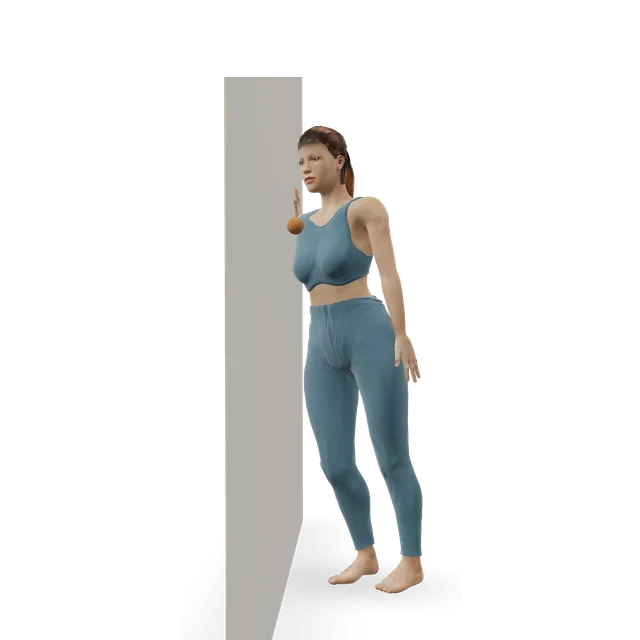
Chest: stand side-on to a wall with a massage ball on the chest muscle just below the collarbone and lean in gently, 45 to 60 seconds a side. Keep it off the armpit and the front of the shoulder joint.
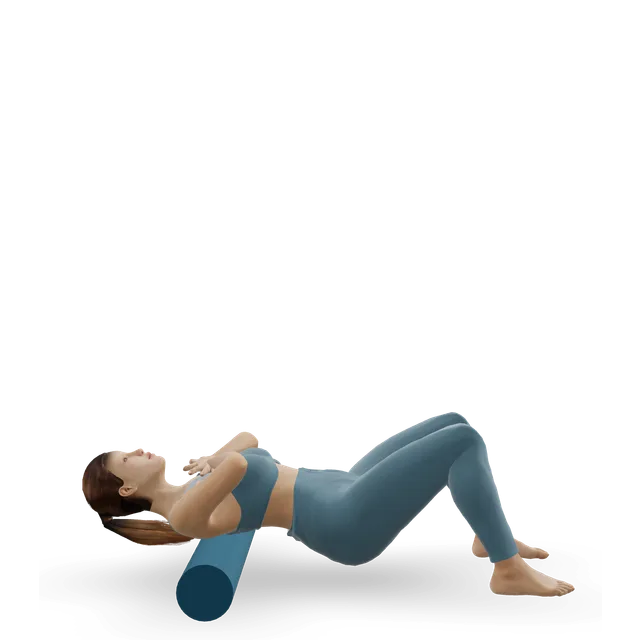
Upper back: lie with a foam roller across your upper back, arms crossed, and roll slowly for about 90 seconds. Keep the roller off your neck and lower back.
Arch: rest your upper back over the still roller with your head supported, and take 5 to 8 slow breaths at each of 3 or 4 spots along the upper back.
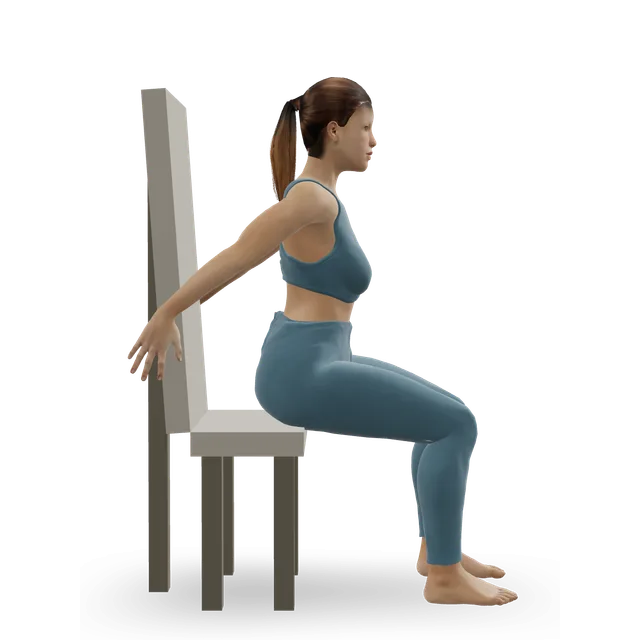
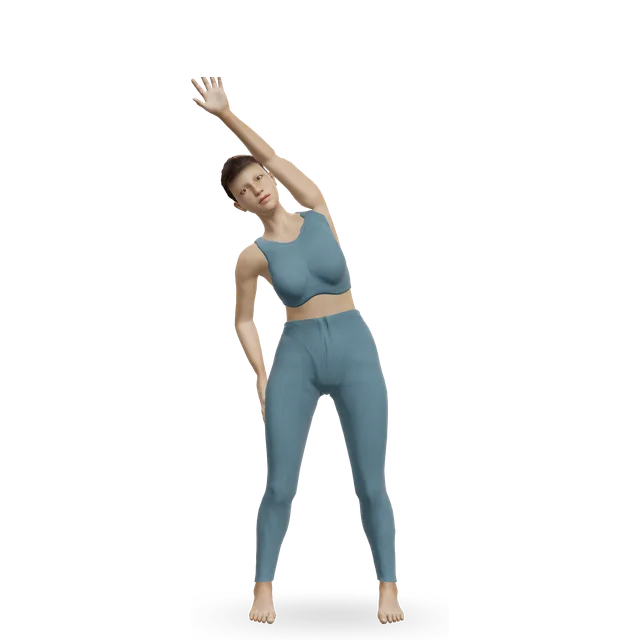
Turn: sitting or standing tall with your arms wide, turn through your upper back, 6 times each side, moving with the breath.
Strengthen: band rows, 3 sets of 10 to 15. With thin bones, do the seated upper back lift instead: 3 to 5 lifts, each held 3 to 5 seconds.
Two or three times a week, add prone Y-T-W raises or wall angels, 2 sets of 8 to 10.
Keep the strength work going 2 or 3 times a week for at least 8 weeks if you want posture to change.
Loading the 3D figure…
Drag to turn
Gets into position, then repeats the movement. Technical checks passed; qualified exercise review is pending.
Each dose names its source or is our editorial starting point. Doses are starting points, not prescriptions.
Release
The chest ball against a wall, 45 to 60 seconds a side, and the upper back roll, about 90 seconds: the move pages' doses (the chest ball's is editorial; the roll's comes from a review of rolling studies). Use a pressure you can breathe through.
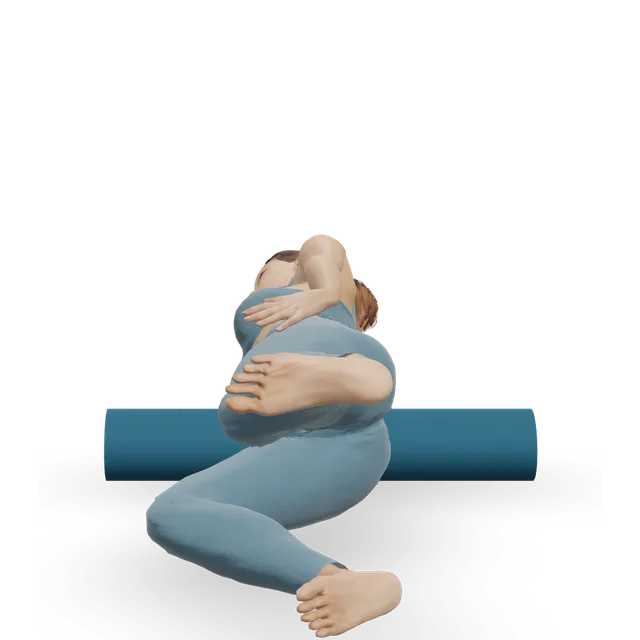
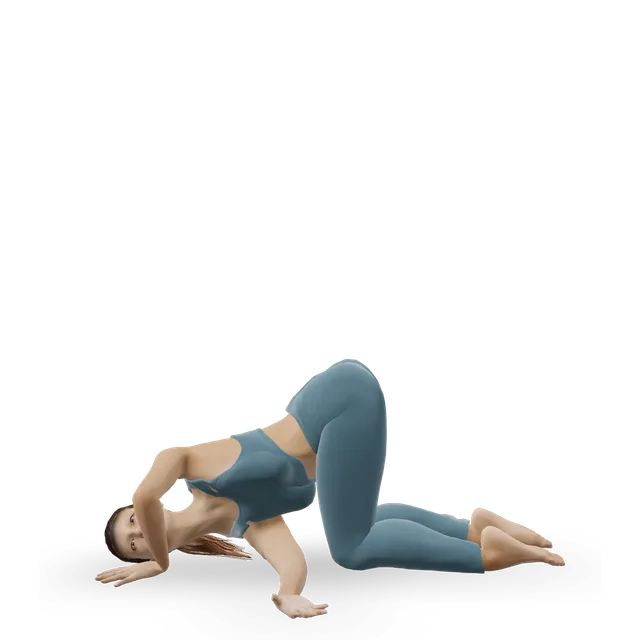
The roller arch, 5 to 8 slow breaths at each of 3 or 4 spots (its move page's editorial dose); the seated or standing rotation, 6 each side (its move page's dose); the side-lying open book, 8 to 10 slow openings each side (its move page's editorial dose).
Strength: the part that changes posture
Band rows, 3 sets of 10 to 15 (the move page's editorial dose), and the seated upper back lift, 3 to 5 lifts held 3 to 5 seconds at least twice a week (the move page's dose, from the UK osteoporosis consensus). Prone Y-T-W raises, wall angels, band pull-aparts and chin tucks have no page dose: 2 sets of 8 to 10 is our editorial starting point. Two or three sessions a week for 8 weeks or more is our editorial starting point, in line with the trials that did best.
Safety: where not to roll, and who should ask first
Where not to roll
The front and sides of the neck, and the neck itself.
The lower back, the armpit and the front of the shoulder joint.
Over chest pain: get chest pain checked first.
Bruises, broken skin or a recent injury.
Thin bones
With osteoporosis, ask before rolling the upper back or ribs: the NHS notes that a cough or sneeze can sometimes break a rib. UK experts advise avoiding positions that round the spine a lot. With osteoporosis, skip the foam roller unless a physiotherapist has cleared it.
Keep the pressure light, or ask your doctor first, if you take blood thinners, which make bruising more likely, or have a nerve condition such as peripheral neuropathy: the NHS lists these among the reasons hands-on treatments may not be safe.
In an expert consensus of 37 researchers, open wounds and broken bones were reasons not to roll, and inflammation, a clot, a bone infection or bone forming in a muscle after an injury were at least reasons for caution.
The 999 and see-a-GP signs are near the top of this page.
Same day (GP or NHS 111)
Same day (GP or NHS 111): back pain and you feel hot, cold, shivery or generally unwell, or severe pain that starts suddenly or is getting worse quickly.
Call 999 or go to A&E
Call 999 or go to A&E: back pain with chest pain, or back pain that started after a serious accident, such as a car crash.
See a GP
Sudden new pain in the middle or upper back after a minor fall, lift, cough or sneeze, or with no clear cause, from 50 or past the menopause, or if you take long-term steroid tablets; or height loss of 4 cm or more, or a back that is becoming more rounded: see a GP. It can be a spinal fracture; UK guidance asks GPs to think of one, especially with pain in the upper or middle back.
Back pain that hasn't improved after a few weeks of looking after it at home, stops you doing day-to-day activities, worries you, or you're struggling to cope.
Pain at the top of the back, between the shoulders, rather than in the lower back.
A curve in a child or teenager, or a curve that is getting worse: our scoliosis and kyphosis guides list the signs.
"Releasing your fascia fixes your posture"Mixed evidence
Four minutes of chest release moved the shoulders back about 5 mm, light touch about 2 mm, and nobody checked later. No trial has tested rolling alone for posture. Strengthening changed posture in trials; stretching didn't.
"Tight fascia pulls you out of alignment"Mixed evidence
Fascia links some muscles into chains, but dense fascia doesn't change shape at the forces of hands or rollers, and no study shows fascia holding a slouch.
Reviews found no agreement that postures cause back pain and no strong link between spinal curves and spinal pain, and teenage sitting posture wasn't linked with neck pain.
"A foam roller will straighten a hunched back"Mixed evidence
A roller programme in older women improved arm movement, with no comparison group and no measure of the curve. Spine strengthening is what cut the curve, by about 3 degrees over 6 months.
A popular saying with no study behind it. Posture reflects habits, strength and sometimes the bones: a stoop in later life can come from spinal fractures or disc wear.
Not on its own. In one trial, 4 minutes of chest release moved the shoulders back about 5 mm straight away, and light touch about 2 mm. Strengthening changed posture in trials and stretching didn't, so use release as a warm-up for strength work.
Does tight fascia cause bad posture?
No study shows it. Fascia links some muscles into chains, but dense fascia doesn't change shape at the forces hands or rollers apply, and tightness is a feeling rather than a measurement. Habits, strength and sometimes the bones shape posture.
Is foam rolling good for posture?
It gives a short-lived gain in how far you can move, about the same as stretching. We found no trial showing that rolling on its own changes posture, so treat it as a movement break before strength work.
Does myofascial release help forward head posture or rounded shoulders?
Briefly, at most: single sessions of release changed shoulder position by a few millimetres in small studies. Exercise made the head about 3 degrees more upright over several weeks, and strengthening is what changed rounded shoulders.
How long does it take to improve posture?
Exercise for forward head posture worked best when it lasted 8 weeks or more, for about 3 degrees of change. Spine strengthening classes 3 times a week for 6 months cut older adults' upper-back curve by 3 degrees. Pain can improve without posture changing, and the other way round.
What exercises actually change posture?
Strengthening, especially for the upper back and neck: rows, prone raises, chin tucks and back-extension work. Our posture guides have the plans.
Can myofascial release get rid of a hunchback?
A rounded upper back in later life can come from the bones, through spinal fractures or disc wear, not from fascia. The NHS says physiotherapy exercises can ease the pain and stiffness of kyphosis but won't improve the curve, and spine strengthening changed it by about 3 degrees in a trial. A new or worsening hunch needs a GP.
Can massage fix my posture?
In a 12-week exercise programme, posture improved whether sessions began with a therapist's massage or with foam rolling, the massage group a little more. Everyone did the exercises, so massage alone hasn't been shown to change posture.
Does bad posture cause back or neck pain?
Reviews found no agreement that postures cause back pain and no strong link between spinal curves and spinal pain. Adults with neck pain do hold the head slightly further forward, but they were measured once, so the pain could come first.
Is it safe to foam roll my upper back with osteoporosis?
Ask first: with osteoporosis, a cough or sneeze can break a rib, and UK experts advise avoiding positions that round the spine a lot. Seated rotations and the upper back lift are the usual swaps.
When should I see a doctor about my posture?
See a GP about new hunching, a change in posture, height loss or unexplained back pain with muscle spasms, especially after a minor fall or from 50, after the menopause or on steroid medicines. These can be signs of spinal fractures from osteoporosis.
Movement education, not medical advice. Stop for sharp or increasing pain, numbness or tingling, and get individual advice if you are pregnant, after an injury or surgery, or managing a health condition. Health disclaimer.