Rolling buys a few minutes
Across 26 trials, mostly of the legs, one rolling session gave a short-term gain in range about the same as stretching. We found no trial of upper back rolling on its own for upper back pain.
Fascia guide
Upper back release usually means rolling on a foam roller across your upper back, leaning into a ball between your shoulder blades, or arching your upper back over a still roller and turning through it. It can ease tightness and make turning and reaching feel freer for a few minutes, mostly by changing what your nervous system allows. It doesn't break up knots or release fascia.
The honest headline: we found no trial of upper back rolling on its own for upper back pain, and hands-on treatments did little more than a placebo in the best trials. What lasts is strength work for the back and shoulders: even 2 minutes a day eased neck and shoulder pain and tenderness in a trial of 198 workers.
This guide shows how to roll, arch and turn your upper back safely, what trials found for knots, desk work and posture, a routine to follow, and the warning signs that mean upper back pain needs checking first, because pain between the shoulder blades can come from the heart or lungs.
Across 26 trials, mostly of the legs, one rolling session gave a short-term gain in range about the same as stretching. We found no trial of upper back rolling on its own for upper back pain.
Dense fascia needs far more force than a roller applies to change shape. Pressure on a tender spot eases it for a while, through the nervous system, not by breaking anything up.
In 198 workers, 2 minutes a day of elastic band exercises eased neck and shoulder pain and muscle tenderness over 10 weeks. A Cochrane review rates the evidence for strengthening the neck, shoulders and shoulder blades as moderate.
For upper back pain, manipulation gave a small, clinically unimportant short-term benefit against a placebo, and in 143 people neither manipulation nor instrument scraping beat a placebo at any point up to a year.
The heart, a clot in the lungs and a torn main artery can all cause it, and the NHS says to see a GP for back pain that comes from the top of your back rather than the lower back. The warning signs are below.
The thoracic spine runs from the base of the neck to the bottom of the ribs, with 12 pairs of ribs joined to it. The shoulder blades sit on the back of the ribcage. Between and over them lie the rhomboids and the middle and lower trapezius; the long back muscles (erector spinae) run beside the spine, and the lats wrap the side of the back. Our muscle guides cover each one, and our thoracolumbar fascia guide covers the lower back.
A review of 33 studies found upper back pain common in children, teenagers and adults, more often in girls and women. Between about 15% and 28% of people had some upper back pain over a year, depending on the study. It was linked with other aches, school bags, posture and mood, with little evidence on what causes it.
Source 13
A modelling study found that dense fascia needs forces far outside the normal range to compress or shear by even 1%, though softer layers near the surface give way more easily. Reviewers concluded that rolling doesn't work by releasing fascia; it changes how the area feels and moves for a while, through receptors in the skin and fascia, the body's own pain control and muscle tone.
Tender spots in the rhomboids and trapezius are real sensations, often called trigger points. Examiners don't reliably agree where they are, as our trigger points guide explains. In trials, holding pressure eased their tenderness for a while, and strength training reduced muscle tenderness over 10 weeks.
In a review of 10 studies, people with and without shoulder pain had similar upper back curves, though sitting upright let people lift their arm higher in the moment. In footballers, 6 weeks of upper back exercises improved rotation but didn't change the curve. Our kyphosis and rounded shoulders guides cover what changes posture.
A meta-analysis of 26 trials found a large short-term gain in range against no exercise, the same as stretching, and how long or how fast people rolled made no clear difference. Across 20 studies, single bouts of rolling and stretching matched straight after and at 10, 15 and 20 minutes. Almost all of these trials rolled the legs.
In 52 people with neck pain, one session of arching and bending the upper back over two tennis balls taped together improved neck movement straight away against a placebo version, with no difference in pain or disability.
Source 16
In 30 people with upper back muscle pain, both a tennis ball technique and Bowen therapy, 3 times a week for 4 weeks, eased pain and disability, Bowen more. There was no untreated group, so time alone may explain some of the change.
Source 17
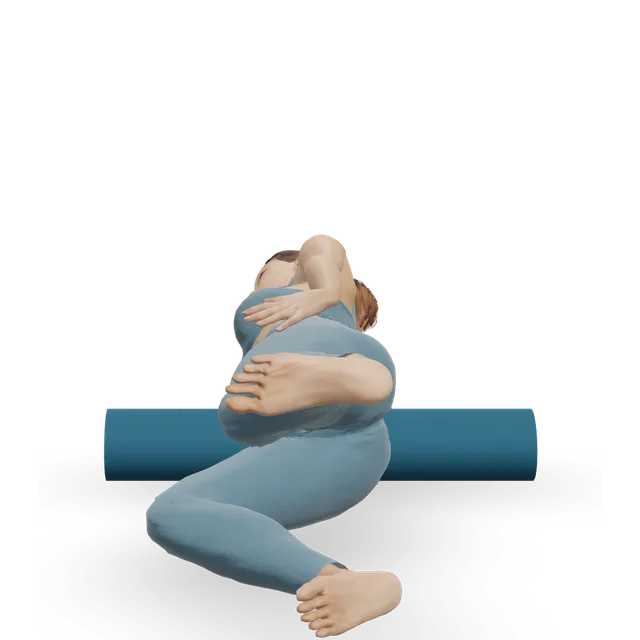
In 42 professional footballers, six supervised upper back exercises, including foam roller extension and an open book from a side plank, 3 times a week for 6 weeks, improved rotation a lot, but the curve of the upper back didn't change. In 11 older women with a rounded upper back, 20 minutes a day on a long foam roller for 8 weeks improved how far they could lift their arms, with no comparison group. In 30 students, a 12-week corrective programme improved posture and pain whether it began with a therapist's massage or with foam rolling, the massage group a little more.
A review found only 2 low-risk trials of treatments without medicines for upper back or chest wall pain: manipulation gave a statistically significant but clinically unimportant short-term benefit against a placebo, and acupuncture did no better than a placebo. In 143 people, up to 10 sessions of manipulation, Graston scraping or a switched-off ultrasound placebo made no difference to pain or disability at any point from 1 week to 12 months; everyone improved with time.
Across 14 trials, a therapist's thrust to the upper back eased neck pain by about 13 points out of 100 more than gentler mobilisation or standard care in the short term, but did no better than a placebo thrust or neck manipulation, on very low to moderate certainty evidence. This is a therapist's technique, not self-release.
Source 20
In 119 people with trigger points in the upper trapezius, gentle pressure for 90 seconds, or firmer pressure for 30 seconds, eased them straight away. In 40 people with trigger points in the neck or upper back, a 5-day home programme of pressure followed by stretching eased pain and tenderness more than range-of-movement exercises.
In 198 workers with frequent neck and shoulder pain, elastic band training for 2 or 12 minutes a day, 5 days a week for 10 weeks, eased pain by 1.4 and 1.9 points out of 10 and reduced muscle tenderness, more than health advice. In 549 office workers, a year of strength training or all-round exercise eased neck, lower back, elbow and hand pain more than a comparison programme. A Cochrane review found moderate quality evidence for strengthening, while stretching alone may not change neck pain.
For neck pain, a Cochrane review of 33 studies found massage probably makes little or no difference against a placebo up to 12 weeks, on low certainty evidence, mostly after single sessions. Courses of 8 or more sessions over 4 weeks looked more useful.
Source 23
Across 29 trials, neck strengthening and changes to the workstation eased office workers' neck pain, on low quality evidence. A review of 7 trials (967 people) found workplace exercise helpful, but rated 6 of the trials at high risk of bias.
We found no trial of upper back rolling, a peanut ball or a massage gun for upper back pain. Most of these studies are small, and we read their summaries (abstracts), apart from the footballers' trial, which we read in full.
Steps 1 and 2 follow the upper back rolling move's page, which gives about 90 seconds for each muscle you roll; step 4 is the roller extension page's dose, which it calls our editorial starting point; the open book and band row doses are their move pages', both editorial. The hold times come from a pressure trial (Hou 2002) and the 2 minutes of band work from a trial of 198 workers (Andersen 2011). One or two spots is our editorial starting point. No trial has tested this sequence.
Loading the 3D figure…
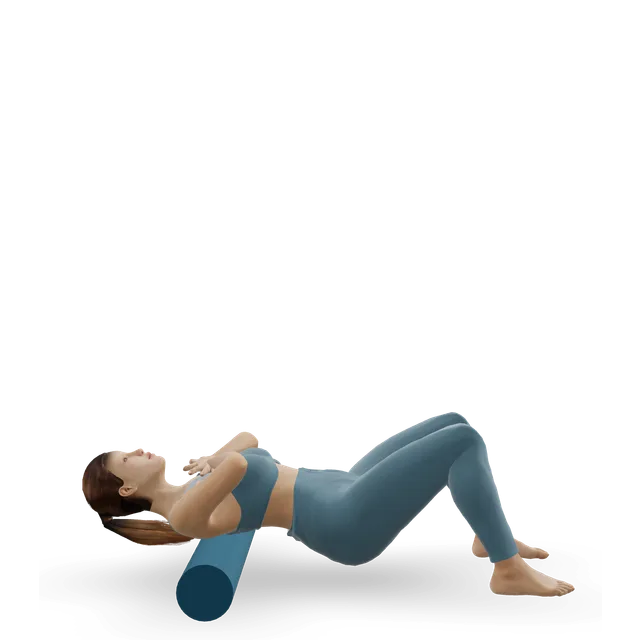
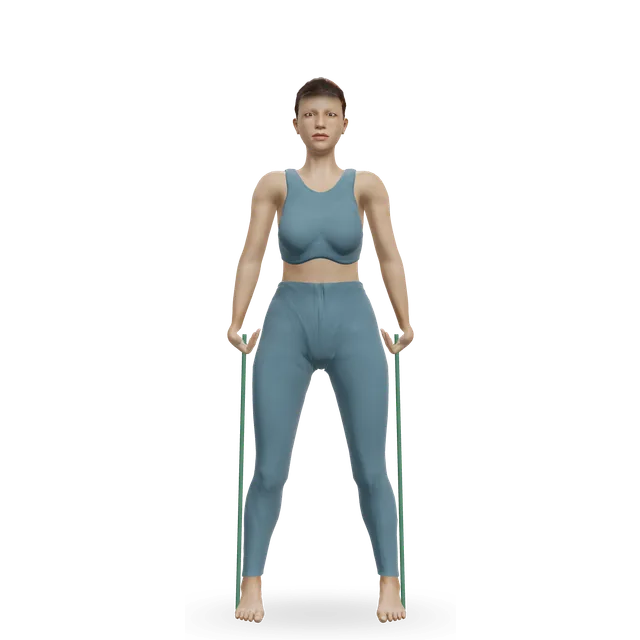
The movement on the figure: Foam roller thoracic extension
Each dose names its trial or move page, or is our editorial starting point. Doses are starting points, not prescriptions.
About 90 seconds on the upper back, the move page's dose, at a pressure you can breathe through: in a thigh trial, rolling pressures of about 4, 6 and 8 out of 10 gave the same gain. Our foam rolling guide has the full technique.
Stand with your back to a wall and a ball between your shoulder blade and spine, or use two tennis balls taped together or a peanut-shaped ball, which keeps pressure off the bony spine. Bend your knees a little to move it, and hold a tender spot for 30 to 90 seconds, the times from the pressure trial. There's no ball demo yet; our massage balls guide has the same steps.
Source 5
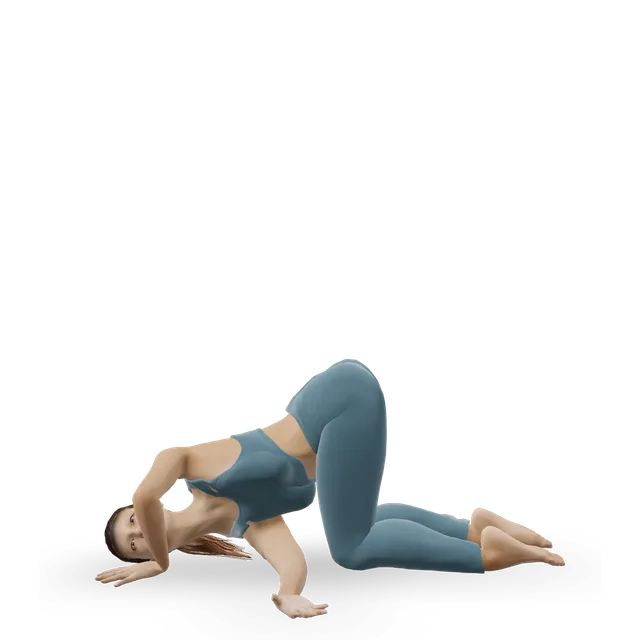
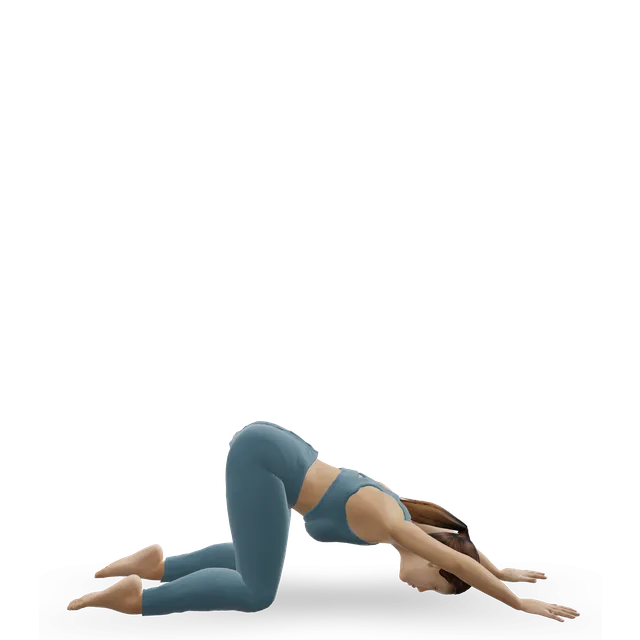
Roller extension: 5 to 8 slow breaths at 3 or 4 spots, the move page's dose, which it calls our editorial starting point. Thoracic rotation: 6 each side, moving with the breath, the move page's dose. The side-lying open book: 8 to 10 slow openings each side, the move page's dose (editorial).
Get up and move around every hour or so, the NHS's advice for lowering the risk of clots, and turn your upper back while you're up: 6 thoracic rotations each side, the move page's dose. Strength work and a well set-up workstation helped office workers' neck pain in trials; our sitting guide covers the desk.
Across 38 studies, rolling and stretching gave no more flexibility than other warm-ups, so a general warm-up does as much. If you like rolling first, keep it brief.
Source 28
Roll the upper back and the side of the back, then arch over the still roller, using each move page's dose; keep the roller off the neck, the low back and the armpit.
Use these straight after rolling, while the extra ease lasts, and move within a comfortable range.
Shoulder-blade and upper back strength work of the kind that eased pain in trials; start light and use each move page's dose where it gives one.
Start with the back release routine: gentle rolling for the upper back and lats, rotation, then two easy strength moves. The knots routine adds the shoulder strength work from the trials.
Gentle rolling for the upper back and lats, rotation and segmental spine work, then two easy strength moves. Exercise is what back-pain guidelines recommend.
15 minBeginner11 movesA foam rollerKnotted neck and shoulders: a minute of self-pressure, two gentle stretches, then the shoulder-blade strength work that eased neck pain in trials.
15 minBeginner8 movesA foam roller, A bandA 12-minute routine for a stiff upper back and rounded shoulders: chin tucks, wall angels, Y-T-W raises and open books.
12 minBeginner8 movesA foam roller, A wallA 3-minute standing break to repeat every 30 to 60 minutes at your desk: sit-to-stands, calf raises, marching, an upper-back turn and chin tucks.
3 minBeginner5 movesA bench or box, A wallA 30-minute routine for a rounded upper back in later life, built from the SHEAF trial: floor back-strengthening, posture practice and gentle mobility.
30 minBeginner13 movesA bench or box, A wallIn an expert consensus of 37 researchers, open wounds and broken bones were reasons not to roll, and inflammation, a clot, a bone infection or bone forming in a muscle after an injury were at least reasons for caution.
Source 30
With osteoporosis, ask before rolling the upper back or ribs: the NHS notes that a cough or sneeze can sometimes break a rib. UK experts advise avoiding positions that round the spine a lot. In a case series of 3 rib fractures after spinal manipulation, the patients were aged 57 to 77 and two had thinning bones. Gentle rotation is the usual swap, as our upper back pain guides say.
Keep the pressure light, or ask your doctor first, if you take blood thinners, which make bruising more likely, or have a nerve condition such as peripheral neuropathy: the NHS lists these among the reasons hands-on treatments may not be safe.
In later pregnancy, the NHS advises avoiding anything that means lying flat on your back for more than a few minutes, so do the rotations sitting or side-lying and leave the roller out.
Source 36
Get help from NHS 111: pain or tightness in your chest, neck, shoulders, jaw or arms that comes and goes, often brought on by exercise, stress, emotion or cold and easing after a few minutes' rest. It can be angina, a sign of a heart problem. If you've been diagnosed with angina, get help from NHS 111 too if it feels worse than before, is happening more often, lasts longer or happens when you're resting.
Source 38
Source 12
Dense fascia needs far more force than a roller gives to change shape, and reviewers concluded rolling doesn't work by releasing fascia. Pressure eases a tender spot for a while; strength work reduced muscle tenderness over 10 weeks.
Six weeks of upper back exercises, foam roller extension among them, improved rotation but not the curve in 42 footballers, and a roller programme in older women measured arm movement, not the curve. Our kyphosis and rounded shoulders guides cover what changes posture.
We found no evidence that the pops mean anything has moved back into place. Manipulation, which often pops, did no better than a placebo for upper back pain in a trial of 143 people.
Upper back pain goes with other aches, posture and mood, and the heart, a clot in the lungs or a torn main artery can cause pain between the shoulder blades. Warning signs come first.
Moderate rolling pressure gave the same range as hard pressure in a trial, and gentle pressure for 90 seconds eased tender spots as well as firmer pressure for 30.
Graston scraping did no better than a placebo for upper back pain at any point up to a year, and nothing shows that tools change fascia. Our muscle scraping and massage gun guides cover them.
Roll slowly on a foam roller across your upper back for about 90 seconds, then let your upper back drape over the still roller for a few breaths at 3 or 4 spots, and turn with an open book. The ease lasts minutes, so follow it with band rows or a couple of minutes of shoulder strength work, which is what eased pain in trials.
Lean on a ball against a wall, or lie on a roller, and hold a tender spot for 30 to 90 seconds: it eases the tenderness for a while. For knots that keep coming back, strength training helped most in trials: 2 minutes a day of band exercises eased neck and shoulder pain and tenderness over 10 weeks.
No. Dense fascia needs far more force than a roller applies to change shape. Rolling seems to work through the nervous system, easing how the area feels for a few minutes.
Yes, against a wall or on the floor, on the muscle beside the spine rather than on the bony middle. Two tennis balls taped together, or a peanut-shaped ball, keep the pressure off the spine. In a small trial, moving the upper back over taped tennis balls improved neck movement straight away.
For most people, yes, if you keep the roller off your neck and lower back and use a pressure you can breathe through. Ask first if you have osteoporosis, and don't roll through upper back pain that comes with chest pain, breathlessness or sweating: call 999.
Joints can pop when they move; it isn't a sign that anything has gone back into place. Manipulation, which often pops, did no better than a placebo for upper back pain in a trial.
Not that any trial shows: 6 weeks of upper back exercises improved rotation but not the curve in footballers. Our kyphosis and rounded shoulders guides cover what changes posture.
Rotation and extension moves such as the open book, thread the needle and arching over a roller. No trial has picked a best one; they ease stiffness for a while, and strength work makes the gains last.
You can, as a comfort break, but getting up every hour or so and doing strength work have more support: strength training and workstation changes eased office workers' neck pain in trials.
Usually not, but pain between the shoulder blades with chest pain, breathlessness, sweating or feeling sick needs a 999 call, and so does sudden pain that feels like tearing. See a GP if your back pain comes from the top of your back rather than your lower back.
It eases how the muscles feel for a while, like rolling. Keep it on the muscle, off the spine and neck, and keep it light or ask your doctor first if you take blood thinners.
Movement education, not medical advice. Stop for sharp or increasing pain, numbness or tingling, and get individual advice if you are pregnant, after an injury or surgery, or managing a health condition. Health disclaimer.