Cuban rotation
The upper arms out at shoulder height, the elbows bent to a right angle, the forearms turn up to vertical and back: external rotation at 90 degrees of abduction. Shoulder programmes bring it in after rotation with the elbow at the side, once strength and control return, since the raised arm is the position most prone to impingement.
Shoulder rotation family
Cuban rotation
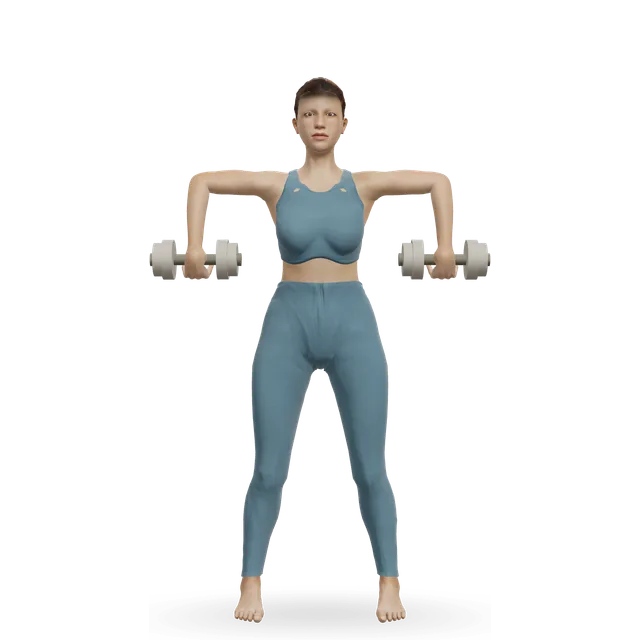
Loading the 3D figure…
Source-researched guide.
How to move
- Raise the upper arms out to shoulder height, the elbows bent to a right angle and the forearms hanging forward.
- Turn the forearms up until they point at the ceiling, the upper arms still.
- Lower them slowly.
Form cues
- Use very light weights or a band.
- Keep the elbows at shoulder height.
Practice and cautions
No universal dose is assigned. Choose a manageable amount for your current capacity, leave room for controlled repetitions, and allow recovery. A clinician’s individual plan takes priority.
The muscles doing this work are small: a weight that feels insultingly light is correct, and going heavy turns the drill into a shrug or a strain. A sharp pinch at the top means reduce the range or the load. This is movement education, not an assessment or treatment prescription. Stop for sharp or increasing pain, dizziness, numbness or tingling; seek individual guidance for symptoms, injury or restrictions.
Sources and review status
Sources support the educational description; they do not establish that this exercise is suitable for you.
- NHS Ayrshire & Arran · Exercises for painful and weak shoulders (rotation with the elbow at the side at levels 1 and 2; rotation with the arm raised to 90° at level 3, then standing with a weight or band) ↗
- Wilk 2006 · Non-operative shoulder instability rehabilitation (external rotation at the side first; at 90° of abduction in the advanced phase; NAJSPT) ↗
- Reinold 2010 · The overhead thrower's shoulder, part 2 (side-lying rotation in the intermediate phase; tubing at 90° of abduction once strength and control return; Sports Health) ↗
- Reinold 2004 · Rotator cuff activity in external rotation exercises (side-lying highest; EMG, JOSPT) ↗
No variation is labeled clinically validated.
What it works
Muscles
Main: Shoulders.
Anatomy: Deltoid, Rotator cuff, Supraspinatus, Infraspinatus, Subscapularis, Teres minor.
Equipment
A dumbbell + A band
Level
Intermediate. See the easier and harder options above.
Workouts that use it
Pain guides that use it
Part of a staged plan, with when to get help first.
- Shoulder impingement and rotator cuff pain: the exercises that help, and what surgery trials found
- Shoulder pain when swimming (swimmer's shoulder): what to change in the pool and how to build back
- Back of shoulder pain: the rotator cuff, the joint, the neck, a trapped nerve and how to build back
- Shoulder pain from surfing (surfer's shoulder): paddling, pop-ups, wipeouts, the neck and what helps
Guides that use it
Similar moves
Browse more
Questions people ask
What muscles does the Cuban rotation work?
Mainly the shoulders.
What equipment do I need for the Cuban rotation?
A dumbbell + A band.
Is the Cuban rotation good for beginners?
It is graded intermediate. If it is too hard right now, start with the Side-lying external rotation.
What is an easier alternative to the Cuban rotation?
Try the Side-lying external rotation or the Standing band external rotation. Both are written steps in the same progression.
How do I make the Cuban rotation harder?
Progress to the Cuban press. Follow that guide’s technique and any stated timing.