Training guide

How to do step-downs: the step height, knee control, step-downs for knee pain and the glutes, and how many

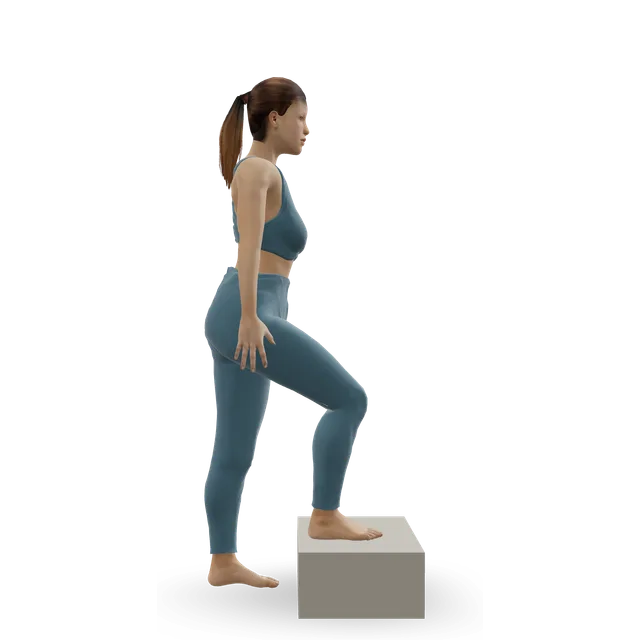
A step-down is a slow single-leg lowering off a step: standing on one leg, you bend that knee and hip to lower the other heel to the floor, tap it, and straighten back up. Start on a low step or the bottom stair, keep your knee over your middle toes and your pelvis level, and do 2 sets of 8 slow reps on each leg.

Step-downs train your thigh and hip to control your knee, for stairs, downhills and sport. The step's height sets how hard they are on your knee: lowering off a step loaded the kneecap more than stepping up onto it, and a higher step more than a lower one, so they come after step-ups.

This guide shows the forward and lateral step-downs, step height, knee control, where they fit with knee pain, what they do for your glutes, the step-down tests, and how many.

The short version

Lower slowly off a low step

Stand on one leg on a low step, the other leg free in front. Bend the standing knee forward over its toes and sit your hips back a little, lowering the free heel to the floor over about 3 seconds, tap it, and straighten back up. The lateral step-down lowers the free foot beside the step instead.

Source 1

The step's height is the dial

In 20 healthy adults, lowering off a step loaded the joint behind the kneecap more than stepping up the same step, and a higher step more than a lower one. A higher box also made knee control worse. Start at about 10 cm or the bottom stair and build towards 15 to 20 cm (our editorial heights).

Sources 2, 3

With kneecap pain, step-ups come first

Because they load the kneecap more, step-downs come after low step-ups, not before. Hip and knee exercise helps kneecap pain, but no trial has compared step-downs with step-ups.

Sources 2, 4, 5

Your knee can pass your toes; don't let it cave in

The knee travelling forward is part of the move: blocking it in a squat shifted load onto the hips and lower back. The fault to fix is the knee drifting inwards, which a stiff ankle makes more likely.

Sources 6, 7

Light glute work, good control work

From a 15 cm step, glute activity was low to moderate. Step-downs train control of your hip and knee; loaded step-ups, hip thrusts and squats build the glutes.

Source 8

How many

2 sets of 8 slow reps on each leg from a low step, building to 3 sets of 8 to 10, 2 or 3 times a week: our editorial starting point. A kneecap pain trial used 3 sets of 10, three times a week, inside a hip and knee programme.

Source 9

What step-downs are, and what they work

Forward, lateral, backward and eccentric

A step-down is any slow single-leg lowering off a step. In the forward step-down, the one on our 3D figure, the free heel reaches forward to tap the floor; in the lateral step-down the free foot lowers beside the step, as in the clinical test; in the backward one it lowers behind you. "Eccentric step-down" means the same move with the emphasis on a slow lowering.

Peterson, Patrick and Poliquin step-downs are coaches' names for the forward step-down with the knee travelling well over the toes. The Poliquin step-up is its mirror.

Source 1

The joints

The standing knee bends to roughly 45 to 60 degrees (studies set the step height to reach that bend), the hip bends, the ankle bends as your shin moves forward, and your pelvis has to stay level on one leg.

Sources 4, 10

The muscles

The front of your thigh (the quadriceps) controls the lowering, working while it lengthens. The side of your hip (the gluteus medius) holds your pelvis level and, with the gluteus maximus, keeps your knee from drifting in; your calf steadies the foot.

From a 15 cm step, gluteus maximus activity was 8 to 13% and gluteus medius 19 to 27% of a maximal effort, and women worked nearer their maximum than men.

Source 8

Muscle activity isn't growth

Those figures are EMG (electromyography: electrodes measuring how hard a muscle works over a few reps), which shows effort in one session, not what a muscle builds over months.

Source 11

What you need first

Steady balance on one leg, as the move page asks, and comfortable low step-ups, as our step-up guide teaches.

How people differ

A stiff ankle makes the knee drift in and the hip drop: limited ankle bend was the clearest difference between people who moved well and less well in the lateral step-down, in healthy women and in soldiers with kneecap pain. Older adults go downstairs nearer their maximum strength than young adults, so a low step-down is real training for them. Kneecap pain is typically worse on stairs and when squatting.

Sources 12, 13, 14, 15

What the evidence says

Lowering off a step loads the kneecap more than stepping upEmerging evidence

In 20 healthy adults, lowering off a step loaded the joint behind the kneecap more than stepping up the same step, and a higher step loaded it more either way. The paper doesn't make clear which kind of step-down it measured. In another 20 adults, with the step set so the knee bent to 45 degrees, the forward step-down put more stress on the kneecap than a forward or a lateral step-up (13.8 against 11.2 and 11.5 megapascals). Both studies estimated the loads with models, and we read only the second one's abstract.

Sources 2, 4

A low step-down is still a modest tendon loadEmerging evidence

In the same 20 people, a step-down from the low step was in the lowest of three tiers of load on the tendon below the kneecap, and one from the high step in the middle tier. The two papers on these people give the step heights differently, so we don't quote them.

Source 16

Harder on the hip than a step-upEmerging evidence

In 20 adults, the step-down and the single-leg squat were the most demanding tasks for the hip and the step-up the least, with a half step-down in between. We read only the abstract.

Source 17

Low to moderate glute activityEmerging evidence

Bodyweight step-downs from a 15 cm step drew 8 to 13% of a maximal effort from the gluteus maximus and 19 to 27% from the gluteus medius in 34 adults, and the authors wrote that "None of the subjects generated sufficient EMG activity for strength gains". Another study found 13 to 14%. In reviews, lateral and crossover step-ups reached far more (79 to 113%), and step-downs gave "small excitation in males and moderate excitation in females".

Sources 8, 18, 19, 20

The ACL: about the same as a step-upEmerging evidence

In 9 people with a strain gauge on a normal ACL (anterior cruciate ligament), step-downs strained it about as much as step-ups, with no significant difference between the four exercises tested.

Source 21

Everyday stairs are a different taskEmerging evidence

In a review pooling studies of healthy people, walking down stairs loaded the kneecap no more than walking up (2.8 against 3.2 times body weight). An exercise step-down is a slow lowering on one leg, so the stair figures don't transfer to it. We read only the abstract.

Source 22

Higher boxes make control harderEmerging evidence

In 20 people at least a year after ACL reconstruction, lateral step-downs from a 15 cm box showed more pelvic drop and more of the thigh drifting in than from a 10 cm box, and worse movement scores.

Source 3

A step-down isn't the same as a single-leg squatEmerging evidence

In 14 healthy adults at the same 60 degrees of knee bend, the step-down had more hip adduction (the thigh drifting in) and the single-leg squat more of the knee buckling inwards, though people's hip and knee angles still tracked together across the two.

Source 23

How to do a forward step-down, step by step

Steps from our move page ("Bend the standing knee forward over its toes, reaching the free heel forward and down until it just touches the floor"; "Keep the standing knee in line with its toes"). The 3-second lowering follows our step-up and hiking workouts; the step height and where to end the set are editorial.

  1. Stand tall on a low, stable step (about 10 cm, or the bottom stair with a hand on the rail), one foot near the edge and the other just off it in front.
  2. Put your weight through the whole standing foot, the knee soft and in line with your middle toes, your pelvis level and your hands on your hips or the rail.
  3. Breathe in and slowly bend the standing knee forward over its toes, sitting your hips back a little, so the free heel lowers towards the floor over about 3 seconds.
  4. Tap the heel lightly on the floor without putting weight on it.
  5. Breathe out and straighten the standing leg to rise back to the top.
  6. Do all your reps on one leg, then switch. End the set 2 or 3 good reps short, or when your knee starts to cave in or your pelvis drops.

Loading the 3D figure…

Gets into position, then repeats the movement. Technical checks passed; qualified exercise review is pending.

The movement on the figure: Patrick step-down

How to do a lateral step-down

We have no 3D demo of the lateral version, so the figure shows the forward step-down; the standing leg does the same job. The set-up follows the clinical lateral step-down test (Piva 2006); the tempo and step height are editorial.

  1. Stand side-on at the edge of a low step on one leg, the free foot hanging just off the side.
  2. Put your hands on your hips, stand tall and keep your pelvis level.
  3. Breathe in and bend the standing knee to lower the free foot slowly, over about 3 seconds, until its heel touches the floor beside the step.
  4. Keep the standing knee over your second toe and your trunk upright, without leaning.
  5. Breathe out and straighten the standing leg to rise back up.
  6. Do all your reps, then turn round and work the other leg.

Loading the 3D figure…

Gets into position, then repeats the movement. Technical checks passed; qualified exercise review is pending.

The movement on the figure: Patrick step-down

Backward, half and weighted step-downs

No 3D demo for these; the forward step-down demo shows the standing leg.

Backward

Stand facing away from the edge and lower the free foot behind you. It's another way to vary the move; nobody has compared it with the forward or lateral version.

Half step-down

Lower only part of the way, then come back up. In one lab study it was less demanding for the hip than a full step-down and more than a step-up, so it's a natural step between them.

Source 17

With weights

Hold dumbbells at your sides and go back to a lower step. Coaches load step-downs with dumbbells, kettlebells or a barbell, though Catalyst Athletics notes they're used more for knee care than as a main leg strength exercise.

Source 24

How high should the step be?

Start low and build up

About 10 cm, or the bottom stair with a hand on the rail. Raise it a few centimetres at a time towards 15 to 20 cm, the height the clinical tests use, once every rep keeps your knee over your toes and your pelvis level. That's our editorial progression; the Chartered Society of Physiotherapy's step exercise uses a step of about 12 to 18 cm.

Sources 1, 25

A higher step loads the kneecap moreEmerging evidence

In 20 healthy adults, a higher step loaded the joint behind the kneecap more than a lower one, and a step-down more than a step-up from the same step. A step-down from the low step still loaded it less than a lunge or a single-leg squat to 60 degrees.

Source 2

A higher step is harder to controlEmerging evidence

Movement scores were worse from 15 cm than from 10 cm after ACL reconstruction. If your knee starts to cave in, the step is too high for now.

Source 3

Height before weight

Raise the step before you add weight. When you add dumbbells, drop back to a lower step and build up again, as our step-up workout does (editorial).

From step-ups to pistol squats

Low step-ups, 8 each leg, and step-ups, 3 sets of 8 to 12 each leg (our step-up workout); the forward step-down, 2 sets of 8 slow reps each leg from a low step (our step-up workout, editorial), building to 3 sets of 8 to 10 (our knee guides, editorial); then skater squats and pistol squats, 3 sets of 5 to 8 each side (our pistol squat progression). The Poliquin step-up is the step-down's mirror: 2 sets of 8 slow reps per side (its move page's dose).

Knee control: your knee, hip and ankle

Knee over your middle toes

Keep the middle of your kneecap over your second or middle toes as you lower. An NHS trust leaflet puts it as "make sure your knees stay in line with your feet".

Source 26

Your knee can go past your toes

That's part of a step-down. In a squat, blocking the knees from moving forward cut the load at the knee a little but raised the load at the hip about tenfold. More forward travel does raise kneecap stress, so with a sore kneecap a little less travel and a lower step is a sensible short-term change.

Sources 6, 27

Keep your pelvis level

A hip that drops on the free-leg side is one of the faults raters look for, and poor ratings went with more pelvic drop measured in 3D. Hands on your hips help you feel it.

Sources 28, 29

Check your ankle

Limited ankle bend went with the knee drifting in and the hip dropping in the lateral step-down, in healthy women, healthy adults and soldiers with kneecap pain. These were snapshots, not trials. If your heel lifts or your knee can't travel forward, add knee-to-wall rocks, 10 slow rocks per side daily (the move page's dose).

Sources 12, 13, 7

Strengthening changed how the knee movedEmerging evidence

In 40 women with kneecap pain, only the hip and quadriceps strengthening groups reduced how often the knee caved in during step-downs. In 34 young women whose knees caved in, 8 weeks of hip and trunk strengthening reduced the thigh drifting in during the step-down. Adding movement-control training to strengthening gave no clear extra benefit in 34 women with kneecap pain.

Sources 30, 31, 10

Knock knees

How your knees line up when you stand is a separate question; our knock knees guide covers it.

Step-downs and knee pain

Hip and knee exercise helps kneecap painStrong evidence

An international consensus says "Combining hip and knee exercises is recommended to reduce pain and improve function in the short, medium and long term", in preference to knee exercises alone. It doesn't name step-downs.

Source 5

Step-downs were part of a programme that workedEmerging evidence

In 42 women with kneecap pain, 4 weeks of hip and knee strengthening plus movement training that included step-downs, 3 sets of 10 three times a week by video call, cut pain by 3.7 cm more on a 10 cm scale than stretching. The step-down's own share can't be separated.

Source 9

No trial has compared step-downs with step-ups

From the same step, a step-down loads the kneecap more, which makes it the harder, later exercise, not the better treatment.

Sources 2, 4

When to add them

Start with low step-ups, stepping down with the working foot first, and add step-downs from a low step once step-ups are comfortable. NHS inform's advice for stairs is to "lead with your problem leg when going downstairs", and one NHS trust leaflet brings the step-down in at its third stage. Our runner's knee, front of knee pain and knee pain on stairs guides bring them in at their later stages.

Sources 32, 33

The knee pain rule

Pain from 0 to 2 out of 10 is fine, and up to 5 is acceptable if your knee is back to its usual level by the next morning; for tendon pain just below or above the kneecap, keep it to 3 or less. Sharp, catching or giving-way pain, or new swelling, means stop. That's our knee guides' rule.

NHS inform's kneecap pain exercises keep pain within 0 to 5 out of 10.

Source 34

Tendon pain below the kneecap

A step-down from a low step was a low tendon load in healthy adults. With jumper's knee, follow our jumper's knee guide's stages and keep the pain to 3 or less.

Source 16

After knee surgeryEmerging evidence

Lowering-focused training after ACL reconstruction grew the quadriceps 23.3% against 13.4% at a year, and after a knee replacement it helped people go downstairs, but both trials used motorised machines, not step-downs. Step-downs come in at your surgical team's stage, usually from the bottom stair holding the rail; our ACL surgery and knee replacement guides have the stages.

Sources 35, 36, 37

The lateral and forward step-down tests

How the lateral step-down test works

You stand on a 20 cm step with your hands on your waist and do 5 slow step-downs while an observer scores five things: using your arms, leaning your trunk, your pelvis dropping, your knee drifting in (2 points if it crosses your second toe) and wobbling. A score of 0 or 1 is good, 2 or 3 medium, and 4 or more poor.

Source 1

Raters agree only moderatelyMixed evidence

Agreement between raters, scored as kappa (0 is chance and 1 perfect agreement), was 0.67 in the original study, 0.40 to 0.65 between physiotherapists rating 22 people with kneecap pain, and 0.59 to 0.81 in a review of 16 studies, which also found no agreed way to run the test.

Sources 1, 38, 39

The forward step-down testEmerging evidence

In the forward version you tap the heel in front. Raters agreed well (kappa 0.80) in 26 women, and fairly to well across 142 physiotherapists, and poor ratings went with more pelvic drop in 92 healthy adults.

Sources 40, 41, 29

Neither test has been shown to predict injuryEmerging evidence

In the two prospective studies that used one, it didn't: forward step-down reps didn't predict kneecap pain over 2 years in 114 young women, and lateral step-down quality didn't predict Achilles pain in 70 recruits. For the related single-leg squat, a study of 306 young athletes found higher odds of leg injury but concluded the test "is not sensitive and specific enough to be used as a screening tool", and in 880 elite female players it predicted ACL injuries no better than chance.

Sources 42, 43, 44, 45

Use it as practice feedback

Film yourself from the front on a low step and watch your knee, pelvis and trunk. It's feedback for your training, not a diagnosis (editorial).

Sets, reps and how often

Sets and reps

Start with 2 sets of 8 slow reps on each leg from a low step (our step-up workout), building to 3 sets of 8 to 10 each leg (the dose our knee guides use). Both are editorial starting points.

They sit inside the sourced doses we found: a kneecap pain trial's 3 sets of 10, three times a week; one NHS trust leaflet's step-down "8 to 12 times, three times a day" at its third stage; another trust's step exercises at 8 to 12 reps, resting 60 to 90 seconds and repeating the set 2 to 3 times; and NHS inform's "maximum of 2 sets of 15", building up from 2 or 3 reps.

Sources 9, 33, 26, 34

Tempo

Lower over about 3 seconds, as our step-up and hiking workouts do (editorial).

How hard

Stop 2 or 3 good reps short, and as soon as your knee caves in or your pelvis drops (editorial).

Rest

About 60 to 90 seconds, or work the legs in turn (editorial); the trial rested a minute between sets.

Source 9

How often

2 or 3 times a week on days that aren't back to back (editorial); the trial used three times a week.

Source 9

Weekly sets

Count step-downs with squats, lunges and step-ups towards about 10 hard sets a week for your thighs, though from a low step they're light work for the glutes.

Sources 46, 8

Progressing

Slower lowering first, then a higher step a few centimetres at a time, then the lateral version, then dumbbells on a lower step (editorial).

Common mistakes and how to fix them

Dropping into the bottom

Lower over about 3 seconds; tap the floor, don't land on it.

The knee caving in

Keep it over your middle toes; lower the step if it keeps drifting.

The pelvis dropping or the trunk leaning

Stand tall with your hands on your hips, and strengthen the side of your hip with the moves below.

Pushing off the floor foot

Tap the heel without putting weight on it, then rise on the standing leg.

A step too high too soon

Go back down a few centimetres: control got worse from a higher box.

Source 3

Heels lifting, or the knee can't travel forward

Often a stiff ankle: add knee-to-wall rocks.

Source 7

Moves that go with it

Knee-to-wall rocks, 10 slow rocks per side daily, and the standing wall-press hip abduction, 3 to 5 holds of 5 to 15 seconds each side twice a day (their move pages' doses); lateral band walks, 2 sets of 10 steps each way, and single-leg glute bridges, 8 each side for 2 rounds (our knee control warm-up); wall sits, 30 seconds for 2 rounds, and single-leg stands, 2 holds of 30 seconds each leg (our knee strengthening workout); single-leg calf raises on the same step, 2 sets of 10 to 15 each leg (our step-up workout). The hip hitch has no 3D demo: stand side-on on the step on one leg, let the free side of your pelvis drop a few centimetres, then lift it level with the side of your standing hip, 3 sets of 15 slow reps each side 3 times a week (its move page's dose, from a runners' trial), starting with 2 sets of 10.

Workouts to follow

The step-up workout has step-downs at 2 sets of 8 slow reps each leg on the bottom stair; the knee strengthening workout and the knee control warm-up at 8 slow reps each side for 2 rounds; the hiking workout's descents at 2 to 3 sets of 8 slow reps each leg, lowering over 3 seconds; and the pistol squat progression starts with them at 3 sets of 8 slow reps each side.

Who should change it

Kneecap pain

Low step-ups first, then step-downs from a low step once those are comfortable, within our knee pain rule. Our runner's knee guide has the plan.

After knee surgery or a knee replacement

Follow your surgical team's stages. Step-downs usually start from the bottom stair holding the rail.

Older adults

Going downstairs asks older adults for 42% of their maximum strength, against 30% for young adults. Machine strength training improved older adults' stair descent but couldn't make higher steps easier, and we found no trial of step-downs for stairs or falls. The NHS asks older adults to do strength and balance activities on at least 2 days a week; start on the bottom stair with a hand on the rail.

Sources 47, 14, 48

Shaky balance

Hold a rail or a wall while you learn. With a history of falls, numb feet or dizziness, stay within reach of something solid, as our single-leg stand move page advises.

Pregnancy

Strength training is fine in pregnancy if you did it before; start anything new gently. With pelvic girdle pain, skip step-downs if stairs hurt and do sit-to-stands instead, as our step-up guide suggests for step-ups (editorial).

Source 49

Muscular dystrophy

Our muscular dystrophy workout leaves out step-downs because they put more strain through weakened muscles. Follow your neuromuscular team.

Warning signs

Stop and get medical help

If you get chest pain or pressure, feel faint or dizzy, are unusually breathless, or your heart races or beats irregularly during exercise, as our plans advise. The American Heart Association says these need immediate medical evaluation.

Source 50

Call 999 (911 in the US)

For chest pain that comes on suddenly and doesn't go away, feels tight or like squeezing, spreads to your arms, neck, jaw, stomach or back, or comes with sweating, feeling sick, light-headedness or breathlessness; arm pain that comes on suddenly with pressure, heaviness or squeezing across your chest; severe difficulty breathing, or a chest that feels tight or heavy; someone who faints while exercising; palpitations that don't go away, or come with chest pain, shortness of breath or feeling faint; or a headache that starts suddenly and is extremely painful, especially while lifting or straining. The NHS says a bleed on the brain may be more likely when lifting something heavy. Don't drive yourself to A&E.

Sources 51, 52, 53, 54, 55, 56, 57, 58, 59

The same day: a pop at the front of the knee

A pop or tearing feeling at the front of the knee, then you can't straighten it or lift the straight leg, there's a dent above or below the kneecap, or the kneecap sits higher or lower than the other: go to A&E or an urgent treatment centre, or get help from NHS 111. A torn quadriceps or patellar tendon does best repaired soon; our patellar tendon rupture guide explains.

Your knee

Get advice from NHS 111 if your knee is very painful, you can't move it or put weight on it, it's badly swollen or has changed shape, it locks, gives way or clicks painfully (painless clicking is normal), or it's hot and red and you have a high temperature. NHS inform adds a knee that swells straight after a twisting injury to that list. See a GP if knee pain doesn't improve within a few weeks. In the US, your doctor or urgent care.

Sources 60, 32

A fall or a twist

Call 999 or go to A&E if you heard a crack, the joint or limb has changed shape or points at an odd angle, it's numb or tingling, or the skin looks blue or grey or feels cold. Get help from NHS 111 (in the US, urgent care) if it's very painful, very swollen or bruised, very stiff, or you can't put weight on it or walk more than a few steps.

Source 61

A headache with effort

Ask for an urgent GP appointment or get help from NHS 111 for a headache that's triggered or made worse by coughing, sneezing, bending down or exercising.

Source 58

Before you start

Speak to your GP first if you haven't exercised for some time or have medical conditions or concerns, as the NHS advises. Get advice before hard or straining work if your blood pressure is uncontrolled (140/90 or higher at a clinic, or 135/85 at home), or you have heart disease or chest pain when you're active, a pacemaker or defibrillator, diabetic eye disease, glaucoma, a hernia, recent eye or tummy surgery, or you're pregnant, as our breathing guide lists.

With controlled high blood pressure, the American Heart Association considers low- to moderate-intensity strength training with proper breathing safe: breathe out as you lift.

Sources 62, 47, 53, 50

Myths

"Your knee must never pass your toes"Emerging evidence

Not as a rule. In a squat, blocking the knees from moving forward cut the knee's turning load (from 150 to 117 newton metres) but raised the hip's from 28 to 303. More forward travel does raise kneecap stress in squats and lunges, so with a sore kneecap less travel is a fair short-term change.

UK advice differs: the Chartered Society of Physiotherapy's knee video says "Do not let the knee go past the toes" and the NHS knee exercises for runners give similar advice for squats, while the NHS strength exercises page says of mini-squats "Aim to get them over your big toe".

Sources 6, 27, 63, 25, 64, 65

"Step-downs are only for rehab"

Coaches load them with dumbbells, kettlebells or a barbell, and they're the first rung of our pistol squat progression. Step height and load make them as hard as you need, though no trial has tested them in healthy athletes.

Source 24

"Step-downs help knee pain more than step-ups"

No trial has compared them. From the same step a step-down loads the kneecap more, which makes it the harder, later exercise, not the better treatment.

Sources 5, 2

"The step-down test predicts injury"Emerging evidence

Not shown. In the two prospective studies that used one, it predicted nothing, and screening with the related single-leg squat was poor.

Sources 42, 43, 44, 45

"Step-downs are a great glute exercise"Emerging evidence

From a 15 cm step, glute activity was low to moderate, and the authors judged it too low for strength gains. Loaded step-ups, hip thrusts and squats build the glutes; our glute guide covers them.

Sources 8, 11

"Step-downs target the VMO"

We found no study showing step-downs work the VMO (vastus medialis obliquus, the inner quad) on its own. Women with kneecap pain used more of it than women without in step-ups, step-downs and lunges alike.

Source 66

"Eccentric step-downs are proven after ACL surgery or a knee replacement"

The lowering-focused trials used motorised machines; no trial has tested step-downs after surgery. Follow your surgical team's stages.

Sources 36, 37

Questions people ask

How do you do a step-down?

Stand on one leg on a low step. Bend the standing knee forward over its toes and sit your hips back a little to lower the other heel slowly to the floor in front, tap it, then straighten back up. Keep the knee over your middle toes and your pelvis level.

What muscles do step-downs work?

The front of your thigh controls the lowering, and the side of your hip keeps your pelvis level and your knee from caving in. Glute activity from a low step is low to moderate.

How high should the step be for step-downs?

Start low, about 10 cm or the bottom stair with a rail, and build towards 15 to 20 cm a few centimetres at a time. A higher step loaded the kneecap more and made knee control harder in studies. Those heights are our editorial starting point.

Are step-downs good for knee pain?

They're a common part of kneecap pain programmes, which work, but they load the kneecap more than step-ups. Start with low step-ups, add step-downs once those are comfortable, and keep within our knee pain rule. Our runner's knee guide has the plan.

Step-downs vs step-ups: which is better?

Neither: they're steps on the same ladder. From the same step, a step-down loads the knee more and asks more of the hip, so step-ups come first. No trial has compared them for knee pain.

Should my knee go past my toes in a step-down?

Yes, that's normal: blocking the knee from moving forward shifted load onto the hips and back in squats. What to avoid is the knee caving inwards. With a sore kneecap, a little less forward travel and a lower step help.

Lateral or forward step-downs?

Both work the same muscles. The lateral version is the one clinicians use as a test, and the forward one is our 3D demo. Start with whichever you control better, at the same low height.

What is the lateral step-down test?

You stand on a 20 cm step and do 5 slow step-downs while someone scores your arms, trunk, pelvis, knee and balance. Raters agree only moderately, and it hasn't been shown to predict injury, so use it as practice feedback, not a verdict.

Are step-downs good for your glutes?

They work the side of your hip and your glutes lightly, which helps knee control, but they aren't a glute builder. For glute size, loaded step-ups, hip thrusts and squats do more; our glute guide covers them.

How many step-downs should I do?

Start with 2 sets of 8 slow reps on each leg from a low step and build to 3 sets of 8 to 10, 2 or 3 times a week. That's our editorial starting point. One kneecap pain trial used 3 sets of 10 three times a week, and NHS trust leaflets use 8 to 12 reps.

How do I make step-downs harder or easier?

Easier: a lower step, a hand on a rail, or lowering only part of the way. Harder: a slower lowering, a higher step a few centimetres at a time, the lateral version, then dumbbells on a lower step, then skater and pistol squats.

Can I do step-downs after knee surgery or a knee replacement?

Yes, when your team says so, usually from the bottom stair holding the rail. The lowering-focused training that helped after ACL reconstruction and knee replacement used machines, not step-downs, so follow your team's stages. Our ACL surgery and knee replacement guides have them.

Sources

  1. Piva 2006 · The lateral step-down test and other measures in 30 people with kneecap pain (reliability study, BMC Musculoskelet Disord)
  2. Song 2023 · Kneecap joint loading across 35 rehabilitation exercises and daily activities, in 20 adults (lab study, Am J Sports Med)
  3. Mostaed 2018 · Lateral step-downs from 10 and 15 cm boxes after ACL reconstruction, in 20 people (motion analysis, Int J Sports Phys Ther)
  4. Chinkulprasert 2011 · Kneecap stress in forward and lateral step-ups and the forward step-down, in 20 adults (lab study, J Orthop Sports Phys Ther)
  5. Crossley 2016 · Patellofemoral pain consensus statement, part 2: recommended physical interventions (consensus, Br J Sports Med)
  6. Fry 2003 · Knee position and hip and knee loads in the barbell squat, in 7 trained men (lab study, J Strength Cond Res)
  7. Rabin 2016 · Ankle range and hip and knee movement in the lateral step-down, in 30 adults (motion analysis, J Orthop Sports Phys Ther)
  8. Bolgla 2014 · Trunk and hip muscle activity in four single-leg squat exercises, including step-downs from a 15 cm step, in 34 adults (EMG study, Int J Sports Phys Ther)
  9. Nilmart 2024 · Hip and knee exercise by video call, including step-downs, for 4 weeks in 42 women with kneecap pain (randomised trial, BMJ Open Sport Exerc Med)
  10. Rabelo 2017 · Adding movement-control training to strengthening in 34 women with kneecap pain (randomised trial, Gait Posture)
  11. Vigotsky 2022 · Muscle activity measured in one session isn't a validated predictor of muscle growth (review, Sports Med)
  12. Rabin 2010 · Ankle range and hip strength in 29 healthy women who moved well or less well in the lateral step-down (cross-sectional study, J Orthop Sports Phys Ther)
  13. Rabin 2014 · Ankle range and movement quality in the lateral step-down in 79 soldiers with kneecap pain (cross-sectional study, J Orthop Sports Phys Ther)
  14. Reeves 2008 · How much of their strength older and young adults use going down stairs (lab study, J Electromyogr Kinesiol)
  15. Crossley 2016 · Patellofemoral pain consensus statement, part 1: terminology, definitions and diagnosis (consensus, Br J Sports Med)
  16. Scattone Silva 2024 · Patellar tendon loading across 35 rehabilitation exercises, in 20 adults (lab study, MSSE)
  17. Hatfield 2017 · The hip's demands in step-ups, half step-downs, step-downs and single-leg squats, in 20 adults (lab study, J Strength Cond Res)
  18. Bouillon 2012 · Muscle activity in step-downs, lunges and side lunges, in 40 adults (EMG study, Int J Sports Phys Ther)
  19. Macadam 2015 · Gluteal muscle activity in hip abduction and rotation exercises: 23 studies (systematic review, Int J Sports Phys Ther)
  20. Macadam 2019 · Gluteus maximus activity in bodyweight exercises: 39 studies (systematic review, Int J Sports Phys Ther)
  21. Heijne 2004 · ACL strain in step-ups, step-downs, lunges and one-legged sit-to-stands, in 9 people (strain gauge study, MSSE)
  22. Hart 2022 · Kneecap joint force across daily activities and exercises (systematic review and meta-analysis, Br J Sports Med)
  23. Lewis 2015 · Step-downs against single-leg squats: hip, knee and trunk movement in 14 adults (motion analysis, PLoS One)
  24. Catalyst Athletics · Step-down (exercise library)
  25. CSP · Video exercises for knee pain (Chartered Society of Physiotherapy, last reviewed May 2020)
  26. East Sussex Healthcare NHS Trust · Patellofemoral pain, patient leaflet 0780/03, January 2026
  27. Kernozek 2018 · Knees forward in the squat and kneecap stress, in 25 women (lab study, J Sport Rehabil)
  28. Rabin 2016 · Visual ratings of the lateral step-down against 3D motion of the pelvis, hip and knee, in 30 adults (validity study, J Strength Cond Res)
  29. Peleg 2023 · Forward step-down test ratings against pelvis and hip angles, in 92 healthy adults (observational study, BMC Musculoskelet Disord)
  30. Saad 2018 · Hip, quadriceps, stretching or control exercises for 8 weeks in 40 women with kneecap pain (randomised trial, Braz J Phys Ther)
  31. Araújo 2017 · Hip and trunk strengthening and knee movement in the step-down, in 34 young women (controlled trial, Clin Biomech)
  32. NHS inform · Knee problems (NHS Scotland)
  33. King's College Hospital NHS · Knee cap pain (patellofemoral joint pain), patient leaflet PL938.1, March 2021 (review date January 2024 passed)
  34. NHS inform · Exercises for patellofemoral knee pain (NHS Scotland)
  35. Gerber 2009 · Early lowering-focused training after ACL reconstruction: muscle size at a year in 40 people (randomised trial, Phys Ther)
  36. Gerber 2009 · Lowering-focused (eccentric) training on machines after ACL reconstruction (review, Sports Health)
  37. LaStayo 2009 · A motorised lowering-focused stepper 1 to 4 years after knee replacement, in 17 people (pilot trial, Clin Orthop Relat Res)
  38. Mansfield 2022 · Moderate agreement between physiotherapists rating the lateral step-down test in 22 people with kneecap pain (reliability study, Physiother Theory Pract)
  39. Silva 2019 · Rating movement quality in the lateral step-down test: 16 studies (narrative review, J Bodyw Mov Ther)
  40. Park 2013 · Movement quality in the forward step-down test in 26 women (reliability and strength study, J Orthop Sports Phys Ther)
  41. Herman 2016 · 142 physiotherapists rating the forward step-down test from video (reliability study, J Sport Rehabil)
  42. Pazzinatto 2023 · Physical tests, including the forward step-down, and kneecap pain over 2 years in 114 young women (prospective study, J Sport Rehabil)
  43. Rabin 2014 · Ankle range, step-down quality and Achilles pain in 70 recruits over 6 months (prospective study, J Foot Ankle Res)
  44. Räisänen 2018 · Knee control in the single-leg squat and leg injuries in 306 young athletes over 12 months (prospective study, BMJ Open Sport Exerc Med)
  45. Petushek 2021 · Single-leg squat and drop jump ratings and ACL injuries in 880 elite female players (prospective study, J Orthop Sports Phys Ther)
  46. Currier 2026 · Resistance training for muscle function, size and performance in healthy adults: an overview of 137 reviews (ACSM position stand, MSSE)
  47. NHS · Physical activity guidelines for older adults
  48. Gavin 2019 · Machine strength training with calf stretching and stair descent in 15 older adults over 16 weeks (training study, Front Physiol)
  49. NHS · Exercise in pregnancy
  50. Paluch 2024 · Resistance exercise training with and without cardiovascular disease: 2023 update (American Heart Association scientific statement, Circulation)
  51. NHS · Chest pain (past its review date: reviewed August 2023, review due August 2026)
  52. NHS · Heart attack
  53. NHS · High blood pressure
  54. NHS · Elbow and arm pain
  55. NHS · Shortness of breath
  56. NHS · Fainting
  57. NHS · Heart palpitations
  58. NHS · Headaches
  59. NHS · Subarachnoid haemorrhage
  60. NHS · Knee pain
  61. NHS · Sprains and strains
  62. NHS · Physical activity guidelines for adults aged 19 to 64
  63. Escamilla 2008 · Kneecap force and stress in short- and long-step forward lunges, in 18 adults (lab study, J Orthop Sports Phys Ther)
  64. NHS · Knee exercises for runners
  65. NHS · Strength exercises
  66. Glaviano 2022 · Glute and quadriceps activity in step-ups, step-downs, lunges and squats, in 20 women with and 20 without kneecap pain (EMG study, J Strength Cond Res)

Exercise education, not a personal prescription, and clinical review of these guides is pending. Check with a GP before starting hard training if you have a heart condition, chest pain, dizziness or breathlessness when active, and stop for sharp or increasing pain. Health disclaimer.