Yoga doesn't treat epilepsy or replace medicine
Epilepsy Action: "Complementary therapies cannot cure or control epilepsy". The NHS (National Health Service): "Do not change your dose or stop taking your medicine without talking to your specialist."
Yoga guide
Most people with epilepsy can do yoga. Exercise rarely brings on seizures, and yoga may help with stress, anxiety and quality of life, which matter when stress and poor sleep are the triggers people name most. Whether yoga reduces seizures isn't known: the Cochrane review found too little evidence, and in the best trial since, fewer seizures were a secondary finding from self-reported diaries. Yoga goes alongside your anti-seizure medicine and your epilepsy team's advice, never instead of them.
This guide covers how to set up a safe practice, why slow breathing is fine but fast, forceful breathing such as kapalabhati is best left out, hot rooms, relaxation, flashing lights, water and heights, what the trials show, seizure first aid for a class, and a free 30-minute practice that follows the order the trial used.
Epilepsy Action: "Complementary therapies cannot cure or control epilepsy". The NHS (National Health Service): "Do not change your dose or stop taking your medicine without talking to your specialist."
Exercise rarely brings on seizures: in 204 adults with active epilepsy, only 2% had seizures in more than half of their sessions. The international task force: "in general, sport activities are unlikely to provoke or facilitate the occurrence of seizures."
The Cochrane review found 2 small trials (50 people): "no reliable conclusions can be drawn at present". The best trial since, 160 adults in New Delhi with a sham yoga comparison, found a small fall in felt stigma, and less anxiety. Fewer seizures were a secondary finding in 72 people, from self-reported diaries. A 2025 Cochrane review says mind-body treatments "may reduce seizure frequency slightly", on low-certainty evidence.
Deep over-breathing is used in EEG (brain wave) tests because it can change brain activity, and it brings on absence seizures in most children with childhood absence epilepsy. Kapalabhati, bhastrika and breath of fire are fast breathing: skip them unless your epilepsy team agrees. The trial's breathing was all slow.
Tell the teacher what your seizures look like and how to help. With seizures that aren't controlled, keep balance poses near a wall and leave out headstands, handstands and other poses you could fall from onto your head (our suggestion, from the task force's way of judging risk by what would happen if a seizure struck; it hasn't been tested).
A high temperature is a common trigger, and topiramate and zonisamide can reduce sweating; avoid hot yoga while seizures aren't controlled or on those medicines (our suggestion). Stress, lack of sleep and tiredness are the triggers people name most, and missing doses is one of the most common.
"Epilepsy is a condition that affects your brain and causes seizures (sometimes called fits). It cannot currently be cured, but treatment can often help manage it." (the NHS) Seizures range from brief absences or odd feelings to tonic-clonic seizures, where the body stiffens and jerks: "Most tonic-clonic seizures last between 1 and 3 minutes." (Epilepsy Action) Our exercise and epilepsy guide has the numbers.
"The main treatment for epilepsy is medicine to prevent seizures, called anti-epileptic or anti-seizure medicine." (the NHS) If medicine is ever to be stopped, NICE (the National Institute for Health and Care Excellence) says it's planned with the specialist, reducing it gradually.
Epilepsy Action: "Missing one or more doses of your epilepsy medicine is one of the most common seizure triggers." and "Many people with epilepsy say that feeling tired or not sleeping well can trigger seizures." A high temperature from an infection is a trigger, "particularly common" in children, and "About 3 to 5 in every 100 people with epilepsy (3-5%) have seizures that are triggered by flashing or flickering lights." The Epilepsy Society lists essential oils "not recommended for use by people with epilepsy", including rosemary, fennel, sage, eucalyptus, hyssop, wormwood, camphor and spike lavender.
A class can include fast breathing, a heated room, upside-down poses and arm balances, long eyes-closed relaxation, scented oils, music with lighting effects, and versions on water (paddleboard yoga) or in the air (aerial yoga). Each has a note below (our list).
Source 11
Functional (dissociative) seizures look like epileptic seizures but have no epileptic brain activity, and are treated differently. In a 50-person pilot, adding a yoga nidra recording to education "did not provide measurable additional benefit over the control condition". This page is about epilepsy.
Source 17
Epilepsy Action: "If you take part in yoga classes, you can tell the person leading the class that you have epilepsy and how they can help if you have a seizure." Show them your care plan if you have one.
Source 1
The ILAE (International League Against Epilepsy) task force judges each activity by what would happen if a seizure struck during it, and says people "with uncontrolled seizures associated with impaired awareness may practice and compete in group 1 sports", which include dancing. A mat class is closest to that group (our reading). If your seizures are controlled, or never affect your awareness or make you fall, few changes are needed.
Our suggestion, untested: practise with someone who knows what to do, put your mat away from hard furniture and edges, do one-leg balances beside a wall, and leave out headstands, handstands, forearm stands, shoulder stands, plough and arm balances such as crow, because a seizure in them means falling onto your head or neck. No study shows these poses bring on seizures; the reason is the fall.
If your seizures tend to come soon after waking or after a poor night, practise later in the day (our suggestion).
Source 18
Long-term use of carbamazepine, phenytoin, primidone or sodium valproate is linked with lower bone density, NICE says. With osteoporosis:
Modify or avoid exercises that round your back deeply or repeatedly, especially with a weight: sit-ups, toe touches, Pilates roll-downs and curl-ups, and extreme yoga forward folds. Bend from the hips instead. You do not need to avoid bending, twisting or lifting altogether: move smoothly and keep your upper back straight.
Twisting should be safe if you do it smoothly and comfortably. Slow down and shorten fast or forceful twists, and leave out the added weight.
Source 15
In 433 people with epilepsy, 5 minutes of over-breathing during an EEG brought on a seizure in 2. In childhood absence epilepsy, over-breathing brings on absence seizures, usually within 90 seconds, in most children. It is far less often a trigger in adults with focal epilepsy. Epilepsy Action's EEG page: "There's a very small risk that you could have a seizure during these activities."
Our search found no case report of a seizure caused by kapalabhati, bhastrika or breath of fire, and a review of 76 yoga adverse-event reports found none. But fast, forceful breathing is a form of over-breathing (our reading), and the Epilepsy Society says extreme breathing techniques in yoga may need extra care.
Breathing deeply for a few minutes is part of an electroencephalogram (EEG), a test of brain waves, because it can change the brain's electrical activity, and Epilepsy Action says it carries a very small risk of bringing on a seizure. The Epilepsy Society says extreme breathing techniques in yoga may need extra care. Skip breath of fire unless your epilepsy team agrees.
The Epilepsy Society: "Relaxing activities such as meditation, visualisation, yoga, or slow, focused breathing can help reduce stress and so help to reduce seizures for some people." The trial's breathing was alternate nostril breathing with a 2-second hold, left nostril breathing and humming bee breath, all slow.
Deliberate fast, deep over-breathing can bring on absence seizures in some children, and the Epilepsy Society says extreme breathing techniques in yoga may need extra care. Slow, gentle breathing is different.
There's no 3D demo for this one. The trial did 3 minutes of it; these steps are our wording.
Source 10
Leave out fast or forceful breathing altogether (our suggestion): over-breathing is far more likely to bring on seizures in children with absence seizures than in adults.
A raised body temperature, with or without a fever, can lower the seizure threshold, and "Some ASMs, particularly topiramate and zonisamide, may predispose to hyperthermia or heatstroke in some PWE by disturbing thermoregulation via insufficient sweat production during high ambient temperatures" (ASMs are anti-seizure medicines; PWE, people with epilepsy). Epilepsy Action says the evidence on extreme temperatures is mixed. Our search found no study of hot yoga in people with epilepsy; the one hot yoga seizure on record came from low blood sodium after drinking 3.5 litres of water, in a woman without epilepsy. Our suggestion: avoid hot yoga while seizures aren't controlled, and on topiramate or zonisamide; otherwise, drink normally and leave if you feel unwell.
About 3 to 5 in 100 people with epilepsy are photosensitive. With photosensitive epilepsy, avoid classes with strobe or flickering lights, and keep a follow-along video at a sensible brightness and distance (our suggestion).
Source 27
Ask for an unscented class, or a mat away from diffusers: the Epilepsy Society lists rosemary, fennel, sage, eucalyptus, hyssop, wormwood, camphor and spike lavender as oils "not recommended for use by people with epilepsy".
Source 16
Paddleboard yoga carries the water risks of swimming, and aerial yoga the height risks of climbing (our reading). Follow our exercise and epilepsy guide's swimming and heights advice: never on the water alone, someone with you who knows what to do, and a buoyancy aid; talk to your epilepsy team first.
In 1,677 people, "Emotional stress, sleep deprivation, and tiredness were the three most frequently reported precipitants." A UK clinic survey of 104 people found the same. Epilepsy Action: "Yoga can improve your general health and wellbeing by helping you relax and reduce stress. Stress can trigger seizures for some people."
The Epilepsy Society: "If your seizures tend to happen when you are very relaxed, or during sleep, then deeply relaxing activities such as meditation and hypnotherapy may increase your risk of having seizures." Then keep the final rest and yoga nidra short, rest sitting up, or keep your eyes open (our suggestion).
Source 16
A class won't make up for a missed dose or a short night. Take your medicine at the same times each day, and keep a regular sleep pattern; a gentle evening practice can be part of winding down.
Source 11
Yoga hasn't been shown to reduce seizures. The best trial found a small effect on felt stigma, with less anxiety and better quality of life; anti-seizure medicine carries the evidence for seizure control.
Two trials, 50 people, who all kept taking their medicine: "Overall, we assessed the quality of evidence as low; no reliable conclusions can be drawn at present regarding the efficacy of yoga as a treatment for epilepsy." One trial tested Sahaja yoga meditation in 10 people against two comparison groups; in the other, acceptance and commitment therapy reduced seizures more than yoga in 18 people. Both were tiny and unblinded.
At the All India Institute of Medical Sciences, New Delhi, 160 adults with epilepsy who felt highly stigmatised were randomised to yoga or a sham yoga (movements without slow breathing or attention to the body), with the assessor blinded. Both groups had education sessions, 7 supervised group sessions over 3 months, and home practice "at least 5 times a week for a duration of 30 minutes". At 6 months, yoga reduced felt stigma more, but the effect was small, and the confidence interval for it crosses zero (Cohen's d 0.23, 95% confidence interval -0.08 to 0.55) even though the paper reports a significant P value. Anxiety, mindfulness and quality of life improved more with yoga.
Source 6
In the 72 people who'd had seizures in the past year, seizures more than halved in 14 of 35 (40%) with yoga against 5 of 37 (13.5%) with sham yoga, and 11 against 2 became seizure free. But this was a secondary outcome, from self-reported diaries, and the authors say "there was no statistically significant change in seizures per week across interventions" and "an adequately powered, large-scale trial is required". Attendance was about 60% and 54%, and blinding wasn't checked.
Source 6
A 2025 Cochrane review of adults (searches to 2023, before the trial above): "Three studies showed that mind-body interventions may reduce seizure frequency slightly at six to eight weeks", by about 3 a month, on low-certainty evidence, with no long-term data and no reported side effects. The children's review found one small yoga study, with uncertain results.
A trial of 20 children reported that none in the yoga group had seizures at 3 and 6 months, an implausibly strong result from 10 children. An audit of 15 yoga and epilepsy studies concluded: "it is imperative to be cautious before widely recommending yoga in epilepsy."
A review of 14 studies (331 people) found moderate exercise didn't significantly change seizure frequency, and quality of life improved a little. Seizures brought on by exercise are rare.
The trial's loosening practice took "approximately 5 minutes; 5 rounds each": wrist circles, shoulder rolls and ankle circles, 5 each way; neck movements as 5 slow nods, tilts and turns, done separately (from the move page's dose, "use separate nods, tilts and turns instead"). Sit on a chair or a cushion.
Alternate nostril breathing: 5 minutes (the trial); the trial held the breath for 2 seconds after each in-breath, and the move page says the basic version doesn't need holds. Slow breathing: 2 minutes, in for about 4 and out for about 6, with no holds (our gentle yoga for beginners class), or 5 minutes in our yoga for epilepsy class, which follows the trial's left nostril breathing and humming bee breath (2 and 3 minutes). The humming bee breath steps are in the breathing section above.
Mountain pose: 5 slow breaths; chair pose: 2 holds of 3 to 5 breaths; warrior II: 3 to 5 breaths each side; tree pose: 2 holds of 20 to 30 seconds each side, fingertips on a wall (our gentle yoga for beginners class). With seizures that aren't controlled, keep a wall beside you for every balance (our suggestion).
Cat-cow: 6 slow rounds; bridge: 6 to 8 slow lifts; lying twist and reclined figure four: 45 seconds each side (our gentle yoga for beginners class). Corpse pose: the move page's dose, "Lie still for at least 5 minutes, up to 10", or 15 minutes as in the trial; keep it short, or sit up, if your seizures come when you're very relaxed. Easy pose: 1 minute sitting to finish, for the trial's positive resolve.
 3D demoCat-cowBeginner · No equipment
 3D demoGlute bridgeBeginner · No equipment
 3D demoSupine spinal twist (Supta Matsyendrasana)Beginner · No equipment
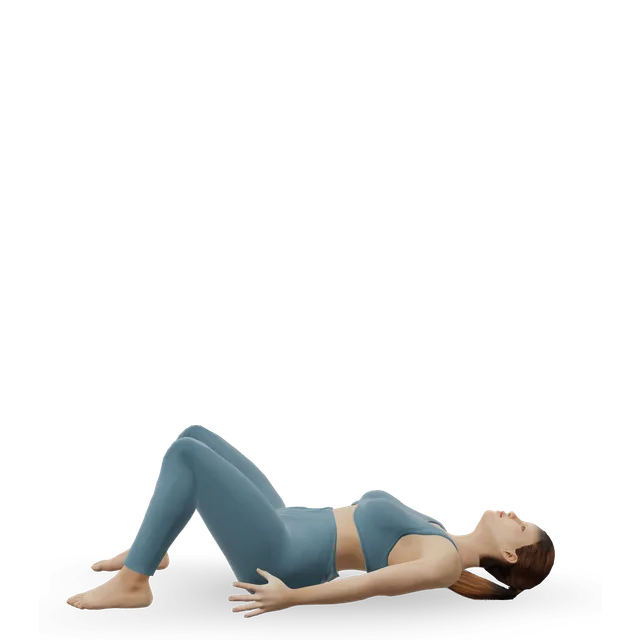 3D demoReclined figure four (eye of the needle, Sucirandhrasana)Beginner · No equipment
 3D demoCorpse pose (Savasana)Beginner · No equipment
 3D demoEasy pose (Sukhasana)Beginner · No equipment
Each change is our suggestion, from the sources named; none has been tested in a trial.
Kapalabhati, bhastrika and breath of fire: leave out unless your epilepsy team agrees, and leave out altogether with absence epilepsy and for children. Box breathing and 4-7-8 breathing hold the breath; no harm has been shown in epilepsy, but they aren't needed (our reading).
Headstand, handstand, forearm stand, shoulder stand, plough and crow: leave them out while seizures aren't controlled, because a seizure in them means a fall onto your head or neck (our suggestion, from the ILAE task force's way of judging risk; untested).
With glaucoma, or high blood pressure that isn't under control, skip headstands, shoulder stands and long head-down holds. With osteoporosis, swap deep forward folds for a flat-back hinge from the hips, and twist smoothly. In pregnancy, our yoga in pregnancy guide covers the changes. NCCIH advises beginners to avoid headstands, shoulder stands, the lotus position and forceful breathing.
Source 4
Tree, warrior III, dancer and half moon: beside a wall while seizures aren't controlled (our suggestion).
Source 4
Fine for most people; shorten them, or rest sitting up, if your seizures come in deep relaxation or sleep.
Source 16
Our yoga for epilepsy class follows the trial's 30-minute home practice: seated loosening, slow breathing, a lying meditation and a positive resolve. It isn't a seizure treatment. The gentle class adds standing poses beside a wall; the hatha and stress classes need only the changes above; the restorative class is rest and slow breathing. If seizures make you fall, chair yoga keeps you seated.
A 30-minute yoga practice for epilepsy in the order of the best trial: seated loosening, slow breathing, a lying meditation and a positive resolve.
30 minBeginner8 movesNo equipmentA 25-minute gentle yoga class for complete beginners and over-50s: slow breathing, a warm-up, supported standing poses, floor poses and a closing rest.
25 minBeginner14 movesNo equipmentA 45-minute beginners' hatha yoga class in the order trial teachers used: relaxation, breathing, floor and standing poses held for a few breaths, then rest.
45 minBeginner20 movesA step, Firm cushionTwenty minutes of yoga for stressful days: the NHS breathing exercise, neck, shoulder and spine moves, standing poses that warm you up, then a slow wind-down.
20 minBeginner13 movesA wallA 45-minute restorative yoga sequence: five fully supported poses held for 4 to 10 minutes each, with slow breathing and a long final rest.
45 minBeginner6 movesFirm cushion, A wallA 15-minute chair yoga routine done entirely sitting: slow breathing, neck, shoulder and wrist stretches, seated twists and side bends, and a calm finish.
15 minBeginner16 movesA bench or boxThese are the lines from our exercise and epilepsy guide, word for word, apart from the line marked as our suggestion.
Move blocks, bolsters and anything hard away, and cushion their head with a folded blanket (our suggestion, from the NHS's "cushion their head if they're on the ground").
Source 35
Stay with them and keep them safe, gently guide them away from danger, stay calm and reassuring, and time it. Don't restrain them.
Many people with epilepsy have a care plan, which may include rescue medicine, and don't need an ambulance every time. If you exercise with someone regularly, show them your plan.
Source 2
These are the warning signs from our exercise and epilepsy guide and our yoga guides, word for word, apart from the lines marked as our suggestion. This is general information, not a diagnosis. A&E means accident and emergency; in the US, call 911 for 999.
For a collapse during exercise with chest pain, palpitations or breathlessness, or if someone faints while exercising. A collapse during exertion isn't always epilepsy, and NICE says it needs an urgent heart check.
Very hot skin with little or no sweating, confusion, muscle cramps, or a fast heartbeat or breathing: move to a cool, shaded place, sponge the skin with cool (not cold) water, drink cold water and get urgent medical help.
Source 12
If you think you've had a seizure for the first time and didn't go to hospital, or you've had a seizure after a long time without one.
Source 2
Talk to them before you try fast breathing practices, hot yoga, aerial or paddleboard yoga, or long relaxation if your seizures come when you're relaxed or asleep (our suggestion), and if:
"Do not change your dose or stop taking your medicine without talking to your specialist." The ILAE says changes to medicine should always be made under close medical supervision. Missing doses is one of the most common triggers.
Epilepsy Action: "Complementary therapies should not be used as alternative treatments. This means they should not replace any epilepsy medicines prescribed to you".
The NHS: "If you're planning to get pregnant or you find out you're pregnant, keep taking your medicine but speak to your specialist team straight away to review your treatment." Our yoga in pregnancy guide has the pose changes.
Source 2
Call 999 if:
A joint pain that is sharp, gets worse during a session, lingers into the next day or changes how you move is a reason to use an easier version, and to see a GP or physiotherapist if it keeps happening (the rule in our plans). Muscle soreness for a day or two after something new is normal. In a hot class, stop if you feel dizzy, sick or unwell; our hot yoga guide lists the signs of heat illness.
You can say no to any hands-on adjustment, and a teacher registered with Yoga Alliance must get your explicit consent each time.
Epilepsy Action's helpline is 0808 800 5050, and the Epilepsy Society also runs a helpline: check its website for the current number.
The NHS advises getting advice from a healthcare professional first if you have a health problem, an injury or symptoms, or have recently had a heart attack or an operation.
Epilepsy Action says complementary therapies "should not replace any epilepsy medicines prescribed to you", and the Cochrane review found no reliable evidence that yoga controls seizures.
No trial supports a cure, and we found no trial of mudras (hand positions) for seizures.
Over-breathing brings on absence seizures in most children with childhood absence epilepsy and is used in EEG tests for that reason, and the Epilepsy Society says extreme yoga breathing may need extra care. No case report links yoga breathing to a seizure, but the caution stands.
Exercise rarely brings on seizures, and the ILAE task force says people with epilepsy have often been kept from sport by fear and overprotection.
That figure comes from 10 people practising Sahaja yoga meditation in 1996, unblinded. The larger 2023 trial found no significant change in seizures per week.
For people whose seizures come when they're very relaxed or asleep, deep relaxation "may increase your risk of having seizures", the Epilepsy Society says.
Source 16
Heat and fever can lower the seizure threshold, and two common medicines reduce sweating. Sweating doesn't remove toxins.
Yoga is safe for most people with epilepsy and may help with stress, anxiety and quality of life. Whether it reduces seizures isn't known: the Cochrane review found too little evidence, and the best trial since found fewer seizures only as a secondary, self-reported result.
Possibly a little, but it isn't proven. Mind-body treatments may reduce seizures slightly in the short term, on low-certainty evidence, and in the best yoga trial seizure counts came from self-reported diaries. Keep taking your medicine.
No. Epilepsy Action says complementary therapies should not replace any epilepsy medicines, and the NHS says never change your dose or stop without talking to your specialist.
No style has been shown to be best. The one well-run trial used a 30-minute practice of seated loosening, slow breathing, a lying meditation and a positive resolve, done 5 times a week; our class follows that order.
Slow breathing is fine: the trial used alternate nostril breathing, left nostril breathing and humming bee breath. Leave out fast, forceful breathing, which can act like the over-breathing used to bring on seizures in EEG tests.
Skip it unless your epilepsy team agrees. No case report links it to a seizure, but fast over-breathing brings on absence seizures in most children with absence epilepsy.
It was part of the breathing in the 2023 trial, as a slow breath with a hum on the way out. It hasn't been tested on its own, but it is slow and gentle.
Rarely: exercise seldom triggers seizures, and no study links yoga poses to them. The risks are fast breathing, heat, flashing lights and, for some people, deep relaxation, plus falling if a seizure happens in a balance or upside-down pose.
We'd avoid it while your seizures aren't controlled, and on topiramate or zonisamide, which can reduce sweating. Heat and fever can lower the seizure threshold.
For most people, yes. If your seizures tend to come when you're very relaxed or asleep, the Epilepsy Society says deep relaxation may increase the risk, so keep it short or sit up.
You don't have to, but Epilepsy Action suggests telling the person leading the class and how they can help if you have a seizure. Show them your care plan if you have one.
Move blocks and anything hard away, cushion their head, time it, and don't hold them down or put anything in their mouth. Roll them onto their side when the jerking stops, and call 999 if it lasts more than 5 minutes, it's their first, or another follows.
Exercise education, not a personal prescription, and clinical review of these guides is pending. If you are pregnant, have a health condition such as glaucoma, high blood pressure or osteoporosis, or have had recent surgery, check with a doctor, midwife or physiotherapist before starting, and stop for sharp or increasing pain. Health disclaimer.