3D demo
Glute and piriformis foam rolling
Stretching · Glutes
Loading the 3D figure…
The figure repeats the movement from its starting position. Drag to turn it; the arrows open the demos either side.
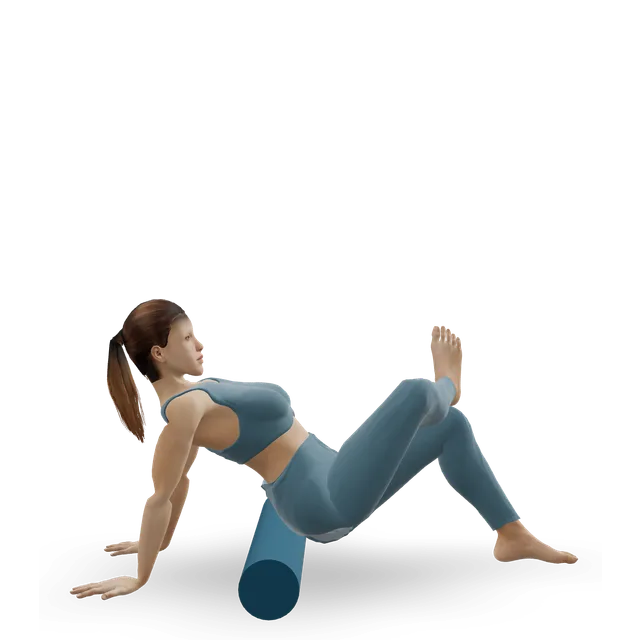
Sitting on a foam roller with one ankle crossed over the other knee and your hands planted behind, you lean toward the crossed side and rock so the roller travels over that buttock. Crossing the leg turns the hip out, putting the deep hip muscles on a light stretch under the roller. NASM lists the glutes as a staple area to roll for people who sit a lot, and in a small trial rolling the glutes and thighs after heavy squats eased thigh tenderness over the next 2 days.
Movement guide
Glute and piriformis foam rolling
Make it easier or harder
Choose a version that fits your control and comfort.
Easier option
Adjust support to keep the pressure comfortable. A more painful roll is not a required next step. Foam rolling review: pressure is not a standardised progression
Harder option
Adjust support to keep the pressure comfortable. A more painful roll is not a required next step. Foam rolling review: pressure is not a standardised progression
Source-researched guide.
Form cues
- Keep the crossed foot flexed.
- Move slowly over the buttock.
- Avoid: rolling onto the tailbone.
Practice and cautions
About 90 seconds for each muscle you roll, for example 2 or 3 slow rounds of 30 to 45 seconds. In a review of rolling studies, about 90 seconds per muscle was the least that eased soreness after exercise.
Ease off if pain or tingling spreads down the leg. If you use a massage ball instead, keep it moving and off the middle of the buttock: in a single case report, a sciatic nerve injury followed ball self-massage there, which shows it can happen, not how often. This is movement education, not an assessment or treatment prescription. Stop for sharp or increasing pain, dizziness, numbness or tingling; seek individual guidance for symptoms, injury or restrictions.
Sources and review status
Sources support the educational description; they do not establish that this exercise is suitable for you.
- NASM · Foam rolling and self-myofascial release: the trainer's application guide (the effect is neural, not tissue release; don't roll directly over the lumbar spine or joints) ↗
- Pearcey 2015 · Rolling the quadriceps, adductors, hamstrings, IT band and glutes after heavy squats eased thigh tenderness over the next 2 days (crossover study of 8 men, J Athl Train) ↗
- Hughes & Ramer 2019 · Duration of rolling: about 90 seconds per muscle was the least that eased soreness (systematic review of 22 studies, IJSPT) ↗
- Cho 2019 · A sciatic nerve injury after self-massage of the buttock with a massage ball (case report, Medicine) ↗
- Free Exercise DB · community text ↗
Unlicense · Free Exercise DB contributors; derived from wrkout/exercises.json. Text import; no photographs or media. · Revision f00c92c7dcf1216a928a52c3706c7ce8e2f71ed5
No variation is labeled clinically validated.
What it works
Equipment
A foam roller
Level
Intermediate.
Workouts that use it
Guides that use it
Browse more
Questions people ask
What muscles does the Glute and piriformis foam rolling work?
Mainly the glutes.
What equipment do I need for the Glute and piriformis foam rolling?
A foam roller.
Is the Glute and piriformis foam rolling good for beginners?
It is graded intermediate.