Mountain climbers
From a high plank, the knees drive in toward the chest one after the other at a quick pace: more demanding than jumping jacks, less than burpees.
Bodyweight conditioning family
Mountain climbers
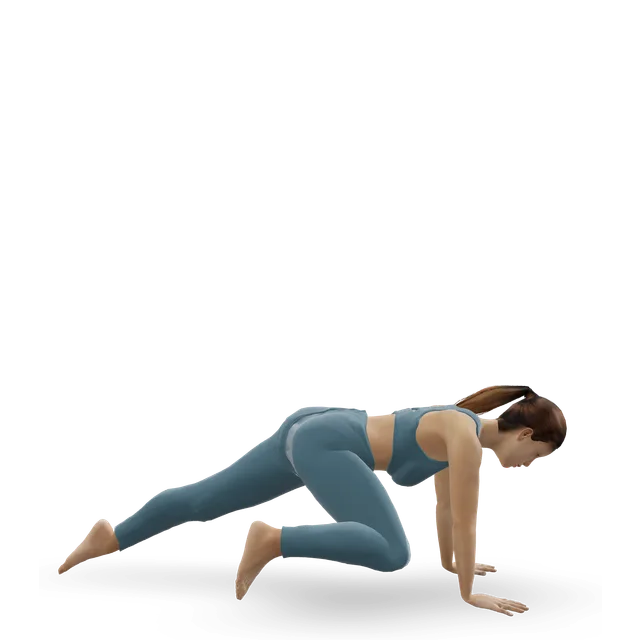
Loading the 3D figure…
Source-researched guide.
How to move
- Start in a high plank, the hands under the shoulders.
- Drive one knee in toward the chest, then switch legs quickly.
- Keep alternating, the hips level.
Form cues
- Keep the shoulders over the hands.
- Slow it down to keep the hips from bouncing.
Practice and cautions
No universal dose is assigned. Choose a manageable amount for your current capacity, leave room for controlled repetitions, and allow recovery. A clinician’s individual plan takes priority.
Low risk. The common faults are hips piking up or sagging, which shifts strain to the lower back, and the position keeps your wrists loaded for as long as you go. In the first weeks after giving birth, the NHS advises avoiding sit-ups and planks to start with; build up from gentler tummy exercises. If a racing heart or fast breathing tends to set off panic, build up over several sessions: these feelings are normal with hard effort and settle as you recover. Chest pain, fainting or palpitations that don't settle need urgent help. With heart disease, keep breathing and ask your cardiac team before long holds; with heart failure, avoid planks. This is movement education, not an assessment or treatment prescription. Stop for sharp or increasing pain, dizziness, numbness or tingling; seek individual guidance for symptoms, injury or restrictions.
Sources and review status
Sources support the educational description; they do not establish that this exercise is suitable for you.
- Machado 2020 · Energy expenditure in a bodyweight HIIT session (oxygen use: jumping jack, then mountain climber, then burpee; Motriz) ↗
- ACE · Mountain climbers (advanced) ↗
- Free Exercise DB · alias and muscle metadata ↗
Unlicense · Free Exercise DB contributors; derived from wrkout/exercises.json. Text import; no photographs or media. · Revision f00c92c7dcf1216a928a52c3706c7ce8e2f71ed5
No variation is labeled clinically validated.
What it works
Muscles
Main: Abs, Hip flexors. Also: Shoulders, Quads.
Anatomy: Rectus abdominis, Obliques, Transversus abdominis, Iliopsoas, Rectus femoris, Pectineus.
Equipment
None: body weight and floor space.
Level
Intermediate. See the easier and harder options above.
Workouts that use it
- Full-body bodyweight workout · 30 min
- Ab workout (no equipment) · 20 min
- HIIT workout at home · 20 min
- Circuit training workout: 8 stations, dumbbells or bodyweight · 35 min
- Tabata-style workout: 20 seconds on, 10 off · 22 min
- Activate rugby warm-up: the adult sample phase · 25 min
- Wrestling conditioning workout: sprint intervals, sprawls and mat drills · 40 min
Pain guides that use it
Part of a staged plan, with when to get help first.
Guides that use it
- HIIT guide
- Burpees guide
- Circuit training guide
- Tabata guide
- EMOM and AMRAP guide
- Mountain climbers guide
- Bear crawl guide
- Plank guide
Show all 12 guidesShow fewer guides
Similar moves
Browse more
Questions people ask
What muscles does the Mountain climbers work?
Mainly the abs and hip flexors, with help from the shoulders and quads.
What equipment do I need for the Mountain climbers?
No equipment: your body weight and a little floor space.
Is the Mountain climbers good for beginners?
It is graded intermediate. If it is too hard right now, start with the Jumping jack.
What is an easier alternative to the Mountain climbers?
Try the Jumping jack or the Skipping. Both are written steps in the same progression.
How do I make the Mountain climbers harder?
Progress to the Burpee. Follow that guide’s technique and any stated timing.