Training guide

How to do band pull-aparts: the band and grip, your shoulder blades, posture claims, and how many

A band pull-apart is about the simplest upper-back exercise there is: hold a light band at shoulder height with straight arms, pull it apart until it touches your chest, and return slowly. It needs no anchor and no gym, which is why it's the warm-up in so many of our workouts.

One small study has measured it: it works the middle and lower trapezius between your shoulder blades, the backs of your shoulders, a rotator cuff muscle and your upper trapezius together, and your grip shifts the balance. No trial has tested pull-aparts on their own for posture or shoulder pain.

This guide covers the steps on the 3D figure, the band and grip, what pull-aparts can and can't do, how many and how often, and the warning signs.

The short version

Straight arms, band to your chest, slow return

Stand tall holding a light band at shoulder height with your arms straight in front, sweep your arms out to the sides until the band touches your chest, and let them come back slowly. The one study of the exercise used 3 seconds each way.

Source 1

It works several upper-back muscles at once

In 10 healthy men pulling at moderate effort, a level pull worked the middle trapezius at 56 to 62% of maximum, the lower trapezius at 37 to 52%, the back of the shoulder at 33 to 48%, the infraspinatus (a rotator cuff muscle) at 31 to 43%, and the upper trapezius at 45 to 60%, depending on the grip. It isn't just a rear delt exercise.

Source 1

Your grip shifts the work

Palms up drew more lower trapezius and rotator cuff activity; palms down more from the back of the shoulder and the upper trapezius. Pulling diagonally upwards drew the most trapezius activity overall, upper trapezius included, and diagonally down the least.

Source 1

It won't fix your posture on its own

No trial has tested pull-aparts alone. Strengthening programmes changed measured posture angles in trials, but pain didn't reliably improve, and the link between posture and pain is uncertain. Our rounded shoulders guide has the programme.

Sources 5, 6, 7, 8

For neck and shoulder pain, the programme matters more than the exercise

Workplace strength programmes eased neck and shoulder pain in office workers, including programmes built on very different exercises, and adding shoulder-blade squeezing exercises to a strengthening programme added nothing in one trial. Pull-aparts are a reasonable part of a mix, not a cure.

Sources 9, 10, 11, 12

How many, and a sound band

15 reps as a warm-up, as our workouts do; as training, 2 to 3 sets of 12 to 15, two or three times a week (our editorial starting point). There's no evidence that 100 a day does more. Bands that slipped or snapped have caused serious eye injuries, so check yours for nicks before every set.

Sources 13, 14

What a band pull-apart is, and what it works

The exercise

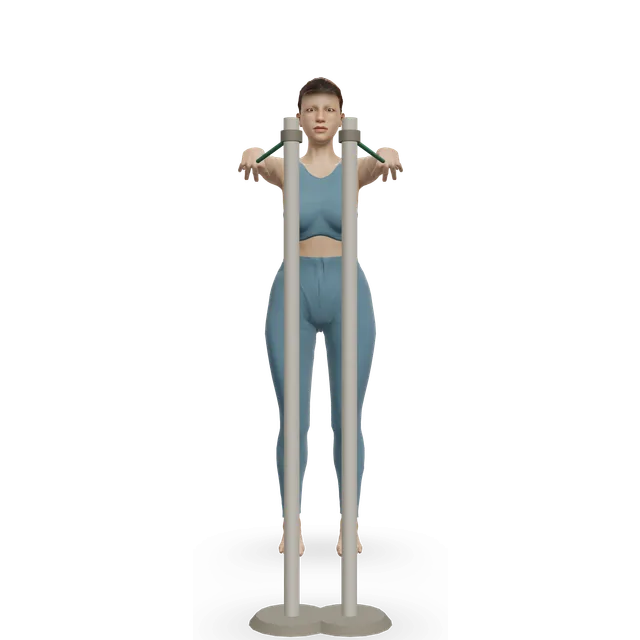
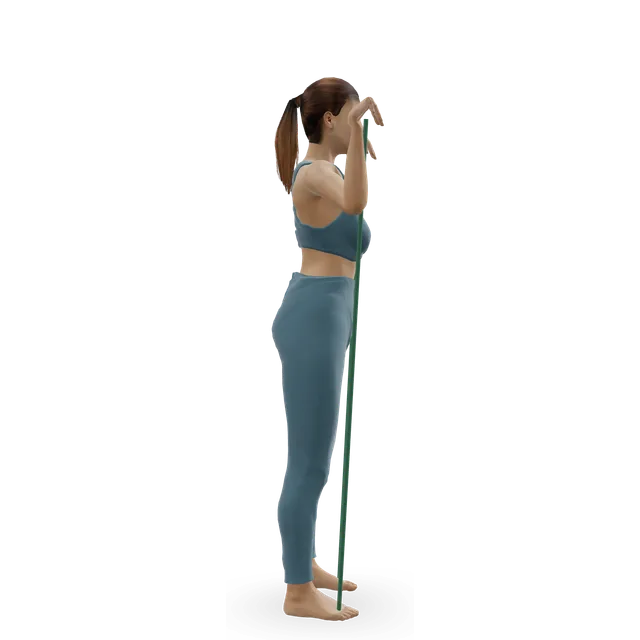
Standing, you pull a light band apart with straight arms at shoulder height until it touches your chest, your shoulder blades drawing back. It's the standing band version of the reverse fly: no anchor, no bench, no weights. The 3D figure shows it palms down; palms up, diagonal and overhead versions are taught in words below.

What it works

The middle and lower trapezius and the rhomboids that draw your shoulder blades back, the back of your shoulders (posterior deltoid) and the infraspinatus, which turns your arm out, with a fair amount of upper trapezius too: 15% to 73% of maximum across nine versions at moderate effort. It moves your shoulders with straight arms, so it's an isolation exercise for the upper back by our compound vs isolation guide's definition, not a compound lift.

Source 1

What you need first

The move page suggests prone Y-T-W raises first. In a Delphi survey, 17 experts rated the band pull-apart 3.18 out of 10 for technique (low to moderate) and agreed it suits novices. You need to raise your straight arms to shoulder height without pain.

Source 15

How the band changes it

Band tension rises the further you stretch it, so holding the band wider makes it easier and narrower makes it harder, and longer arms stretch it further (our reading of how bands work). Bands are sold by colour and tension, and both vary between brands, so choose by feel.

Its neighbours

The face pull adds a high pull and an outward turn and needs an anchor; the reverse fly is the same movement with dumbbells, cables or a machine; Y-T-W raises do it lying face down, which kept the upper trapezius quieter relative to the middle and lower trapezius in muscle-activity studies.

Sources 16, 17

Effort isn't growth

The figures on this page come from EMG (electromyography: electrodes measuring how hard a muscle works over a few reps). It isn't a validated predictor of growth, so treat them as clues about which muscles work, not about what grows.

Source 18

How to do a band pull-apart, step by step

The move page's 3 steps and cues; the band choice, breathing and pause are editorial, and the slow pace follows the one study of the exercise (3 seconds each way). The figure pulls palms down; palms up changes only the grip.

  1. Choose a light band you could pull apart 15 to 20 times with straight arms and no shrugging, and check it for nicks.
  2. Stand tall, feet hip-width apart, knees soft. Hold the band in both hands at shoulder height, arms straight in front of you, hands about shoulder-width apart, palms down, the band just taut.
  3. Breathing out, sweep your arms out to the sides, keeping them straight and level with your shoulders, until the band touches your chest. Let your shoulder blades draw back and down, and keep your shoulders away from your ears.
  4. Pause for a second without arching your lower back or poking your chin forward.
  5. Breathing in, let your arms come back to the front slowly, taking about as long as the pull.
  6. Keep your face out of the band's line, and let the band go slack before you lower your arms at the end.

Loading the 3D figure…

Gets into position, then repeats the movement. Technical checks passed; qualified exercise review is pending.

The movement on the figure: Band pull-apart

Grip, direction and which band

Palms up: more lower trapezius and rotator cuffEmerging evidence

In a level pull, palms up drew 13.3 percentage points more lower-trapezius activity and 11.1 more infraspinatus activity than palms down (52% against 37%, and 43% against 31%, of maximum). Turn your palms up if your neck or upper trapezius complains.

Source 1

Palms down: more back of the shoulder, and more upper trapeziusEmerging evidence

Palms down drew 13.5 points more posterior deltoid activity than palms up (48% against 33%) and 6.3 more upper trapezius activity than palms facing (60% against 53%). Middle trapezius activity was similar across grips, at 56 to 62%.

Source 1

Direction: diagonal up works the trapezius mostEmerging evidence

Pulling diagonally upwards drew the most upper, middle and lower trapezius activity of the three directions, and diagonally down the least. A level pull sits between them, so keeping the pull level or slightly down keeps the upper trapezius quieter.

Source 1

Bands work as well as weightsEmerging evidence

Across 7 small studies, as corrected, elastic band training built strength like weights and machines in the arms and the legs. At matched effort, bands and dumbbells drew similar muscle activity in 16 women with neck and shoulder pain.

Sources 2, 3, 4

Which band

A light one you can pull 15 to 20 times with straight arms and no shrugging (our editorial starting point). If it's too hard, hold it wider; too easy, hold it narrower, then move to the next band. Choose a latex-free band if you're allergic to latex, and replace any band with nicks or a sticky, perished surface.

Only one small study

Everything about grip and direction comes from 10 healthy men aged about 36 doing 3 slow reps of each version. No study has tested any version for strength, size, posture or pain.

Source 1

What the evidence says

One study of the exercise itselfEmerging evidence

10 healthy men pulled a band at moderate effort (5 out of 10) in 3 hand positions and 3 directions. Peak activity ranged from 15% to 73% of maximum across the muscles and versions: the trapezius and the back of the shoulder worked hard, and so did the upper trapezius.

Source 1

Bands against dumbbellsEmerging evidence

In 29 adults at matched 10-rep loads, a band reverse fly anchored at shoulder height drew slightly less rear-shoulder activity but more upper-trapezius and side-shoulder activity than a face-down dumbbell reverse fly. At matched effort, bands and dumbbells drew similar activity in 16 women with neck and shoulder pain.

Sources 19, 4

Lying face down keeps the upper trapezius quieterEmerging evidence

Raising the arms out to the side lying face down, turned out, kept the upper trapezius low relative to the middle and lower trapezius in three EMG studies (45, 30 and 27 people). If your neck takes over in a standing pull-apart, Y-T-W raises are the face-down version.

Sources 16, 17, 20

No training trial of pull-aparts alone

We found no trial of band pull-aparts on their own for strength, posture or pain. The nearest: 2 weeks of face-down dumbbell reverse flys in 20 young adults reduced a forward-shoulder measure more than chest stretching (to 4.5 against 5.5 cm, from about 6.2 cm). That's a tiny, short study with no pain outcome.

Source 21

Do band pull-aparts help posture?

Strengthening programmes change measured postureEmerging evidence

Corrective exercise programmes improved measured forward-shoulder posture by a large amount in the 18 trials that measured it (of 28 small trials, 901 people, in the review), but pain didn't change significantly. Strengthening, not stretching, changed upper-back and neck posture across 23 studies of 969 people. Pull-aparts fit such programmes; none tested them alone.

Sources 5, 6

Posture and pain: only loosely linkedMixed evidence

Adults with neck pain had a slightly more forward head than adults without across 15 snapshot studies, but not adolescents; upper-back rounding didn't differ between people with and without shoulder pain across 10 studies. Snapshots can't show which came first.

Sources 7, 8

Where pull-aparts fit

As one part of a mix with rows, face pulls, Y-T-W raises and chest stretches, as in our rounded shoulders guide, which uses 2 to 3 sets of 12 to 15. Posture changes slowly: give any programme several weeks, and judge it by how you feel and move as much as by how you look.

Neck and shoulder pain, and desk work

Workplace strength training eased neck and shoulder painEmerging evidence

In 48 women with trapezius muscle pain, specific strength training cut their worst neck pain by 35 points out of 100, against 5 points briefly with cycling. In 447 office workers, one hour a week of five dumbbell exercises, reverse flys among them, cut neck pain by 1.1 to 1.9 points on a 0 to 9 scale. In 198 workers, 2 minutes a day of band lateral raises cut pain by 1.4 points out of 10. These are randomised trials, but all from one research group.

Sources 22, 9, 10

Different exercises worked tooEmerging evidence

In 47 office workers, a programme of just two exercises, a push-up plus and a press-up with bands for extra load, also cut neck and shoulder pain (2 points). No single exercise looks essential; doing a progressive programme does.

Source 11

Shoulder impingementMixed evidence

Shoulder-blade-focused exercise gave small, short-term pain benefits across 8 trials at low certainty, and adding shoulder-blade retraction exercises to a strengthening programme added nothing in 60 people. For a new episode of rotator cuff pain, up to six physiotherapy exercise sessions did no better than one advice session in 708 people, while for long-standing impingement a specific rotator cuff and shoulder-blade programme cut decisions for surgery from 63% to 20% in 102 people.

Sources 23, 12, 24, 25

Weaker outward rotators in lifters with impingementEmerging evidence

In 55 male weight trainers, those with signs of impingement had weaker outward rotators and lower trapezius, and in another study those who trained their outward rotators less often had signs of impingement. Snapshots like these can't show cause.

Sources 26, 27

With a sore shoulder or neck

Use pull-aparts inside our shoulder impingement or neck pain plan, keeping pain to about 5 out of 10 or less, settled by your next session. The NHS says not to make up your own strenuous exercises or use heavy gym equipment while your shoulder hurts, so keep the band light and the plan's doses.

Source 37

Shoulder injury prevention in sport

Whole programmes, mixed resultsMixed evidence

A shoulder warm-up programme cut shoulder problems in 660 elite handball players (17% against 23%), and another cut them in adolescent handball players. But a rubber-band strengthening programme made no difference in 579 players, and pooled across 3 trials the effect is uncertain, at low certainty. None tested pull-aparts alone.

Sources 28, 29, 30, 31

How to use them

As one part of your warm-up before throwing or pressing, with outward rotations and rows, rather than as a programme on their own (our view).

From wall angels to face pulls

Wall angels, 8 slow reps, and prone Y-T-W raises, 5 of each letter for 2 rounds (our upper back mobility routine); band pull-aparts, 15 reps as a warm-up (our workouts) or 2 to 3 sets of 12 to 15 as training (our editorial starting point; the move page gives no dose); the standing band reverse fly with the band anchored, 2 to 3 sets of 10 to 15, stopping 2 or 3 reps short (its move page's editorial starting point); the incline dumbbell reverse fly, 2 sets of 12 to 20 (our dumbbell upper body workout B); and face pulls, 3 sets of 12 to 20 (our workouts).

Other versions, in words

The 3D figure shows the palms-down pull; these change the grip or the path.

Palms up

Hold the band with your palms facing up: more lower trapezius and infraspinatus, less upper trapezius than palms down. A good choice if your neck tends to take over.

Source 1

Diagonal

One hand finishes up and out, the other down and out; swap sides each set. The upward pull drew the most trapezius activity overall, upper trapezius included.

Source 1

Overhead

Start with the band overhead, arms straight, and pull it apart as your arms come down to shoulder height in front of your head. Only for shoulders that move freely overhead (our view).

Behind the neck: not recommended

A hospital handout for shoulder training advises against weights behind the head, and our lat pulldown guide found no benefit in behind-the-neck pulling. No study has tested a band there; keep the band in front (our view).

Source 32

No band

Hold the end position with your arms out to the sides for 3 seconds, 10 times, as our Pilates arm workout does, or do prone Y-T-W raises.

Common mistakes

Shrugging your shoulders up

Use a lighter band or hold it wider, try palms up, and think "shoulders down" before each rep.

Bending your elbows to finish

The band is too heavy. Keep your arms straight, as the move page says, and hold it wider.

Arching your back or poking your chin forward

Ribs down, chin level; stop where the band touches your chest (our view).

Snapping back to the start

Let your arms come back slowly, about as long as the pull. The study used 3 seconds each way.

Squeezing as hard as you can at the end

A firm, brief pause is enough: squeezing hard didn't change mid-back activity in rows, as our row and reverse fly guides explain. Draw your shoulder blades back and down instead.

An old, nicked band

Replace it. Bands that slipped or snapped have caused bleeding inside the eye. Keep your face out of the band's line.

Source 13

How many and how often

No study has tested doses for band pull-aparts, and the move page gives none. These are our starting points, matching our workouts and plans.

As a warm-up

1 set of 15 reps with a light band before pressing or pulling, as 77 of our workouts do.

As training

2 to 3 sets of 12 to 15, stopping 1 to 2 reps short of failure, with about 60 seconds' rest, two or three times a week: our editorial starting point, as in our rounded shoulders guide. Our plans let the last set of small moves go to 0 to 2 reps short; going to failure added little in a review of 15 studies.

Source 51

As light extra volume

2 sets of 12 to 15, as our Pilates for posture workout does at the end of a session.

Progressing

Add reps up to 20, then slow the return, then hold the band a little narrower, then move to the next band, as our plans' double progression does.

Weekly back work

Pull-aparts add useful volume for the small upper-back muscles. For more muscle, rows and face pulls let you add load more easily; about 10 or more hard sets a week for your back is our plans' mark.

Source 33

Every day, or 100 a day?

There's no evidence that daily pull-aparts, or 100 a day, do more for posture or shoulders. Rehabilitation programmes that used daily home exercises were prescribed and supervised. Light daily sets are fine if you enjoy them; two or three times a week is plenty.

Source 25

Warm up first

A couple of minutes of easy movement and shoulder circles before your first set, as our plans and the NHS suggest.

Source 34

Band pull-aparts against face pulls, reverse flys and rows

Face pulls

Both train the upper back and the backs of the shoulders. The face pull adds a high pull and an outward turn and needs an anchor; the pull-apart needs only a band, which is why it's the usual warm-up. Many programmes use both, and our face pull guide puts pull-aparts a step below face pulls in its shoulder-blade ladder.

Reverse flys

The same movement with dumbbells, cables or a machine, easier to load. Our reverse fly guide covers the grips and the bench set-ups.

Rows

Rows bend your elbows and add your lats and biceps, and you can load them far more. Pull-aparts don't replace rows; they add work for the muscles between and behind your shoulder blades.

Outward rotations

Band outward rotations with your elbow at your side train the rotator cuff more directly; our shoulder mobility and stability routine pairs them with pull-aparts.

Moves that go with it

Warm up with shoulder circles, 3 slow circles each way with each arm (the move page's editorial starting point). Band outward rotations, 2 rounds of 12 to 15 each arm, scapular push-ups, 10 reps, and the doorway chest opener, 30 seconds each side with your elbow at or below shoulder height (our shoulder mobility and stability routine); band rows, 3 sets of 10 to 15 (the move page's editorial starting point); chin tucks, 10 reps (our upper back mobility routine).

Workouts to follow

The upper back mobility routine and the shoulder mobility and stability routine use pull-aparts as strength work; the resistance band workout puts them in a circuit; the back workout at home and the bench press technique workout use them to warm up; Pilates for posture ends with them.

Plans that use it

Both resistance band workouts in this plan use band pull-aparts.

Who should change it

Shoulder pain

Keep the band light and the range pain-free, within the 5 out of 10 rule, and follow our shoulder impingement guide, which uses light band work.

After a shoulder dislocation

Arms out to the side and moving back is a position to rebuild gradually. Follow the stages in our shoulder dislocation guide before you add pull-aparts, as our reverse fly guide says.

Neck pain

Turn your palms up and pull level or slightly down, which drew the least upper-trapezius activity, and keep your chin level.

Source 1

Latex allergy

Use latex-free bands, as our band workouts advise.

Pregnancy

Pull-aparts are done standing with a light band, so they suit pregnancy if you already exercise. Stop if you feel uncomfortable, too hot or unwell, as the NHS says.

Source 36

Warning signs

Stop and get medical help

If you get chest pain or pressure, feel faint or dizzy, are unusually breathless, or your heart races or beats irregularly during exercise, as our plans advise. The American Heart Association says these need immediate medical evaluation.

Source 41

Call 999 (911 in the US)

For chest pain that comes on suddenly and doesn't go away, feels tight or like squeezing, spreads to your arms, neck, jaw, stomach or back, or comes with sweating, feeling sick, light-headedness or breathlessness; arm pain that comes on suddenly with pressure, heaviness or squeezing across your chest; severe difficulty breathing, or a chest that feels tight or heavy; someone who faints while exercising; palpitations that don't go away, or come with chest pain, shortness of breath or feeling faint; or a headache that starts suddenly and is extremely painful, especially while lifting or straining. The NHS says a bleed on the brain may be more likely when lifting something heavy. Don't drive yourself to A&E.

Sources 42, 43, 44, 45, 46, 47, 48, 49

Your shoulder

Ask for an urgent GP appointment or get help from NHS 111 for sudden or very bad shoulder pain, an arm you can't move, a shoulder that has changed shape or is badly swollen, pins and needles that don't go away, no feeling in your arm or shoulder, an arm or shoulder that's hot or cold to touch, pain after an injury or a fall, severe pain in both shoulders, or feeling feverish or unwell. Go to A&E if, after an injury, you can't move your arm or your shoulder looks out of place or has changed shape. See a GP if shoulder pain is getting worse or hasn't improved after 2 weeks.

Sources 37, 38

An ache over the shoulder blade with weakness

Or a muscle that looks thinner: see a GP or physiotherapist, as our back of shoulder pain guide says, because a nerve can be involved.

Your neck

See a GP if neck pain or stiffness doesn't go away after a few weeks, painkillers haven't worked, or it comes with other symptoms such as pins and needles or a cold arm.

Source 39

A band in the eye

Go to A&E or call 999 if a band hits your eye at high speed, your sight changes afterwards, or you have severe eye pain, an eye you can't move or keep open, or blood or pus coming from it. Don't drive yourself. In two case series of 11 patients each, bands that slipped or snapped caused bleeding inside the eye and, for some, lasting loss of vision. Glasses or sports goggles help.

Sources 40, 13, 14

Back pain

Call 999 or go to A&E: loss of feeling or numbness around the genitals or bottom, new trouble peeing or controlling your bladder or bowels, changes in genital sensation during sex or problems with erections or orgasm, or pain, tingling, weakness or numbness in both legs. These are signs of cauda equina syndrome, which needs treating in hospital urgently. Don't drive yourself.

Source 50

Before you start

Speak to your GP first if you haven't exercised for some time or have medical conditions or concerns, as the NHS advises. Get advice before heavy lifting or hard straining work if your blood pressure is uncontrolled (140/90 or higher at a clinic, or 135/85 at home), or you have heart disease or chest pain when you're active, a pacemaker or defibrillator, diabetic eye disease, glaucoma, a hernia, recent eye or tummy surgery, or you're pregnant, as our breathing guide lists. After a recent shoulder dislocation or shoulder surgery, follow our shoulder dislocation guide or your surgical team first.

Source 35

Myths

"Band pull-aparts fix bad posture"Mixed evidence

No trial has tested them alone. Strengthening programmes changed measured posture angles, but pain didn't reliably change, and the link between posture and pain is uncertain. Pull-aparts are a sensible part of a programme, not a fix.

Sources 5, 6, 7, 8

"Band pull-aparts fix shoulder pain"Mixed evidence

Shoulder-blade exercise gave small, short-term benefits at low certainty, adding retraction exercises to a strengthening programme added nothing, and for a new rotator cuff problem more physiotherapy did no better than one advice session.

Sources 23, 12, 24

"Band pull-aparts only work the rear delts"Emerging evidence

They work the middle, lower and upper trapezius and the infraspinatus at similar levels: an upper-back exercise as much as a rear-shoulder one.

Source 1

"Do 100 a day"

No study supports a daily or a 100-rep dose. The trials that helped neck pain used anything from 2 minutes a day to an hour a week of progressive training.

Sources 10, 9

"Pull-aparts prevent shoulder injuries"Mixed evidence

Whole warm-up programmes cut shoulder problems in handball, but a rubber-band programme didn't and the pooled effect is uncertain. Pull-aparts alone are untested.

Sources 28, 30, 31

"Bands are too light to build anything"Emerging evidence

Band training built strength like weights in 7 small trials. Choose a band that makes the last reps hard.

Sources 2, 3

Questions people ask

How do you do a band pull-apart?

Hold a light band in both hands at shoulder height with your arms straight in front. Sweep your arms out to the sides until the band touches your chest, then let them come back slowly.

What muscles do band pull-aparts work?

The middle and lower trapezius between your shoulder blades, the back of your shoulders and the infraspinatus, a rotator cuff muscle. In the one study of the exercise, the upper trapezius worked hard too.

Should my palms face up or down for band pull-aparts?

Either. Palms up drew more lower-trapezius and rotator cuff activity; palms down more from the back of the shoulder and the upper trapezius. If your neck or upper trapezius complains, turn your palms up.

How many band pull-aparts should I do?

15 reps as a warm-up, as our workouts do. As training, 2 to 3 sets of 12 to 15, two or three times a week, is our starting point.

Can I do band pull-aparts every day?

You can do light sets often, but there's no evidence that daily pull-aparts, or 100 a day, do more for posture or shoulders. Two or three times a week is plenty.

Do band pull-aparts help posture?

Not on their own, as far as anyone has tested. Strengthening programmes change measured posture angles, but pain didn't reliably change, and no trial has tested pull-aparts alone. Our rounded shoulders guide has the programme.

Are band pull-aparts good for shoulder pain?

They're a reasonable part of a shoulder programme, not a cure: shoulder-blade exercise gave small, short-term benefits, and adding retraction exercises to a strengthening programme added nothing in one trial. Follow our shoulder impingement guide.

Band pull-apart or face pull: which is better?

Both train the upper back and the backs of your shoulders. The face pull adds a high pull and an outward turn and needs an anchor; the pull-apart needs only a band, which is why it's the usual warm-up. Many programmes use both.

Which band should I use for pull-aparts?

A light one you can pull 15 to 20 times with straight arms and no shrugging. Colours and tensions vary by brand, so choose by feel, and check the band for nicks before every set.

Do band pull-aparts build muscle?

They add useful volume for the small upper-back muscles, and bands built strength like weights in small trials. For more muscle, rows and face pulls let you add load more easily.

Should I do band pull-aparts before bench press?

Yes, if you like: a set of 15 is the warm-up in our bench press workouts. It warms up the upper back you set against the bench.

Are band pull-aparts safe?

Yes, with a sound band. Bands that slipped or snapped have caused serious eye injuries, so keep your face out of the band's line and replace worn bands.

Sources

  1. Fukunaga 2022 · Band pull-apart direction and hand position: shoulder muscle activity in 10 men (EMG study, Int J Sports Phys Ther)
  2. Lopes 2019 · Elastic bands against weights and machines for strength: 7 studies, 224 people, as corrected (systematic review and meta-analysis, SAGE Open Med)
  3. Lopes 2020 · Corrigendum: 7 studies, not 8, with the upper- and lower-limb results swapped (SAGE Open Med)
  4. Andersen 2010 · Dumbbells against elastic bands in rehabilitation exercises: muscle activity in 16 women with neck and shoulder pain (EMG study, Phys Ther)
  5. Khorramroo 2026 · Corrective exercise for upper crossed syndrome: 28 trials, 901 people (systematic review and meta-analysis, BMC Sports Sci Med Rehabil)
  6. Warneke 2024 · Stretching or strengthening for spinal posture: 23 studies, 969 people (systematic review and meta-analysis, Sports Med Open)
  7. Mahmoud 2019 · Forward head posture and neck pain: 15 studies (systematic review and meta-analysis, Curr Rev Musculoskelet Med)
  8. Barrett 2016 · Upper-back posture and shoulder pain: 10 studies (systematic review, Man Ther)
  9. Andersen 2012 · How often and how long: strength training for neck and shoulder pain in 447 office workers (randomised trial, BJSM)
  10. Andersen 2011 · Two minutes a day of band training for neck and shoulder pain in 198 workers (randomised trial, Pain)
  11. Andersen 2014 · Two shoulder-blade exercises for chronic neck and shoulder pain in 47 office workers (randomised trial, J Occup Rehabil)
  12. Hotta 2020 · Adding shoulder-blade stabilisation to a strengthening programme in 60 people with subacromial pain (randomised trial, Musculoskelet Sci Pract)
  13. Ng 2022 · Eye injuries from elastic exercise bands in 11 patients (case series, Retin Cases Brief Rep)
  14. Al-Khersan 2021 · Eye injuries from exercise resistance bands in 11 patients (case series, Am J Emerg Med)
  15. Kompf 2025 · Selecting resistance training exercises for novices: a Delphi study with 17 experts (expert consensus, Am J Lifestyle Med)
  16. Cools 2007 · Which exercises for scapular muscle balance: 45 people (EMG study, Am J Sports Med)
  17. Ekstrom 2003 · Exercises for the trapezius and serratus anterior in 30 people (EMG study, JOSPT)
  18. Vigotsky 2022 · Surface EMG amplitude in one session is not a validated predictor of muscle growth (review, Sports Med)
  19. Bergquist 2018 · Bands against free weights in single-joint upper-body exercises: muscle activity in 29 adults (EMG study, J Hum Kinet)
  20. Mendez-Rebolledo 2024 · Five shoulder-blade rehabilitation exercises in 27 people (EMG study, Am J Phys Med Rehabil)
  21. Yoo 2018 · Shoulder-blade strengthening against pectoral stretching for forward shoulders in 20 young adults (2-week trial, J Phys Ther Sci)
  22. Andersen 2008 · Specific strength training against cycling for neck muscle pain in 48 women (randomised trial, Arthritis Rheum)
  23. Zhong 2024 · Shoulder-blade stabilisation exercise for subacromial pain: 8 trials, 387 people (systematic review and meta-analysis, Front Neurol)
  24. Hopewell 2021 · Progressive exercise against one advice session for rotator cuff disorders in 708 people: the GRASP trial (randomised trial, Lancet)
  25. Holmgren 2012 · Specific shoulder exercises and the need for surgery in 102 people with impingement (randomised trial, BMJ)
  26. Kolber 2017 · Shoulder strength in 55 male weight trainers with and without impingement (cross-sectional study, JSCR)
  27. Kolber 2014 · Shoulder impingement in recreational weight trainers (cross-sectional study, JSCR)
  28. Andersson 2017 · A shoulder injury prevention programme in 660 elite handball players (cluster-randomised trial, BJSM)
  29. Asker 2022 · Shoulder and knee exercise programmes in adolescent elite handball players (three-armed cluster-randomised trial, Sports Med Open)
  30. Achenbach 2022 · Stretching and rubber band strengthening in 579 handball players (cluster-randomised trial, BMJ Open Sport Exerc Med)
  31. Yonneau 2025 · Shoulder injury prevention programmes in handball (systematic review and meta-analysis, BMJ Open Sport Exerc Med)
  32. Massachusetts General Hospital Sports Physical Therapy · Strength training for the shoulder (patient handout)
  33. Pelland 2026 · Weekly volume and frequency, muscle growth and strength: 67 studies, 2,058 people (meta-regressions, Sports Med)
  34. NHS · How to warm up before exercising
  35. NHS · Physical activity guidelines for adults aged 19 to 64
  36. NHS · Exercise in pregnancy
  37. NHS · Shoulder pain (past its review date: reviewed May 2023, review due May 2026)
  38. NHS · Dislocated shoulder
  39. NHS · Neck pain (past its review date: reviewed April 2023, review due April 2026)
  40. NHS · Eye injuries
  41. Paluch 2024 · Resistance exercise training with and without cardiovascular disease: 2023 update (American Heart Association scientific statement, Circulation)
  42. NHS · Chest pain (past its review date: reviewed August 2023, review due August 2026)
  43. NHS · Heart attack
  44. NHS · Elbow and arm pain
  45. NHS · Shortness of breath
  46. NHS · Fainting
  47. NHS · Heart palpitations
  48. NHS · Headaches
  49. NHS · Subarachnoid haemorrhage
  50. NHS · Back pain
  51. Refalo 2023 · Proximity to failure and muscle hypertrophy: 15 studies (meta-analysis, Sports Med)

Exercise education, not a personal prescription, and clinical review of these guides is pending. Check with a GP before starting hard training if you have a heart condition, chest pain, dizziness or breathlessness when active, and stop for sharp or increasing pain. Health disclaimer.