What a Bulgarian split squat asks of the hips, and what no study has countedEmerging evidence
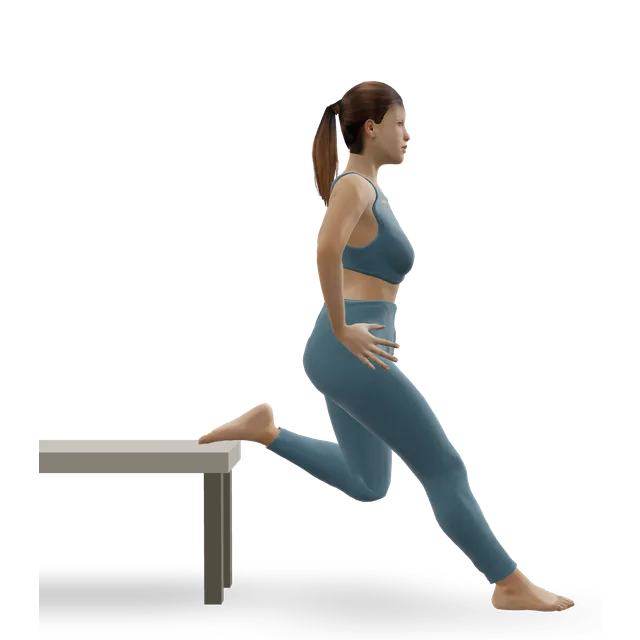
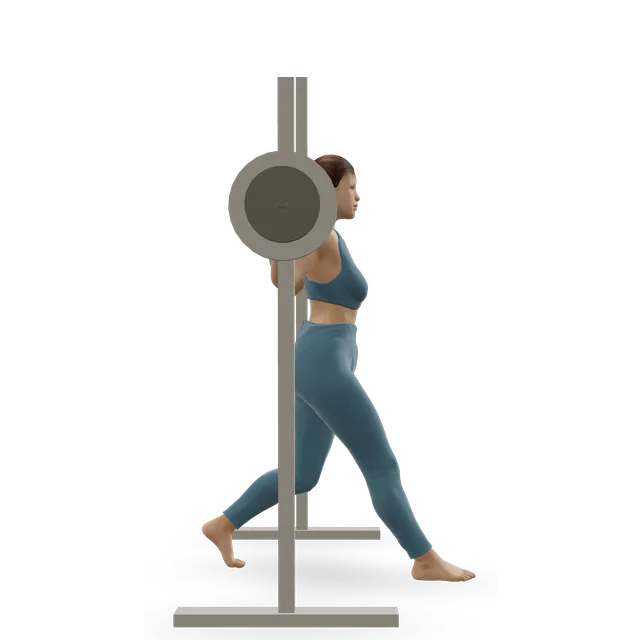
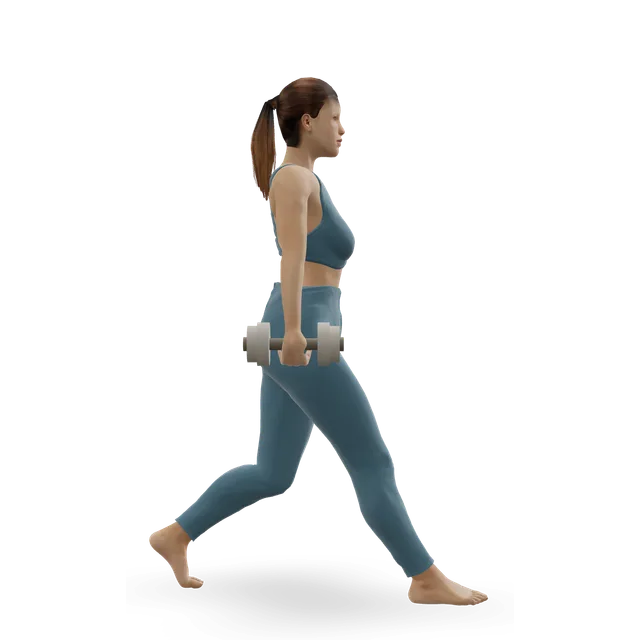
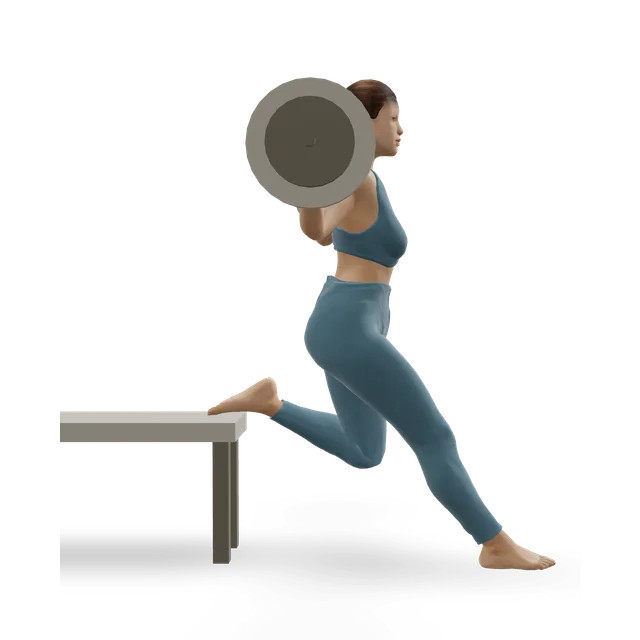
You stand in a long split stance with the top of your back foot on a bench and lower until your front thigh is about level. The two hips do opposite jobs. The front hip bends deeply and does most of the work: in 26 men the front foot produced about 84% of the downward force; in 20 trained men the Bulgarian and the back squat were both hip-dominant, with less knee movement in the Bulgarian; and in 8 rugby players the front hip's turning force was 44% greater than in a back squat at the same relative load, with more work for the outer hip too. The glutes, thigh and hamstrings worked hardest at the bottom in 20 trained women.
The back hip is pushed past straight while its hip flexors work: in 9 trained men, about 4 degrees past with more trunk lean and about 14 with an upright trunk. None of these studies measured pain, tested bench height on its own or measured how far the hip flexors stretch, and no study counts hip pain from Bulgarian split squats. So the map on this page comes from these lab studies of healthy, mostly young, trained people, hip consensus statements, trials of the conditions, health-service pages and a hip physiotherapist's published advice, which we label as expert opinion.
Sources 1, 2, 3, 4, 5
The front of the back hip: the hip flexors on stretch (our reading)Emerging evidence
A pull at the front of the back hip and upper thigh at the bottom, worse with a long stance, a high bench and an upright trunk, is, in our reading, the commonest pattern: the hip flexors (the rectus femoris, which also crosses the knee, and the iliopsoas) working while stretched. The researchers behind the 9-man study note that the hip flexors resist more as the hip passes straight. Holding a lunge on low-dose X-ray, 120 healthy young adults had on average about 16 degrees of extension left at the back hip, with a wide spread, and on average the pelvis tipped slightly back, not forward, so some people have much less room than others.
A hip physiotherapist advises keeping the shoulder, hip and back knee in a fairly straight line, says a front foot placed too far from the bench takes the back hip further back, and singles out the rectus femoris as overloaded: expert opinion, not a study. In the international groin pain agreement, pain on resisted hip flexion or on stretching the hip flexors points to the iliopsoas, which is the back leg's position. A sharp, deep pinch at the front of the back hip may be the front of the joint rather than the muscle: in a computer model, the force on the front of the hip joint was greater with the hip extended than bent, more so with weak glutes. That is a model, not a split squat study.
Sources 5, 6, 7, 8, 9
A deep pinch in the front hip: the hip running out of bendEmerging evidence
A deep pinch at the front of the front hip at the bottom, sometimes with a C-shaped ache round the hip and pain sitting low, is the hip reaching the end of its bend. In a younger active adult it can be femoroacetabular impingement (FAI) syndrome, which needs symptoms, examination signs and imaging to agree. The American Academy of Orthopaedic Surgeons (AAOS) says turning, twisting and squatting may cause a sharp, stabbing pain, and that exercise does not cause FAI. In a UK trial, physiotherapy patients were told to avoid extremes of hip bending, moving the leg out and turning it in: a deep, narrow Bulgarian with the front knee caving in combines all three.
Leaning forward deepens the front hip's bend (10 adults), and in barbell split squats a stance of about one leg length gave the least front hip bend, though the differences were small (about 98 against 102 degrees in 20 men). The hip physiotherapist writes that in most cases the Bulgarian doesn't bend the hip far enough to cause the impingement seen on a leg press, so a front-hip pinch is usually a depth, lean or load question.
Sources 10, 11, 12, 13, 14, 7
The outer hip and the groinEmerging evidence
Pain on the bony point on the outside of the front hip, worse as the pelvis drops or shifts sideways and lying on that side at night, is usually gluteal tendinopathy. It mostly starts in mid-life, affects women more, and the thigh crossing in (hip adduction) is a key provoking position. The hip physiotherapist links its flare in this exercise to the pelvis shifting sideways so the front hip crosses in under load. The side glute works at about 55% of its maximum in the Bulgarian (11 people), and the outer hip's load is higher than in a back squat; a tightrope stance mainly made balance harder in lunges, with similar muscle work (15 trained men).
Groin pain is grouped as adductor-related, iliopsoas-related, inguinal-related, pubic-related and hip-related, and a 2026 consensus uses the same terms for active adults. Adductor-related pain means tenderness of the adductors and pain squeezing the legs together against resistance. The hip physiotherapist describes the back hip drifting out to widen the base, which loads the adductors, and twisting forces across the pelvis that can provoke pain at the pubic bone and the sacroiliac (SI) joint. A lump in the groin is a possible hernia and is in the warning signs.
Sources 15, 7, 16, 3, 17, 8, 18
A sudden sharp pain, and who gets itEmerging evidence
A sudden sharp pain at the front of the hip or top of the thigh mid-rep, then pain lifting the knee, is a hip flexor or rectus femoris strain. These are uncommon in slow gym exercise: in 33 male athletes with acute hip flexor injuries on scans, rectus femoris injuries came mostly from kicking and sprinting and iliacus injuries from changing direction. The AAOS says most hip strains are treated without surgery, and the NHS calls a strain an overstretched or torn muscle.
No study counts who gets hip pain in this exercise. In our reading it mostly bothers people new to Bulgarians or adding sets, depth or dumbbells quickly; people who set a long stance or a high bench and stay very upright; people whose hips have less room to straighten; younger active adults with impingement shapes; mid-life women with outer hip pain; and field-sport athletes. In 494 Dutch gym users with an injury, the hip or pelvis was 3.6% of injuries, with overuse or overload the commonest reported cause. With a broad definition (pain that affects training), 104 Swedish powerlifters named the lower back and pelvis, the shoulder and the hip as the commonest areas, and only 16% of the injured stopped training completely. Reviews of the lifting sports list the shoulder, lower back, knee, elbow and wrist first, with low injury rates.
Sources 19, 20, 21, 22, 23, 24, 25, 26
What a scan shows, and when it mattersStrong evidence
Not at first. Impingement shapes and labral tears are common in hips that don't hurt: across 26 studies of 2,114 painless hips, a cam shape showed in 37% (55% of athletes) and labral tears in 68% of those scanned with magnetic resonance imaging (MRI). A 2026 consensus says imaging should always be used together with the history and an examination.
Scans matter for a teenager's pop at the front of the hip (an X-ray the same day), groin or front-of-hip pain that builds with every run (a possible stress fracture), hip pain after a fall, a suspected complete tendon tear, and hip pain that hasn't settled with a good spell of exercise-based care, when a specialist may image the hip before talking about surgery.
Sources 27, 18, 10
How it usually goesEmerging evidence
No study follows hip pain from Bulgarian split squats. The NHS says it's best to keep moving if you can without overdoing it, and to see a GP if hip pain hasn't improved after 2 weeks of treating it at home. Outer hip pain improved in 51 of 65 people at a year with education and exercise. In a UK trial of 348 people with hip impingement, a hip quality-of-life score rose from about 36 to 50 with physiotherapist-led hip therapy and from about 39 to 59 with surgery over a year. Most hip strains settle without surgery. No one can promise a date.
Sources 28, 29, 30, 21