What a step-up asks of the hip, and what no study has countedEmerging evidence
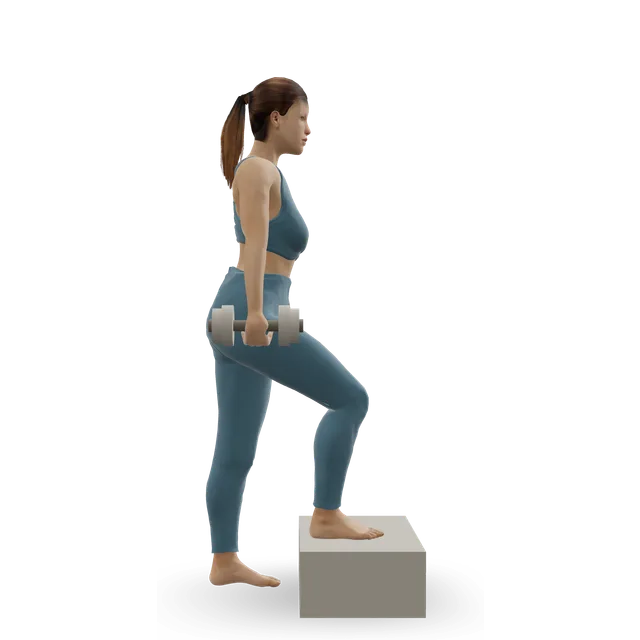
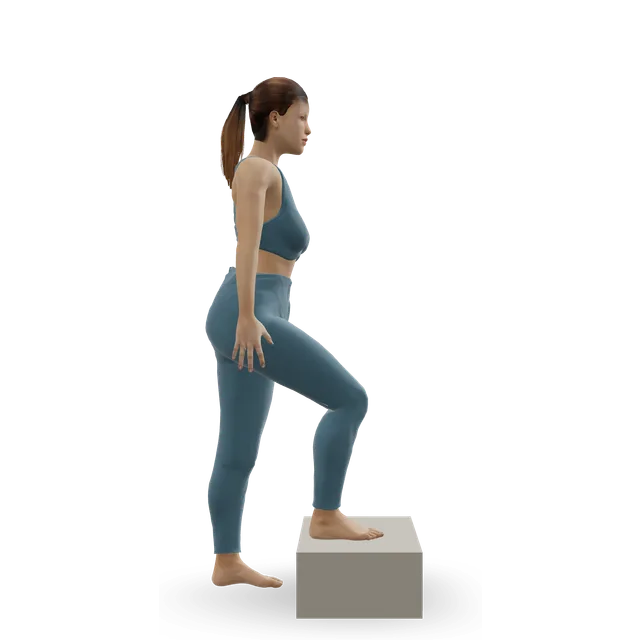
You put one whole foot on a box and straighten that leg to lift your body; the higher the box, the more the hip bends at the start. In 21 adults in their 70s, a 21 cm step took the front hip to 79 degrees of bend going forward and 74 degrees going sideways. In 12 young adults, the step needed to bring the hip to about 90 degrees ranged from 18 to 38 cm, and the authors note that impingement pain often comes at 90 degrees or more. On stairs, going up asked about 28 degrees more hip bend than going down, and people of different heights adjusted mostly at the knee.
In people with instrumented hip replacements, going upstairs loaded the hip joint about 2.5 times body weight, a little more than walking (2.4 times); weight-bearing physiotherapy exercises reached up to 4.4 times in some. Muscle work rises with the box and the load: on a 46 cm box at a 6-rep load, the step-up topped a review of gluteus maximus exercises (about 125% of a maximal contraction on average, all from one study of 15 trained women), while step-ups onto 15 to 20 cm drew about 55% to 64%.
No study counts hip pain from step-ups, and none compares hip load across box heights or measures how much the back leg pushes. So the map on this page is built from what each condition is known to do (our reading).
Sources 1, 2, 3, 4, 5, 6, 7, 8, 9, 10
Side step-ups and the side of the hipMixed evidence
Lateral step-ups worked the gluteus medius, the muscle that holds your pelvis level on one leg, more than forward step-ups in 27 older adults and in 24 adults, and a review of 56 studies ranks the lateral step-up among the exercises that work it hardest; another study of 23 adults found the opposite, so the studies disagree. A single-leg squat worked the glutes more than a front step-up in 18 women, and in a loaded lateral step-up onto a 40 cm box the front of the thigh did most of the work, with the glutes next (20 adults).
Gluteal tendon pain is now thought to be the main local cause of pain on the side of the hip, and for those tendons the position matters as much as the effort: reviews say squeezing combined with high pulling load is the hardest mix for a tendon, and that the thigh moving across the midline (the hip dropping and the knee drifting in) squeezes the tendons against the bone. People with gluteal tendon pain let the hip drift in more on one leg (20 people with pain against 20 without).
Sources 11, 10, 12, 13, 14, 15, 16, 17, 18, 19
Who gets itEmerging evidence
No study gives the share of each cause in step-ups. In our reading, it bothers people who raise the box, the weight, the reps or the speed quickly (step classes, box step-ups in group workouts, hiking and ski preparation), people from about 40 with outer hip pain, younger active adults with impingement or a labral problem, and athletes with hip flexor strains.
Outer hip pain affected 15% of women and 6.6% of men aged 50 to 79 in one large study. Hip flexor injuries were about a third of acute groin injuries in athletes, and the main cause of long-standing groin pain in 36% of 207 sportspeople. NHS inform says new hip pain often begins to settle within 6 weeks.
Sources 20, 21, 22, 23
Telling the hip flexors from the jointStrong evidence
The Doha agreement on groin pain says hip flexor (iliopsoas) pain is more likely with pain on lifting the knee against resistance or on stretching the front of the hip. Stepping faster worked the rectus femoris, a hip flexor, harder in 20 adults.
Hip impingement needs symptoms, examination signs and a scan together, the Warwick Agreement says; a deep bend with the knee turned in and across is the position that provokes it. People with impingement climbed stairs more slowly with more forward lean, and stair climbing showed limits that walking hid.
Sources 24, 25, 26, 27, 28, 29
When a scan or test mattersStrong evidence
Not at first for pain that builds up in step-ups. The NHS starts with home care and a GP if it hasn't improved after 2 weeks. A scan helps confirm impingement once the story and the examination point to it, and it can mislead on its own: a cam-shaped hip showed in 37% of hips without symptoms, and labral tears in about half of people without hip pain. Gluteal tendinopathy is usually recognised from the story and an examination (our reading); the LEAP trial used MRI (magnetic resonance imaging) scans to confirm it for research.
Tests matter urgently after a fall, for a hot hip with a fever (a possible joint infection), for a runner's or walker's groin pain that builds with every step (a possible stress fracture), and for the hip hub's avascular necrosis signs.
Sources 30, 31, 32, 25, 33, 34
How it usually goesMixed evidence
No study follows hip pain in step-ups. NHS inform expects most new hip problems to begin to settle within 6 weeks. Outer hip pain is often slow: at least 36% still had it a year later and 29% at 5 years in a primary care cohort, though 78% of people given education and exercise in the LEAP trial reported success at a year. Hip impingement improved with both physiotherapy and surgery over 8 to 12 months. No one can promise a date.
Sources 23, 35, 33, 36, 37