What a calf raise asks of the ankle, and what no study has countedEmerging evidence
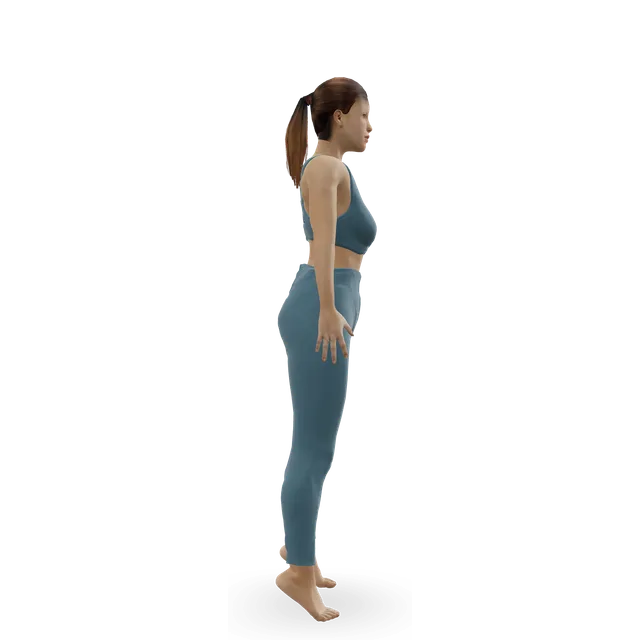
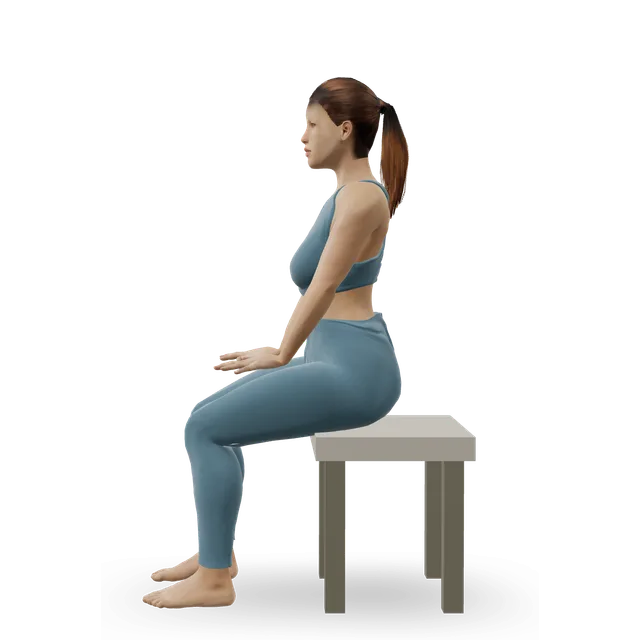
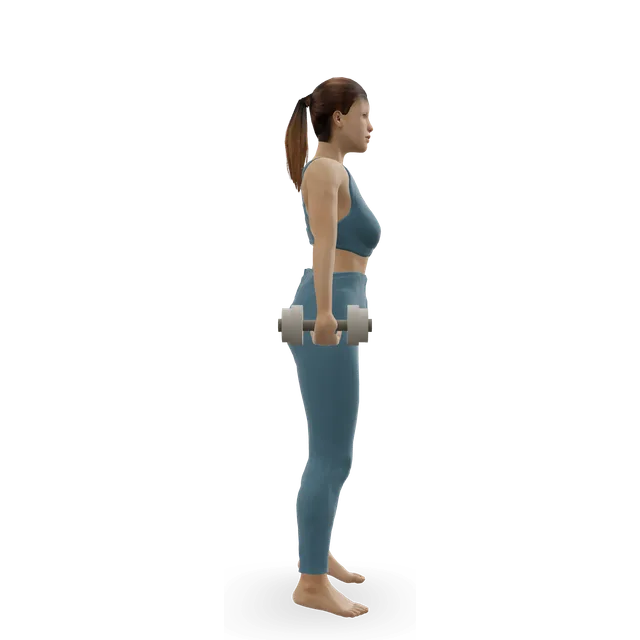
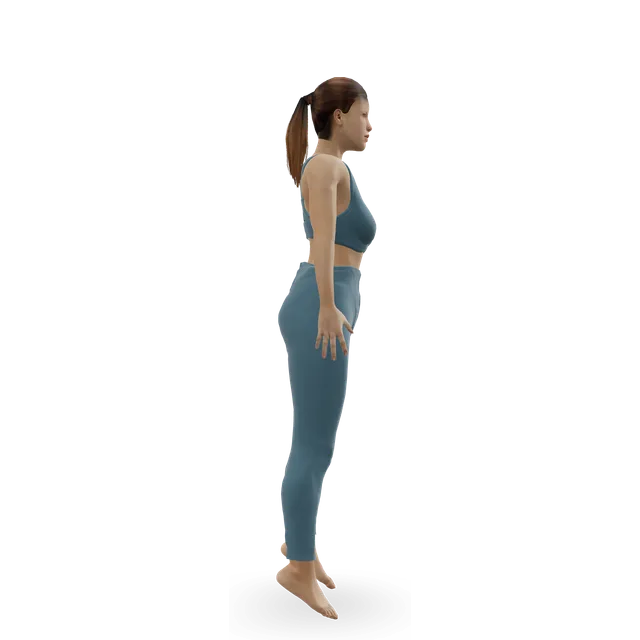
You rise onto the balls of your feet and lower again, and the big calf muscle (gastrocnemius) and the deeper soleus pull through the Achilles tendon on the heel bone. The load depends on how much of your body weight you lift and on how many legs. In one modelling study of 21 healthy men, the estimated Achilles force in a two-leg raise was about 6 times that of a seated raise, and on one leg about 13 times, roughly twice the two-leg load (our conversion from the study's figures). The authors suggest seated and two-leg raises as early steps. In 8 adults, the tendon's estimated load ran from half a body weight in a seated raise to about 7 body weights in a forward hop on one leg.
No study has counted ankle or heel pain caused by calf raises. So this map is built from what each condition is known to do, lab and modelling studies, trials of calf loading and NHS pages. Pain usually comes when a tendon or joint that is already a little sore meets more load than it is used to (our reading).
Sources 1, 2
Lowering, bent knees and the step: what the lab showsEmerging evidence
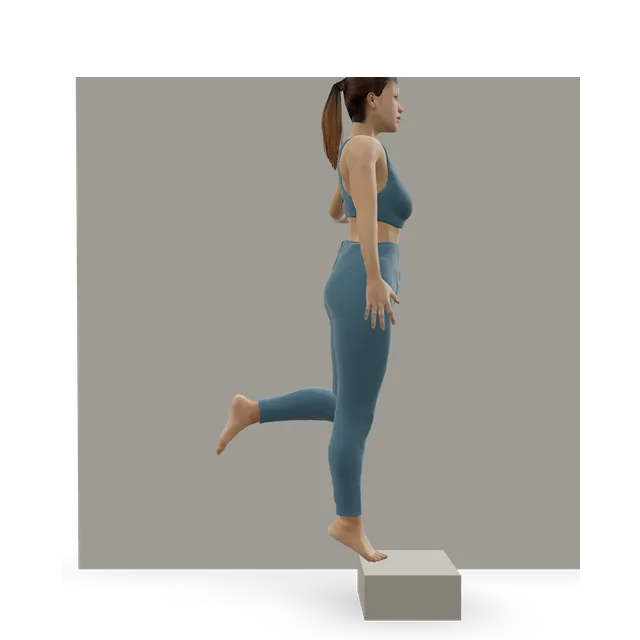
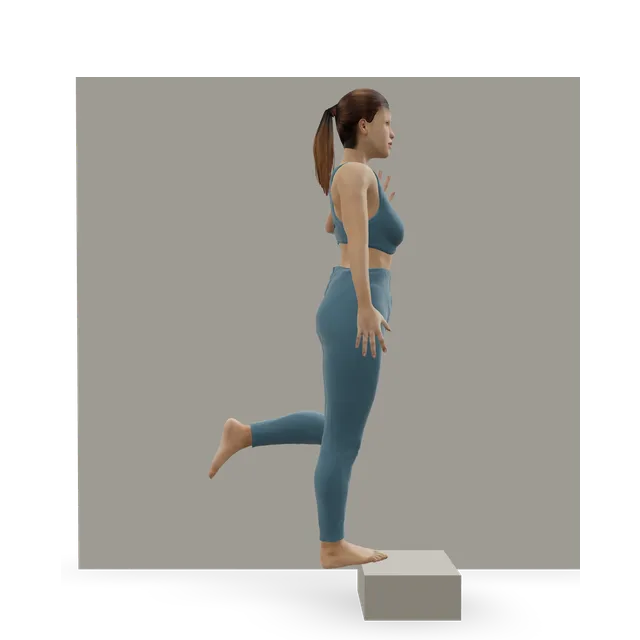
Lowering doesn't load the Achilles more than raising: peak tendon force didn't differ between the two phases in 7 and in 16 healthy adults, and in the 21 men the estimated stress was higher on the way up. Bending the knee to 45 degrees shifted calf muscle activity by only 4% to 5% in 48 adults, because the soleus pulls on the same tendon. In a modelling study of 16 people with Achilles pain and 16 without, the one-leg heel drop with the knee bent loaded the tendon most of the exercises tested, and people with tendon pain moved in ways that lowered the load; a one-person tendon model agreed. In people with Achilles pain, the soleus did about 61% of the calf's work.
So only sitting takes your body weight off the tendon. No study has measured tendon force off a step against on the floor, with added weight or at different speeds.
Sources 3, 4, 1, 5, 6, 7, 8
Why the step matters where the tendon meets the heelEmerging evidence
What a step changes is how far your ankle bends up as the heel drops. That bend presses the tendon against the back of the heel bone where it attaches: ultrasound studies show the tendon squeezed there as the heel lowers, and in insertional tendinopathy the bone presses on the tendon across more of the ankle's range. Squeezing (compression) is a recognised driver of tendon pain.
Pain within about 2 cm of the heel bone is insertional, 20% to 25% of Achilles cases; an NHS trust puts the middle of the tendon at 2 to 6 cm above the heel bone. Guidelines start insertional pain on a flat surface.
Sources 9, 10, 11, 12, 13, 14, 15
Where it hurts sorts the causesEmerging evidence
The NHS lists pain in the ankle and heel, with pain in the calf when standing on tiptoe, under Achilles tendonitis. An NHS trust says Achilles tendinopathy is most common between 30 and 60, and goes with a jump in activity, a new sport, weaker calves, long periods on your feet, diabetes, high cholesterol, inflammatory arthritis, a higher body weight and long-term steroids or some antibiotics.
A pinch deep at the back of the ankle at full tiptoe, tender in front of the tendon rather than in it, points to posterior impingement, which comes from repeated or forced full pointing: ballet, football and downhill running. A pinch at the front at the bottom of a step drop would be the front of the joint, which hurts at the end of the ankle's upward bend; that a step drop brings it on is our reading. Difficulty rising on tiptoe on one side is a key sign of the tibialis posterior tendon on the inner ankle. Nothing links the peroneal tendons on the outer ankle to calf raises, and their care starts without surgery. Calf strains are most likely with age and a past calf strain (10 studies, 5,397 athletes), and in elite Australian footballers 84.6% were in the soleus.
Sources 14, 16, 17, 18, 19, 13, 20, 21, 22, 23, 24
Cramp during calf raisesStrong evidence
The NHS lists putting too much strain on muscles during exercise among the causes of leg cramps, says a cramp lasts from a few seconds to 10 minutes and that the muscle may feel sore for up to 24 hours. A review's first recommendation is to stretch the cramping muscle gently until it lets go.
Dehydration and salt loss aren't supported as causes: the evidence for them is anecdotes, small case series and one small study, and four cohort studies don't support them. Across 9 studies (11,274 people), a past cramp raised the odds of another about 4 times, and fluid intake showed no consistent link.
Sources 25, 26, 27, 28
What a scan shows, and when it mattersEmerging evidence
An NHS trust says Achilles tendinopathy is diagnosed from where it hurts, how it behaves and what makes it better or worse, and that ultrasound or magnetic resonance imaging (MRI) scans are usually not needed.
Read reports with care. An os trigonum is in about 9% of feet (41 studies, 36,612 feet), and in 76 elite dancers and athletes training at full load, an extra bone or bony spur at the back of the ankle showed on MRI in 61.8% and fluid behind the joint in 90.8%. After a snap, a fall or with a swollen calf, the warning signs come first: if a doctor thinks you have a blood clot (deep vein thrombosis, DVT), the NHS says you should be referred for an ultrasound scan within 24 hours.
Sources 14, 29, 30, 17, 31
How it usually goesEmerging evidence
No study follows pain from calf raises. In mid-tendon Achilles pain, improvement starts from about 2 weeks of loading and most of the gain comes by 12 weeks (31 groups of people). An NHS trust says most people notice some improvement within 8 to 12 weeks, but full recovery can take several months, and NHS inform says several months or more. Five years after a heel drop programme, 39.7% of 58 tendons were pain-free and 48.3% had needed other treatment.
Posterior impingement often settles with changed training and physiotherapy: in 26 elite footballers, physiotherapy then an injection settled 18. Cramp passes in minutes. No one can promise a date.
Sources 32, 14, 33, 34, 35, 25