Pain guide · Hip pain

Hip pain in menopause and perimenopause: the outer hip tendons, arthritis, your bones and the back

Hip pain is common in the years around the menopause, and it usually comes from the same places as at any age: the tendons on the outside of the hip, the hip joint itself or the lower back. The outer hip tendons trouble women most between about 40 and 60, so they often flare in perimenopause; hip arthritis becomes commoner from the mid-40s; and pain from the back is easily felt only in the hip. Aching muscles and joints are a recognised menopause symptom, but the menopause hasn't been shown to cause hip pain on its own, and hormone replacement therapy (HRT) isn't a proven treatment for it. What the menopause does change is your bones: they thin fastest from a year before your last period to two years after, which is why strength, impact and balance exercise matter now.

This guide starts with the signs that need help, from a 999 call or accident and emergency (A&E) to an urgent general practitioner (GP) appointment or the National Health Service's 111 line (NHS 111): not being able to stand or put weight on the leg after a fall, a hot, swollen hip or hip pain with a high temperature, and a painful lump at the top of the thigh. Then it sorts the causes by where and when it hurts, explains what changes in sitting, standing and sleeping help the outer hip, what the trials found for exercise, injections and HRT, how to look after your bones, and gives a three-stage plan with 3D demos that ends with bone-building strength and impact.

When to get help first

Exercise is for pain that has been checked or is clearly mild and settling.

Get urgent medical help if

  • Call 999 or go to A&E: severe hip pain after a fall or injury, or you cannot stand, walk or put weight on the leg. In an older adult this can be a broken hip; the leg may be at an odd angle or look shorter. Don't drive yourself.
  • Call 999 or go to A&E: tingling or loss of feeling in the hip or leg after an injury.
  • Call 999 or go to A&E if you have sciatica on both sides, weakness or numbness in both legs that's severe or getting worse, or numbness around or under your genitals, or around your bottom (anus); if you find it hard to start peeing, cannot pee or cannot control when you pee; or if you do not notice when you need to poo or cannot control when you poo, and this is not normal for you. These could be symptoms of a serious back problem that needs to be treated in hospital as soon as possible.
  • Ask for an urgent GP appointment or get help from NHS 111 if you have severe hip pain that started suddenly but you've not had a fall or injured your hip, your hip is swollen and feels hot, the skin around your hip has changed colour, or you have hip pain, feel generally unwell and have a high temperature (or feel hot, cold or shivery). A hot, swollen hip with a high temperature can be a joint infection.
  • Call 999 or go to A&E now if you have a femoral hernia (a small lump at the top of your thigh, in your groin) and very bad tummy pain, you feel sick or you're being sick, you cannot fart or poo, you have a high temperature or you feel hot, cold or shivery, or you've suddenly become confused. Do not drive to A&E. With any other hernia and pain in or around it, a bloated tummy, feeling or being sick, vomiting blood or vomit that looks like coffee grounds, constipation, a high temperature or feeling hot, cold or shivery, or sudden confusion, get help from NHS 111.
  • Contact a GP immediately, go to 111.nhs.uk or call NHS 111: a new or frequent headache that usually comes on suddenly (your scalp may also feel sore or tender), pain in the jaw muscles or tongue when eating or talking, or problems with your sight, such as double vision or loss of vision in 1 or both eyes. With pain and stiffness around the shoulders, these can be signs of temporal arteritis (giant cell arteritis), which up to 1 in 5 people with polymyalgia rheumatica develop. If you suddenly can't see from 1 or both eyes, call 999 or go to A&E.
  • Same day (urgent GP appointment or NHS 111): throbbing pain in one leg (rarely both), usually the calf or thigh; swelling in one leg (rarely both); red, blue or darkened skin around the painful area, which may be harder to see on brown or black skin; or swollen veins. This can be a deep vein thrombosis (DVT). It is more likely after surgery, a hospital stay, 3 or more days in bed, a journey of over 4 hours, pregnancy or a recent birth, cancer, a previous clot, or contraception or hormone replacement therapy (HRT) that contains oestrogen.
  • Call a doctor or NHS 111 straight away: new pain, weakness or discomfort in your thigh, hip or groin while you're taking a bisphosphonate bone medicine, such as alendronic acid. The NHS says this happens rarely but may be an early sign of a possible broken thigh bone, and the UK medicines regulator asks everyone taking these medicines to report thigh, hip or groin pain.

See a doctor or physiotherapist if

  • Hip pain that stops normal activities or disturbs sleep, keeps getting worse or keeps coming back, or has not improved after 2 weeks of looking after it at home.
  • Stiffness lasting more than 30 minutes after waking.
  • Bone pain that is constant or worse at night, especially with a lump, unexplained weight loss, fever or tiredness, or a past history of cancer.
  • See a GP if you have pain and stiffness for more than a week, especially if you're over 50, it's in both shoulders (often the neck and hips too) and the stiffness lasts longer than 45 minutes in the morning. It can be polymyalgia rheumatica.
  • Outer hip pain that hasn't improved within 6 weeks of following this advice, or is getting worse: talk to a healthcare professional. In many areas you can refer yourself to NHS musculoskeletal services.
  • A lump in the groin, upper thigh or tummy, especially one that appears when you cough or strain and goes when you lie down: see a GP, as it may be a true hernia. A femoral hernia (a small lump at the top of the thigh, mainly in women over 50, though it can happen to anyone) needs treating in hospital.
  • Hip or groin pain that hasn't settled after 6 weeks, especially with a normal X-ray, or new hip pain if you take high-dose steroids, drink heavily, or have sickle cell disease or lupus: ask your GP about an MRI (magnetic resonance imaging) scan and a hip specialist. It can be avascular necrosis, which an X-ray can miss early on.
  • You're 50 or over, or past the menopause, and have broken a bone in a fall from standing height or less, or you take steroid tablets long term: ask your GP about a fracture risk assessment. NICE recommends offering a bone density (DXA) scan after a broken hip or spine from thin bones, or another major fragility fracture, such as a broken wrist or shoulder, in the last 2 years.
  • Joint aches around the menopause, with symptoms such as hot flushes, poor sleep or low mood: contact your GP if you want to know your options.

Where does it hurt?

Location narrows the likely causes; it does not diagnose.

The bony point on the outside of the hip, worse lying on it, on stairs and crossing your legs

Usually the outer hip tendons (greater trochanteric pain syndrome, often called hip bursitis), commonest in women aged 40 to 60. Our outer hip pain guide has the full plan.

Read: Outer hip pain →
Told you have hip bursitis

Usually the same outer hip tendons rather than the fluid-filled sac. Our hip bursitis guide covers injections and the plan.

Read: Hip bursitis (gluteal tendinopathy) →
The groin, the front of the thigh or the buttock, stiff after rest and worse walking, from about 45

Often hip arthritis, which NICE (the National Institute for Health and Care Excellence) diagnoses from your symptoms, without a scan.

Read: Hip arthritis →
Hip pain at night, or lying on your side

Usually the outer hip tendons. Our hip pain at night guide covers sleeping positions.

Read: Hip pain at night →
The buttock and outer hip with back stiffness, or pins and needles or pain below the knee

Often the lower back, which can be felt only in the hip. Our lower back and hip pain guide goes through the clues.

Read: Lower back and hip pain →
Pain down the back of the leg, worse than the back

Usually sciatica. Numbness around the genitals or bottom, or new bladder or bowel problems, needs 999.

Read: Sciatica →
Low on one side at the back of the pelvis

Possibly the sacroiliac joint.

Read: SI joint pain →
Aches in the hips and other joints, with stiff fingers or knees

Common around the menopause. Our joint pain in menopause guide covers aches in several joints.

Read: Joint pain in menopause →
Low back pain around or after the menopause

Our back pain in menopause guide covers the back itself, thin bones and spinal fractures.

Read: Back pain in menopause →
Both hips and shoulders stiff for more than 45 minutes every morning, over 50

Possibly polymyalgia rheumatica: see a GP. With a new headache, jaw pain when eating or problems with your sight, contact a GP immediately or NHS 111.

A small, grape-sized lump in the groin crease at the top of the thigh

Possibly a femoral hernia, which mainly happens in women over 50: see a GP. Call 999 if it comes with very bad tummy pain or being sick. Our groin pain guide covers the other causes.

Read: Groin pain →
A burning or numb patch on the outer thigh

Usually a squeezed skin nerve at the front of the hip (meralgia paresthetica).

Read: Meralgia paresthetica →
After a fall, you can't stand or put weight on the leg

Possibly a broken hip: call 999 or go to A&E, and don't drive yourself.

Read: Broken hip →
Groin, buttock or low back pain after a minor fall, or none, making walking very hard

In later life with thin bones, possibly a fragility fracture of the pelvis, which a plain X-ray can miss: get it checked.

Read: Broken pelvis →
Hip pain at other stages of a woman's life, such as pregnancy

Our hip pain in women guide sorts the causes by age.

Read: Hip pain in women →
Hip pain from about 60

Our hip pain in older adults guide covers falls, arthritis and a plan.

Read: Hip pain in older adults →

Understand it

Common around the menopause, but usually a specific, treatable causeMixed evidence

The NHS lists muscle aches and joint pains among the symptoms of perimenopause and the menopause, and NICE lists joint and muscle pain; neither names the hip. No study has compared hip pain before and after the last period with age taken into account, and a review of hormone supplements and tendons found the results "contradictory and inconsistent". NHS inform says hormone changes "may also influence" outer hip tendon pain. So most hip pain at this age has a specific cause, the same as at other ages, and those causes are treatable.

Sources 1, 2, 3, 4

The outer hip tendons: the classic midlife causeStrong evidence

Greater trochanteric pain syndrome is pain over the bony point on the outside of the hip, usually from the gluteal tendons rather than the fluid-filled sac (the bursa), which is why it's often called hip bursitis. NHS inform says it's "more common in females and in those aged between 40 and 60 years old but can affect any age", and an NHS trust leaflet says the same. In 3,026 US adults aged 50 to 79 with, or at risk of, knee arthritis, it affected one hip in 15.0% of women and 6.6% of men, with no rise between 50 and 79; that group wasn't a general population sample. In Dutch general practice, 1.8 people per 1,000 a year were newly diagnosed, 79.9% of them women, with an average age of 55.

It hurts to lie on that side, climb stairs, stand on one leg (getting dressed), cross your legs, or get in and out of a car or bed. In the main trial of outer hip pain, the LEAP trial, 117 of the 167 women were perimenopausal or past the menopause.

Sources 4, 5, 6, 7, 8, 9

Hip arthritis, and what X-rays do and don't showMixed evidence

New hip arthritis was commoner in women than in men in a meta-analysis (men's rate about two thirds of women's), though the difference in how many people have it at any one time was clear only for the knee and hand. NICE diagnoses osteoarthritis from your symptoms from 45, without imaging, when activity brings on joint pain and morning stiffness lasts 30 minutes or less: typically groin, front of thigh or buttock pain, stiff after rest and worse walking, with socks and shoes getting harder.

Scans and pain often disagree. In US cohorts, only 15.6% of frequently painful hips showed arthritis on X-ray, and only 20.7% of hips with arthritis on X-ray were frequently painful. Gluteal tendon changes showed on MRI (magnetic resonance imaging) in all 16 women with outer hip pain and in 88% of 17 women without hip pain, a small study. A scan result on its own doesn't explain your pain.

Sources 10, 11, 12, 13

Your bones change fastest around the last periodStrong evidence

In the Study of Women's Health Across the Nation (SWAN), 862 US women lost 9.1% of the bone density at the top of the thigh bone over 10 years, 5.8% of it between a year before and two years after the final period, and 10.6% at the spine. The NHS says women "lose bone rapidly in the first few years after the menopause", more so after an early menopause (before 45) or removal of the ovaries, and that osteoporosis "is not usually painful until a bone is broken".

About 1 in 2 women over 50 will break a bone because of osteoporosis in their lifetime, the Royal Osteoporosis Society and the UK osteoporosis guideline (NOGG) say. A broken hip is mostly a later-life event: of 65,133 people aged 60 and over who broke a hip in England in 2024, 69.0% were women and the average age was 82.4. NICE asks GPs to assess fracture risk in women past the menopause who have broken a bone in a minor fall or take long-term steroid tablets, and to consider it from 65, or earlier with risk factors such as 2 or more falls in a year, a parent's broken hip, smoking, more than 14 units of alcohol a week, an untreated early menopause or breast cancer tablets called aromatase inhibitors.

Sources 14, 15, 16, 17, 18, 19

Pain felt in the hip that starts elsewhereEmerging evidence

NHS inform says hip problems can come from the back "even though you don't feel pain in your back", often as pins and needles or a sharp, hot or burning pain. The two often go together: in a US spine centre, 20.2% of people referred with low back pain had outer hip tendon pain instead, and about half of 273 people seen for worn spine problems had it too, more often women.

A femoral hernia is a small, grape-sized lump in the groin at the top of the thigh: the NHS says "Femoral hernias mainly happen in women over 50 years old. They can happen to anyone". Polymyalgia rheumatica stiffens both hips and shoulders for more than 45 minutes every morning, mostly in people over 65; it's very rare under 50. Rarely, bone pain that is constant or worse at night, with weight loss or a lump, comes from a cancer, and very low vitamin D can soften the bones (osteomalacia), with pain in the back, pelvis or legs and weak thigh muscles.

Sources 20, 21, 22, 23, 24, 25, 26, 27

When a scan or test helpsStrong evidence

The outer hip tendons and hip arthritis are diagnosed by examination; NICE doesn't routinely use imaging for osteoarthritis unless something doesn't fit, and the LEAP trial used MRI to confirm the diagnosis for research, not for everyday care. After a fall, X-rays come first, and a broken hip needs urgent care.

A DXA (dual-energy X-ray absorptiometry) bone density scan is part of a fracture risk assessment: NICE offers it after a broken hip or spine from thin bones, or another major fragility fracture, such as the wrist or shoulder, in the last 2 years, and considers it when the 10-year risk of a major fracture is 10% or more. It measures bone, not pain. Blood tests answer specific questions, such as inflammation markers when polymyalgia rheumatica is suspected and vitamin D and calcium when osteomalacia is. An MRI helps when hip or groin pain hasn't settled and the X-ray is normal, or before surgery for a tendon tear.

Sources 11, 9, 28, 19, 15, 25, 27

How it usually goesStrong evidence

The outer hip is slow but usually improves. NHS inform says it "can often take 6 to 12 months of rehabilitation to settle", with flare-ups, and an NHS trust expects improvement after 8 to 12 weeks of the right exercises and small changes, with some people taking up to a year. In Dutch general practice, at least 36% still had pain after a year. Hip arthritis changes slowly, over years; exercise eases it a little while you keep it up.

Bone loss slows from about 2 years after the last period but doesn't stop, and HRT's protection for bone fades once it's stopped. The NHS says menopause symptoms usually last 7 to 9 years, sometimes longer. No one can promise a timescale.

Sources 4, 5, 7, 9, 11, 14, 2, 1

What helps, and how strong the evidence is

Education plus exercise works for the outer hip, before or after the menopauseStrong evidence

In the LEAP trial, 204 people aged 35 to 70 with outer hip tendon pain (167 women: 93 past the menopause, 24 perimenopausal and 43 before it) had education plus exercise, one steroid injection, or wait and see. At 8 weeks, 51 of 66 rated education plus exercise a success, against 38 of 65 after the injection and 20 of 68 with wait and see; at a year, 51 of 65, 36 of 63 and 31 of 60. There were no serious side effects. People with marked hip arthritis weren't included.

The education taught avoiding movements and positions that press the gluteal tendons against the bone, and the exercises built from gentle holds to single-leg work over 8 weeks. An exploratory analysis found no difference in the benefit by menopausal status, and the benefit ran through better function, less constant pain and more confidence, not stronger muscles.

Sources 9, 29, 30

HRT isn't a proven treatment for hip painEmerging evidence

The only trial randomised 132 women past the menopause with outer hip tendon pain to a hormone cream or a placebo cream, and to tendon exercise or sham exercise; everyone had education on avoiding squeezing the tendons. Every group improved at 12 and 52 weeks, tendon exercise did no better than sham, and the trial reports no clear overall effect of the cream. Women with a body mass index (BMI) under 25 did better with the hormone cream, but that is a subgroup result that needs confirming (we read only the trial's summary). A sister trial of 94 women past the menopause, all given the same education, found no difference between gluteal loading and sham exercise.

NICE makes no HRT recommendation for joint or hip pain. HRT is a decision about your menopause symptoms, and your bones, made with your GP, who the NHS says "will help you decide".

Sources 31, 32, 33, 2, 34

Injections help for weeks, not a year; other treatments are unprovenMixed evidence

In 120 people in Dutch general practice, 55% had recovered 3 months after a steroid injection against 34% with usual care, but at a year it was 61% against 60%. NHS inform says injections "may not cure your condition", and in LEAP education plus exercise did better than an injection at 8 weeks and on overall improvement at a year.

NICE says the evidence for shockwave therapy is "limited in quality and quantity", so it's used only with special arrangements; platelet-rich plasma did no better than a placebo injection in a trial of 79 people; and surgery for torn gluteal tendons rests on case series, with no randomised trials.

Sources 35, 4, 9, 36, 37, 38, 39

Exercise eases hip arthritis a little, and NICE makes it the core treatmentMixed evidence

Exercise eases hip arthritis pain by about 7 to 8 points out of 100 on average against no exercise, with moderate certainty, and NICE makes therapeutic exercise a core treatment, warning that pain may rise at first and that long-term adherence increases the benefit. Neither review reports results by sex or menopause.

HRT and hip arthritis: in the Women's Health Initiative trials, oestrogen alone went with fewer joint replacements overall but not clearly fewer hip replacements, oestrogen plus progestin showed no effect, and observational studies point both ways. Neither NICE guideline recommends HRT for arthritis.

Sources 40, 41, 11, 42, 43, 44, 45

Strength, impact and balance for bone: safe, and recommendedStrong evidence

The UK consensus on exercise for osteoporosis, which NOGG supports, asks for strength training on 2 or 3 days a week at the most you can lift 8 to 12 times, building to 3 sets; about 50 moderate impacts on most days if you have no spinal fractures; and balance and strength work at least twice a week. Across 62 trials, 5.8% of people who exercised broke a bone against 9.6% who didn't, so exercise "is therefore unlikely to cause a fracture". At the hip, progressive strength training for the legs did best for bone density in a review of 43 trials of women past the menopause, and supervised heavy lifting in 101 women with low bone mass (average age 65) kept hip bone density steady while it fell without it.

Exercise cut falls by 23% in people aged 60 and over living at home, an older group than most readers. Swimming and cycling help your fitness but "are not impact exercises", the Royal Osteoporosis Society says.

Sources 46, 17, 47, 48, 49, 50, 51

HRT and fracturesStrong evidence

NICE says fragility fracture risk is lower while taking HRT, and the benefit fades after stopping. In the Women's Health Initiative, oestrogen plus progestin cut broken hips by about a third (about 5 fewer per 10,000 women a year), and oestrogen alone did too, but the trials found no overall benefit across all health outcomes in women who weren't chosen for fracture risk. NOGG now lists HRT as a first-line option for women aged 60 or under at high fracture risk and low risk of cancer and clots.

The NHS says HRT "helps to prevent osteoporosis" and is "particularly important" after an early menopause, and that HRT tablets slightly raise the risk of blood clots and stroke, while patches, gels and sprays don't raise the clot risk; NICE says the same about clots.

Sources 2, 52, 53, 54, 17, 34

How much pain is OK while you exercise?

Up to about 5 out of 10, settled within an hour, and no worse that night or the next morningEmerging evidence

Borrowed from our hip pain guide: pain up to about 5 out of 10 during exercise is acceptable if it settles within an hour or so and the hip is no worse that night or the next morning. If it is, do less next time (fewer repetitions, a smaller range, a lighter load), not nothing. NHS inform's hip exercises use the same scale and ask that pain is no worse the morning after; NICE says joint pain may rise when you start exercising with arthritis while regular exercise still helps; and across 7 trials of long-lasting pain, exercise that allowed some pain did slightly better in the short term.

For the outer hip, the LEAP trial was stricter in its squats, bridges and side steps: "No change in trochanteric pain was acceptable", and in step-ups and single-leg standing "There must be NO pain over the bone at the side of the hip", though a working ache in the buttock muscles is normal. If the hip wakes you more than usual after a session, drop back a step, not to nothing (our suggestion, as in our outer hip pain guide). Impact work for bone should be comfortable: stop heel drops with foot, knee, hip or back pain, and build impact only once you feel steady.

Never a pain-rule question: a fall with a leg you can't stand on, a hot, swollen hip or a high temperature, a painful lump in the groin, numbness around the genitals or bottom, new bladder or bowel problems, bone pain at night with weight loss, or both hips and shoulders stiff with a new headache. See the warning signs.

Sources 55, 56, 11, 57, 9, 50

The exercise plan: 3 stages

Start at the first stage. Each move opens a full guide with a 3D demo.

Stage 1

Settle: take the squeeze off the tendons, and load them gently

About weeks 0 to 2, daily. Change how you sit, stand and sleep today (the written steps below), and start the LEAP programme's first week: holds and small movements with the knees apart, which load the tendons without squeezing them. With a diagnosis, that guide's plan comes first: hip arthritis, a broken hip or pelvis, a hip replacement, or your team's plan after surgery. No trial has tested a plan for hip pain in menopause: stages 1 and 2 follow LEAP, whose women were mostly perimenopausal or past the menopause, and NHS inform's pacing; stage 3 adds the UK consensus's strength, impact and balance for bone.

Supine isometric hip abduction (belt press) demonstrated on the 3D figure3D demoSupine isometric hip abduction (belt press)Beginner · A band

3 to 5 holds of 5 to 10 s, twice a day, at a light effort · The move page's dose, the LEAP programme's starting dose. Lie on your back, not your side; outer hip pain shouldn't rise during or after, as the move page says

Harder: Lateral band walk

Standing wall-press hip abduction demonstrated on the 3D figure3D demoStanding wall-press hip abductionBeginner · A wall

3 to 5 holds of 5 to 15 s each side, twice a day · The move page's dose, LEAP's standing hold. Keep the standing hip level rather than letting it sag out, as the move page says

Easier: Supine isometric hip abduction (belt press) · Harder: Lateral band walk

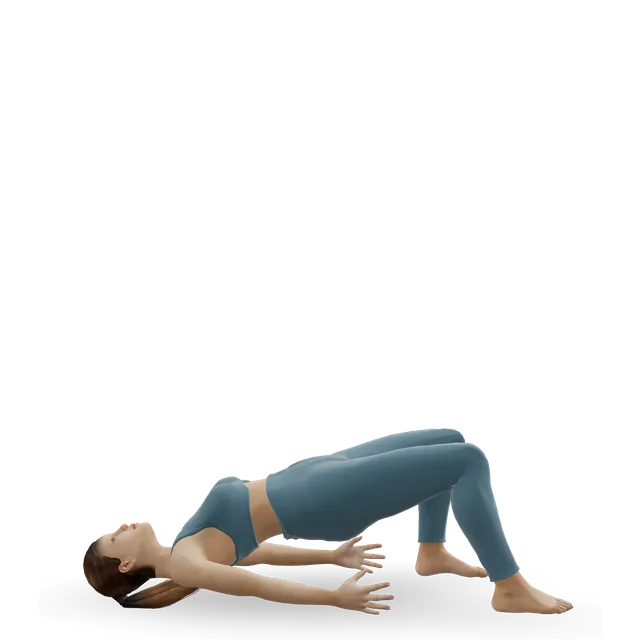
Glute bridge demonstrated on the 3D figure3D demoGlute bridgeBeginner · No equipment

10 slow bridges, once a day, at a light effort · LEAP's first-week bridge; NHS inform builds from 2 to 3 at a time to sets of 8 if 10 is too many

Easier: Pelvic tilt into bridge · Harder: Single-leg glute bridge

Sit squat (partial squat) demonstrated on the 3D figure3D demoSit squat (partial squat)Beginner · No equipment

10 slow squats, once a day, a third to half of the way down to a chair, knees over your toes · LEAP's first-week squat

Harder: Bodyweight squat

Side-stepping (sideways walking) demonstrated on the 3D figure3D demoSide-stepping (sideways walking)Beginner · A wall

10 steps each way, once a day, next to a counter, stepping back only to hip width · The move page's dose (the NHS balance exercises); LEAP's first week used the same, with "Do NOT bring ankles together"

Harder: Lateral band walk

Supine heel slide demonstrated on the 3D figure3D demoSupine heel slideBeginner · No equipment

10 slow repetitions each side, once or twice a day, if the hip joint itself is stiff · The move page's dose (editorial), as in our hip arthritis guides

Harder: Hip windshield wipers

Move on when: None of these raises pain over the bony point on the side of the hip, and your nights have been no worse for about a week (as in our outer hip pain guide, editorial).

Follow along: a timer, a cue and the next move, one step at a time.
Stage 2

Build: one leg at a time, pelvis level

About weeks 2 to 8: the holds and bridges daily, the harder moves 3 or 4 days a week, and walking on most days. LEAP's step from two legs to one, with balance, keeping the hip from drifting across the body.

Staggered-stance bridge (offset bridge) demonstrated on the 3D figure3D demoStaggered-stance bridge (offset bridge)Beginner · No equipment

5 slow repetitions each side once a day, building to 2 sets of 5 to 10 at a somewhat hard effort · The move page's dose, from LEAP. Shorten the range if outer hip pain rises, as the move page says

Easier: Pelvic tilt into bridge · Harder: Single-leg glute bridge

Split squat demonstrated on the 3D figure3D demoSplit squatIntermediate · No equipment

5 slow repetitions each side in a short range, building to 2 sets of 5 to 10 · LEAP's offset squat (the nearest catalog move, as in our outer hip pain guide). Pad the back knee and keep a hand on a wall, as the move page says

Easier: Bodyweight squat · Harder: Reverse lunge

Step-up demonstrated on the 3D figure3D demoStep-upBeginner · A step

A low step, 3 to 4 s up and 3 to 4 s down, building to 2 sets of 8 · LEAP's step-up, with NHS inform's pacing. There should be no pain over the bone at the side of the hip

Easier: Low step-up · Harder: Dumbbell step-up

Lateral band walk demonstrated on the 3D figure3D demoLateral band walkBeginner · A band

5 to 10 steps each way, 1 or 2 sets, with a light band, from about week 3 · LEAP's band side steps (the nearest catalog move). A sharp pain on the outside of the hip, rather than a working burn, means a lighter band, as the move page says

Easier: Hip abduction machine · Harder: Lateral band walk, band at the feet

Single-leg stand demonstrated on the 3D figure3D demoSingle-leg standBeginner · A wall

Holds from 5 s, building to 15 s, then 30 s, pelvis level, a hand near a support · LEAP's single-leg standing, starting at 5 s and building to 15; 30 s is editorial

Easier: Tandem stance and heel-to-toe walk · Harder: Single-leg reach matrix

Sit to stand from a chair demonstrated on the 3D figure3D demoSit to stand from a chairBeginner · A bench or box

2 sets of 8 to 12 from a firm chair, then a lower one without your hands · Editorial, as in our hip arthritis guide. Use a chair that can't slide or tip, as the move page says

Easier: Sit to stand, pushing on the thighs · Harder: Bodyweight squat

Move on when: You can stand on the sore leg for 30 s with the pelvis level and no outer hip pain, and you're sleeping through most nights in your chosen position (as in our outer hip pain guide, editorial).

Follow along: a timer, a cue and the next move, one step at a time.
Stage 3

Stronger hips and bones, and back to everything

From about week 8, and ongoing: strength 2 or 3 days a week, impact on most days and balance at least twice a week. Heavier single-leg strength without squeezing the tendons, plus the UK consensus's bone work. Walking, stairs, sleeping on your side, gardening, shopping, swimming and the gym come back by the written steps below.

Dumbbell goblet squat demonstrated on the 3D figure3D demoDumbbell goblet squatIntermediate · A dumbbell

2 sets of 8 to 12, building to 3 sets with a weight you can lift 8 to 12 times with good technique · The UK osteoporosis consensus dose; squat to a box or chair at first, knees over your toes (editorial)

Easier: Bodyweight squat · Harder: Barbell front squat

Single-leg Romanian deadlift demonstrated on the 3D figure3D demoSingle-leg Romanian deadliftAdvanced · A dumbbell

2 to 3 sets of 6 to 8 each side, fingertips on a wall at first · As in our hip bursitis guide (editorial). Learn it with a support, as the move page says

Easier: Dumbbell Romanian deadlift

Step-up demonstrated on the 3D figure3D demoStep-upBeginner · A step

A higher step, 3 sets of 8 to 10 each leg, then holding dumbbells · Editorial. Lower the step before you add weight, as the move page says

Easier: Low step-up · Harder: Dumbbell step-up

Heel drop (impact for bone) demonstrated on the 3D figure3D demoHeel drop (impact for bone)Beginner · No equipment

20 to 30 drops at first, building toward about 50 on most days, for example 5 sets of 10 · The move page's dose, which it credits to the UK osteoporosis consensus. Keep them gentle, or march instead, with spinal fractures, and see a pelvic health physiotherapist if you leak, as the move page says

Harder: Jump rope (basic bounce)

Tandem stance and heel-to-toe walk demonstrated on the 3D figure3D demoTandem stance and heel-to-toe walkBeginner · A wall

Holds of 10 to 30 s, then 3 to 5 lengths of a hallway, at least twice a week · The frequency is the UK consensus's for balance; the holds and lengths are editorial, as in our hip pain in older adults guide

Easier: Semi-tandem stance · Harder: Single-leg stand

Suitcase carry demonstrated on the 3D figure3D demoSuitcase carryIntermediate · A dumbbell + A kettlebell

3 walks of 20 to 30 m each side · As in our hip pain in women guide (editorial). If you can't stay level, the weight is too heavy, as the move page says

Easier: Farmer's carry · Harder: Overhead carry (waiter's walk)

Move on when: Our suggestion: a normal week of walking, stairs and chores leaves your hip no worse that night or the next morning. Keep two strength days a week and impact on most days for your bones; for hip arthritis, NICE makes exercise the long-term core treatment. Our workout plans for women over 40 and over 50 are a long-term home.

Follow along: a timer, a cue and the next move, one step at a time.

What to change for now

Standing, sitting and sleeping (written steps)

Our 3D figure can't show these. They come from NHS inform, the NHS, NHS trusts and Arthritis UK; none has been tested on its own, but the LEAP trial's education taught the same principle and carried much of its benefit.

  • 1. Standing: spread your weight evenly across both feet and don't lean on one leg (NHS inform), and don't stand with your hip pushed out to one side (an NHS trust).
  • 2. Sitting: don't cross your legs, and avoid low chairs: the NHS says "do not sit in low chairs - this can put extra pressure on your hips". A firm chair high enough that your hips are a little higher than your knees, or a cushion, helps, and so does breaking up long spells of sitting.
  • 3. Sleeping: "try lying on your back with a pillow under your knees or lie on your good side with a pillow between your legs to keep them in line with your hip joints" (NHS inform), with a pillow behind your back so you don't roll onto the sore side (an NHS trust). No trial has tested sleeping positions.
  • 4. The car: sit on the edge of the seat and swing both legs in together, rather than stepping in one leg at a time (Arthritis UK).
  • 5. Stairs: lead with your good leg going up and your sore leg coming down, holding the handrail (NHS inform).
  • 6. Flares: "it may be best to reduce the repetitions or rest for a few days before starting again" (NHS inform), with an ice pack wrapped in a towel for up to 20 minutes every 2 to 3 hours and paracetamol or ibuprofen gel if needed (the NHS).

Sources 4, 5, 58, 59, 21, 20, 9

Walking, work and sleep (written steps)

These come from NHS inform, an NHS trust, Acas and the NHS, except where a step is our suggestion.

  • 1. Keep active and "stay at work even if you have to modify your duties" (NHS inform), and avoid complete rest (an NHS trust).
  • 2. Build walking distance and pace gradually: NHS inform lists a sudden increase among the things that can bring outer hip pain on.
  • 3. At work, talk to your manager early about any menopause symptoms: Acas asks employers to consider changes such as rest areas and flexible working.
  • 4. Sleep: the NHS lists the menopause and long-term pain among causes of poor sleep, and suggests regular daytime exercise but none in the 4 hours before bed.

Sources 4, 5, 60, 61

Your bones, HRT and supplements (written steps)

These come from the NHS, NICE and the Royal Osteoporosis Society.

  • 1. Weight-bearing and strength exercise, calcium-rich food and a daily 10 microgram vitamin D supplement help your bones (the NHS); swimming and cycling are good for fitness but aren't impact exercise, so keep strength and impact work alongside them (the Royal Osteoporosis Society).
  • 2. If you're 50 or over, or past the menopause, and have broken a bone in a minor fall, or you take steroid tablets long term, ask your GP about a fracture risk assessment (NICE).
  • 3. HRT and bone medicines are decisions with your GP. HRT lowers fracture risk while you take it; the NHS says HRT tablets slightly raise the risk of blood clots and stroke, while patches, gels and sprays don't raise the clot risk.
  • 4. We found no trial of supplements or collagen for hip pain in the menopause, and NICE warns that the safety and purity of unregulated preparations may be unknown.

Sources 15, 62, 19, 2, 34, 50

Positions to swap, and why

Habit or positionWhy it mattersInstead
Sitting with your legs crossedIt brings the thigh across the body, squeezing the tendons against the bone; NHS inform says avoid it.Knees hip-width apart, hips a little higher than your knees.
Standing with your weight hanging on one hipNHS inform says spread your weight across both feet.Weight even on both feet, and standing wall-press holds.Try: Standing wall-press hip abduction
Lying on the painful side, or on the good side with the top knee dropped acrossNHS inform says avoid lying on the painful side and keep your legs in line with your hips.Your back with a pillow under your knees, or your good side with pillows between your knees.
IT band and outer hip stretchesThey hold the hip in the squeezed position, the LEAP programme left them out, and the move page says skip it if the bony point is sore.Holds that load the tendons without squeezing them.Try: Supine isometric hip abduction (belt press)
The knee-across-the-body stretchThe move page says skip it with pain on the outside of the hip, because it presses the tendons against the bone.Standing wall-press holds.Try: Standing wall-press hip abduction
Clamshells while the outer hip hurts at nightThe move page says leave them out while it hurts at night, and the trial that did best didn't use them.The lying hold and bridges now; side-lying work last.Try: Supine isometric hip abduction (belt press)
Side-lying leg raises on a sore outer hipThe move page says this position can aggravate a painful outer hip.Staggered-stance bridges.Try: Staggered-stance bridge (offset bridge)
A sudden jump in walking distance or paceNHS inform lists it among the things that bring outer hip pain on.Shorter walks more often, building up.Try: Treadmill walking
Relying on repeated steroid injectionsThey help for weeks, not a year, and education plus exercise did better in LEAP.Education and the exercise plan first.Try: Staggered-stance bridge (offset bridge)
Starting HRT to treat outer hip painIn the one trial, hormone cream made no clear overall difference.A GP conversation about your menopause symptoms and bones, and the plan on this page.
Stopping exercise because of osteoporosisExercise is unlikely to cause a fracture, and the UK consensus and NOGG recommend it.Strength, impact as advised, and balance.Try: Heel drop (impact for bone)
Swimming or cycling as your only exercise for your bonesThey aren't impact or weight-bearing exercise.Add strength work and impact.Try: Dumbbell goblet squat

Routines to follow

Pilates for hip pain: a 20-minute class that spares the hip

A 20-minute Pilates class for hip pain: bridges, outer-hip holds, standing leg work and balance, without deep bends, crossed legs or lying on the sore side.

20 minBeginner14 movesA band, A wall

Strength and balance workout

Strength and balance in one session: squats, Romanian deadlifts, push-ups, rows, step-ups, back extensions, carries and single-leg balance.

45 minBeginner14 movesA wall, A dumbbell

Bone-strengthening workout

Impact, strength and balance for stronger bones, following UK osteoporosis consensus advice, with options for every level.

40 minBeginner14 movesA kettlebell, Other / check instructions

Balance exercises routine

Balance practice in 10 minutes: tandem stance, single-leg stands, marches, heel walks, tree pose and floor transfers.

10 minBeginner7 movesA wall, A bench or box

Low-impact leg workout (no jumping)

A gentle leg strength routine with no jumping: sit-to-stands, step-ups, wall sits, bridges and calf raises.

20 minBeginner7 movesA bench or box, A step

Yoga for menopause: a 35-minute practice for strength, balance and winding down

Thirty-five minutes of standing strength, balance, back strengthening and a long relaxation for the menopause, with no deep forward folds or shoulder stands.

35 minBeginner15 movesFirm cushion

Pilates for osteoporosis: a mat class with safe swaps

A 25-minute Pilates workout for osteoporosis and osteopenia: the Royal Osteoporosis Society's swaps for rounding moves, plus back strength and balance.

25 minBeginner16 movesA wall, A bench or box

More moves for this area

Questions people ask

Can the menopause cause hip pain?

Muscle aches and joint pains are recognised menopause symptoms, and the outer hip tendons trouble women most between 40 and 60, NHS inform says, adding that hormone changes may play a part. But no study has shown that the menopause itself causes hip pain: most has a specific cause, such as the outer hip tendons, arthritis or the back, and those are treatable.

Why do my hips hurt at night, and how should I sleep?

Usually because lying on a sore outer hip presses the tendons against the bone, and lying on the other side lets the top knee drop across. Lie on your back with a pillow under your knees, or on your good side with a pillow between your knees and one behind your back. Bone pain that is constant or worse at night, with weight loss, needs a GP.

Is hip bursitis caused by the menopause?

"Hip bursitis" is usually the gluteal tendons rather than the bursa, and it's commonest in women aged 40 to 60. No study has compared it before and after the menopause, and in a trial of 132 women past the menopause, everyone improved with advice on avoiding squeezing the tendons. Our outer hip pain guide has the full plan.

Does HRT help hip pain?

It isn't a proven treatment: in the only trial, hormone cream made no clear overall difference to outer hip pain, and a better result in women with a lower BMI is a subgroup result that needs confirming. HRT does lower the risk of broken bones while you take it, and your GP can talk you through its benefits and risks for your menopause symptoms.

Can HRT cause hip pain?

We found no trial showing that HRT causes hip pain. HRT tablets slightly raise the risk of a blood clot, which can cause a swollen, throbbing calf or thigh, while patches, gels and sprays don't. A swollen, painful leg needs help the same day.

Why does only one hip hurt?

The outer hip tendons often affect one side first: in one study, one hip was affected in 15% of women aged 50 to 79 and both in 8.5%. Pain from the back, felt in the buttock and outer hip on one side, is common too, so pain on one side doesn't point to a cause on its own.

Is it my hip or my back?

Pain over the bony point on the side of the hip, worse lying on it, points to the tendons; groin pain and stiffness to the hip joint; buttock pain with pins and needles or pain below the knee to the back. The two often go together, and outer hip pain is easily mistaken for back pain. Our lower back and hip pain guide goes through the clues.

Can the menopause cause hip arthritis?

New hip arthritis is commoner in women than in men, and it becomes commoner from midlife, but the menopause hasn't been shown to cause it, and HRT trials didn't clearly change hip replacements. Exercise is the core treatment, and NICE diagnoses it from your symptoms from 45, without a scan.

Will thinning bones make my hips hurt?

Not on their own: the NHS says osteoporosis is not usually painful until a bone is broken. Bone is lost fastest from a year before to two years after the last period, so it's a good time to build strength, impact and balance into your week, and to ask your GP about bone health if you have risk factors.

What exercises help hip pain in the menopause?

For the outer hip, the programme that did best started with gentle holds pressing the knees apart, bridges, small squats and side steps, then built up to single-leg work. For your bones, add strength training on 2 or 3 days a week, about 50 moderate impacts on most days and balance work. Leave out outer hip stretches while the side of the hip hurts.

Do supplements or collagen help hip pain?

We found no trial of supplements or collagen for hip pain in the menopause, and NICE warns that the safety and purity of unregulated preparations may be unknown. The NHS does suggest a daily 10 microgram vitamin D supplement for bone health.

When is hip pain serious?

Call 999 or go to A&E for severe hip pain, or not being able to stand or put weight on the leg, after a fall. Get an urgent GP appointment or NHS 111 for a hot, swollen hip or hip pain with a high temperature, and call 999 for a lump at the top of the thigh with very bad tummy pain or being sick. See a GP if it isn't better after 2 weeks or stops your usual activities; in the US, call 911 where this page says 999.

Related exercise guides

Other pain guides

Sources

  1. NHS · Symptoms of menopause and perimenopause
  2. NICE NG23 · Menopause: identification and management (recommendations, last updated April 2026)
  3. Ganderton 2016 · Female sex hormone supplements and tendons in women before and after the menopause (systematic review, J Musculoskelet Neuronal Interact)
  4. NHS inform · Greater trochanteric pain syndrome
  5. Leicestershire Partnership NHS Trust · Greater trochanteric pain syndrome: outer hip pain (physiotherapy leaflet, 2026)
  6. Segal 2007 · Outer hip pain (greater trochanteric pain syndrome) in 3,026 adults aged 50 to 79 (cross-sectional study, Arch Phys Med Rehabil)
  7. Lievense 2005 · How outer hip pain goes over 1 and 5 years in Dutch general practice (cohort study, Br J Gen Pract)
  8. Albers 2016 · Lower limb tendinopathy in a Dutch general practice population (cross-sectional study, BMC Musculoskelet Disord)
  9. Mellor 2018 · Education plus exercise vs corticosteroid injection vs wait and see for gluteal tendinopathy (RCT, BMJ)
  10. Srikanth 2005 · Sex differences in osteoarthritis (meta-analysis, Osteoarthritis Cartilage)
  11. NICE NG226 · Osteoarthritis in over 16s: diagnosis and management (2022)
  12. Kim 2015 · Hip pain and hip osteoarthritis on X-ray often disagree (diagnostic study of two US cohorts, BMJ)
  13. Ganderton 2017 · How outer hip pain is diagnosed in women (cross-sectional study, J Womens Health)
  14. Greendale 2012 · Bone density loss around the final menstrual period (SWAN cohort, Journal of Bone and Mineral Research)
  15. NHS · Osteoporosis (past its review date: reviewed October 2022, review due October 2025)
  16. Royal Osteoporosis Society · Are you the One in Two? (news release, October 2026)
  17. Gregson 2025 · The 2024 UK clinical guideline for the prevention and treatment of osteoporosis (NOGG, Archives of Osteoporosis)
  18. National Hip Fracture Database · Hip fracture in 2024: annual report 2025 (Royal College of Physicians)
  19. NICE NG259 · Osteoporosis: risk assessment (2026)
  20. NHS inform · Hip problems
  21. Arthritis UK · Hip pain
  22. Tortolani 2002 · Greater trochanteric pain syndrome in people referred to spine specialists with low back pain (case series, Spine J)
  23. Tan 2018 · Outer hip pain in 273 people seen in a spine clinic (clinical study, J Clin Neurosci)
  24. NHS · Femoral hernia
  25. NHS · Polymyalgia rheumatica (past its review date: reviewed April 2023, review due April 2026)
  26. NHS · Symptoms of bone cancer
  27. NHS · Rickets and osteomalacia
  28. NHS · Broken hip
  29. Mellor 2016 · The LEAP trial protocol (BMC Musculoskeletal Disorders)
  30. Mellor 2022 · What made education plus exercise work for gluteal tendinopathy in LEAP (exploratory analysis of an RCT, J Orthop Sports Phys Ther)
  31. McMillan 2022 · Hormone therapy, exercise, or both for greater trochanteric pain syndrome in postmenopausal women (factorial RCT, AJSM)
  32. Ganderton 2016 · Hormone therapy, exercise or both for outer hip pain after the menopause: the trial protocol (BMC Womens Health)
  33. Ganderton 2018 · Gluteal loading against sham exercises in 94 women after the menopause with outer hip pain (RCT, J Womens Health)
  34. NHS · Benefits and risks of hormone replacement therapy (HRT) (past its review date: reviewed February 2023, review due February 2026)
  35. Brinks 2011 · A steroid injection against usual care for greater trochanteric pain syndrome in 120 people (RCT, Ann Fam Med)
  36. NICE HTG248 · Extracorporeal shockwave therapy for refractory greater trochanteric pain syndrome (2011, first published as IPG376)
  37. Atchia 2025 · Platelet-rich plasma against a placebo injection for greater trochanteric pain syndrome in 79 people (double-blind RCT, J Bone Joint Surg Am)
  38. Spencer 2026 · Treatment of gluteal tendon tears (systematic review, BMC Musculoskelet Disord)
  39. Ramadanov 2026 · Keyhole against open repair of torn gluteal tendons (meta-analysis, Knee Surg Sports Traumatol Arthrosc)
  40. Fransen 2014 · Exercise for osteoarthritis of the hip (Cochrane review)
  41. Hall 2026 · Exercise for osteoarthritis of the hip (Cochrane review update)
  42. Cirillo 2006 · Hormone therapy and hip and knee replacement in the Women's Health Initiative (randomised trials, Arthritis Rheum)
  43. Nevitt 1996 · Oestrogen use and hip osteoarthritis on X-ray in older white women: the Study of Osteoporotic Fractures (cross-sectional study, Arch Intern Med)
  44. Von Mühlen 2002 · Oestrogen use after the menopause and clinical osteoarthritis in older women (cohort study, J Womens Health)
  45. Dennison 1998 · Hormone replacement therapy and symptomatic hip osteoarthritis in older women (case-control study, Br J Rheumatol)
  46. Brooke-Wavell 2022 · Strong, steady and straight: UK consensus on physical activity and exercise for osteoporosis (BJSM)
  47. Howe 2011 · Exercise for preventing and treating osteoporosis in postmenopausal women (Cochrane review)
  48. Watson 2018 · High-intensity resistance and impact training in postmenopausal women with low bone mass: the LIFTMOR trial (JBMR)
  49. Sherrington 2019 · Exercise for preventing falls in older people living in the community: 108 trials (Cochrane review)
  50. Royal Osteoporosis Society · Impact exercise to help make your bones stronger
  51. Royal Osteoporosis Society · Strength exercise to help make your bones stronger
  52. Rossouw 2002 · Risks and benefits of oestrogen plus progestin: the Women's Health Initiative main results (randomised trial, JAMA)
  53. Jackson 2006 · Oestrogen alone, fractures and bone density in women after a hysterectomy: the Women's Health Initiative (randomised trial, J Bone Miner Res)
  54. Manson 2013 · Hormone therapy and health outcomes during and after the Women's Health Initiative trials (randomised trials with follow-up, JAMA)
  55. NHS inform · Exercises for hip problems
  56. NHS inform · Exercises for greater trochanteric pain syndrome
  57. Smith 2017 · Should exercises be painful in chronic musculoskeletal pain? (systematic review and meta-analysis, Br J Sports Med)
  58. NHS · Hip pain in adults
  59. Arthritis UK · Osteoarthritis of the hip
  60. Acas · Menopause at work: supporting staff through the menopause
  61. NHS · Insomnia
  62. NHS · Things you can do to help menopause and perimenopause symptoms
  63. NHS · Sciatica
  64. NHS · Hernia
  65. NHS · Temporal arteritis (giant cell arteritis) (past its review date: reviewed August 2023, review due August 2026)
  66. NHS · DVT (deep vein thrombosis)
  67. Royal Osteoporosis Society · Exercise for bones
  68. NHS inform · Osteoarthritis of the hip

Exercise education, not a diagnosis or treatment plan. It is written from the guidelines and studies listed above; review by a clinician is pending. If your pain follows an injury, is severe, is getting worse, or comes with any warning sign listed on this page, get it assessed. Health disclaimer.