Pain guide · Back pain

Back pain in menopause and perimenopause: the back itself, thin bones, fractures and what helps

Back pain is common around the menopause, as it is at every age, and most of it is the back itself: a strain, stiff joints or a disc, which gets better the same way as anyone's back pain. Surveys find more back pain around and after the menopause than before, but they can't separate the menopause from age, and the most careful study, of 11,332 Norwegian women, found no link once age was taken into account. What the menopause does change is bone: women lose bone fast in the first years after it, so from about 60 a sudden pain after a minor fall, a lift or even a cough can be a spinal fracture. Hormone replacement therapy (HRT) protects bone while it's taken, but it isn't a treatment for back pain.

This guide starts with the signs that need help, with when to call 999 or go to accident and emergency (A&E), and when to get help from a general practitioner (GP) or the National Health Service's 111 line (NHS 111): numbness around the genitals or bottom, sudden pain after a minor strain past the menopause, back pain with chest pain, and bleeding after the menopause. Then it sorts the causes by where and when it hurts, explains what scans, HRT, supplements and exercise really do, and gives a three-stage plan with 3D demos, from gentle movement to the strength, impact and balance work that protects your back and bones, with safe ways to lift, garden and carry.

When to get help first

Exercise is for pain that has been checked or is clearly mild and settling.

Get urgent medical help if

  • Call 999 or go to A&E: loss of feeling or numbness around the genitals or bottom, new trouble peeing or controlling your bladder or bowels, changes in genital sensation during sex or problems with erections or orgasm, or pain, tingling, weakness or numbness in both legs. These are signs of cauda equina syndrome, which needs treating in hospital urgently. Don't drive yourself.
  • Call 999 or go to A&E: back pain with chest pain, or back pain that started after a serious accident, such as a car crash.
  • Call 999 or go to A&E if breathing suddenly becomes difficult, if pain in your chest or upper back comes on suddenly with breathlessness or a very fast heartbeat, or if someone passes out. These are the NHS's signs of a blood clot in the lungs (a pulmonary embolism) or another serious condition. Don't drive yourself.
  • Call 999: sudden, severe pain in the tummy or back, which can come with breathlessness, pale or grey skin, or collapse. It can be a burst abdominal aortic aneurysm, most common in men aged 65 or over and in people who smoke or used to smoke.
  • Call 999 if you or someone else has fallen and may have hurt the head, back, neck or hip, or cannot get up. Get help from NHS 111 after a fall if you may be in pain, injured or unwell.
  • Same day (GP or NHS 111): back pain and you feel hot, cold, shivery or generally unwell, or severe pain that starts suddenly or is getting worse quickly.
  • Same day (urgent GP appointment or NHS 111): you think you may have a kidney infection (pain in your lower back or side, often with a high temperature, burning or stinging when you pee or needing to pee more often), and you have a very high temperature or feel hot, cold or shivery, a very low temperature (below 36C), pain in the lower tummy or in the back just under the ribs, or blood in your pee, or you're feeling or being sick, haven't had a pee all day or are pregnant. Call 999 or go to A&E if you're confused, drowsy or have difficulty speaking. Don't take ibuprofen for it unless a doctor advises you to.
  • Same day: you have or have had cancer, and new back pain that is severe and doesn't let up, is getting steadily worse, is worse at night and disturbs your sleep, is worse when you cough, sneeze or strain, or comes with tenderness over the spine. Contact your cancer team or GP urgently. With cancer, new weakness, difficulty walking, numbness or bladder or bowel problems are an emergency.
  • Same day: leg weakness that is getting worse.
  • Same day: new numbness, pain or weakness in your legs after a spinal fracture. Very occasionally a piece of broken bone presses on the nerves, and an NHS trust says it needs to see you urgently if this happens. Contact your fracture team or GP, or call NHS 111.

See a doctor or physiotherapist if

  • Sudden new back pain after a minor fall, lift, cough or sneeze, from 50 or past the menopause, or if you take long-term steroid tablets; or height loss, a curved spine or a change in posture: see a GP. It can be a spinal fracture.
  • You're 50 or over, or past the menopause, and have broken a bone in a fall from standing height or less, or you take steroid tablets long term: ask your GP about a fracture risk assessment. NICE recommends offering a bone density (DXA) scan after a broken hip or spine from thin bones, or another major fragility fracture, such as a broken wrist or shoulder, in the last 2 years.
  • A spinal fracture found on an X-ray or scan: ask your GP about a bone health check and treatment to prevent another. UK guidance asks for follow-up through a fracture liaison service for women past the menopause and men aged 50 and over with a new spinal fracture.
  • Back pain that hasn't improved after a few weeks of looking after it at home, stops you doing day-to-day activities, worries you, or you're struggling to cope.
  • Unexplained weight loss, or a lump, swelling or change in the shape of your back.
  • Pain that doesn't improve with rest or is worse at night, or pain that is worse when you sneeze, cough or poo.
  • Back pain that is persistent and unchanging after following self-care advice, isn't affected by movement, or is worse at night: contact your GP practice, or NHS 111 if it's closed.
  • Pain at the top of the back, between the shoulders, rather than in the lower back.
  • Any vaginal bleeding after you haven't had a period for more than 12 months: see a GP, even if it only happened once, there was only a little blood, spotting, or pink or brown discharge, you have no other symptoms, or you're not sure it was blood. It's not usually serious, but it can be a sign of cancer, which is easier to treat if it's found early.
  • You are 60 or over with bone pain in your hips, back, ribs or shoulders that won't go away, especially with tiredness, feeling very thirsty or weight loss: see a GP. The National Institute for Health and Care Excellence (NICE) asks GPs to offer blood tests for myeloma in people 60 and over with persistent bone pain.
  • Back pain that started before 45 and has lasted more than 3 months, especially if it wakes you in the second half of the night, comes with buttock pain, eases with movement or within 48 hours of anti-inflammatories, or you have psoriasis or a parent, sibling or child with spondyloarthritis. These can point to inflammatory back pain (axial spondyloarthritis, such as ankylosing spondylitis); the National Institute for Health and Care Excellence (NICE) refers people with four or more of these features to a rheumatologist.
  • Joint aches around the menopause, with symptoms such as hot flushes, poor sleep or low mood: contact your GP if you want to know your options.

Where does it hurt?

Location narrows the likely causes; it does not diagnose.

Low back pain that changes with movement and position, with no warning signs

Usually the back itself, which gets better the same way at any age. This page and our back pain guide cover it.

Read: Back pain →
Low back pain with your periods in perimenopause

Our lower back pain in women guide covers period pain and endometriosis. Bleeding after your periods have stopped for a year needs a GP.

Read: Lower back pain in women →
Sudden mid or low back pain after a minor fall, lift, cough or sneeze, past the menopause or from 50

Possibly a spinal fracture from thin bones: see a GP, the same day if the pain is severe. Our spinal compression fracture guide covers recovery.

Read: Spinal compression fracture →
Height loss, a new curve in the upper back or a change in posture

Possibly spinal fractures, which often go unnoticed: see a GP about a bone check.

Read: Spinal compression fracture →
Between the shoulder blades, or the middle of the back

Usually the muscles and joints of the upper back; sudden pain here with thin bones can be a spinal fracture, and pain with chest symptoms needs 999.

Read: Middle back pain →
A sharp, burning pain down the back of one leg, often to the foot, worse than the back

Usually sciatica. Numbness around the genitals or bottom, or new bladder or bowel problems, needs 999.

Read: Sciatica →
Leg ache when you walk that eases when you sit or bend forward

Possibly spinal stenosis, usually from 60.

Read: Lumbar spinal stenosis →
Low back and buttock on one side, below the belt

Possibly the sacroiliac joint, which hasn't been linked to the menopause.

Read: SI joint pain →
Low back and hip together

Our lower back and hip pain guide goes through the clues, and our hip pain in menopause guide covers the outer hip.

Read: Lower back and hip pain →
Low back, buttock or groin pain after a minor fall, or none, in later life with thin bones, making walking very hard

Possibly a fragility fracture of the pelvis or the base of the spine, which a plain X-ray can miss: get it checked.

Read: Broken pelvis →
Stiff in the mornings, easing as you move

Our back pain in the morning guide covers it. Stiffness that wakes you in the second half of the night, starting before 45, needs a GP.

Read: Back pain in the morning →
Aches in the back and other joints, with hot flushes or poor sleep

Common around the menopause. Our joint pain in menopause guide covers aches in several joints.

Read: Joint pain in menopause →
In your side or back just under the ribs, with a high temperature or pain when you pee

Possibly a kidney infection: get help the same day from a GP or NHS 111.

Back pain with vaginal bleeding after the menopause

See a GP about the bleeding, even if it happened once or was only spotting.

Back pain from about 60

Our back pain in older adults guide covers stenosis, fractures, falls and a plan.

Read: Back pain in older adults →

Understand it

Common at every stage, and usually the back itselfStrong evidence

The NHS says back pain "usually improves within a few weeks but can sometimes last longer or keep coming back", and "Very rarely, back pain can be a sign of a serious problem such as a broken bone, cancer or an infection". In 11,332 Norwegian women aged 40 to 69, 30% had low back pain that had lasted at least 3 months; 32.9% of 210 healthy Italian women past the menopause had low back pain, and 51% of 119 Australian women past the menopause had had upper back pain in the past month.

The NHS menopause page lists muscle aches and joint pains, and weakening bones, among menopause symptoms, but not back pain as such.

Sources 1, 2, 3, 4, 5

Does the menopause cause back pain? The studies disagreeMixed evidence

Pooled surveys of 93,021 women found back pain in 42% before the menopause, 57% in perimenopause and 59% after it (1.15 to 1.2 times as often), but the symptom checklists weren't designed for back pain and the figures weren't adjusted for age. In 292 Seattle women followed with diaries, back pain rose through the transition and early years after the menopause, unrelated to measured hormones and alongside stress, hot flushes, low mood, night waking and higher weight. The Study of Women's Health Across the Nation (SWAN) found aches in general higher after the menopause, but only a marginal link with seeing a clinician for back pain.

The most careful study, of 11,332 Norwegian women aged 40 to 69, found no link between long-lasting low back pain and being past the menopause, or the age at which it happened, once age was taken into account, followed over 11 years. So the surveys can't separate the menopause from age, weight, sleep and mood. Women report more back pain than men at every age, from childhood on, and the idea that the menopause explains the later gap is a hypothesis: a 2026 review says the findings are "correlational rather than causal".

Sources 6, 7, 8, 2, 9, 10, 11, 12

Disc and joint changes on scans are common, and don't explain the painStrong evidence

In 846 Chinese women, MRI (magnetic resonance imaging) scans showed more disc wear after the menopause, mostly in its first 15 years, and disc narrowing was more common in older Chinese women than men. Slipped vertebrae from wear were found in 8.4% of women and 2.7% of men in Copenhagen, unrelated to the age at menopause. But these changes are common in people without pain: worn discs in 37% of pain-free people at 20 and 96% at 80, and facet joint arthritis in 89% of people in their 60s, unrelated to back pain. That is why the National Institute for Health and Care Excellence (NICE) says don't routinely scan low back pain.

Sources 13, 14, 15, 16, 17, 18

The menopause matters most through boneStrong evidence

The NHS says "Women also lose bone rapidly in the first few years after the menopause", more so after an early menopause (before 45), removal of the ovaries, long-term high-dose steroid tablets or anti-oestrogen tablets after breast cancer, and that "Osteoporosis is not usually painful until a bone is broken, but broken bones in the spine are a common cause of long-term pain". In the UK about 1 in 2 women will have a fragility fracture in their lifetime, and there are about 86,000 spinal fractures a year, the UK osteoporosis guideline (NOGG) says. NICE says women under 60 are less likely to have a spinal fracture; the risk rises through the 60s and beyond.

Sources 19, 20, 21

Spinal fractures from thin bones: the pattern to knowStrong evidence

The Royal Osteoporosis Society lists "unexplained back pain and muscle spasms; height loss; a curved spine or change in posture" as signs, and says "Sometimes, spinal fractures don't cause the pain you'd expect from a broken bone". The NHS says "Sometimes a cough or sneeze can cause a broken rib or the partial collapse of one of the bones of the spine", and in one US population, 83% of diagnosed spinal fractures followed moderate or no injury. NOGG asks GPs to think of a spinal fracture in women past the menopause with sudden back pain, especially in the middle of the back, and risk factors for osteoporosis. The Royal Osteoporosis Society says: "spinal fractures caused by osteoporosis do not cause paralysis. They're what we call 'stable'".

NOGG says "The majority of vertebral fractures do not currently come to medical attention". The figures come from older women, mostly in their 70s: in a large trial, about 1 in 4 new spinal fractures seen on X-rays had been diagnosed, X-ray reports missed 34% in another study, and spinal fractures showed on X-rays in 18% to 26% of European women aged 50 and over. In 7,223 women aged 65 and over, a new spinal fracture raised the odds of more back pain about 2.4 times, even if it never came to medical attention.

Sources 22, 19, 23, 20, 21, 24, 25, 26, 27

Other causes to knowEmerging evidence

Fragility fractures of the base of the spine (the sacrum) or pelvis mostly affect women in their late 70s and 80s with osteoporosis, causing low back or buttock pain after little or no injury; plain X-rays missed 11 of 16 in one series, and MRI is the most sensitive test. Sacroiliac joint pain is common but hasn't been linked to the menopause.

A kidney infection causes pain in the side or back just under the ribs with a high temperature, and the NHS says urine infections can become more common around the menopause. The British Heart Foundation lists pain spreading to the upper back among heart attack signs. Rarely, back pain comes from a cancer, more likely with a past cancer, and NICE asks GPs to offer blood tests for myeloma in people 60 and over with persistent bone pain. Bleeding after the menopause isn't a back problem, but needs a GP whatever your back is doing.

Sources 28, 29, 30, 31, 32, 5, 33, 34, 35

When a scan or test helpsStrong evidence

For ordinary back pain, NICE says don't routinely scan. With sudden back pain and risk factors for osteoporosis, 4 cm or more of height loss, a curved upper back or long-term steroids, NOGG asks for the spine to be checked with side-view X-rays or a DXA (dual-energy X-ray absorptiometry) spine image, and NICE suggests considering a spine check at a DXA bone density scan for women from 60, and under 60 with unexplained back or rib pain or a changed shape. A suspected fracture of the sacrum needs an MRI. The Royal Osteoporosis Society says "You do not usually need to have a spine X-ray before you start exercise".

Sources 18, 20, 21, 36, 30

How it usually goesMixed evidence

After a new episode of back pain, pain fell on average from 52 to 23 out of 100 by 6 weeks and to 6 by a year, more slowly once it had lasted (from 51 to 23 over a year), and NHS inform says most problems should have improved within 6 weeks.

After a spinal fracture, the Royal Osteoporosis Society says the bone takes 6 to 12 weeks to heal and keeps its new shape, and the pain usually gets better as it heals, though some people have pain for longer. The figures come from people in their 70s: 40% of one group still had pain of 4 out of 10 or more at a year, and another improved only 10% to 15% by 3 months. In women in their 70s, 19.2% with a new spinal fracture had another within a year, which is why a bone check matters. No one can promise a timescale.

Sources 37, 38, 39, 40, 41, 42, 43

What helps, and how strong the evidence is

Staying active and exercise help back painStrong evidence

Across 249 trials, exercise therapy eased long-lasting low back pain by about 15 points out of 100 against no treatment or usual care, with mostly minor side effects such as muscle soreness. NICE suggests a group exercise programme, says don't offer belts or corsets, suggests anti-inflammatory tablets taking into account your age and other risks, and advises against paracetamol on its own and against opioids for long-lasting low back pain. The NHS says "stay active and try to continue with your daily activities" and "do not stay in bed for long periods of time", and NHS inform says "any activity is better than none".

Sources 1, 44, 18, 38

Trials in women after the menopause are smallEmerging evidence

Pilates trials of 22 to 128 women past the menopause with low back pain reported benefits, one of them with implausibly large effects, and 2 years of extra activity in 210 healthy women didn't change back pain more than in the comparison group. Nothing suggests women around the menopause need a different exercise approach from other adults.

Sources 45, 46, 47, 3

With thin bones, exercise is safe and recommended: how, not whetherStrong evidence

The UK consensus on exercise for osteoporosis, which NOGG supports, recommends strength training on 2 or 3 days a week at "the maximum that can be lifted 8-12 times (building up to three sets for each exercise)", about 50 moderate impacts on most days if you have no spinal fractures and impact up to brisk walking if you do, back-muscle exercises "repeated 3-5 times and held for 3-5 s at least twice a week", and balance work at least twice a week. It asks for "'how to' rather than 'don't do'", and across 62 trials, 5.8% of people who exercised broke a bone against 9.6% who didn't.

What to change is sustained, repeated, end-of-range or loaded rounding of the spine, such as sit-ups and toe touches. The Royal Osteoporosis Society says "It is how you lift rather than how much you lift that matters", "There is not a specific weight that is safe or unsafe", and "Moving around and bending forward is generally safe and won't cause a spinal fracture".

Sources 48, 20, 36, 49

Heavier training and back-muscle work for boneEmerging evidence

In the Australian LIFTMOR trial, 101 women with low bone mass (average age 65) did 8 months of twice-weekly supervised heavy lifting and impact: spine bone density rose 2.9% against a 1.2% loss, with one minor back spasm, and the upper back's curve improved. A similar trial of 115 women found the same direction, and a small trial of 40 women aged 45 to 60, around the menopause, found heavy strength and impact training was feasible. None of these trials measured back pain, and the heavy lifting was supervised throughout.

Back-muscle training raised back strength (26% against 11% in 80 women with osteoporosis), and in a small 10-year follow-up of 50 women, those who had strengthened their backs had fewer spinal fractures. Posture training reduced the upper back's curve by about 3 degrees in 6 months in older adults.

Sources 50, 51, 52, 53, 54, 55, 56, 57

After a spinal fracture: gentle back exercises from the startMixed evidence

A Cochrane review of 9 trials (749 people) found exercise after a spinal fracture improved walking speed a little, but its effect on pain is uncertain; an international panel strongly recommends combined strength and balance training. The Royal Osteoporosis Society's exercises for back pain after spinal fractures are done "at least once a day", held "three to five seconds" and repeated "up to 10 times", starting "as soon as you feel ready. You don't need to wait until your bones are fully healed". It advises waiting until the bone has healed, which can take up to 3 months, before building up strength work, and NOGG recommends back-muscle strengthening after a spinal fracture, starting lying down while it hurts.

Sources 58, 59, 40, 36, 20

Fracture treatments: what helps, and what doesn'tStrong evidence

For a spinal fracture, NOGG advises pain relief by mouth, the weakest that works for the shortest time, and says routine bracing "cannot be recommended"; in a trial of 284 women aged 65 to 85, a rigid brace was no better than a soft one. Cement injections into the bone (vertebroplasty) were 0.7 points better than a sham procedure on a 0 to 10 scale at a month, not a clinically important difference, and NICE keeps them for severe ongoing pain from a recent fracture. NOGG recommends bone medicines and follow-up through a fracture liaison service after a new spinal fracture.

Sources 20, 60, 61, 62, 39

HRT protects bone while it's taken, but isn't a back pain treatmentMixed evidence

NICE says fragility fracture risk is lower while taking HRT, and the benefit fades once it stops. In the Women's Health Initiative, oestrogen alone cut diagnosed spinal fractures by about a third, and oestrogen plus progestin cut fractures overall by about a quarter, in women aged 50 to 79. NOGG lists HRT as a first-line option for women aged 60 or under at high fracture risk and low risk of its harms.

Back pain is different. In 6,007 Norwegian women followed for 11 years, those taking HRT were about 1.3 times as likely to develop long-lasting low back pain (from about 20% to 26%); in US women aged 65 and over, 52.7% of current users had back pain against 43.4% of never users. These studies of women taking HRT in the 1990s can't show that HRT caused it, as women with more symptoms are more likely to take it. The only trial was in 48 women before the menopause. A 2026 review calls the evidence for HRT for back pain "inconclusive". HRT is a decision about your menopause symptoms and bones, made with a GP, who the NHS says "will help you decide".

Sources 63, 64, 65, 20, 66, 67, 68, 69, 12, 70

How much pain is OK while you exercise?

Up to 5 out of 10, settled within an hour and no worse the next morning; with a spinal fracture, move as far as pain allowsEmerging evidence

Borrowed from our back pain guide: some discomfort during exercise is fine, and hurt doesn't necessarily mean harm. Aim for pain no more than about 5 out of 10 that settles within an hour or so, with your back no worse the next morning; if it's worse, do less next time (fewer repetitions, a smaller range, a lighter load), not nothing. Leg symptoms are the exception: stop or shrink any movement that sends pain, pins and needles or numbness further down your leg. NHS inform's back exercises use the same 0 to 5 scale and ask that pain is no worse the morning after, and across 7 trials of long-lasting pain, exercise that allowed some pain did slightly better in the short term.

With a known or suspected spinal fracture, borrowed from our spinal compression fracture guide: while it heals, move slowly into each position as far as your pain allows, alternating gentle movement with rest if the pain is severe at first (the Royal Osteoporosis Society). Once you're building strength, "It is normal to feel stiff or sore for a few days after you exercise", but stop for any pain during an exercise, feeling sick, dizziness, severe breathlessness, clamminess or chest tightness, and "Put the weight down if you feel the strain in your back" (the Royal Osteoporosis Society).

Never a pain-rule question: numbness around the genitals or bottom, bladder or bowel changes, weakness or numbness in both legs, back pain with chest pain or breathlessness, a high temperature or feeling unwell, sudden severe pain after a minor fall, lift, cough or sneeze, new leg symptoms after a spinal fracture, or bleeding after the menopause. See the warning signs.

Sources 71, 72, 40, 36

The exercise plan: 3 stages

Start at the first stage. Each move opens a full guide with a 3D demo.

Stage 1

Settle: keep moving, and find what eases it

About the first 2 weeks, daily, little and often. Keep up your daily activities and walk little and often, with heat for stiffness or spasm, and start gentle back-muscle work, which suits thin bones too. With a known or suspected spinal fracture, our spinal compression fracture guide's plan comes first; with sciatica, stenosis or period-related pain, that guide's plan does. No trial has tested a plan for back pain in menopause: the stages follow our back pain guide, NHS inform's pacing and the UK osteoporosis consensus.

Treadmill walking demonstrated on the 3D figure3D demoTreadmill walkingBeginner · Cardio machine

5 to 10 minutes, several times a day · As in our back pain guide (editorial); walking outdoors counts the same

Harder: Treadmill jogging

Cat-cow demonstrated on the 3D figure3D demoCat-cowBeginner · No equipment

8 waves, slower than feels natural · The move page's dose. With osteoporosis or a spinal fracture, do the Royal Osteoporosis Society's cat instead: hold each end 3 to 5 s, up to 10 times, once a day, keeping the rounding small

Harder: Half lord of the fishes (Ardha Matsyendrasana)

Seated upper-back lift (sit tall, shoulders back) demonstrated on the 3D figure3D demoSeated upper-back lift (sit tall, shoulders back)Beginner · A bench or box

3 to 5 repetitions, each held 3 to 5 s, at least twice a week; after a painful spinal fracture, daily, building to up to 10 · The move page's dose, which it credits to the UK osteoporosis consensus. Stop if it brings on pain that spreads round the ribs, as the move page says

Easier: Elbows back · Harder: Prone Y-T-W raises

Glute bridge demonstrated on the 3D figure3D demoGlute bridgeBeginner · No equipment

Hold 3 to 5 s, up to 10 times, once a day, only as high as is comfortable · The Royal Osteoporosis Society's bridge

Easier: Pelvic tilt into bridge · Harder: Single-leg glute bridge

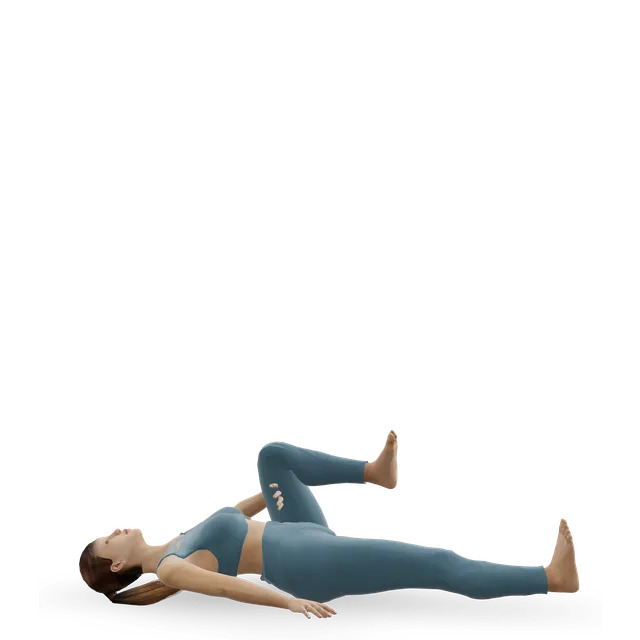
Single knee-to-chest stretch demonstrated on the 3D figure3D demoSingle knee-to-chest stretchBeginner · No equipment

Hold 20 to 30 s, 2 to 4 times each side, only if bending forward eases your pain · The move page's dose (editorial). Leave it out if it sends pain down a leg, and with osteoporosis avoid deep or repeated rounding, as the move page says

Harder: 90/90 hip lift-off

Lateral breathing (Pilates breathing) demonstrated on the 3D figure3D demoLateral breathing (Pilates breathing)Beginner · No equipment

5 to 8 breaths at the start of each session · The move page's dose (editorial); the UK consensus recommends breathing exercises for symptoms a very curved upper back can make worse

Harder: Roll-up (Pilates)

Move on when: You can walk for 15 to 20 minutes and get through normal daily tasks, and your back is no worse the next morning (our back pain guide's check, editorial).

Follow along: a timer, a cue and the next move, one step at a time.
Stage 2

Build: trunk, hips and back muscles

About weeks 2 to 8: 2 or 3 days a week, with walking on most days. Load the trunk, hips and back muscles on purpose, and learn the hip hinge for bending and lifting.

Bird dog, one limb at a time demonstrated on the 3D figure3D demoBird dog, one limb at a timeBeginner · No equipment

2 to 3 sets of 6 to 8 each side, with 3 to 5 s holds · As in our back pain guide (editorial); then the full bird dog

Easier: Side-lying tummy draw-in · Harder: Bird dog

Dead bug heel taps demonstrated on the 3D figure3D demoDead bug heel tapsBeginner · No equipment

2 sets of 6 to 8 each side · As in our back pain guide (editorial)

Easier: Bent-knee fall-out · Harder: Forearm plank

Sit to stand from a chair demonstrated on the 3D figure3D demoSit to stand from a chairBeginner · A bench or box

8 to 12, building to 3 sets · The UK osteoporosis consensus's 8 to 12 repetitions. Use a firm chair that can't slide or tip, as the move page says

Easier: Sit to stand, pushing on the thighs · Harder: Bodyweight squat

Band row demonstrated on the 3D figure3D demoBand rowBeginner · A band + An anchor point

3 sets of 10 to 15, stopping 2 to 3 repetitions short of failure · The move page's dose (editorial); the UK consensus asks for the back muscles in strength work

Harder: Supported single-arm dumbbell row

Low cobra (Bhujangasana) demonstrated on the 3D figure3D demoLow cobra (Bhujangasana)Beginner · No equipment

3 to 5 lifts, each held 3 to 5 s, on most days, building towards 10 · As in our spinal compression fracture guide, from the UK consensus's back-muscle dose. Skip it with spinal stenosis, and ease off if arching sharpens your pain, as the move page says

Easier: Sphinx pose (Salamba Bhujangasana) · Harder: Cobra pose (Bhujangasana)

Hip-hinge practice demonstrated on the 3D figure3D demoHip-hinge practiceBeginner · No equipment

2 to 3 sets of 8 to 10 · Editorial: the hip hinge is how the UK consensus teaches safe bending

Harder: Dumbbell Romanian deadlift

Move on when: Every set is done with good control and any pain settles by the next morning (our back pain guide's check, editorial).

Follow along: a timer, a cue and the next move, one step at a time.
Stage 3

Stronger: lift, carry and load your bones

From about week 8, and ongoing: strength 2 or 3 days a week, impact on most days and balance at least twice a week, as the UK osteoporosis consensus advises. With spinal fractures, keep impact to brisk walking and follow our spinal compression fracture guide's last stage instead. Lifting, gardening, shopping, housework, driving and the gym come back by the written steps below.

Dumbbell goblet squat demonstrated on the 3D figure3D demoDumbbell goblet squatIntermediate · A dumbbell

8 to 12, building to 3 sets at the most you can lift 8 to 12 times with good technique · The UK osteoporosis consensus dose

Easier: Bodyweight squat · Harder: Barbell front squat

Dumbbell Romanian deadlift demonstrated on the 3D figure3D demoDumbbell Romanian deadliftIntermediate · A dumbbell

The same dose, light at first, with a long back · The UK consensus asks for safe lifting technique and the hip hinge. Get a current disc-related back problem assessed before loading a hinge, as the move page says, and learn heavier lifts with a qualified instructor (the Royal Osteoporosis Society)

Easier: Hip-hinge practice · Harder: Single-leg Romanian deadlift

Suitcase carry demonstrated on the 3D figure3D demoSuitcase carryIntermediate · A dumbbell + A kettlebell

3 walks of 20 to 30 m each side · As in our back pain guide (editorial). If you can't stay level, the weight is too heavy, as the move page says

Easier: Farmer's carry · Harder: Overhead carry (waiter's walk)

Locust pose (Salabhasana) demonstrated on the 3D figure3D demoLocust pose (Salabhasana)Beginner · No equipment

3 to 5 lifts, each held 3 to 5 s, at least twice a week, building towards 10 · As in our spinal compression fracture guide, from the UK consensus. Lower the chest if your low back pinches, as the move page says

Easier: Seated upper-back lift (sit tall, shoulders back) · Harder: One-legged bow (half locust)

Heel drop (impact for bone) demonstrated on the 3D figure3D demoHeel drop (impact for bone)Beginner · No equipment

20 to 30 drops at first, building toward about 50 on most days, for example 5 sets of 10 · The move page's dose, which it credits to the UK consensus. With spinal fractures, keep them gentle or march instead, and see a pelvic health physiotherapist if you leak, as the move page says

Harder: Jump rope (basic bounce)

Single-leg stand demonstrated on the 3D figure3D demoSingle-leg standBeginner · A wall

3 holds of 5 to 10 s each leg, fingertips on the wall, building towards 30 s · As in our back pain in older adults guide: the start is the NHS balance exercises', the build editorial. The UK consensus asks for balance at least twice a week

Easier: Tandem stance and heel-to-toe walk · Harder: Single-leg reach matrix

Move on when: Our suggestion: lifting, carrying and a full day leave your back no worse the next morning. Keep two strength days a week for good, because back pain often comes back; our workout plans for women over 40 and over 50, and our osteoporosis exercise page, are a long-term home.

Follow along: a timer, a cue and the next move, one step at a time.

What to change for now

Flares, getting up and sleep (written steps)

Our 3D figure can't show these. They come from the NHS, NHS inform and the Royal Osteoporosis Society.

  • 1. In a flare, keep moving, take an anti-inflammatory such as ibuprofen if it suits you, use ice for pain and swelling and heat for stiffness or spasm, and don't stay in bed for long (the NHS). NHS inform suggests ice for up to 15 minutes, with a few hours between, and no ice or heat if you have problems with circulation or feeling.
  • 2. Getting out of bed: roll onto the side you find most comfortable, push yourself up with your arms, and carefully bring your legs towards the floor as you sit up and stand (NHS inform).
  • 3. Sleep: experts no longer recommend a very firm "orthopaedic" mattress for back pain, and pillows can support your leg when you lie on your side. On bad mornings, take your painkiller half an hour before getting up, except ibuprofen and similar anti-inflammatories, which shouldn't be taken on an empty stomach (the Royal Osteoporosis Society).
  • 4. Sitting: change position regularly, and take regular breaks from a desk to reduce stiffness (NHS inform and the Royal Osteoporosis Society).

Sources 1, 38, 73

Lifting and bending with thin bones (written steps)

These come from the Health and Safety Executive (HSE), the Royal Osteoporosis Society and the UK consensus.

  • 1. Plan the lift, keep the load close to your waist, stand with your feet apart and one leg a little forward, bend slightly at your back, hips and knees rather than stooping or squatting fully, turn with your feet rather than twisting, and "Put down, then adjust" (the HSE).
  • 2. The HSE's guideline weights for women are about 13 to 16 kg held close to the body between mid-shin and shoulder height, 7 kg from the floor or above the shoulder, and less at arm's length, and they are not "safe limits".
  • 3. "Think straight": keep your upper back straight and your neck in line with your spine, tighten your tummy muscles, and move slowly and smoothly; twisting should be safe if it's smooth and comfortable (the Royal Osteoporosis Society).
  • 4. Bending forward is "generally safe and won't cause a spinal fracture", but avoid sustained, repeated or loaded rounding of your back, such as toe touches and sit-ups (the Royal Osteoporosis Society and the UK consensus).
  • 5. Put a weight down if you feel the strain in your back; it's how you lift rather than how much you lift that matters (the Royal Osteoporosis Society).

Sources 74, 75, 49, 76, 36, 48

Gardening, shopping, housework and the car (written steps)

These come from the Royal Osteoporosis Society, written for people after a broken bone, the NHS and Acas.

  • 1. Gardening: "Do a little gardening often, rather than too much at once", take breaks every 10 to 15 minutes, use a padded kneeling stool and raised beds, and a hose rather than a heavy watering can.
  • 2. Shopping: use a supermarket trolley rather than a basket, a shopping trolley on wheels rather than bags, and ask for help with packing and carrying.
  • 3. Housework: a lightweight vacuum cleaner in short sessions, a long-handled dustpan and brush, a lighter bucket and a perching stool at the sink.
  • 4. The car: plan breaks to stretch and move, set your seat up well with a back support if it helps, and don't twist to reach into the back seat.
  • 5. If you fall: take your time, roll onto your side, get onto your hands and knees, and use something stable to stand up slowly (the NHS).
  • 6. At work: you don't need to be free of pain to return (NHS inform), and Acas asks employers to consider changes for menopause symptoms.

Sources 77, 73, 78, 79

Your bones, HRT and bleeding after the menopause (written steps)

These come from the NHS and NICE.

  • 1. For your bones: strength exercise and weight-bearing exercise such as walking or dancing, calcium-rich food, a daily 10 microgram vitamin D supplement, no smoking and less alcohol (the NHS).
  • 2. Ask your GP about bone health if you had an early menopause, take steroid or breast cancer tablets, or have broken a bone easily.
  • 3. Talk to your GP about your menopause symptoms and the options, including HRT. The NHS says HRT tablets slightly raise the risk of blood clots and stroke, while patches, gels and sprays don't raise the clot risk, and NICE says the same about clots.
  • 4. See a GP about any vaginal bleeding after your periods have stopped for more than 12 months, even if it happened once or was only spotting (the NHS).

Sources 80, 19, 70, 63, 5

Positions to swap, and why

Habit or positionWhy it mattersInstead
Resting in bed until it settlesThe NHS says don't stay in bed for long, and NHS inform says resting in bed often makes it harder to get going again.Short walks, little and often.Try: Treadmill walking
Sit-ups and crunches with thin bonesThe UK consensus asks you to modify sustained, repeated or end-of-range rounding of the spine.Dead bug heel taps.Try: Dead bug heel taps
Lifting with a rounded back, or twisting while you liftThe UK consensus advises against curving the back under load, and the HSE says turn with your feet.The hip hinge.Try: Hip-hinge practice
Never lifting anythingThe Royal Osteoporosis Society says it's how you lift rather than how much that matters.Practise lifting, light at first.Try: Dumbbell Romanian deadlift
Jumping with known spinal fracturesThe UK consensus keeps impact to brisk walking with spinal fractures, as a precaution.Brisk walking.Try: Treadmill walking
Only walking, for your back and bonesThe UK consensus asks for strength 2 or 3 days a week and impact on most days, not walking alone.Strength twice a week, such as goblet squats.Try: Dumbbell goblet squat
Wearing a back brace or belt for weeksNICE says don't offer belts or corsets for low back pain, and NOGG doesn't recommend routine bracing after a spinal fracture.Back-muscle work.Try: Seated upper-back lift (sit tall, shoulders back)
Waiting out sudden back pain after a minor fall, lift or cough past the menopauseIt can be a spinal fracture.See a GP.
Starting or stopping HRT to treat back painHRT isn't a back pain treatment; it's a decision about your menopause symptoms and bones.A conversation with your GP.
Ignoring bleeding after the menopause because your back is the problemBleeding after the menopause always needs checking.See a GP.

Routines to follow

Pilates for back pain (gentle routine)

A gentle 15-minute Pilates-based routine for ongoing low back pain, built from neutral-spine moves with options for backs that dislike bending or arching.

15 minBeginner10 movesNo equipment

Spine mobility routine: neck to pelvis, every direction

A 15-minute routine that moves your neck, upper back and lower back through bending, arching, side bending and twisting, then holds the spine steady.

15 minBeginner12 movesNo equipment

Pilates for osteoporosis: a mat class with safe swaps

A 25-minute Pilates workout for osteoporosis and osteopenia: the Royal Osteoporosis Society's swaps for rounding moves, plus back strength and balance.

25 minBeginner16 movesA wall, A bench or box

Yoga for osteoporosis: a 30-minute class with the safe swaps built in

A 30-minute yoga class for osteoporosis: standing strength, balance at a wall, back-strengthening holds and hip hinges in place of deep forward folds.

30 minBeginner19 movesA bench or box, A wall

Bone-strengthening workout

Impact, strength and balance for stronger bones, following UK osteoporosis consensus advice, with options for every level.

40 minBeginner14 movesA kettlebell, Other / check instructions

Yoga for menopause: a 35-minute practice for strength, balance and winding down

Thirty-five minutes of standing strength, balance, back strengthening and a long relaxation for the menopause, with no deep forward folds or shoulder stands.

35 minBeginner15 movesFirm cushion

Daily pelvic floor workout

A 5-minute daily pelvic floor workout for women and men: slow holds and quick squeezes, three times a day, with how to find the right muscles.

5 minBeginner2 movesNo equipment

More moves for this area

Questions people ask

Can the menopause cause back pain?

It may add to it, but the evidence is mixed: surveys find back pain in about 42% of women before the menopause and 57% to 59% around and after it, but they can't separate the menopause from age, and the most careful study, of 11,332 Norwegian women, found no link. Most back pain at this age is the back itself, and it gets better the same way as anyone's.

Is back pain an early sign of the perimenopause?

It isn't one the NHS lists: its symptom list includes muscle aches and joint pains, not back pain as such. One US diary study found more back pain through the transition, alongside hot flushes, poor sleep and low mood.

Why does my back hurt around my period in the perimenopause?

Period pain and endometriosis can cause low back pain while your periods continue, and periods often change in the perimenopause; our lower back pain in women guide covers them. Any bleeding after your periods have stopped for 12 months needs a GP.

Is my back pain osteoporosis?

Osteoporosis itself doesn't usually hurt; a broken bone does. See a GP for sudden back pain after a minor fall, lift, cough or sneeze, height loss or a new curve, especially if you're past the menopause or take steroid tablets. Spinal fractures are less likely before 60.

What does a spinal fracture feel like?

Often a sudden back pain, sometimes with muscle spasms, worse moving and eased lying down, after a small strain; but many cause little pain and are found later. They are stable and don't cause paralysis, and the bone heals in about 6 to 12 weeks.

Does HRT help back pain?

It hasn't been shown to: no trial has tested it in women after the menopause, and in Norway and the US, women taking HRT reported somewhat more back pain, not less. HRT does lower fracture risk while you take it, which is part of a decision about your menopause symptoms with your GP.

Can HRT cause back pain?

Studies of women taking HRT in the 1990s found more back pain, about 1.3 times the risk, but they can't show that HRT caused it, as women with more symptoms are more likely to take it. If you notice new back pain after starting HRT, mention it to your GP (our suggestion).

Why do I get pain between my shoulder blades?

Usually from the muscles and joints of the upper back, and the NHS asks for a GP check for pain at the top of the back. Sudden pain in the middle of the back with thin bones can be a spinal fracture. With chest pain, breathlessness, sweating or feeling sick, call 999.

I have back pain and some bleeding after the menopause. What should I do?

See a GP about the bleeding, even if it happened once or was only spotting: it's not usually serious, but it can be a sign of cancer, which is easier to treat if it's found early. Back pain with a high temperature or pain when you pee needs help the same day.

Why is my back worse at night?

Stiffness after rest is common with ordinary back pain, and pillows can support you on your side. Pain that is worse at night and doesn't ease with rest, or comes with weight loss or a past cancer, needs a GP.

Can the menopause cause severe back pain?

Severe pain is more likely to be a strain, a disc or, with thin bones, a spinal fracture than the menopause itself. Severe pain that starts suddenly or gets worse quickly needs a same-day GP appointment or NHS 111, and numbness around the genitals or bladder changes need 999; in the US, call 911 where this page says 999.

What exercises help menopause back pain?

Staying active, then trunk, hip and back-muscle exercises, then strength and impact for your bones 2 or 3 days a week. Pain up to 5 out of 10 that settles by the next morning is fine. With spinal fractures, keep impact to brisk walking and start with gentle back exercises.

Related exercise guides

Other pain guides

Sources

  1. NHS · Back pain
  2. Heuch 2022 · Age at first period, age at menopause and chronic low back pain (HUNT population study, BMJ Open)
  3. Marini 2017 · Low back pain and extra physical activity in 210 healthy women after the menopause (secondary analysis of an RCT, PLoS One)
  4. Spencer 2019 · Upper back pain and back muscle endurance in 119 women after the menopause (cross-sectional study, PLoS One)
  5. NHS · Symptoms of menopause and perimenopause
  6. Kruse 2026 · Muscle and joint symptoms around the menopause in 93,021 women (systematic review and meta-analysis, JBJS Open Access)
  7. Mitchell 2010 · Pain symptoms through the menopausal transition in 292 US women: the Seattle Midlife Women's Health Study (cohort study, Climacteric)
  8. Dugan 2006 · Muscle and joint aches by menopausal status in 2,218 US women: SWAN (cross-sectional study, Clin J Pain)
  9. Kozinoga 2015 · Low back pain in women before and after the menopause (review of 7 studies, Prz Menopauzalny)
  10. Wang 2016 · Low back pain in women and men by age across 98 studies (literature synthesis, Quant Imaging Med Surg)
  11. Wang 2017 · The menopause as a possible cause of more low back pain in women (hypothesis review, J Orthop Translat)
  12. Chagas 2026 · The menopause, hormones and spine health (narrative review, Cells)
  13. Lou 2014 · The menopause and lumbar disc degeneration in 846 Chinese women (MRI study, Climacteric)
  14. Wang 2013 · Disc space narrowing in 2,000 older Chinese women and 2,000 men (X-ray study, Arthritis Rheum)
  15. Jacobsen 2007 · Degenerative spondylolisthesis in the Copenhagen Osteoarthritis Study (population study of 4,151, Spine)
  16. Kalichman 2008 · Facet joint osteoarthritis and back pain in the community (CT study of 188 adults, Spine)
  17. Brinjikji 2015 · Spine degeneration on scans of people without back pain (systematic review, AJNR)
  18. NICE NG59 · Low back pain and sciatica in over 16s: assessment and management (2016, updated 2026)
  19. NHS · Osteoporosis (past its review date: reviewed October 2022, review due October 2025)
  20. Gregson 2025 · The 2024 UK clinical guideline for the prevention and treatment of osteoporosis (NOGG, Archives of Osteoporosis)
  21. NICE NG259 · Osteoporosis: risk assessment (2026)
  22. Royal Osteoporosis Society · Osteoporosis symptoms
  23. Cooper 1992 · Clinically diagnosed spinal fractures in Rochester, Minnesota (population study, J Bone Miner Res)
  24. Fink 2005 · How many new spinal fractures seen on X-ray are diagnosed: older women in a large trial (cohort study, J Bone Miner Res)
  25. Delmas 2005 · Spinal fractures missed on X-ray reports worldwide: the IMPACT study (J Bone Miner Res)
  26. Ballane 2017 · Osteoporotic spinal fractures around the world (systematic review of 62 studies, Osteoporos Int)
  27. Nevitt 1998 · Spinal fractures found on X-ray, back pain and function in 7,223 women aged 65 and over (prospective study, Ann Intern Med)
  28. Grasland 1996 · Sacral insufficiency fractures: an easily overlooked cause of back pain in older women (case series of 16 women, Arch Intern Med)
  29. Lyders 2010 · Imaging and treatment of sacral insufficiency fractures (review, AJNR)
  30. Gewiess 2024 · Fragility fractures of the pelvis and sacrum and their treatment (review, Arch Orthop Trauma Surg)
  31. Cohen 2013 · Sacroiliac joint pain: how common it is, diagnosis and treatment (review, Expert Rev Neurother)
  32. NHS · Kidney infection
  33. British Heart Foundation · Signs and symptoms of heart attacks in women
  34. NICE NG234 · Spinal metastases and metastatic spinal cord compression (2023)
  35. NICE NG12 · Suspected cancer: recognition and referral (2015, updated 2026)
  36. Royal Osteoporosis Society · How to exercise safely for bones
  37. da C Menezes Costa 2012 · The prognosis of acute and persistent low back pain (meta-analysis of 33 cohorts, CMAJ)
  38. NHS inform · Back problems
  39. Royal Osteoporosis Society · Spinal fractures (vertebral fractures) (past its review date: reviewed April 2022, review due April 2025)
  40. Royal Osteoporosis Society · Exercises to help with back pain after spinal fractures (past its review date: reviewed February 2019, review due February 2022)
  41. Venmans 2012 · Pain over a year in vertebral fractures treated without surgery: VERTOS II (trial comparison group, AJNR)
  42. Suzuki 2008 · Pain and disability over a year after a spinal fragility fracture in 107 people (cohort study, Eur Spine J)
  43. Lindsay 2001 · Risk of a new vertebral fracture in the year after one (pooled placebo groups of 4 trials, JAMA)
  44. Hayden 2021 · Exercise therapy for chronic low back pain (Cochrane review of 249 trials)
  45. Cruz-Díaz 2016 · Clinical Pilates added to physiotherapy in 101 women after the menopause with low back pain (RCT, Disabil Rehabil)
  46. Nageswari 2025 · Pilates for low back pain in 128 women after the menopause (RCT, Musculoskeletal Care)
  47. Castro 2022 · Pilates with and without elastic bands in 22 women after the menopause with low back pain (randomised trial, Pain Manag)
  48. Brooke-Wavell 2022 · Strong, steady and straight: UK consensus on physical activity and exercise for osteoporosis (BJSM)
  49. Royal Osteoporosis Society · Protecting your back (past its review date: reviewed February 2019, review due February 2022)
  50. Watson 2018 · High-intensity resistance and impact training in postmenopausal women with low bone mass: the LIFTMOR trial (JBMR)
  51. Watson 2019 · High-intensity exercise did not cause vertebral fractures and improved thoracic kyphosis: the LIFTMOR trial (Osteoporosis International)
  52. Kumar 2025 · Exercise for postmenopausal bone health: can we raise the bar? (review, Current Osteoporosis Reports)
  53. Kistler-Fischbacher 2021 · Heavy bone-targeted exercise with or without bone medicine in 115 women after the menopause: MEDEX-OP (RCT, J Bone Miner Res)
  54. Whitman 2026 · Heavy strength and impact training in 40 women around the menopause: STOP-EM (feasibility RCT, Bone Rep)
  55. Sinaki 2002 · Stronger back muscles reduce the incidence of vertebral fractures: a 10-year follow-up of postmenopausal women (Bone)
  56. Hongo 2007 · A home face-down back exercise in 80 women with osteoporosis (randomised trial, Osteoporos Int)
  57. Katzman 2017 · Spine strengthening and posture training to reduce hyperkyphosis in older adults: the SHEAF trial (RCT, Osteoporosis International)
  58. Gibbs 2019 · Exercise for improving outcomes after osteoporotic vertebral fracture (Cochrane review)
  59. Giangregorio 2014 · Too Fit To Fracture: exercise recommendations for osteoporosis or osteoporotic vertebral fracture (international consensus, Osteoporos Int)
  60. Kato 2019 · Rigid vs soft brace for acute osteoporotic vertebral fracture (RCT of 284 women, J Clin Med)
  61. Buchbinder 2018 · Vertebroplasty for osteoporotic vertebral compression fracture (Cochrane review of 21 trials)
  62. NICE TA279 · Percutaneous vertebroplasty and balloon kyphoplasty for osteoporotic vertebral compression fractures (2013)
  63. NICE NG23 · Menopause: identification and management (recommendations, last updated April 2026)
  64. Jackson 2006 · Oestrogen alone, fractures and bone density in women after a hysterectomy: the Women's Health Initiative (randomised trial, J Bone Miner Res)
  65. Cauley 2003 · Oestrogen plus progestin, fractures and bone density in the Women's Health Initiative (randomised trial, JAMA)
  66. Heuch 2023 · Menopausal hormone therapy, the pill and chronic low back pain (HUNT population study, BMC Musculoskelet Disord)
  67. Musgrave 2001 · Back problems in women taking oestrogen after the menopause: the Study of Osteoporotic Fractures (cohort study of 7,209 women, Spine)
  68. Brynhildsen 1998 · Hormone replacement therapy and low back pain in 1,324 Swedish women aged 55 and 56 (survey, Spine)
  69. Kyllönen 1999 · Oestrogen plus progestin and back pain in 48 slim women before the menopause with low spine bone density (2-year placebo-controlled trial, Spine)
  70. NHS · Benefits and risks of hormone replacement therapy (HRT) (past its review date: reviewed February 2023, review due February 2026)
  71. NHS inform · Exercises for back pain
  72. Smith 2017 · Should exercises be painful in chronic musculoskeletal pain? (systematic review and meta-analysis, Br J Sports Med)
  73. Royal Osteoporosis Society · Daily living after fractures (fact sheet, content reviewed April 2023)
  74. Health and Safety Executive · Manual handling at work: good handling technique
  75. Health and Safety Executive · Manual handling at work: a brief guide (INDG143, 2020)
  76. Royal Osteoporosis Society · Bending forward
  77. Royal Osteoporosis Society · Getting back to everyday activities after a broken bone (past its review date: reviewed January 2022, review due January 2025)
  78. NHS · Falls
  79. Acas · Menopause at work: supporting staff through the menopause
  80. NHS · Things you can do to help menopause and perimenopause symptoms
  81. NHS · Sciatica
  82. NHS · Heart attack

Exercise education, not a diagnosis or treatment plan. It is written from the guidelines and studies listed above; review by a clinician is pending. If your pain follows an injury, is severe, is getting worse, or comes with any warning sign listed on this page, get it assessed. Health disclaimer.