Why the way down shows up a sore ankleEmerging evidence
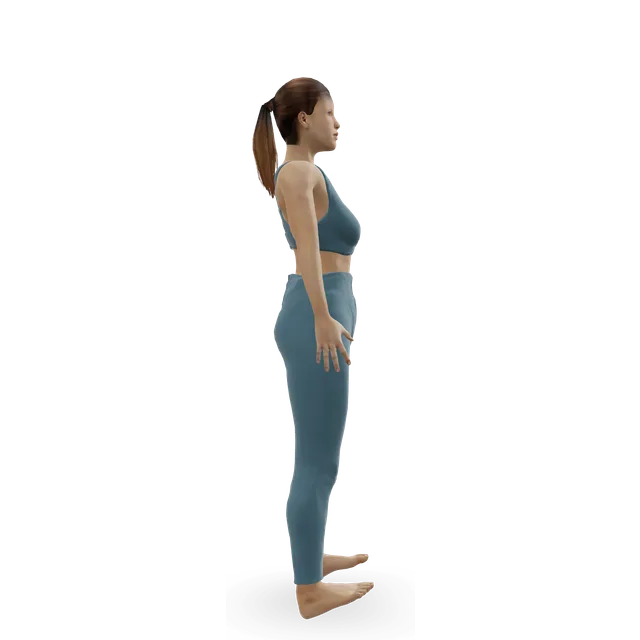
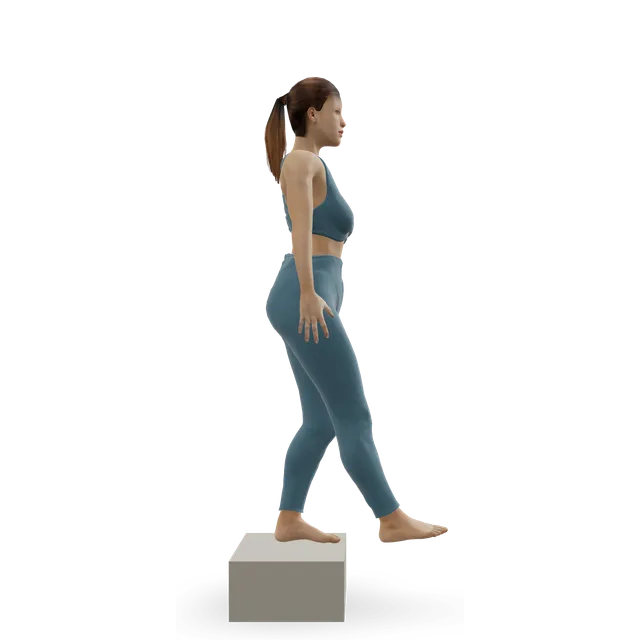
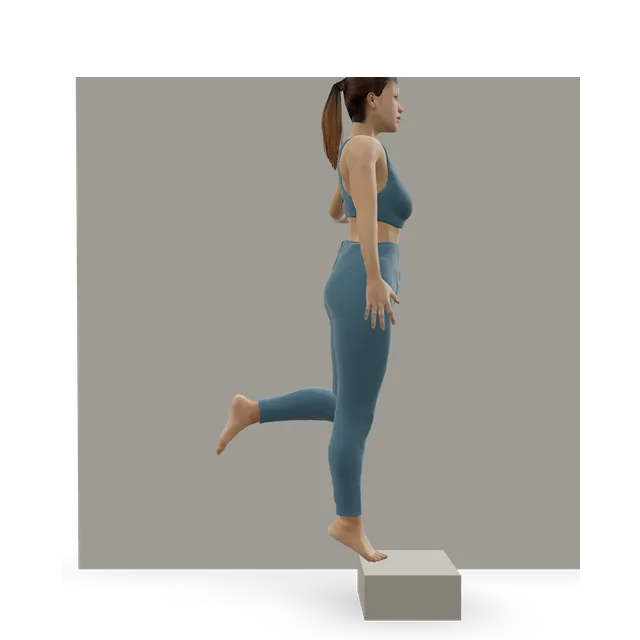
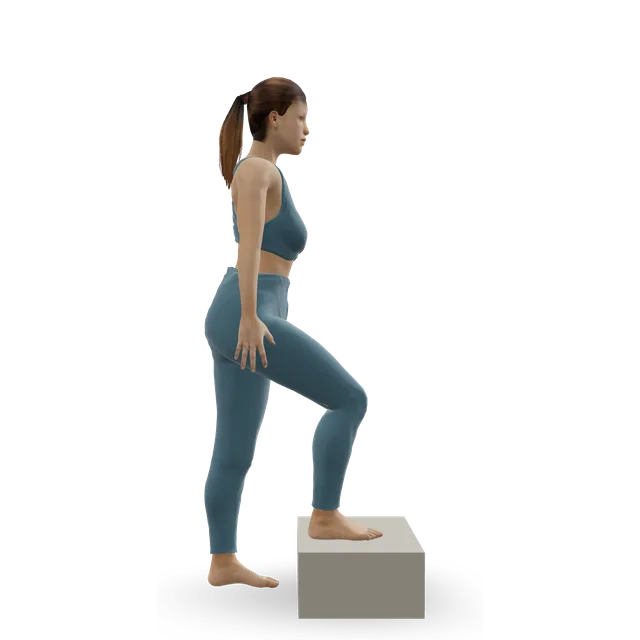
Going down a stair is a controlled drop onto the front of the foot, while the ankle of the trailing leg bends up as far as it goes and the calf lowers you as it lengthens. In 33 young adults, going down used about 10 degrees more upward bend of the ankle and 9 degrees more pointing than going up; the front of the foot landed first both ways. Older adults used about three quarters of their ankle strength going down. Going up asks more of the hip and knee and is the harder task overall.
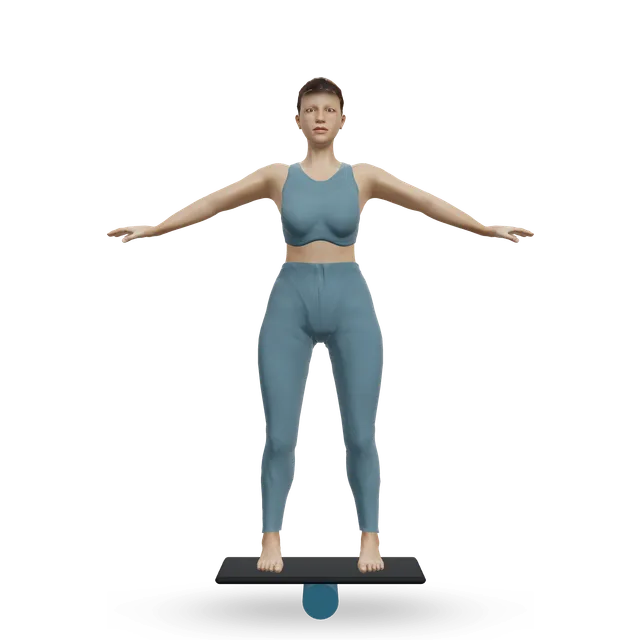
So a stiff ankle, a pinch at the front or the back, a sore Achilles and a wobbly ankle all tend to show on the way down (our reading of these lab studies of people without pain). Stairs are a common problem with foot and ankle pain: in 16,222 people over 55, foot and ankle problems raised the odds of difficulty with stairs by 71%. No study counts the causes of ankle pain on stairs, so this guide's map is built from the studies of each condition.
Sources 1, 2, 3, 4, 5, 6, 7
The front and the back of the ankleEmerging evidence
A review describes front-of-ankle impingement as pain at the front at the end of bending the ankle up, made worse by "climbing stairs, running or walking up hills, ascending ladders, and deep squatting", and it often follows sprains. The same review links pain at the back of the ankle (posterior impingement) with "downhill running and walking, descending stairs, and high-heeled shoe wear".
Bone spurs at the front of the ankle showed on X-rays in 52% to 59% of 88 professional footballers' ankles, mostly without pain, so a spur on its own doesn't explain the pain. A standard side X-ray misses many spurs; an extra angled view helps if surgery is being considered.
Sources 9, 10, 11
Old sprains and arthritisStrong evidence
Sprains usually settle, but across 31 studies 5% to 33% of people still had pain a year later, 3% to 34% sprained the same ankle again, and up to 40% go on to an ankle that keeps giving way. The questionnaire clinicians use to measure an unstable ankle asks about going down stairs, and an NHS trust tells people the foot may keep rolling on uneven surfaces for months.
Most ankle arthritis follows an injury: 78% of 406 and 70% of 639 badly worn ankles at specialist centres, mostly after fractures, and in one series an average of 34 years after ligament injuries. In 5,109 adults over 50 in North Staffordshire, 11.7% had ankle pain in the past month and 3.4% had painful arthritis on an X-ray. Arthritis UK says ankle arthritis symptoms "probably won't get worse, and they may even improve".
Sources 21, 22, 23, 26, 14, 15, 16, 17, 19
The Achilles and the tendons on either sideEmerging evidence
Achilles tendinopathy brings stiffness that is worse in the morning or after rest and pain that is worse during or after activity, NHS inform says; an NHS trust lists "pain when walking, running or climbing stairs", and the Achilles questionnaire clinicians use asks about pain "walking downstairs". Pain where the tendon meets the heel seems to dislike the ankle bending right up: heel drops below a step suited 89% of people with pain higher up the tendon but only 32% with pain at the heel, and a version on the flat did better (our reading of these small studies).
The peroneal tendons behind the outer ankle bone are an under-recognised cause of outer ankle pain and often go with an unstable ankle. The tibialis posterior tendon along the inner ankle, with an arch that slowly drops, affected 3.3% of women over 40 in one English practice, all of them undiagnosed.
Sources 31, 32, 33, 38, 39, 40, 42, 43
What a scan or test showsStrong evidence
After a twist or a fall, clinicians use the Ottawa ankle rules to decide on an X-ray: being unable to take four steps, or tenderness at the back edge or tip of either ankle bone. Across 27 studies of 15,581 people, the rules missed almost no fractures and cut X-rays by 30% to 40%. The NHS says a crack, an odd shape, numbness or a cold, discoloured foot after an injury means you may have broken a bone.
One sore spot on a bone that hurts with every step needs checking even if the X-ray is normal: the first X-ray showed a stress fracture of the inner ankle bone in only 3 of 8 athletes, and MRI (magnetic resonance imaging) is the most sensitive test. Arthritis and typical Achilles pain are diagnosed by examination, without routine scans, and tendon changes on ultrasound also turn up in tendons that don't hurt.
Sources 53, 54, 25, 46, 47, 18, 37, 41
How it usually goesEmerging evidence
An NHS trust says "Most ankle sprains will improve within 6-12 weeks", though swelling and pain can last 3 to 6 months. Achilles pain takes time, "in most cases several months or more", NHS inform says, and another NHS trust expects some improvement within 8 to 12 weeks. No study has followed stair pain itself over time. No one can promise a date.
Sources 24, 31, 32, 19